Alliterative Linux
The Ubuntu Linux distribution is well known for its use of alliteration in the naming its releases.
This convention dates back to the release of version 5.04 which bore the name “Hoary Hedgehog“.
The latest in the series has just been announced: Softpedia reported yesterday that Ubuntu 16.04 LTS will be named Xenial Xerus.
What’s a Xerus and how is it xenial?
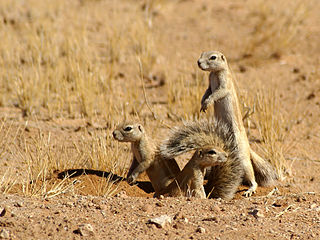 Wikipedia informs us that the genus Xerus is better known as African ground squirrels. These squirrels form a taxon of squirrels under the subfamily Xerinae and are only found in Africa. A family group of 3 Xerus inauris or Cape Ground Squirrel is shown to the left of this paragraph.
There are four species of African ground squirrels divided into three subgenera.
The subgenus Euxerus is made up of the Striped Ground Squirrel, Xerus erythropus, which lives in south-western Morocco, southern Mauritania and Senegal.
The subgenus Geosciurus consists of 2 species:
- Cape Ground Squirrel, Xerus inauris (also called South African Ground Squirrel), native to Namibia, Botswana, Zimbabwe, South Africa; and
- Damara Ground Squirrel, Xerus princeps, native to south-western Angola and Namibia.
The subgenus Xerus also consists of just one species, the Unstriped Ground Squirrel, Xerus rutilus, whose home range is from north-eastern Sudan to north-eastern Tanzania.
As for xenial, that’s a great word whose definition is:
1. Hospitable, especially to visiting strangers or foreigners.
2. Of the relation between a host and guest; friendly.
In addition, Dictionary.com informs us that the word originates from the Greek xenía, meaning hospitality.
However, if you want your computing to be powered by a hospitable African ground squirrel, you’ll have to wait until next April!


 The Dutch government wants to accelerate the adoption of
  Matthias Kirschner and Alessandro Rubini are the new President and Vice-President respectively of the
  The idea of Software Freedom Day (SFD) is for everyone without a vested interest in proprietary software to unite and educate the world about the ideals of Software Freedom and the practical benefits of Free Software. August 28th 2004 was the first ever Software Freedom Day and was initiated group of FOSS believers – Matt Oquist, Henrik Omma and Phil Harper – with the idea of distributing