Your ‘umble scribe has today received an email from Kurt James, Neighbourhood Partnership Co-ordinator at Bristol City Council, announcing an event next month in east Bristol.
Bristol Libraries is organising a free (as in beer. Ed. 😀 ) digital skills workshop next month in collaboration with the Ashton, Easton and Lawrence Hill Neighbourhood Partnership and local volunteers to help local residents who haven’t already done so get online.
The event will be held at Junction 3 Library, Baptist Mills Court, Easton, Bristol, BS5 0FJ (map).
The date and time: Tuesday 11th October, 1.30 p.m. – 3.30 p.m.
Attendees will learn how to:
Get online for the first time;
Shop and bank online;
Access government services online;
Use social media.
Those interested can book a space at the workshop by contacting the library by telephoning 0117 9223001. Call that number too if you want more information on the workshop.
Modern British society seems obsessed with celebrity culture: this is no more evident than in the mainstream media; and such is true of Bristol’s (news)paper of (warped) record, the Bristol Post.
It would appear that no sooner does a Z-list non-entity have something to do with the city than the illiterati that constitute the current reporting staff of the Temple Way Ministry of Truth than they are lost for words – or for le mot juste at the very least.
This is evident in a puff piece in today’s online edition featuring some nobody off some dire TV talent show, as per the obligatory screenshot below.
So Bristol Post, is a nobody off the telly looking intently at a show at the Hippodrome or taking part in it? In the immortal words of Private Eye, I think we should be told.
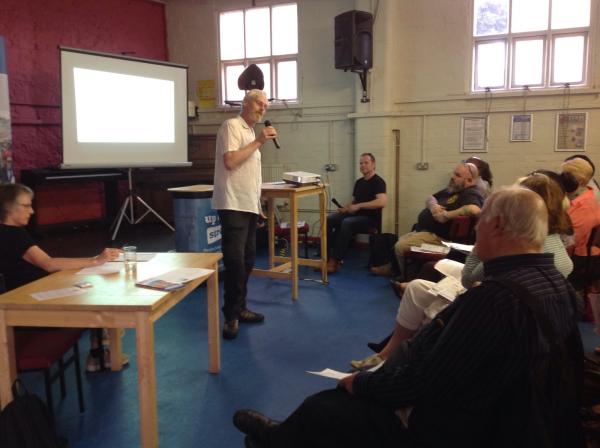
The latest Easton & Lawrence Hill Forum held on Wednesday evening at Easton’s Pickle Factory attracted some 40 lively, vocal residents who’d come along to the event whose theme was waste management and its attendant problems such as litter and fly-tipping.
After the initial announcements, your ‘umble scribe was first out at the front of the hall to administer death by PowerPoint, giving a brief history of Tidy BS5, its activities and successes over the past two and a half years and calling for residents to act as the eyes and ears of Bristol City Council to combat fly-tipping, report litter and urging them to report other environmental crimes that blight the inner city such as fly-posting, dog fouling and graffiti. The Tidy BS5 slot finished with a showing of the “Green Capital Tale of Two Cities” video produced for viewing at full council last year.
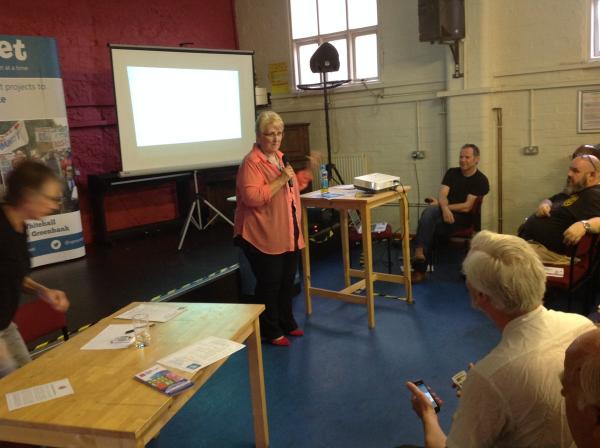
I was followed on the microphone by Tracy Morgan, CEO of Bristol, the wholly-owned council waste company responsible for keeping the bins emptied and the streets tidy.
This was the main talk of the evening and Tracy gave some background of Bristol Waste’s work, which stretches from carrying out some 17 mn. waste collections around the city to clearing its streets of dead animals. Those collections yield an annual total of 140,000 tonnes of waste and recycling, of which 53,000 tonnes is sent for recycling or composting.
Tracy remarked, “We want to create a cleaner, greener Bristol… but waste is a shared responsibility,” before going on to the main point of her presentation – the 12 weeks-long trial to remove communal bins (otherwise known as skipbins or 1280l Eurobins. Ed.) from the Stapleton Road corridor.
The communal bins were introduced some years ago with a typical botched BCC consultation to attempt to tackle the problem of fly-tipping in the area. The communal bins consultation carried out last year (posts passim) clearly revealed that the introduction of the communal bins had failed in this respect.
Instead of the thrice-weekly communal bin collections, those streets where residents have sufficient storage space will be issued with 180l wheelie bins to be emptied fortnightly. Where this is not possible, residents will be given rubbish bags (hopefully gull-proof. Ed.) for collection on Mondays, Wednesdays and Fridays, to be put out at a certain time.
After Tracy’s presentation came questions and comments from the audience to a panel comprising, Tracy, Tom Ward from enforcement and myself.
There was lots of intelligence offered to Tom, particularly as regards fly-tipping along the Lawrence Hill/Church Road corridor, although the main concern was the Stapleton Road trial and the communal bins.
One resident spoke passionately for retaining on Claremont Street and Seymour Road (which are regularly abused, like all the other communal bins within the proposed trial area. Ed.). However, I feel she’s on a hiding to nothing with her desires and she was the only person in the room defending the communal bins that other residents described as the bane of their lives and a health hazard since they attracted rats.
Other residents wanted to see more litter bins, particularly in parks and along the Bristol & Bath Railway Path, whilst the operation of the St Philips Recycling Centre (e.g. no pedestrian access) and the surly, unhelpful attitude of the Centre’s staff were also mentioned to Tracy for attention, as were the habit of recycling crews leaving “offerings” in the streets for the local gods and the reaction of certain street sweepers to local residents trying to help them.
No doubt this will be a matter to which forthcoming Neighbourhood Forums will return.
The photos used in the post are by kind permission of Up Our Street.
For local news Bath, Bristol’s near neighbour, is served by the Bath Chronicle. Like the Bristol Post, the Chronicle is part of the Local World group and shares its close neighbour’s reputation for (lack of) accuracy.
Today’s Bath Chronicle carried an exclusive, but readers had to read the caption under the photograph accompanying the report to realise it.
Bath Spa railway station used to look as shown in the photograph below.
Bath Spa railway station. Image courtesy of Wikimedia Commons
Close observation of today’s Bath Chronicle report, especially the photo caption, reveals there is no nowhere for InterCity 125s or any other passenger rolling stock to stop where Bath Spa station once stood.
The site of Bath Spa railway station according to the Bath Chronicle
For the life of me I cannot understand why the Chronicle ignored the disappearance of a major piece of transport infrastructure and had its piece concentrate on delays to train services between the West of England and London Paddington. 😉
A strange phenomenon is occurring in Bristol: people not playing football is resulting in the closure of bank branches in the city.
The source of this curious news is the ever (un)reliable Bristol Post, which yesterday carried a story headlined: “Two HSBC banks to shut in Bristol following slump in customers“.
The relevant section is shown in the following screenshot*.
Either football is vital to the survival of HSBC bank branches or there’s a typographical error in the third sentence.
To help readers decide which of the two above alternatives is correct, your correspondent has not noticed that the floors of HSBC bank branches are marked out with white lines to resemble football pitches.
As a final thought and a bit of idle speculation, are more errors creeping in to news reports appearing online due to modern “journalists” working with predictive text options switched on?
* = The article’s copy has since been amended with “footfall” replacing “football” in the third paragraph.
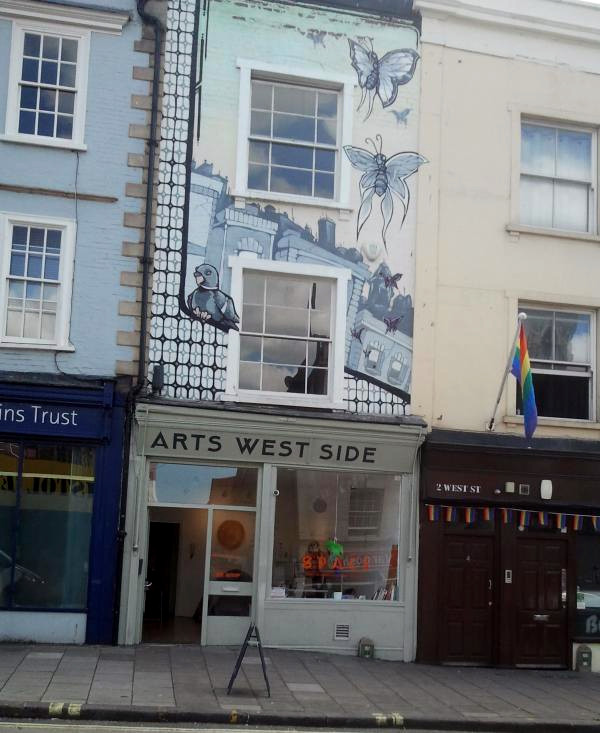
Arts Side West and SPACE will continue to provide community arts at 6 West Street in Bristol’s Old Market area following after its online and paper petition (posts passim) gathered more than 1,000 signatures, Bristol24/7 reports today.
The venue was threatened with closure after Bristol City Council announced it wanted to rent the premises out commercially for £15,000 per year – not even petty cash in view the £60 mn. in budget savings (i.e. cuts) the council is stating it will have to find in the next few years.
The council went back on its original decision after a series of meetings was held with deputy mayor Cllr. Estella Tincknell.
Emma Harvey of Trinity Community Arts, which manages the venue, is quoted as follows by Bristol 24/7:
The support we’ve received from the public has been amazing…a big thank you to those involved who have helped us to achieve this fantastic outcome for Old Market.
At the weekend, Cllr. Marg Hickman, the cabinet councillor for neighbourhoods and a great supporter of the Tidy BS campaign, shot the video below at the junction of Perry Street and Stapleton Road – a notorious fly-tipping hotspot which your correspondent has been reporting to Bristol City Council for the best part of two and a half years.
The Post’s report states that Marg also sent the footage and photos to the city council in the hope Bristol Waste, which manages street cleansing and waste collections, will finally begin to get to grips with the problem.
According to the Post a council spokesperson said:
The refuse team emptied the bins this morning, and Bristol Waste Company have two men on Stapleton Road every week day, so they will clear up following attendance from the refuse crew.
One of the street cleansing supervisors has been sent to check the area to make sure everything is clean and tidy.
The council may have sent out a street cleansing supervisor yesterday to check, but one needs to be at that location 24 hours a day, 7 days a week, since your correspondent reported another load of fly-tipping had mysteriously appeared in the same spot overnight.
Although progress on the ground may be slow, the Tidy BS5 campaign seems to be making better headway in the corridors of power since Marg’s intervention prompted Marvin Rees, Bristol’s elected mayor and past resident of Easton, to tweet on the filthy state of Stapleton Road, voicing his commitment to get our streets tidy.
However, Marvin and Marg have a big problem on their hands, as dumping litter and rubbish seem to be endemic throughout the city, not just in deprived BS5. Bristol’s annual Harbour Festival ended on Sunday evening and the Post noted in a separate report that the clean-up from the event is still continuing today, Tuesday.
Two of Bristol’s key arts providers – Trinity Community Arts & Artspace Lifespace – have launched a petition to save SPACE & Arts West Side, both located at 6 West Street in the Old Market area. The petitioners are urging Bristol City Council to keep the property as a space for community arts.
The two groups recently applied to the Council to keep Arts West Side for community arts use, but the city council has decided it wants to let the premises commercially, which the council estimates will generate £15,000 per year in rent – not even petty cash considering the council is facing an estimated budget deficit of £60 mn. forecast for 2019/2020.
This decision will have a huge impact on the grass-roots community art work taking place in the Old Market area, which sits in Lawrence Hill, Bristol’s most deprived council ward.
Trinity has been running the venue since August 2011 through Bristol City Council’s Community Asset Transfer Policy (CAT). The policy seeks to make publicly owned spaces across the city available for community use.
Emma Harvey of Trinity said: “We’re surprised by this decision, given the lack of commercial value of the premises and how it seems to conflict with the city’s vision of Bristol as an inclusive city of culture. We opened Arts West Side to support regeneration of the area. At a time when communities in Bristol are concerned that they are being left behind as other parts of the city prosper, it is sadly ironic that the Council themselves are acting as an agent of gentrification.”
There was good news this week for Bristol businesses with a yearning for high speed internet connectivity.
The Bristol Post reported on the deployment of ultra-fast 1 Gbps internet in the city.
While journalists at the Temple Way Ministry of Truth are quite competent at their main task of churnalism, such as copying and pasting the words of wisdom given in press releases by men in suits – as in the article in question – standards slip dramatically and the absence of sub-editors and the associated lack of quality control are patently obvious when Post staff try simplifying complicated technical concepts, as shown by the following sentence.
Shall we just examine the above sentence in detail? There’s plenty wrong with it both technically and grammatically, which schoolchildren sitting their SATs examinations at ages 10 or 11 years would be embarrassed to get wrong.
Firstly, those glass cables. The proper designation is “optical fibre cable“; and as is well known the correct use of terminology is important. An optical fibre cable is a cable containing one or more optical fibres that are used to carry light, whilst an optical fibre itself is a flexible, transparent fibre made by drawing glass (silica) or plastic to a diameter slightly thicker than that of a human hair. So an optical fibre cable can be made of either glass or plastic, i.e. not solely glass.
Data from an internet connection is transmitted as light down an optical fibre cable. Light travels at the speed of light. However, it is the method for providing the internet connection which is “highly reliable and efficient, not the speed of light. The subordinate clause, i.e. “which is highly reliable and efficient is misplaced and should at any rate have been preceded by a comma.
Finally, there’s that speed of light; it’s so reliable and efficient that its precise value is 299,792,458 metres per second (approximately 3.00×10⁸ m/s). It is commonly denoted as c, as in Einstein’s famous mass–energy equivalence formula. Furthermore, c is the maximum speed at which all matter – and hence information – in the universe can travel.
In the slightly better old days when the Post still employed proper sub-editors, any decent holder of that position would have taken that sentence to bits and re-written it roughly as follows:-
“These fibre optic cables deliver an internet connection reliably and efficiently at the speed of light.”
Or alternatively:
“These fibre optic cables deliver a reliable, efficient internet connection at the speed of light.”
Unfortunately, local newspapers and their online analogues nowadays seem to have forgotten that quality matters and with quality comes a reputation and with the latter, authority.