media

  • A penny for your thoughts?

    If there’s one thing that can be said about language, it’s that it’s dynamic. Blink for a second and you might miss the coining of a neologism or an old turn of phrase becoming obsolete.

    The latter in particular can have amusing consequences, especially if re-used by someone possibly too young to appreciate the original connotations of the word or phrase.

    One such most likely occurred today in a Bristol Post piece about free travel in the Bristol area on Unibus services.

    The item’s second paragraph reads as follows:

    Passengers will able to hop on the Unibus U2 service, from Monday February 18 until Friday, February 22 without spending a penny.

    To someone of my age (rapidly approaching where I qualify for a pass for free bus travel. Ed.), the phrase has connotations other than obtaining buckshee travel.

    As Collins Dictionary helpfully points out:

    If someone says that they are going to spend a penny, they mean that they are going to go to the toilet. [British, old-fashioned, politeness]

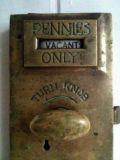
    old coin-operated public toilet lockThe origins of the phrase stretch back to the Victorian era and refer to the use of coin-operated locks on public toilets in the UK. Such locks were first used in a public toilet outside London’s Royal Exchange in the 1850s.

    The phrase “to spend a penny” has now largely died out and been forgotten, except by those with greying hair, due to changes to public toilets themselves (many of which have been closed by austerity-hit local authorities. Ed.) and changes in the charges to use a toilet. Last time I looked while on my travels, the toilets at Manchester Victoria railway station cost an exorbitant 20p, i.e. 4 shillings or 48 times the original cost of one penny.

  • Northampton or Novosibirsk?

    Via Twitter, the following image arrived in my timeline this morning. It’s a below the piece comment, ostensibly from someone called DAZ21, from the mobile version of the Daily Mail website.

    Text of comment reads White British in London 45 percent, white British in Birmingham 50 percent..Our 2 largest cities don't belong to us anymore, we have been very tolerant and are probably the least racist country on Earth. But these ideologies we import are incompatible to our own... I give it 5 years before civil war breaks out.

    As you can see, at the top of the comment DAZ21 would like us all to think he’s from the fair English county town of Northampton.

    However, there are a couple of problems with locating dear ole DAZ21 there if one examines the text of the comment closely; and the vowels in particular.

    Look first near the bottom of the comment. Is that a letter “a” with diaresis (ä), I see before me?

    The letter “a” with diaresis is quite common in German (as in Käse – cheese. Ed.), but not in English.

    However, there’s a real clincher in the text that shows DAZ21 is more likely to hail from Novosibirsk than Northampton: and once again it’s a vowel that gives the game away, namely the “i” with diaresis “ï“).

    According to Wikipedia, “Yi (Ї ї; italics: Ї ї) is a letter appearing the Cyrillic script, as used by Russian, amongst other languages.

    In English this is a very uncommon character and is used when ⟨i⟩ follows another vowel and indicates hiatus (diaeresis) in the pronunciation of such a word.

    There have been questions about the reliability of the the Daily Mail for decades. Last year it was banned as a source by Wikipedia due to its “reputation for poor fact checking and sensationalism“.

    One wonders how much further that reputation has slumped if its below the piece comments are now full of bots or actual Russians pretending to be Brits posting provocative and/or misleading content.

    By the way, Novosibirsk is Russia’s third most populous city after Moscow and St Petersburg.

  • The value of understanding

    It seems we live in a society that knows the cost of everything and the value of nothing.

    On Monday Kent Online reported that Kent County Council is expecting to spend £1.5 million more than the central government funding it has received to support unaccompanied asylum-seeking children (UASC) who left the care system during the current local authority financial year.

    The county has received a total of £6.9 million from the Home Office and Department for Education to help more than 900 young people who have entered the UK unaccompanied, but is looking at costs of £8.4 million.

    According to council officers, part of the problem is apparently “a shortage of translators [sic] living in the area.”

    However, one reason for the higher costs can be laid firmly at the government’s door. The government has decided to extend support for all care leavers up to the age of 25 years; it was previously 21.

    Legal costs and the immigration application process are also factors that have resulted in higher costs.

    Kent’s Director for children’s integrated services, Sarah Hammond, seems to understand the value of interpreters. She is reported as saying the following:

    It’s absolutely critical both for the young people and social workers that there is no window of doubt what the young person is saying. For that reason, we have to use trained and certified interpreters.

    The validity of the assessment work we do would fall away if we were not able to demonstrate we had the right quality and accreditation of a translation body – and that comes with significant costs.

    The reality is the majority of interpreters are coming from outside of the county, so we are incurring travel costs as well as their professional fees.

    The very words Kent Online quoted Sarah Hammond as saying shows that she at least recognises the value of understanding. Young refugee people leaving care might not always have had much opportunity to become fluent enough in English to deal with whole panoply of officialdom and bureaucracy one has to deal with once past the age of majority in the UK; and one way to ensure both parties achieve full comprehension is by using qualified linguists.

    The consequences of using unqualified interpreters has been amply illustrated down the years by the Ministry of Justice’s disastrous outsourcing of police and court language services, which is still continuing, as shown by this example from the north east of England.

    Ms Hammond’s comments are in marked contrast to the reaction of the sole councillor quoted, Conservative Rosalind Banks, who remarked: “I suspect if the translation costs were made known to the average resident of Kent, they might turn around and say I’m sure this could be done a lot cheaper“.

    Cheaper, councillor? We linguists are skilled professionals, in case you hadn’t noticed.

    Needless to say, the councillor’s ignorant, penny-pinching sentiments are reflected in the comments below the piece, the majority of which are xenophobic, if not bordering on the racist.
  • Cheese toastie shocker

    Yesterday’s online version of the Bristol Post (now renamed Bristol Live. Ed.) carried a shocking item about a hitherto unknown catalyst for violence: the toasted cheese sandwich.

    According to the Post, this humble snack may not be served at a proposed catering concession in Monk’s Park in Bristol’s Southmead district “amid fears a proposed hot food van could attract booze-fuelled anti-social behaviour and motorbike gangs“.

    The Post continues:

    Councillors have agreed to grant a provisional licence for cold food, such as ice cream, and tea and coffee in Monk’s Park, Biddestone Road.

    But the vendor would be barred from selling hot snacks following dozens of objections from residents, a ward councillor and the headteacher of a nearby secondary school.

    A provoker of violence, accompanied by tomato soup.
    A provoker of violence, accompanied by not quite so provocative tomato soup. Image courtesy of Wikimedia Commons.

    However, the fear of violent behaviour was not the only concern for banning hot food: councillors on the city council’s public safety and protection committee also feared children from the next-door school would be tempted to skip lessons due to the lure of grilled fermented curd.

    Following the committee’s decision the concession will now be put out to tender.

    However, the story does not end there. When your correspondent posted about the article on Twitter, one person to respond was local artist Dru Marland, whose response about fermented curd addiction was hilarious.

    XDru's tweet reads they start 'em on Dairylea slices, and before you know it they're mugging pensioners for their next fix of Stinking Bishop

    For a more complete understanding of the violence-inducing properties of cheese, I should have asked the committee about their opinions of more exotic varieties of fermented curd, such as Roquefort or Graviera, but pressure of time dictated otherwise. 🙂

    Update: Not forty-eight hours after Bristol was opened to national and international ridicule over this affair, Bristol Live reports that residents of Bristol’s Cotham district have branded a hot food catering van an “appalling idea“. You couldn’t make this stuff up!

  • Post exclusive: fire brigade incident at non-existent tower block

    One thing is certain about life in Bristol: it’s quite unlike living anywhere else and can sometimes be well beyond the borders of the surreal.

    This feeling is enhanced by reading the Bristol Post, city’s newspaper of (warped) record.

    Just skimming casually through the Post website, readers may easily miss some real exclusives, such as this fire brigade incident reported yesterday by Heather Pickstock, who is alleged to be the paper’s North Somerset reporter.

    As shown in the screenshot above, Ms Pickstock informs readers as follows in this fine piece of creative writing:

    screenshot of part of article

    Crews from Southmead, Temple, Kingswood, Hicks Gate, Bedminster and Pill were called at 9.46pm yesterday to reports of smoke billowing from the sixth floor of a high rise block a Littlecroft House, Pip Street, Eastville.

    There’s just one thing wrong with the above sentence: it’s completely incorrect; there’s no Pip Street in Eastville and no high rise block called Littlecroft House either.

    A research technique known to ordinary mortals, but not to Ms Pickstock, affectionately known as “5 minutes’ Googling” reveals there’s a a council tower block called Little Cross House in Phipps Street, Southville, a good four miles across the city from Eastville.

    The Bristol area can breathe a sigh of relief that Ms Pickstock does not work as a call handler on the 999 emergency switchboard. 😉

  • French IT website praises LibreOffice 6

    Yesterday French IT website Le Monde Informatique posted a review of the free and open source LibreOffice 6 office suite.

    LibreOffice 6 splash screen

    Author Michael Ansaldo speaks warmly of the office suite your ‘umble scribe has been using since its inception in 2010, following the mass departure of OpenOffice.org developers from Sun Microsystems following its takeover by Oracle.

    Translated into English, Ansaldo’s final paragraph reads as follows:

    In summary, amongst the notable features of LibreOffice 6, we note its excellent compatibility with the [Microsoft] Office formats, as well as an interface that will not disorientate the aficionados of Microsoft’s office suite. Nevertheless, some features are lacking, such as integrated cloud storage or even joint real-time editing. Anyway, LibreOffice 6 is still the best choice for open source fans and all those wanting compatibility with Office without buying Microsoft Office. Its availability for multiple platforms and its frequent updates also make it a clear choice for individuals and businesses.

  • Fell is foul

    Many of the phrases in common use in English have 2 sources: either the Bible (both the authorised King James version and earlier translations, such as those of Wycliffe and Tyndale. Ed.) and the pen of William Shakespeare.

    Indeed, some lovers of the English language actually refer to it euphemistically as “the language of Shakespeare” when someone ignorant commits an indignity with it.

    Today’s online edition of the Bristol Post/Live, the city’s newspaper of (warped) record has not difficulty in mangling some of the Bard of Avon’s actual words.

    The misquoting of the Bard occurs in a promotional piece advertising a supermarket chain’s substantial breakfast. The piece itself was a cut and paste job lifted from the Post’s Trinity Mirror stablemate, the Manchester Evening News, which itself lifted the item from the Metro, a publication so downmarket its owners the Daily Mail have to give it away.

    misquoted Shakespeare quote is one foul swoop

    However, neither the MEN nor the Metro saw fit to misquote Shakespeare; that was a solo effort by the Temple Way Ministry of Truth.

    The offending sentence is in the final passage shown in the above screenshot, i.e.:

    The breakfast contains your entire daily allowance in one foul swoop, but it’s described as the perfect meal for those with a big appetite.

    The actual words penned by Shakespeare are not “one foul swoop” but “one fell swoop” and occur in Macbeth, Act 4, scene 3, when Macduff hears that his family have been killed. Macduff remarks:

    All my pretty ones?
    Did you say all?—O hell-kite!—All?
    What, all my pretty chickens, and their dam,
    At one fell swoop?

    One fowl swoop” is occurs frequently as a variation to the misquotation.

    Whether Shakespeare actually invented the phrase himself or was the first to write it down is a matter of debate. Even so, Macbeth was written in 1605, so even the Bard’s the phrase dates back over four centuries.

    The adjective “fell” is archaic, meaning evil or cruel, so it’s unsurprising that it’s misquoted. Moreover, in its context tends to occur in literary works such as J.R.R. Tolkien’s epic “Lord of the Rings” (e.g. fell beasts).

  • Driverless vehicle turns to theft

    This blog has previously documented the carnage on the highways caused by driverless vehicles (posts passim).

    The Bristol Post, the city’s newspaper of warped record, has now discovered that driverless vehicles are not only responsible for so-called “accidents“, but have now turned to theft – or attempted theft – as well.

    Headline reads Police stop 4X4 on motorway with fake license plates after it tried to steal a caravan

    If there’s one crumb of comfort to be gained from the above report, it is that our brave boys and girls in blue would have had no trouble spotting the offending vehicle with those American “license plates“. 😉

  • Exclusive: Bristol Post changes name to Manchester Evening News

    It’s official: the Bristol Post (or is it BristolLive? Ed.) is changing its name to the Manchester Evening News.

    And the revelation comes in a piece from no less a personage than Mike Norton, the title’s editor in chief himself, and is hidden away in the details about the implications of the General Data Protection Regulation (GDPR).

    The relevant section is outlined in red in the image below. Click on the image for the full-sized version.

    relevant sentence reads: However, the GDPR is not just related to emails. It affects every industry, business, including publishing and therefore ours here at manchestereveningnews.co.uk

    Whether production of the Post will be moved up north from the Temple Way Ministry of Truth is not mentioned.

    Is Mike Norton guilty of copying and pasting without checking the actual wording?

    In Private Eye’s immortal words: we should be told! 🙂

Posts navigation