There must be something in the water in North Somerset that induces idiocy and Luddism in that unitary authority’s councils.
Not far away from schizophrenic Clevedon, where members of the public can use social media to their hearts’ content during council meetings, but councillors cannot (posts passim), is Nailsea.
Today’s Bristol Post reports on yesterday’s meeting of Nailsea Town Council which, with typical bureaucratic perspicacity, voted to ban councillors from using iPads and laptops during meetings over concerns that councillors would use them to either surf the internet, send emails or post messages on networking sites.
The move hasn’t gone down well with one member of the town council – Councillor Mary Blatchford, who also represents Nailsea on North Somerset Council. Cllr. Blatchford has good reason to feel aggrieved: she has a hand injury; the latter makes it hard for her to write. She therefore quite sensibly uses her iPad for taking notes during meetings. It’s therefore hardly surprising she described the move as “archaic” and has moreover threatened to resign in protest.
Once upon a time the only place one would see anything “iconic” was in a Greek Orthodox or Russian Orthodox Church. A gilded frame, copious amounts of gold leaf and a halo or haloes were usually involved.
However nowadays – much to my dismay – something just has to exist to be regarded as an icon: no veneration is necessary and the word has become hackneyed and synonymous with lazy journalism, as in this piece from today’s Bristol Post, where the undeserving victim is traditional British fish and chips.
In danger of losing all meaning after an average three appearances a day in the Guardian and Observer, employed to describe anything vaguely memorable or well-known – from hairdressers, storm drains in Los Angeles and the Ferrero Rocher TV ads to Weetabix, the red kite and the cut above the eye David Beckham sustained after being hit by a flying boot kicked by Sir Alex Ferguson. Our advice, even if our own writers rarely follow it, is to show a little more thought, and restraint, in using this term.
Turning to icon, the Style Guide lists the following objects which were described in the Guardian as “iconic” in a single fortnight in 2010:
Archaeopteryx
bluefin tuna
Castro’s cigar
David Beckham wearing an anti-Glazer scarf
Grace Kelly in casual wear
Imperial War Museum North
Liberty prints
limestone stacks in Thailand
Nigel Slater
Mad Men
Variety
the John Hughes films Breakfast Club, Ferris Bueller’s Day Off and Weird Science
postboxes
prints of the Che Guevara image
Stephen Fairey’s Obama Hope design
the parliamentary constituency of Hove
the Brandenburg Gate
Bach’s St Matthew Passion
a community-owned wind turbine
Kraft cheese slices
salmon farming
the blue and white stripes of Cornishware pottery
Penarth Pavilion, Cardiff
the Norwegian church and Pierhead Building in Cardiff Bay
a multimillion-pound arena in Leeds
a “rock-built engine house at Bottalack near St Just”
the Royal Albert Hall
wind turbines (“iconic renewable energy technology”)
Wembley Arena
the video for Kylie Minogue’s Can’t Get You Out of My Head
This abuse of language has gone on far too long. Let’s put icons back where they belong: in an Orthodox church, in a gilt frame and covered in gold leaf; is that too much to ask?
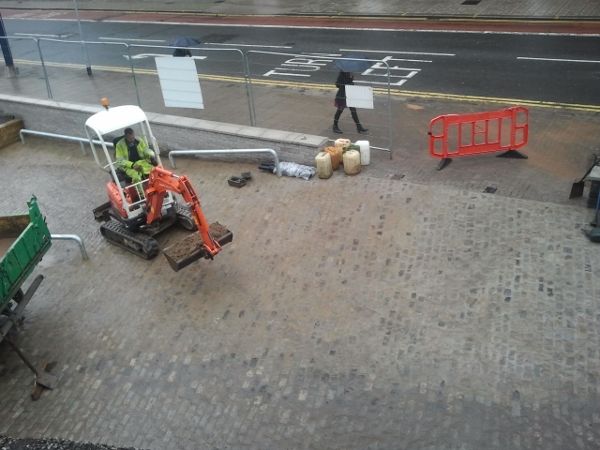
Take a look at the picture below, taken in Bristol on Monday 8th October. Fairly unremarkable isn’t it? What’s the most interesting thing about it? The digger perhaps?
No, the most interesting aspect of the picture is what isn’t there. However, before we come to that, a bit of history and context is required.
Lower Castle Street, Bristol showing the old alignment (cobbled) and the new alignment (asphalt)
As the caption states, the image shows Lower Castle Street in central Bristol. The cobbled surface near the foot of the picture shows the street’s old alignment hard by the moat and outer defensive walls of the now demolished Bristol Castle; the modern asphalt surface beyond is the modern alignment of Lower Castle Street designed to accommodate modern motorised traffic. The old cobbled bit of what was Lower Castle Street has been incorporated into Castle Park, which occupies the site of Bristol Castle and what was Bristol’s main shopping area until the Luftwaffe razed it during the Blitz in the Second World War.
Bristol City Council has recently commissioned some works in the corner of the park occupied by the old alignment of Lower Castle Street, as the picture shows. New flowerbeds or grassed areas (it is not yet obvious what they’ll be) have been laid out and the cobbles relaid. So far, so good.
However, before Bristol City Council sent in its contractors to do the works, the old cobbled bit of Lower Castle Street held what some would regard a significant element of the city’s transport heritage: one of the last set of tram rails visible in any road surface in the city and, as can be seen from the picture, these have now vanished; this leaves just one place in the city where tram rails can still be seen set into the road surface – Bristol Temple Meads station, where the tracks are part of the former tram terminus between the ramp and the old station.
Perhaps the City Council thinks that ‘heritage’ is something that belongs in a museum. It doesn’t: it’s part of everyday life in a city like Bristol which has existed since Saxon times; and some parts of the city are even older than that. By its vandalism the City Council has shown it is not a fit and proper curator of the city’s history and heritage.
There’s yet one more place in central Bristol where a tram rail – a single one – can still be seen; it’s in the churchyard of St Mary Redcliffe. During the Second World War a bomb exploded in a nearby street, throwing a rail from the tramway over the houses and into the churchyard, where it remains to this day.
(I am indebted to Pete Insole for information re Temple Meads.)
Since Clevedon Town Council enacted its ban, legislation has come into effect under which local councils are expected to provide reasonable facilities for members of the public to report the proceedings of council meetings as they happen. Indeed, the legislation was devised to “make it easier for new social media reporting of council executive meetings, thereby opening proceedings up to internet bloggers, tweeting and hyper-local news forums”.
However, while members of the public will be able to report freely during the proceedings, Cllr. Jane Geldart has told me she will still be silenced, as per the following conversation on Twitter:
@JaneGeldart I just read that Clevedon Town Council will allow live tweeting by public. Does ban on councillors tweeting still apply?
@wood5y It does sadly. Despite new legislation they (Town Council) are hiding behind an Act from 1960 …….
Given that MPs and peers regularly tweet the proceedings of Parliament and council meetings everywhere else in the country are covered by webcasts, local bloggers and Twitter, one must wonder what motives Clevedon Town Council has for its schizophrenic attitude.
There are naturally products directed by their use at the different sexes. However, products today are driven more by marketing than matters of gender.
Tesco, the supermarket that ate Britain, has now come up with a new money-making wheeze: sexist cereal.
Gender-specific cereal. How low can marketing go?
Does Tesco’s male muesli have the ability to detect chromosomes to prevent its accidental ingestion by women? I think we should be told.
Best you learn your f*cking place. You don’t run this f*cking government. You’re f*cking plebs.
According to his Wikipedia entry, featuring public school, Cambridge and the world of high finance there’s no doubt that Mitchell is a patrician.
The term patrician originally referred to the elite families in ancient Rome. They were the top of the social pile and had wider political influence than the citizens and residents below them. It has subsequently become a vaguer term used for the aristocracy and elite bourgeoisie in many countries.
Below the patricians in ancient Rome’s pecking order came the plebeians. Plebeians were defined as “the non-aristocratic class of Rome, and consisted of freed people, shopkeepers, crafts people, skilled or unskilled workers and farmers“. Over the centuries, some plebeian families in Rome nevertheless became quite rich and influential. Pleb is now used – as above by Mitchell – as a derogatory term for someone thought of as inferior, common or ignorant.
However, the plebeians were not the lowest of the low in Rome. Below them came the “Capite censi“, i.e. “those counted by head” in the census, and slaves. The largest group of the capite censi were the proletarii, literally “those who produce offspring”. Proletarii were therefore Roman citizens owning little or no property.
So, looking back at the origins of “plebs”, by using it, was Mitchell actually (if unknowingly) abusing the middle classes, Middle England and the bedrock of Tory support?
Over at the Huffington Post, Nathaly Kelly has been dispelling some translation myths in a piece entitled “Clearing up the Top 10 Myths About Translation”.
The 10 myths as are:
Translation is a small, niche market;
There is a declining need for translation;
Most translators translate books; most interpreters work at the United Nations;
Any bilingual person can be a translator or an interpreter;
Translators and interpreters do the same thing (posts passim);
Translators and interpreters work in more than two languages;
Translation only matters to “language people”;
Crowdsourcing puts professional translators out of work;
Machine translation is crushing the demand for human translation; and
All translation will someday be free.
It would be easy to go through each of the above points and comment. However, I would simply make one small remark regarding item 9: I’m so glad machine translation is so bad and likely to remain so for quite some time. I might just make it to state retirement age without having to claim benefits. 🙂
Yesterday, the last day for responses, Bristol Wireless responded to the Department for Education‘s consultation on internet blocking in the cause of keeping children safe online. The consultation arose from a campaign called ‘Safety Net‘, run by Premier Christian Media and SaferMedia, and supported by the Daily Mail. The campaign, and now the consultation is about requiring Internet Service Providers (ISPs) to block adult and other content at network level whilst giving adults a choice to ‘opt-in’ to this content.
However, taking part in the consultation wasn’t easy. Consultees had to do the following:
Download consultation questionnaire;
Fill in questionnaire;
Upload completed questionnaire to Dept. of Education website.
Sounds easy, doesn’t it? It wasn’t.
Here’s why. Ignoring the rhetoric on open standards coming out of their Whitehall neighbours the Cabinet Office, Education Department civil servants only made the consultation questionnaire available as a Microsoft Word file (Wot? No ODF? Ed.). The author of the questionnaire had also stuffed it full of Word macros; this made it very difficult, if not impossible, to open using alternative office suites, such as LibreOffice. Many highly experienced openistas encountered this: Alan Lord (aka the Open Sourcerer) mentioned on Twitter that he couldn’t open it, whilst Glyn Moody could, but found the questionnaire impossible to fill in! On the chief scribe’s, machine attempting to open the file either stalled to a complete halt or crashed the office suite! 🙁 Ultimately, the chief scribe was only able to complete the questionnaire as he had access to a copy of MS Office.
We cannot understand why the civil servants at the Dept. for Education couldn’t have designed the consultation questionnaire as an online survey. Bristol City Council has years of experience of doing online consultations in this manner – and they work very well indeed. Perhaps Sir Humphrey at the Dept. for Education should have called the Counts Louse for advice. As it is, out of 10 we’re giving this Education Dept. consultation a mark of 2. They’d better pull their socks up or it’ll be detention for them… 🙂
Update 08/09/12: It seems that the consultation did originally start out as an online consultation, but was rejigged owing to extremely embarrassing security cock-ups, as The Register reports.
The Register was first to reveal – within hours of the Department for Education publishing its parental internet controls proposal – that the DfE’s website was ironically exposing the email addresses, unencrypted passwords and sensitive answers submitted people who filled in the consultation’s questionnaire.
As a result of this additional information, we’ve now reduced the DfE’s mark to minus 2 out of 10. 🙂