February 14th is St Valentine’s Day, a day normally devoted in non-pandemic times to the enrichment of florists and restaurateurs, and generally associated with the pleasures of romance and love.
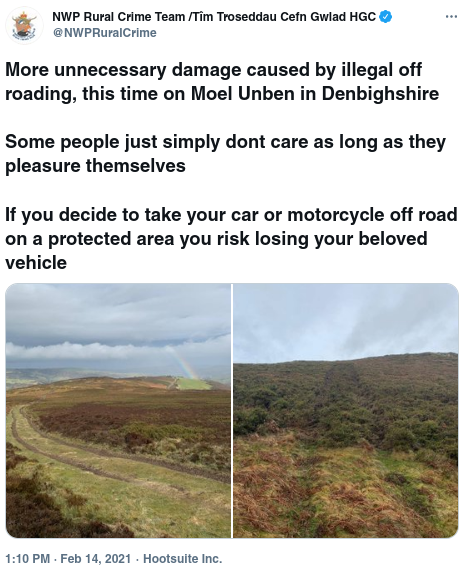
However, the North Wales Police Rural Crime Unit had matters of countryside damage on its mind that day, when it tweeted the following.
Pleasure themselves? Surely not!
Take a close look at the second paragraph of the tweet and Mr/Ms Plod clearly meant something completely different.
The person in charge of the force Twitter account clearly spent yesterday in a state of confusion between love and lust. 😀
I do hope they got their vocabulary sorted out by the time they came off shift and headed home to spend time with their significant other.
When related to property, the noun premises is defined by Collins Dictionary as:
a piece of land together with its buildings, esp considered as a place of business.
When related to property, premises has since time immemorial (or even longer. Ed.) been a plural noun.
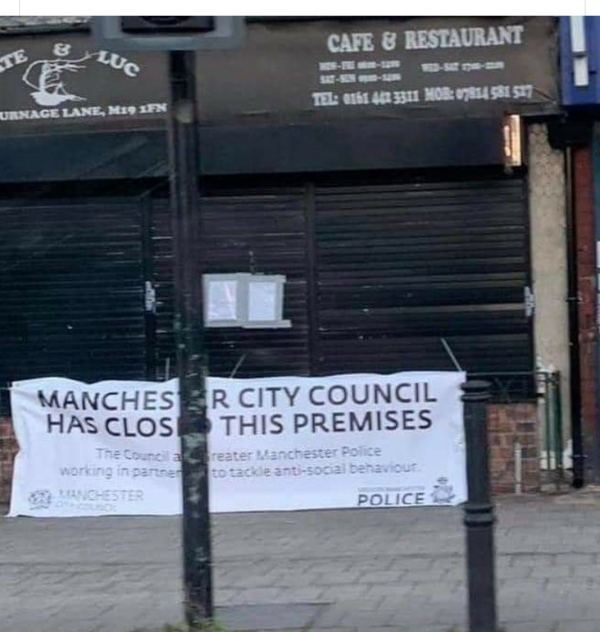
However, it is a source of constant surprise how many people these days regard premises as a singular noun, as shown by this recent example, courtesy of Manchester City Council.
A singular example
However, it should be remembered that premise does exist as a singular noun, in which instance it takes the following definition:
something that is supposed to be true and is used as a basis for developing an idea.
Local authorities are not the only people to get confused about premises and premise as regards use of the plural and singular.
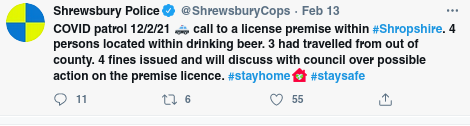
Take this example on Twitter courtesy of the constabulary in Shrewsbury.
A singular licence
That’s right. Why have a premises licence when a premise licence will do just as well? I’m sure Mr Plod meant the former, but having a licence for a premise raises many new questions indeed.
Professor Paul Brains of Washington State University has included the confusing of premises and premise in his book, Common Errors in English Usage. Read his simple, eloquent distinction.
Premises are also quite particular about where any action takes place too. Anything that happens always, always takes place on them, not in them.
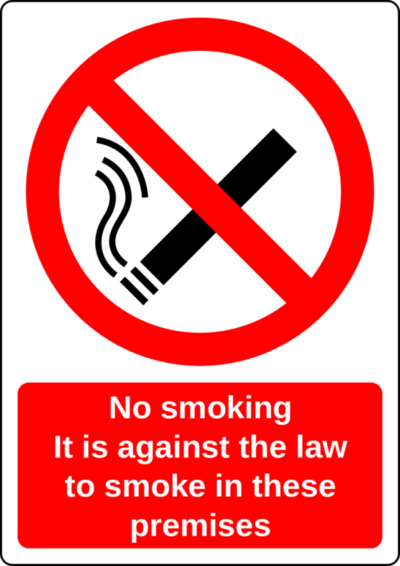
The introduction of a blanket ban on smoking indoors gave rise to a wave of illiteracy, as exemplified by this typical example.
Image courtesy of Wikimedia Commons
It does feel as though those of use who are held to higher standards of language use and/or were taught proper English (Ahem! Ed.) are fighting a losing battle. Will premises become increasingly singular? Will actions take place in them ( or it? Ed.) in future?
For the answers to such questions, one must wait and see.
Only time can tell as language always has been dynamic, i.e. a moving target: and what is regarded as proper usage will always be subject to change, just like language itself.
After Wales’ 21-13 decisive victory in yesterday’s Six Nations rugby fixture in Cardiff, Traffig Cymru, the Welsh Government’s traffic information service, couldn’t resist having a bit of fun on Twitter at the expense of the England squad and English rugby fans.
Swing low…
I wonder if the chariot had been rescued by a band of angels before Mr Plod had a chance to find it… 😀
Gloucestershire Live is a sister title of the Bristol Post/Bristol Live and as such provides a similar mediocre quality of journalism to its victims readers.
My Gloucestershire friends have this morning confirmed via social media that as far as the governance of the county is concerned, politics inevitably equals the Conservatives and the Blue Team dominate what is effectively a de facto one-party state.
A spot of conning anyone?Recent delvings into the history of Market Drayton’s court leet (posts passim) have taught me of the duties of the officers of that ancient manorial court; and the more researching I’ve done, the more has come to light.
The duties of one officer in particular caught my attention: the ale-conner.
Further news of that officer’s duties at Drayton’s Dirty Fair comes from a surprising source – the 30th December 1911 edition of The Corrector. This was a newspaper that used to be published in the 19th and early 20th century in Sag Harbor on Long Island in New York State.
At the bottom of page 3, in E.J. Edwards’ New News of Yesterday column, the following piece entitled Tasting The Drinks appears:
An old custom has just been observed at Market Drayton, where the annual fair, called “the Dirty Fair,” has been opened by the Court Leet. A proclamation, it is reported, was read by the “Ale-Canner,” who warned “all rogues. vagabonds, cut-purses, and idle men immediately to depart from this fair.”
“Ale-Canner” has a jovial smack about it, but we are afraid it is a misprint for “Ale-Conner,” an ancient and honorable officer, both of manors and corporations, His duty was to taste the new brew of every “brewer and brewster, cook. and pie-baker.” and if it were unfit to drink the whole was confiscated and given to the poor.
It should be added that in the middle ages “unfit to drink” usually meant weak and watery. The chemist was not abroad in those benighted days, so there was no risk of arsenical by-products being present in the pottle-pot.
Besides testing beer and the measures in which it was sold, the ale-conner also ensured the goodness and wholesomeness of bread, plus the measures in which it too was sold.
If this report is to be believed, it was therefore the ale-conner’s duty to declare the Dirty Fair open in times gone by, in addition to his public health duties in the days before the various improvements in ensuring the health of the public brought about by our 19th century forebears.
Conner is an interesting noun as regards its origins. Nowadays we are all familiar with the noun con, which is short for confidence trick. However, thinking there is any connection between the two would be erroneous. There’s also a conning tower on a submarine, but its origins have more to do with conning in the sense of navigating a vessel.
To find the conner’s origins one has to go back to many hundreds of years. According to Merriam Webster, its origins are indeed in Middle English, as would befit an office established in a medieval court. In Middle English, the noun was cunnere, meaning an examiner or tempter, which was derived from the Middle English verb cunnian, to examine, which itself originates from the Old English verb cunnan, meaning to be able.
Finally, ale-conner was sometimes also rendered as aleconner or even ale-kenner.
Following on from my post on the markets and fairs of Market Drayton (posts passim), my home town, the following comment was left on the site by Andrew Allen long after comments on the post itself were closed.
Andrew also grew up in Market Drayton somewhat later than myself and my siblings and his words are reproduced below.
I was born and brought up in MD and for some reason I just had a flashback of the Court Leet which I recall being re-enacted when I was a child in the late 1970s.
It was great to read your notes about the Court. We have a photo at home (my mother’s) of a load of gentlemen standing outside the Corbet in their finery, I guess around 1900… it has my grandfather in the shot… I now think that must have been the Court Leet.
Anyway, thanks for your notes.
Courts Leet were a very old institution. According to Wikipedia, “The court leet was a historical court baron (a manorial court) of England and Wales and Ireland that exercised the “view of frankpledge” and its attendant police jurisdiction“.
My original source for information of Market Drayton’s Court Leet – Peter Hampson Ditchfield’s 1896 book, Old English Customs Extant at the Present Time: an account of local observances – states the following:
At Market Drayton there are several fairs held by right of ancient charter. One great one, called the “Dirty Fair,” is held about six weeks before Christmas, and another is called the “Gorby Market,” at which farm-servants are hired. These are proclaimed according to ancient usage by the ringing of the church-bell, and the court-leet procession marches through the town, headed by the host of the “Corbet Arms”, representing the lord of the manor, dressed in red and black robes, and the rest of the court carrying silver-headed staves and pikes, one of which is mounted by a large elephant and castle. At the court several officers are appointed, such as the ale-conner, scavengers, and others. The old standard measures, made of beautiful bell-metal, are produced, and a shrew’s bridle, and then there is a dinner and a torchlight procession.
High Street Market Drayton with the Corbet Arms Hotel on the right. Image courtesy of Wikimedia Commons.
Only two officers of the court are mentioned by Ditchfield – the ale-conner and scavengers. The ale-conner’s duties were to ensure the quality of ale and to check that true measures are used. The duties of scavengers were to ensure standards of hygiene within the lanes and privies and to try and prevent the spread of infectious disease.
The ceremony Andrew remembers seeing as a youngster in the late 70s was a one-off re-enactment in 1977 for the Queen’s Silver Jubilee. The Shropshire Star sent a photographer to record the event. The paper’s record of the celebrations, including the court leet re-enactment is still available online. As regards photographs of the original court leet, the Shropshire Archives collection contains 3 photographs of the court leet, all dating from the first decade of the twentieth century. According to the National Archives, the Shropshire Archives also contain a printed menu from 1936 for the Market Drayton Tradesmen’s Association dinner held at the Corbet Arms Hotel after Drayton Manor Court Leet broadcast. So it seems the court leet may have survived in some form until the mid-1930s.
Many thanks to Andrew for getting in touch and sharing his memories.
If anyone has further knowledge of which other officers constituted the Court Leet, please use the comments below or the contact form.
The right-wing Telegraph newspaper has enjoyed a long and close relationship with the Conservative Party. So close indeed that it is often referred to as the Torygraph.
This close relationship means that developments within the Tory Party are frequently reported first in the Telegraph.
It is therefore no surprise that the latest developments on the state of the UK’s Brexit negotiations popped into my Twitter feed this morning with the following Telegraph headline and abstract.
Yes, that’s why the negotiations have been so disastrous. They’ve been handled by ducks, or more specifically a Eurasian teal, a male specimen of which is shown below.
A top international negotiator according to the Telegraph. Photograph courtesy of Wikimedia Commons.
How a duck or ducks actually managed to deal with the question of the Irish backstop remains a mystery and is probably why the Tory right wing is so obsessed with it. And quite what a revamped negotiating teal is, one could indulge in conjecture. Was it taken to some backstreet ornithologist and given the plumage of, say, an Arctic skua, together with a bit of beak remodelling?
If there’s one thing that can be said about language, it’s that it’s dynamic. Blink for a second and you might miss the coining of a neologism or an old turn of phrase becoming obsolete.
The latter in particular can have amusing consequences, especially if re-used by someone possibly too young to appreciate the original connotations of the word or phrase.
One such most likely occurred today in a Bristol Post piece about free travel in the Bristol area on Unibus services.
The item’s second paragraph reads as follows:
Passengers will able to hop on the Unibus U2 service, from Monday February 18 until Friday, February 22 without spending a penny.
To someone of my age (rapidly approaching where I qualify for a pass for free bus travel. Ed.), the phrase has connotations other than obtaining buckshee travel.
If someone says that they are going to spend a penny, they mean that they are going to go to the toilet. [British, old-fashioned, politeness]
The origins of the phrase stretch back to the Victorian era and refer to the use of coin-operated locks on public toilets in the UK. Such locks were first used in a public toilet outside London’s Royal Exchange in the 1850s.
The phrase “to spend a penny” has now largely died out and been forgotten, except by those with greying hair, due to changes to public toilets themselves (many of which have been closed by austerity-hit local authorities. Ed.) and changes in the charges to use a toilet. Last time I looked while on my travels, the toilets at Manchester Victoria railway station cost an exorbitant 20p, i.e. 4 shillings or 48 times the original cost of one penny.