media

  • Vocabulary – what a bummer

    It’s a well-known adage that Britain and the United States are 2 countries divided by a common language.

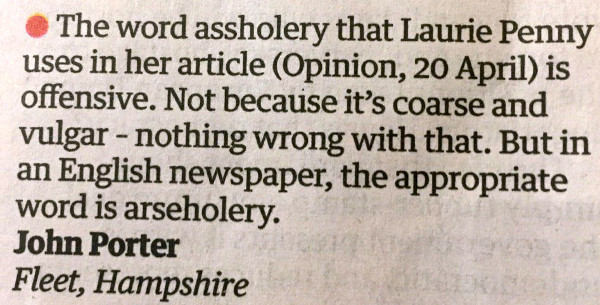
    However, that doesn’t seem to stop constant encroachment from over the other side of the Atlantic, as illustrated by the following letter from yesterday’s The Grauniad (dead tree edition).

    shot of letter complaining assholery should have been arseholery

  • Je suis saboteur

    Today’s Daily Mail front page is in full censorious mode following the announcement yesterday morning of a snap election by the UK’s not at all unelected Prime Minister.

    Daily Mail front page with headline crush the saboteurs

    As can be seen, those who voted remain in last year’s EU referendum have now been reclassified by the Mail. We’re no longer Remoaners, but Saboteurs.

    Indeed the Mail headline has been greatly exercising the Twittersphere this morning, with its wording being compared with both extreme wings of politics (the phrase “Crush the Saboteurs” was first used by Lenin in January 1919. Ed.), with several reminders of the Mail’s infamous Hurrah for the Blackshirts headline from January 1934.
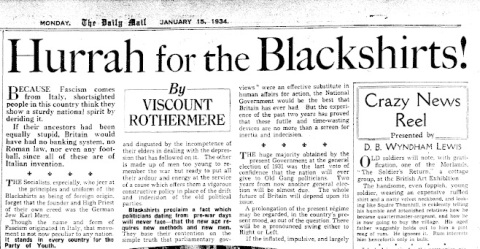
    Mail's Hurrah for the Blackshirts headline

    Since this morning Mrs May has defended the Mail’s intemperate stance and headline, pleading “freedom of the press”. Some would argue freedom comes with a sense of responsibility attached, Mrs May.

    As someone who voted remain in the referendum and still regards the course towards a so-called hard Brexit favoured by the Prime Minister and entailing leaving the Single Market, the course of action she is advocating looks to me like the ultimate sabotage.

    As a person whose life is built around words, the definition and etymology of the word sabotage interests me.

    According to Dictionary.com, sabotage has the following meanings as a noun:

    • any underhand interference with production, work, etc., in a plant, factory, etc., as by enemy agents during wartime or by employees during a trade dispute; and
    • any undermining of a cause
    • .

    Sabotage can also be used as a verb, meaning to injure or attack by sabotage.

    As regards the origins of sabotage, it came into use in English in the late 19th/early 20th century, emanating from the French, equivalent to sabot(er) to botch, orig., to strike, shake up, harry, derivative of sabot, which dates back to the 13th century and denotes a clog or wooden shoe. Sabot originates from an unidentified source that also produced similar words in Old Provenรงal, Portuguese, Spanish (zapata), Italian (ciabatta), Arabic (sabbat) and Basque (zapata).

    As regards sabotage in the context of the UK’s relationship with the European Union/EEC, it must be remembered that the Europhobes (later called Eurosceptics. Ed.) were moaning even before the ink was dry on the signatures of Edward Heath, Alec Douglas-Home and Geoffrey Rippon on the 1972 Treaty of Accession.

    The Europhobes have consistently sabotaged Britain’s relationship with Europe ever since and, as someone who is diametrically opposed to their plans, I am therefore proud to declare: “Je suis saboteur!”
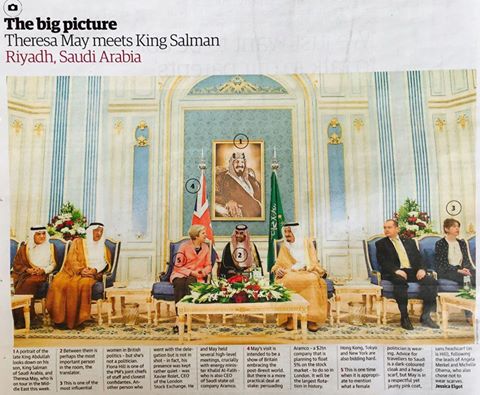
  • Grauniad terminology failure

    On Twitter, the ITI has kindly pointed out a terminological error in last week’s Guardian. I appeared in the text of the article shown below, taken on the occasion of the UK’s not at all unelected prime minister Theresa May’s visit to those nice people in Saudi Arabia who are kind enough to buy lots of weapons off the British for use in Yemen.

    shot of page of paper version of Guardian

    The person identified as Person 2 is described as “the most important person in the room, the translator”.

    I’m afraid you are wrong there, Grauniad. He may be the most important person in the room, but alas he is no translator.

    The error of the Grauniad’s ways was helpfully pointed out in a letter on Tuesday by fellow linguist Jane Straker and her letter is reproduced in full below.

    The big picture (5 April) was good and the numbered captions helpful. It was a boost for our profession to have the man below the late King Abdullah’s portrait described as “perhaps the most important person in the room”. However, translators are not normally people who listen and speak (sometimes simultaneously) in meetings: that is the job of interpreters. Some translators are trained to interpret, but they usually excel at writing, keyboard skills and carefully honing text. Speech is not writing; transfer of meaning between languages and cultures requires not only accuracy, speed and clarity, but impartiality. Interpreters should have no vested interest in the outcome of a meeting. It would be useful to know whether Theresa May had a British Arabic-English interpreter in her delegation.

    To avoid future blunders and save interpreters from putting pen to paper – or fingers to keyboard – passing Grauniad (& other) journalists are advised to consult my handy illustrated guide to translators and interpreters.

    Some linguists have remarked that the two sides of the profession should stop being so pedantic about terminology. However, I believe terminological exactitude is a crucial skill for both translators and interpreters. Give your thoughts in the comments below.

  • Post exclusive: broadcaster now runs Bristol hospital

    The Bristol Post, the city’s newspaper of warped record, has recently revamped its website, which now uses the standard template for Mirror Group titles.

    In addition, the standard of what passed in recent decades for journalism from the title seems to have taken a dive too. Whether this is related to the change of template cannot be corroborated.

    One thing that has not changed is the inability of the Post’s reporters to concentrate on the most relevant facts of a story.

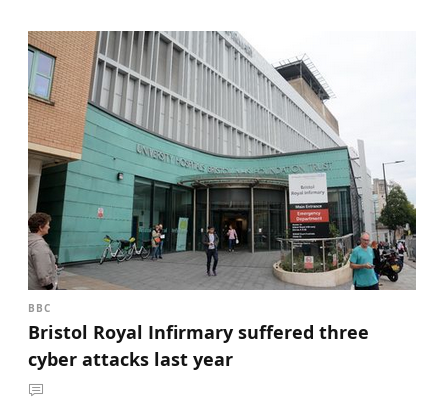
    An example from today is shown in the screenshot below.

    Heading to article says BBC. Headline reads Bristol Royal Infirmary suffered three cyber attacks last year

    The story itself relates that the Bristol Royal Infirmary (BRI) suffered 3 cyber attacks involving ransomware last year.

    This is only to be expected if major organisations continue to base their IT infrastructure on Microsoft’s insecure operating systems.

    For me, the important point was on the front page as shown in the screenshot, according which the BRI now comes under the aegis of the National Health Service, although for some unfathomable reason, there is no mention whatsoever in the article itself of the British Broadcasting Corporation.

    To echo the purported words of a proper, old-school journalist, the late Bill Deedes, “Shome mishtake shurely?” ๐Ÿ™‚

  • Recognition

    On Tuesday March 21st, your correspondent had a special appointment to keep up at the Mansion House in Clifton, the official residence of the Lord Mayor of Bristol.

    The occasion was the presentation of Lord Mayor’s Medals to what Jeff Lovell, the current Lord Mayor, described in his opening remarks as “community champions”.

    Only some 20 medals are awarded each year and your ‘umble scribe was a recipient this year.

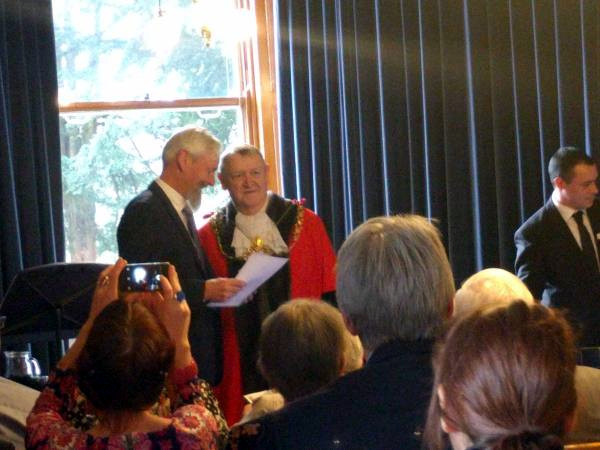
    Receiving the medal from the Lord Mayor
    Receiving the medal from the Lord Mayor. Picture courtesy of Up Our Street

    According to the citation, I was commended for my work in the voluntary and community sector in East Bristol, including all the Tidy BS5 efforts to make Easton and Lawrence Hill a cleaner, more pleasant environment.

    However, I was not the only recipient with a BS5 postcode. Three other locals received recognition.

    Hannah Crudgington was recognised for her work for Tidy BS5 (particularly her videos. Ed.) and her efforts to show a more positive side to Easton than is generally given by the local media.

    Bruce Yates was commended for his work in turning around local youth organisation Baggator at The Pickle Factory in All Hallows Road, as well as his work for RADE Bristol, which campaigns for inner-city clean air and against efforts to install polluting standby electricity generating plant in the city.

    Last but not least, Amy Harrison received a medal for her work for Up Our Street.

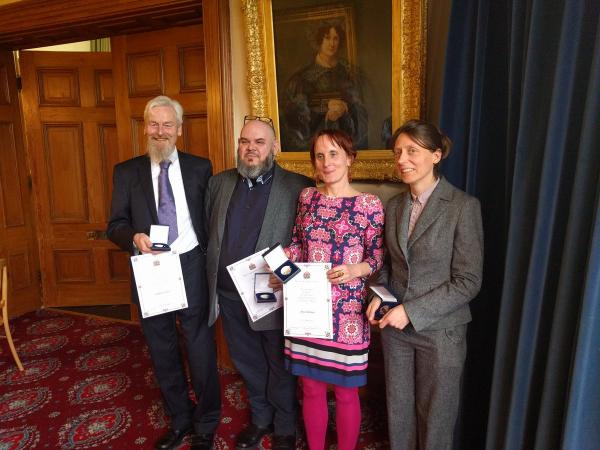
    All four of us are shown in the photograph below.

    BS5 recipients of the Lord Mayor's Medal
    The BS5 recipients of the Lord Mayor’s Medal. Picture courtesy of Up Our Street.

    It was, all told, a lovely afternoon, which was made even more special by a surprise visit by my eldest niece Katherine and boyfriend Martyn, who were subsequently treated to a night on the tiles in Easton.

  • Chronicling allergy

    At least once a week, the Bristol Post, the city’s newspaper of warped record, comes up with an exclusive, although this might not be immediately apparent to the casual reader.

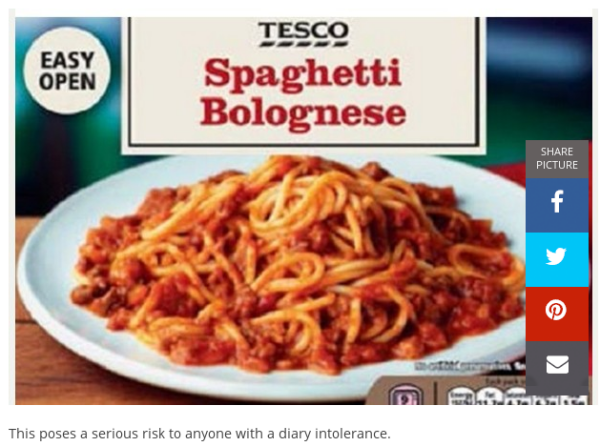
    Today is no exception as, buried in this report on the recall of dodgy products is the revelation that some people are allergic to written records of discrete events organised by date, as revealed by the following screenshot.

    text reads this poses a serious risk to anyone with a diary intolerance

    No illiteracy or lack of proof-reading skills should be inferred concerning the alleged “journalist” involved. ๐Ÿ™‚

  • Struck off and die

    There’s a skill to writing an intriguing headline that invites the reader to engage with an article.

    Besides the above that skill also involves the ability to make the headline make sense.

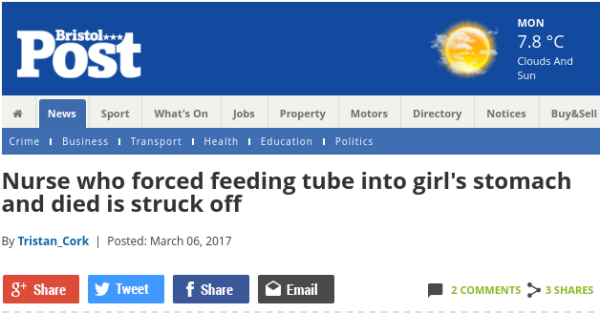
    It’s an ability that seems to be lacking down at the Temple Way Ministry of Truth, headquarters of the Bristol Post, the city’s newspaper of (warped) record, as shown by the screenshot below of the head of this article.

    headline reads Nurse who forced feeding tube into girl's stomach and died is struck off

    Comments on the piece accuse the Post’s headline of not making sense, but to your correspondent it does make perfect sense… as long as nurses can get struck off posthumously.

    Update 07/03/17: Perhaps prompted by the mocking nature of the comments, the headline has now been amended to reflect the gist of what actually happened.

  • “Th” sound to disappear from English in coming decades?

    The “th” sound, which had its own letter – thorn (รž, รพ) in Old and Middle English – could disappear from spoken British English, today’s Daily Telegraph reports.

    By 2066, linguists are predicting that the “th” sound will vanish completely in london because there are so many foreigners who struggle to pronounce interdental consonants – the term for a sound created by pushing the tongue against the upper teeth.

    In the wider South East of England Estuary English โ€“ a hybrid of Cockney and received pronunciation (RP)โ€“ is already being replaced by Multicultural London English (MLE), which is heavily influenced by Caribbean, West African and Asian Communities.

    The Telegraph is reporting on the release of the Sounds of The Future report produced by Dr. Dominic Watt and Dr. Brendan Gunn from the University of York.

    Other predictions from the authors include:

    • Sound softening โ€“ hardly anyone says ‘syoot’ for ‘suit’ any more and this trend will continue with the sharp corners knocked off words;
    • Yod dropping – words like ‘cute’ or ‘beauty’ will become ‘coot’ and ‘booty’;
    • Consonant smushing โ€“ ‘w’ and ‘r’ are already similar for many southern English speakers, but the letters could completely collapse into one sound, whilst Words with ‘ch’ and ‘j’ could also become indistinguishable;
    • Glottal stop โ€“ the slight linguistic trip which turns ‘butter’ into ‘buโ€™er’ in dialects like Cockney could become more widespread around the country.

    Commenting on the same report, the Newcastle Chronicle leads with the headline “The Geordie accent is on the way out say language experts“, remarking that language experts say that by 2066 the distinctive Geordie accent will sound like a southern one.

    The Sound of 2016 report was commissioned by bankers HSBC, to mark the “voice biometric” technology which the bank is rolling out to 15 million customers, so perhaps it’s worth mentioning here the usual disclaimer about not trusting information from someone trying to sell you something. ๐Ÿ˜€

  • Stare-struck hack?

    Modern British society seems obsessed with celebrity culture: this is no more evident than in the mainstream media; and such is true of Bristol’s (news)paper of (warped) record, the Bristol Post.

    It would appear that no sooner does a Z-list non-entity have something to do with the city than the illiterati that constitute the current reporting staff of the Temple Way Ministry of Truth than they are lost for words – or for le mot juste at the very least.

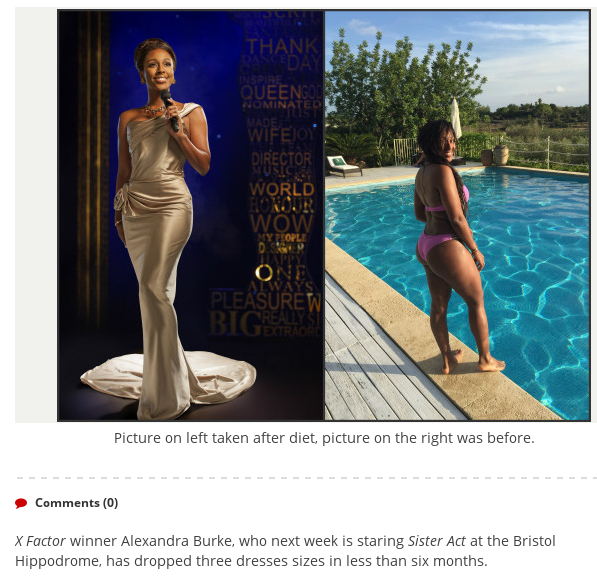
    This is evident in a puff piece in today’s online edition featuring some nobody off some dire TV talent show, as per the obligatory screenshot below.

    sentence reads X Factor winner Alexandra Burke, who next week is staring Sister Act at the Bristol Hippodrome, has dropped three dresses sizes in less than six months

    So Bristol Post, is a nobody off the telly looking intently at a show at the Hippodrome or taking part in it? In the immortal words of Private Eye, I think we should be told.

Posts navigation