England won the toss, elected to bowl first and put Australia into bat. Before lunch Australia were all out for 60 runs (including extras), clocking up the worst batting performance by an Australian team in an Ashes match for some 8 decades.
If I couldn’t believe my ears, one can just imagine how well such a shambolic performance with the bat went down in the Australian media.
The Sydney Morning Herald‘s sports headline writer perhaps encapsulated feelings best with the back page headline “It’s Pomicide“, as per the photograph below.
Whilst I take a rather ambiguous attitude to newspaper headline writers and their frequently inappropriate use of puns, the invention of Pomicide strikes me as most apposite. Should I recommend it to the Oxford English Dictionary for its word of the year accolade?
Responses have been received to my recent Freedom of Information Act (FoI) requests requests to Bristol City Council.
These concerned the relative numbers of staff involved in press, PR, etc. and so-called ‘streetscene (i.e. fly-tipping, litter, dog fouling and the like). This is a subject which this blog has tackled previously. However, I felt it necessary to obtain the most up-to-date figures I could.
This is a request for information under the Freedom of Information Act.
Kindly disclose the number of press, public relations and communications staff/officers who are employed at present by Bristol City Council and/or have their place of work in Bristol City Council offices.
Yours etc.
The response to the request reads:
The number of press, public relations and communications staff/officers who are employed at present by Bristol City Council and/or have their place of work in Bristol City Council offices:
(The list below shows the number of full-time equivalent staff)
Service Manager: Corporate Communications x 1
Service Manager: Public Relations x 1
Design Manager x 1
Senior Designer x 1
Designer x 4.49
Assistant Designer x 5
Senior Communications & Marketing Officer x 5.41
Senior Communication Officer – Enterprise Zone x 1
Senior Communication Officer (Corporate Campaigns and Special
Projects Team) x 0.81
Marketing & Communications Officer (Level 1 and 2) x 9.51
Marketing & Communcations Support Officer x 4
Internal Communications Manager x 1
Internal Communications Support Officer x 2.39
Channel Editor (Level 2) x 1
Digital Public Relations Officer x 2
Senior Public Relations Officer x 1.2
Public Relations Officer x 5
Exhibition Designer x 1
Apprentice x 1
Total Full-Time Equivalents: 48.81
This is a request for information under the Freedom of Information Act.
Kindly disclose the total number of streetscene officers who are employed at present by Bristol City Council, as well as the total number employed in the last financial year.
I would also be grateful if you would inform me whether the said officers are employed full-time or part-time and how many, if any, are on long-term sick leave.
Yours etc.
This was duly answered as follows:
Our reply to your request is:
In 2014/15 we employed 5.7 full-time equivalent (FTE) Streetscene Enforcement Officers up until November 2014. Since November 2014 we have employed 4.7 FTE. There are four full-time officers and one
part-time officer. Presently, we plan to recruit an additional 1.5 FTE.
There are currently no Streetscene Enforcement Officers on long-term sick leave
The staffing situation is thus more out of kilter than was originally imagined. Bristol City Council is now actually employing more press, PR and communications staff than when examined previously by the Press Gazette in its FoI request.
Bristol City Council priority: weasel words in press releases
Presumably this is due to the additional quantities of bullshit needing to be shovelled out of the Council House due to Bristol’s unwarranted elevation this year to European Green(wash) Capital.
On the other hand, council staffing managers have deemed that the city can get by with a maximum of 6 people chasing fly-tippers and litter droppers for the time being.
Not a council priority: fly-tipping in Woodborough Street, BS5
In my opinion the city would be a tidier and more truthful place if the above numbers were reversed, with the council employing 49 enforcement officers (they’re really needed! Ed.) and under 6 press, PR and communications wonks.
Whether you agree or disagree with my opinion, please feel free to comment below.
It’s the first day of the first test match in Cardiff of the latest Ashes series being played between England and Australia.
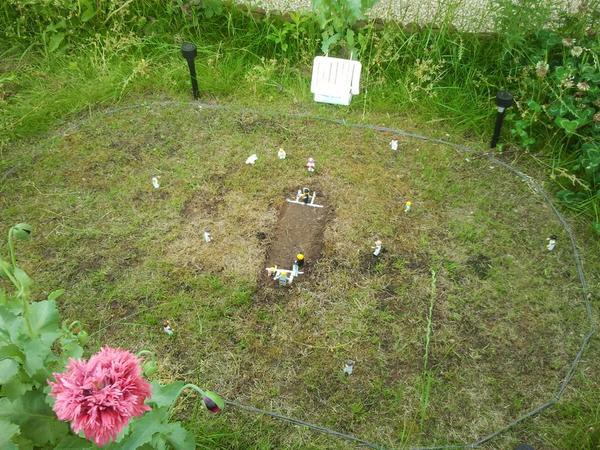
One household in Beaumont Street in the Easton area of Bristol has entered into the spirit of the occasion, as shown below.
As it’s the postage stamp-sized front garden of a terraced house, the players are a mix of Playmobil* and Lego figures, not life size.
Note the loving preparation that’s gone into the pitch, an uncovered one (naturally) in line with traditional British values and thus guaranteed to cheer the most outspoken of cricket commentators – a certain G. Boycott.
Talking of Mr Boycott, if you’re a fan of the Test Match Special radio commentary on the BBC, add to your enjoyment of the excellent commentary by Aggers, Blowers et al.; make sure you’ve got your Boycott Bingo card ready for when the world’s greatest living Yorkshireman sounds off (posts passim). 🙂
Awards recognising local people and businesses which support the environment have been launched by the Bristol Post, the rag of that name reports on its website today.
The article continues that the Bristol Post Green Capital Awards will celebrate those people who are making our city a greener, healthier, happier place to live and work.
The article does quote the chairman of Bristol 2015 – a company established by the city council to run this year-long green-tinged public relations exercise – admitting that Green Capital has not reached all parts of Bristol.
That being so, I’d like to see an alternative set of awards that won’t go to the usual suspects amongst Bristol’s great and good and their pet vanity projects. Let’s call them the Greenwash Capital Awards.
Some of these can be awarded already.
For starters, there’s the Green Transport Award, for which there can only be one set of winners, namely the selfish individuals who all drive their vehicles containing just one person into the city from the surrounding areas of South Gloucestershire, North Somerset and Bath & North East Somerset, causing congestion, pollution and getting in the way of local bus services.
Selfish commuters clogging Bristol’s M32 inbound
Then there’s the Green Waste Management Award. This prize should I believe be split between the citizens of Bristol who managed to generate 18% more waste for landfill last year, Bristol City Council, which seems to be labouring under the delusion that exporting what would go to landfill to Sweden for incineration in power stations is a good idea and finally the people – both traders and others – who think that the BS5 postcode area is the natural home for the city’s fly-tipping.
One of the regular but ephemeral arts installations on Stapleton Road; is it critiquing the throwaway society?
How about the Habitat and Biodiversity Destruction Award? There’s a clear winner for this one: the four councils making up the West of England Partnership and their ludicrous transport white elephant, the Metrobus scheme.
Last weekend saw the staging of BarnCamp 2015 (in which Bristol Wireless’ volunteers have been involved since its inception. Ed.). Running from Friday 19th June to Sunday 21st, BarnCamp was as usual a low-cost rural DIY skillsharing event open to everyone, including UK activists, campaigners, people involved in social and community groups and anybody else with an interest in technology and how to subvert it to put it to good use.
According to the sales pitch: “All skill levels are invited and we promise that workshops are not too geeky due to our infamous nerd gag” (of which more later. Ed.).
Once again we were the guests of Highbury Farm, a housing co-operative set in some 30 acres of unimproved but rather steep grassland at Redbrook in the beautiful Wye Valley south of Monmouth.
Looking north towards Monmouth from Highbury Farm
Your correspondent formed part of the forward crew who went to site on Wednesday to set up the event. This year a few more of us were on hand to ensure that all the essential infrastructure – large tents for workshops, signage, kitchen, other refreshment facilities, camp fire, showers and the like – was all in place for the first arrivals. Indeed it was more or less complete by lunchtime on Thursday. Well done all!
Once into the event proper, each day started with breakfast, followed by a plenary session, then workshops, lunch, more workshops and concluding with supper and socialising.
The workshops this year had the usual variety: an introduction to satellite communications, basic electronics, using WordPress and OpenStreetMap, to mention but a few. There were even sessions on basic self defence, whilst Ben’s ever-popular wild food walk took place on no fewer than 3 occasions.
Your correspondent was in charge of building the nightly campfire, a duty that occasionally involved some sheltering of the previous night’s embers from the rain, whilst even the woodpile showed its geeky side.
The pyromaniac’s equivalent of the locked screen
The woodpile geeking out wasn’t the only bit of strangeness occurring on site during BarnCamp. There was also the the intriguing sounding shamanic laptop massage that happened somewhere in the surrounding woodland, for which scant photographic evidence exists.
Shamanic laptop massage
What’s happened to the nerd gag? And what is it in the first place? This was a standard implemented some years ago to stop the less technical becoming too intimidated to the use of too much jargon by the more technically adept. Workshop presenters are encouraged to explain things properly if anyone so asks; this year there was even a space on the information wall where BarnCampers could share the jargon they had just acquired.
The jargon buster
Nevertheless, there was one workshop – Sunday morning’s session on server optimisation – that not only ripped off the nerd gag, but set light to it and threw it away! (And that was just with the first slide of the presentation! That one slide contained more technical acronyms than the rest of the programme put together. Ed.) However, this was perhaps the most jargon-laden session of the weekend and the most geeky, but it did come with lots of laughs… as long as you could get the jokes.
I hope all my fellow BarnCampers had as good a weekend as I did and once again my thanks go out to the good folk at Highbury Farm for their friendliness and hospitality. See you at the next one! 🙂
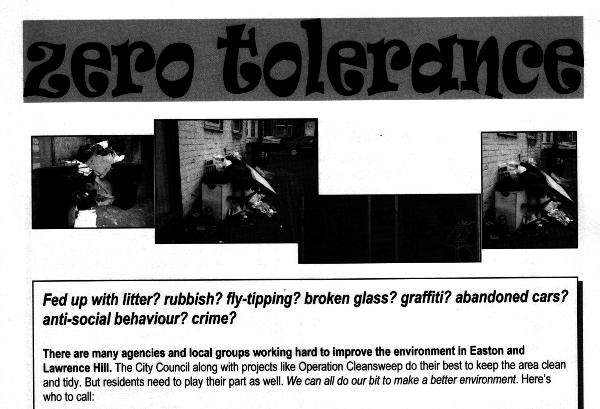
Coming into the Bristol Wireless lab this afternoon,I found that the weekend spring clean by 2 of our volunteers had thrown up a copy of “renewal“, bylined “the newsletter of Easton and Lawrence Hill Neighbourhood Renewal” dated March 2006, over nine years ago.
Turning to page 12, the subject matter seemed to have a familiar look to it, as per the scanned and cropped page below.
Fly-tipping, litter, rubbish, graffiti: these all sound like themes currently receiving the attention of the Tidy BS5 campaign by local residents and councillors, ably assisted and supported by Up Our Street.
The 2006 article then goes on to give telephone numbers for residents to call to deal with these matters. The telephone number for reporting street cleaning matters and abandoned cars, etc. has since changed to 0117 922 2100 and readers may find it more convenient to report these and other problems online.
The fact that so little has changed, reminds of a quotation from the late Tony Benn.
There is no final victory, as there is no final defeat. There is just the same battle. To be fought, over and over again. So toughen up, bloody toughen up.
There’s a hidden exclusive in today’s online edition of the Bristol Post. Unknown to the fans and probably the club itself, the Post reveals that Bristol Rovers now play in “blue and white stripes“, as shown by the following screenshot.
For the benefit of passing Post journalists, here are the three strips currently used by Bristol Rovers. Please note the only stripes are on the alternative away colours and have one thin blue stripe. The pattern used on the regular strip is commonly known as “quarters“.
Image courtesy of Wikipedia
The Post also mentions in the article that Catalonia’s CE Sabadell FC (who are in the Spanish Segunda División. Ed.) play in a strip “similar” to that of Rovers. FC Sabadell’s current strips are shown below and yes, the home strips do look very similar, even if the teams’ respective league positions do not; Rovers are chasing promotion from the Conference, whilst Sabadell are fighting relegation.
Image courtesy of Wikipedia
Let’s hope the players of both teams are more on target than Bristol’s alleged newspaper of record. 🙂
The minions of the Bristol Post, possibly under strain from toiling away at the Temple Way Ministry of Truth looking for the city’s blandest news content, seem to have particular difficulty with homophones, i.e. words that are pronounced the same as another word but differ in meaning and may differ in spelling.