open source

  • Linux: suitable for business and personal use

    image of Tux, the Linux kernel mascotThe Netherlands’ Nationaal Cyber Security Centrum (NCSC), part of the Dutch Ministry of Justice, has recently published a fact sheet (PDF) about Microsoft’s impending withdrawal of support for its ancient Windows XP operating system.

    The fact sheet urges users to switch to more modern operating systems as alternatives, but also says some interesting things about Linux, for example:

    Newer versions of Windows, such as Windows 7 are 8, are still well supported. The same is true of Linux-based operating systems like Ubuntu and Red Hat.

    When it comes to operating system updates and suitable uses for operating systems, the NCSC remarks as follows:

    In addition to the newer versions of Windows, there are other operating systems which are also regularly provided with updates. There are various Linux distributions which are suitable for personal and business use. Ubuntu and Red Hat are two popular examples of these. It is also possible to replace the computer itself, or you could also choose a computer with a Mac OS X operating system. These are supplied and supported by Apple. Even older versions of Mac OS X or Linux-based systems reach the “end of life” status from time to time. It is therefore also important for users of these operating systems to use a current version.

    The NCSC’s main target groups for this working paper are the Netherlands’ ministries, national government councils and service organisations, Joinup reports.

  • LibreOffice 4.1.3 released

    the LibreOffice logoThe Document Foundation (TDF) blog announced earlier today that LibreOffice 4.1.3 has been released for Linux, Mac OS X and Windows. This is the third minor release of the LibreOffice 4.1 family, which features a large number of improved interoperability features for proprietary and legacy file formats.

    According to TDF, the new release is another step forward in the process of improving the overall quality and stability of LibreOffice 4.1. Nevertheless, for enterprise adoptions, The Document Foundation suggests the use of LibreOffice 4.0.6, which is supported by certified professionals.

    The release of LibreOffice 4.1.3 is taking place just one day before the LibreOffice HackFest in Freiburg, Germany, where the community will gather at the ArTik to get started on EasyHacks under the mentoring of experienced LibreOffice developers such as Thorsten Behrens, Eilidh McAdam, Bjoern Michaelsen, Markus Mohrhard, Eike Rathke and Michael Stahl.

    LibreOffice 4.1.3 is available for immediate download. Change logs are available at the following links: https://wiki.documentfoundation.org/Releases/4.1.3/RC1 (fixed in 4.1.3.1) and https://wiki.documentfoundation.org/Releases/4.1.3/RC2 (fixed in 4.1.3.2).

  • Jamaica adopts GNU Health

    GNU Health logoJamaica is to become the first country in the world to adopt GNU Health, the free and open source health and hospital administration system nationwide, Joinup reports, following the signing of an agreement between the Jamaican Ministry of Health (MoH) and GNU Solidario, a NGO supplying free software for health and education.

    This will be a herculean task, demanding cross-sectoral integrations from all the regions of this country. To initiate the implementation, programmers, system administrators, physicians, nurses and health records staff, as well as other public officials gathered to participate in several meetings, workshops and focus groups. The MoH Health Informatics team itself had representatives from both the national and the regional levels, as well as health records, clinical, IT and management personnel.

    After an intense week, the initial guidelines for the project were designed in order to complete the first stage by the end of this year.

    GNU Health provides the following functionality:

    • Health Information System (Demographics, Epidemiology);
    • Hospital Information System;
    • Electronic Medical Records.

    In addition, GNU Health has won the Best Project of Social Benefit award from the Free Software Foundation, amongst other international awards.

  • Embedded Linux on a growth curve

    Tux - the Linux kernel mascot
    Tux – the Linux kernel mascot
    Embedded Linux developers got together in Edinburgh on 24th and 25th October 2013 for the Embedded Linux Conference Europe in conjunction with LinuxCon Europe, German technology news website Heise reports. Sony’s Tim Bird, Chair of the Linux Foundation’s Consumer Electronics working group, presented a wild ride through the achievements of recent years. Linus Torvalds‘ old joke that Linux would one day achieve world domination has become surprisingly serious.

    According to kernel developer Wolfram Sang, problems are causing the overloading of the maintainers who can hardly keep up any more with the incorporation of patches in the kernel. Basic devices were also a topic: the microcontrollers from ARM’s Cortex-M series (which are used for applications such as smart metering, human interface devices, automotive and industrial control systems, white goods, consumer products and medical instrumentation. Ed.) have no memory management unit (MMU), which requires appreciable differences in development. As a consequence uClinux uses its own format for binaries for devices without a MMU.

  • Take care when updating Ubuntu

    Ubuntu logoAccording to German technology news website Heise, news is emerging on discussion and support forums of graphics problems when updating from Ubuntu 13.04 to the latest version – Ubuntu 13.10. Users are reporting graphics problems in the form of a black screen. The problem most affects systems with AMD graphics cards if the proprietary AMD driver (fglrx) is used. However, additional package sources can also cause problems.

    Anyone wishing to update their current Ubuntu 13.04 installation to the latest 13.10 version, should first check whether they are using proprietary graphics drivers and uninstall them if necessary. This can be done in the System/Software & Updates settings under the “Additional Drivers” tab. Uncheck the Nvidia or AMD driver respectively there and pick the X.Org-X-Server driver instead and then reboot.

    Some reports of problems also indicate that there can be problems with the update if individual components of the graphics stack don’t originate from the standard Ubuntu repositories. If you have included PPAs such as Xorg-edgers with the latest X.org code or Ubuntu Unity with the current developer version of the Unity desktop, you should remove these repositories with the ppa-purge tool, which can be installed from the software centre. A reboot before the upgrade is also recommended here to check that everything is working.

  • Calibre 1.7 released

    Version 1.7 of Calibre, the cross-platform e-book reader and management software, was released on 18th October, Softpedia reports.

    Calibre’s features include:

    • Library management;
    • E-book conversion;
    • Syncing to e-book reader devices;
    • Downloading news from the web and converting it into e-book form;
    • Comprehensive e-book viewer;
    • Content server for online access to your book collection.
    image of calibre interface
    Calibre running on the KDE desktop under Linux

    A complete list of changes since the last version release can be found in Calibre’s release announcement.

    The new version is available for download for Linux, Mac OSX and Windows.

  • Italy’s Emilia-Romagna region to save €2 mn. with OpenOffice

    Flag of Emilia-RomagnaThe administration of the Italy’s Emilia-Romagna region will switch to the open source OpenOffice productivity suite, Joinup reports. It thus hopes to save some €2 mn. euro on the licences that it would have spent for updating the ubiquitous MS Office suite. To prepare the migration, a three-month pilot involving 300 workstations has started at the region’s Directorate-General for Agriculture; all other regional departments will switch over to OpenOffice by the end of 2014. The region employs some 3,545 office staff.

    screenshot of OpenOffice splash screen

    The region is currently using a ten year-old version of MS Office. Instead of spending €2 mn. to upgrade 3,200 proprietary licences that are due to expire next year, the province decided to switch to OpenOffice which “offers basically the same functionality”.

    The region has set aside a budget of €220,000 for the switch to OpenOffice; this budget includes a staff training element.

  • Freeze date and Freeze Policy for Debian Jessie announced

    Debian logoThe next version (8.0) of Debian GNU/Linux, codenamed Jessie, will be released in the first half of 2015. Debian’s developers have now announced the freeze date and freeze policy for Debian Jessie. An extract of the announcement (entitled “Bits from the Release Team (Jessie freeze info)”) is reproduced below.

    We are happy to announce that we will freeze Jessie at 23:59 UTC on the 5th of November 2014. To avoid any confusion around exactly how we will freeze, we have prepared a draft of the Jessie Freeze Policy in advance

    FREEZE POLICY

    Notable changes to the policy include:

    • Well-defined stages in the freeze policy at certain dates.
      • After 3 months of freeze, we will no longer allow remove packages to re-enter testing
      • We only accept fixes for important bugs in the first month.
      • etc.
    • Proactive automated removals 3 months into the freeze.
      • Note that bug-free packages will be removed if they (build-)depend on a RC-buggy, non-key package.
      • Also note the interval of 7 days between each removal run.
    • Inclusion of “do” and “don’t” guidelines for uploads and unblock bugs.
    • Currently, we are undecided whether to maintain “carte blanche” freeze exceptions at the start of the freeze. For now, exceptions are *not* included in the freeze policy (i.e. do *not* rely on them). This means that changes have to migrate to testing *before* the freeze date if they are to be included in the release.
      • *If* such exceptions are added, they will *not* apply for packages where migration would change the “upstream” version.
      • Native packages are at a disadvantage here, since all uploads of native packages are considered a new “upstream” version.
      • It should go without saying, but “urgency” abuse is not an acceptable way of getting your latest changes into the release.
      • It should also go without saying that embedding a new upstream release in a patch just to get a such “carte blanche” exception is also considered abuse.

      As noted we are dealing with a draft, so there may be changes to the actual freeze policy. Should we change the policy in a substantial way, this will be included in subsequent “bits”.

  • GNU Make 4 released

    GNU head imageThe GNU Project has announced the release of version 4 of GNU Make, the software’s latest stable version.

    Make is a utility that automatically builds executable programs and libraries from source code by reading files called makefiles which specify how to derive the target program.

    This latest version provides support for Guile integration as an embedded scripting language for makefiles, as well as other new features and many bug fixes and performance improvements. There are also some backward-incompatibilities.

    Potential users are advised to read the NEWS file that comes with the GNU make distribution for complete details on changes visible to the user.

    Make can be downloaded from http://ftp.gnu.org/gnu/make/.

  • Linux for Astronomers

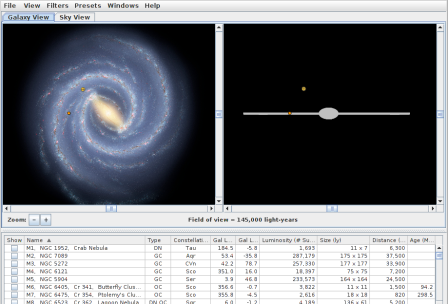
    Distro Astro is a Linux distribution based on Ubuntu/Linux Mint which aims to cover the requirements of astronomers and astronomy enthusiasts.

    The project has announced the release of version 1.0.2 of its distribution, codenamed Ceres.

    Distro Astro has features for almost all astronomy uses — from observatories, planetariums – and for all users from professional researchers to astro-photographers and amateur enthusiasts; and that’s why it’s called Linux for Astronomers. The project’s website has a full review of Distro Astro’s features.

    Distro Astro’s ISO (size: 1.9 GB) can be downloaded from South Common Observatory in East Sussex.

    screenshot of program running on Distro Astro

Posts navigation