English usage

  • BBC employs greengrocers

    The BBC – and Radio 4 in particular – is often criticised for being the voice of middle England speaking to itself.

    However, it seems that Auntie is now making great strides to improve the diversity of its staff, as shown by the Tweet below, which was posted during last night’s broadcast of Any Questions.

    Yes, Radio 4 is now employing greengrocers (shouldn’t that be greengrocer’s? Ed. 🙂 ), or at least people who know how to use superfluous (or greengrocers’) apostrophes.

  • Political proofreading failure

    Below is a picture of part of an actual election leaflet delivered recently to somewhere in South Bristol by the local Liberal Democrats.

    Lib Dem leaflet with the wording Anywhere Council
    Is it a three horse race too, Lib Dems?

    Note that local party hacks have omitted to change this generic national leaflet’s wording from ‘Anywhere Council’ to the name of the relevant local authority.

    I for one would like to wish the candidate involved – [Insert Name Here] – every success.

    Hat tip: Bristol Red.

  • The importance of the space bar and proofreading

    The Wig and Pen public house in Truro, Cornwall had some unexpected publicity earlier this week when a badly temporary temporary sign was snapped by an amused regular before being hurriedly removed by embarrassed staff, according to yesterday’s Western Daily Press.

    By the time the sign came down, its fame had spread round the world by social media; and it’s easy to see why.

    sign saying The Wig & Penis Is Open For Business

    However, according to the Western Daily Press article, the sign itself was not the only linguistic clanger involved in the episode:

    But a remember [sic] of staff named Georgie-Tim later took to Twitter to say: “Well, it got you’re attention!

  • Big Retail is watching you

    Cabot Circus is hardly my favourite place in Bristol. It’s an out-of-town shopping centre with associated multi-storey car park plonked at the inner city end of the M32. It consists of 3 floors full of identikit national chain stores, plus CCTV and surly security guards to track and/or keep out those who have no intention of buying overpriced, mass-produced consumer tat they probably don’t want, definitely don’t need and most likely cannot really afford.

    Today I noticed another reason for avoiding Cabot Circus – mobile phone surveillance.

    image of notice at Cabot Circus
    Warning! Big Retail is watching you.

    Note the exemplary use of newspeak: spying on your mobile is “in use at this site to improve our customer service“.

    I’m not convinced by the bland assurance regarding personal data either, as will be explained below.

    The Footpath technology in use in Cabot Circus has been developed by a company called Path Intelligence and is in use in a number of shopping centres around the UK, including Gunwharf Quays in Portsmouth, Princesshay in Exeter, the Buchanan Galleries in Glasgow, Bon Accord & St Nicholas in Aberdeen and The Centre, Livingston, all of which like Cabot Circus are operated by Land Securities Ltd. The surveillance system works through units placed in shops which detect the changing signals of mobile phones.

    Unless people entering the shopping centre happen to see the warning signs (which are conveniently placed alongside lots of others telling the public what they’re not allowed to do, such as use skateboard, take photographs. Ed.) they’re probably unaware that their phones are being monitored.

    According to Path Intelligence
    , the Footpath technology works as follows:

    The vast majority of visitors to any given location now carry a mobile (cell) phone. To be able to make and receive calls, the telephone network must understand the phone’s geographical location. The technology behind this is complicated, but in basic terms, the phone and the network continuously ‘talk’ (ping) to each other (sending a unique signal), sending and updating information every time the location of the phone changes.

    Footpath technology from Path Intelligence consists of discreet monitoring units able to read the anonymous signals that all mobile phones send. So we’re able to ‘see’ where the phone is (but not the data on it) and map its geographic movements from location to location accurately to within a few meters [sic]. In isolation the information isn’t very revealing but when aggregated, patterns and trends start to emerge. It’s those patterns and trends that are of interest in business planning.

    The data collected is fed back to our data centers [sic] 24 hours a day, seven days a week, to be audited and have sophisticated statistical analysis applied. This results in continuously updated information on the flow of people in any monitored location.

    As no source code is available for Footpath, no check can be made on its lack of ability to collect personal data or telephone numbers.

    Concerns were expressed by Big Brother Watch about the tracking of shoppers’ mobiles 2 years ago.

    At present the technology is not capable of recording phone numbers or personal information, but this will probably change as the system improves and as highlighted by Big Brother Watch:

    However, as technology improves, those facilities will become more accessible, and consumers need to have faith that the law protects their privacy. Uncertainty over when and how technology is being used only undermines trust and confidence in any system using mobile phones.

    To avoid being tracked, turn off your mobile when visiting Cabot Circus or any other shopping centre operated by Land Securities.

  • Crash course in language

    Have you ever noticed the language used when road traffic incidents are reported?

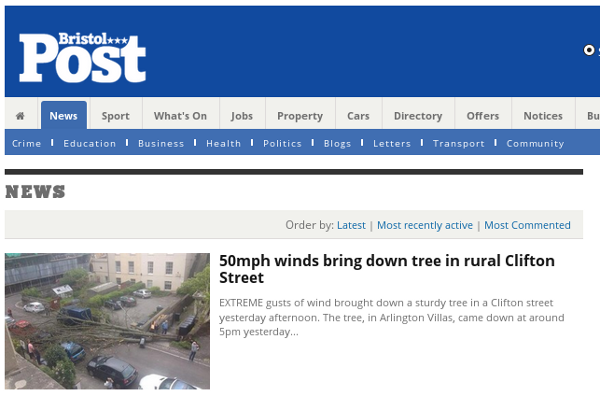
    As a typical example, look at this story from Wednesday’s Bristol Post.

    The headline reads:

    Man taken to hospital after his car collided with road sign in Avonmouth

    The first sentence outlines how the incident occurred:

    A man in his 40s had to be removed on a spinal board after his car collided with a road sign in Avonmouth.

    Note how the car’s occupant – presumably its driver – plays a passive role; the car apparently collided with a road sign of its own volition without any human intervention. One would almost think that cars and other motor vehicles are so capricious and flighty that conscious action by human beings is imperative to stop the public highway becoming a large linear scrapyard in next to no time and remaining such permanently.

    Perhaps a more accurate headline would have been Man taken to hospital after driving into road sign.

    Similar examples of this use of English can be found in any local paper in the country.

    However, such language is not confined to the print media. An similar example from inside the BBC in Bristol was posted on Twitter this morning (screenshot below).

    tweet screenshot

    Note the absence of any human involvement in the incident: a horse was killed by a fast car. Was it an unoccupied, autonomous vehicle? A more accurate rendition would be that a horse was killed by a fast driver.

    Then there’s the way large swathes of the media report collisions using the noun accident to describe them. In the vast majority of cases, there’s nothing accidental about them. According to RoSPA, 95% of all road ‘accidents’ involve some human error, whilst a human is solely to blame in 76% of road ‘accidents’.

    According to the Collins English Dictionary, accident has the following definitions:

    an unforeseen event or one without an apparent cause
    anything that occurs unintentionally or by chance; chance; fortune
    a misfortune or mishap, esp one causing injury or death

    It would seem that the third definition is the one relied upon by the media. Interestingly, the British police stopped using the term Road Traffic Accident (RTA) some years ago; the police now refer to a Road Traffic Incident (RTI) instead.

    Perhaps the media should follow the example of the police if they wish to retain their alleged reputation for truth and accuracy.

  • Virtute et Industrial

    The motto of the city of Bristol is Virtute et Industria (Virtue and Industry).

    However, one feature of Bristol’s local dialect is the addition of a final, intrusive ‘L’ – a so-called terminal L – to words ending in a vowel.

    Consequently, area, say, becomes ‘areal‘, whilst Clifton’s Princess Victoria Street mutates into Princess Victorial Street, so Industria naturally becomes Industrial.

    The terminal L is beautifully illustrated in Virtute et Industrial, a song written by Adge Cutler (posts passim), and sung here by the late Fred Wedlock.

  • Thee’s got’n where thee cassn’t back’n hassn’t?

    As with elsewhere in the country, the Bristolian dialect is not as strong as it once was, mainly due to the influence of mass media and the spread of received pronunciation.

    Here from a few years ago is a fine example of the local dialect delivered in song by Adge Cutler & the Wurzels many years ago at the Webbington Country Club, Loxton, Somerset.

    Adge was born in Long Ashton, just outside Bristol.

    Hat tip: Patrick Wise.

  • Parking meters arrive in Easton

    On 1st April – April Fool’s Day – Bristol City Council’s Easton & St Philips Residents’ Parking Scheme comes into operation. (Some would consider the choice of date most apposite. Ed.)

    road sign announcing works for Easton RPZ
    Does Easton have one resident? Do you proof-read your signs, Bristol City Council?
    This is just one of many Residents’ parking schemes being introduced by the council at the instigation of the autocratic elected Mayor, George Ferguson, the man in red trousers (posts passim).

    Needless to say, the schemes haven’t exactly received universal support from the residents of a city with a high level of car ownership and an abysmal level of public transport provision. Overall, it’s been condemned by residents as a ‘parking tax’ as residents will have to acquire permits, both for their own vehicles, as well as for visitors arriving by motor vehicle.

    There has been consultation, of course. However, as is usual with Bristol City Council, consultation is a portmanteau word, a crafty elision of ‘confidence trick’ and ‘insult’. With a city council consultation, the stress is always firmly on the first syllable. When something goes out to consultation, what the council wants to do is usually a fait accompli.

    There have been howls of protest about the Residents’ Parking Schemes in the local press, particularly the car-loving Bristol Post, which has even enlisted the odd high-profile petrolhead to trash the Mayor’s plans.

    image of parking meter on Stapleton Road
    A new parking meter on Stapleton Road
    As this post is being written, the streets of Easton are being prepared for the arrival of the new parking regime. New double yellow lines and parking bays marked on the streets. In addition, there’ll be parking charges for visitors and parking meters have started to make their appearance both on main thoroughfares like Stapleton Road and the backstreets.

    Bristol’s residents’ parking schemes programme is very flawed.

    One of the justifications for implementing them is to dissuade the thousands of daily commuters from outside the local authority area clogging up residential roads by parking there all day. As the scheme doesn’t cover the whole city, the thousands of commuting motorists will just park a bit further out in districts not covered by residents’ parking schemes, such as the area where your ‘umble scribe happens to live.

    Where I live, it’s the residents that are guilty of problem parking; the streets are Victorian, narrow and were intended for use by horse and cart, not 21st century motor vehicles. Pavement parking is rife in the backstreets, making pavements impassable to wheelchair users and parents with children in prams and pushchairs. There’s minimal enforcement to combat such anti-social parking. Indeed, the police often contribute to the problem themselves (posts passim).

    If Mayor Ferguson really wanted to stop Bristol being choked by out of town commuting motorists, his counterpart in London came up with an alternative that was introduced 11 years ago. It’s called the London Congestion Charge Zone.

  • Sausages!

    pack shot of sausagesToday for breakfast I indulged in some sausages; not just any sausages, but Sainbury’s Outdoor Bred Pork Sausages. They were delicious and disappeared off the plate in double-quick time.

    However, there was one thing that stuck in my throat: the product name.

    Can inanimate objects – even ones made of once living matter – breed?

    If so, I should congratulate Sainbury’s on this fine achievement in the field of al fresco coitus? If not, should I condemn their marketing department for coming up with an idiotic product name that’s a complete physical impossibility?

    Digging further into this term, it is apparent that Sainsbury’s are not the only sinners here, as a quick image search for “outdoor bred” sausages will reveal. Moreover, if I had my way, Tesco, Waitrose, Rankin, Morrison’s, Marks & Spencer, Asda and many more suppliers should all be standing in the corner of the room with Sainsbury’s trying on the dunce’s hat for size. 🙂

    Nevertheless, my suggesting that all these corporate grocers are a bunch of illiterates is perhaps being a bit hasty and an over-reaction. Time for some final research.

    Consulting the Good Housekeeping Institute’s site, I find that outdoor bred actually has a specific meaning in food labelling terms, as follows:

    As with Outdoor Reared, this tends to apply to pork and means the pigs are born outside. However, after a few weeks they’re brought inside for fattening.

    So, outdoor bred is a proper food labelling term, although I do wish people would think more clearly about the connotations of naming products.

Posts navigation