-
-
PCC candidate queries paltry interpreting bill
This May sees a whole slew of elections to local councils, the Welsh Assembly, Scottish Parliament and last but not least, 41 local Police & Crime Commissioners (PCCs).
 As regards the election of the PCC for Gloucestershire, Will Windsor-Clive, the Conservative candidate, has decided to play the bigotry and xenophobia card early. He’s doing so by questioning the £100,000 the force spends annually on interpreters, having filed a Freedom of Information Act request on the subject, the Western Daily Press reports.
The paper reports the overall costs have remained around £100,000 a year over the three years between 2011 and 2014.
In a quote for the paper, Mr Windsor-Clive is reported to have commented: “This is an unseen cost of high levels of immigration. Taxpayers quite rightly want their money spent on keeping their community safe, not on providing translating services. I’m determined to find ways of cutting back-office costs to spend on frontline policing and this is one area that needs investigating.”
Here are a number of questions electors (and others) should ask Mr Windsor-Clive.
1. Is it right to whip up bigotry and xenophobia for electoral gain?
2. Does Mr Windsor-Clive regard the rule of law and the administration of justice as priceless commodities in a civilised society?
3. If the answer to 2. above is yes, wouldn’t any reasonable person regard £100,000 a reasonable price to pay to enable the full participation of both victims and accused persons who don’t speak English proficiently in the enforcement of the rule of law and the administration of justice?
4. If Mr Windsor-Clive were to fall foul of the police in a foreign country whose language he did not speak, would he be content to forego the services of an interpreter, as he obviously wants to do in Gloucestershire?
-
Why pick on Muslim women, Mr Cameron?
Earlier this morning a man doing Prime Minister impressions appeared on the BBC’s Today programme to explain why Muslim women should be encouraged to learn English.
That person – a man called Cameron – is reported by the press to be advocating such an idea to “combat radicalisation“.

At the same time, this Prime Minister impersonator announced £20 mn. additional funding to teach Muslim women English, an initiative that applies a sticking plaster to the massive wounds inflicted to English language teaching by his governments since 2010. The most recent of these cuts was last July, involving a £45 mn. scheme that taught English to 47,000 foreigners.
Whilst I would concur that parents with a poor command of English in this country would place them at a disadvantage when it came to understanding the influences on their children, why are Muslim women being singled out for special treatment? After all, there are plenty of women of other religions – and none – with poor English skills.
Journalist Fleet Street Fox of the Mirror has labelled Cameron’s announcement as “breathtakingly cretinous“, in addition to which he’s come under fire from his own ranks, including via social media from a former Minister, Sayeeda Warsi.
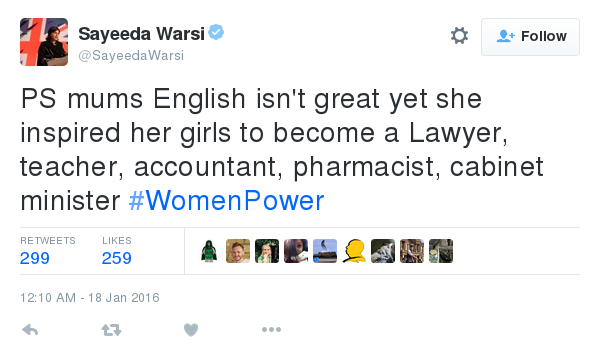
Furthermore, Cameron’s pronouncement has been roundly condemned by the Ramadhan Foundation whose Chief Executive Mohammed Shafiq commented as follows earlier today:
The Prime Minister David Cameron and his Conservative Government are once again using British Muslims as a political football to score cheap points to appear tough. There are three million Muslims in this country and the Prime Minister chooses to focus on a very small minority of extremists when clearly the majority of British Muslims reject extremism.
The Ramadhan Foundation has been clear for many years that we face an increased risk from terrorism and an ideology of hatred, the best way to confront it is to build support within Muslims and support the work done across the country and not lashing out and denigrating Muslims.
The irony of the Prime Minister calling for more resources to help migrants learn English when his Government cut the funding for English classes in 2011 has not been lost on many people.
This was a right wing, neo con Prime Minister delivering more of the same disgraceful stereotyping of British Muslims rather than focusing on the positive contribution of our faith and community he focuses on the extreme minority of issues which clearly is not representative.
Many in the British Muslim community will reject this neo con agenda and continue our work in confronting extremism and terrorism without the support of the Conservative Government.
-
2016 – the greenwash continues
Bristol’s wasted year as European Green Capital (posts passim) may be over, but the greenwash* continues, as shown by the advertising hoarding below by the side of the A4032 Easton Way, a dual carriageway blasted through this inner-city community in the late 1960s or early 1970s to speed motorists from one jam to another. To be more specific, the hoarding itself is conveniently situated next to the traffic lights by the Stapleton Road bus gate, where bored commuters can gawp at it waiting for the lights to change as they suffocate in their own traffic fumes and poison the rest of us.

Picture credit: StapletonRd As can be seen from the photo, at least one local hasn’t fallen for the greenwash and has said so, pinpointing the source as the trousers of Bristol’s elected mayor. 🙂
The mayor – and the local authority he runs – had an ideal opportunity during Green Capital Year to tackle some of Bristol’s endemic problems, such as the chronic over-reliance on the motor car, abysmal public transport and the unending stream of litter and fly-tipping blighting the inner city, but decided to do very little on these matters, preferring instead to spend money on pointless art projects and mutual back-slapping events for the great and good.
* Greenwash (n.), a superficial or insincere display of concern for the environment that is shown by an organisation.
-
Happy 15th birthday, Wikipedia
 This week, Wikipedia reaches its fifteenth birthday.
 These days the free online encyclopaedia is the world’s seventh most popular website and now includes more than 38 million articles in 289 languages, all maintained by an army of volunteer editors and contributors.
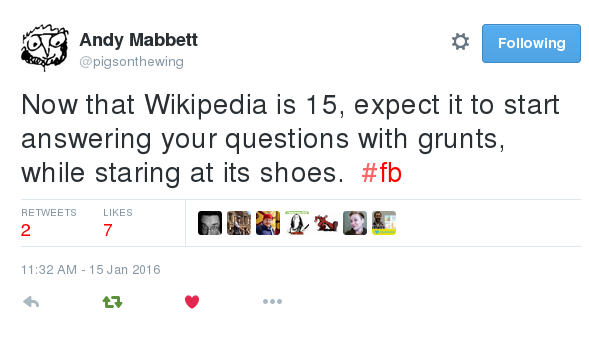
Andy Mabbett, one of that army of editors and contributors, has been musing on Twitter as to how Wikipedia will react having reached this chronological milestone.
Over the last 15 years, although the project was originally initiated by Anglophone geeks, Wikipedia has been working to increase the diversity of its content and contributors through outreach programmes such as edit-a-thons at universities and museums and by trying to appoint more women administrators. However, there is still plenty of work to be done in this field.
The Wikipedia website and the open source Mediawiki software it runs on are managed by the Wikimedia Foundation charity, which is funded by donations, the vast majority of them from small donors.
To mark Wikipedia’s 15th birthday the Foundation has created an endowment fund that it hopes will raise $100 mn. over the next 10 years.
Happy birthday, Wikipedia – and may you enjoy many, many more.
-
Rustic riposte
Only a couple of days after hearing of the creation of a giant statue of Mao Zedong (posts passim), reports have been received that the statue of the so-called Great Helmsman in Henan province has been destroyed.
Pictures such as the one below have been posted on Chinese social media.

The statue’s hands, legs and feet appear to have been hacked off and a black cloth draped over its head.
According to an unnamed local delivery driver, it was destroyed because it had occupied a farmer’s land.
This destruction brings to mind the traditional farmer’s challenge to trespassers: “Get off my land!” 🙂
Another reason for the destruction could be that Henan province was one of the regions worst hit by China’s great famine, a catastrophe that claimed tens of millions of lives that was caused by Mao’s disastrous “Great Leap Forward” – a bid for rapid industrialisation.
The official Chinese line is that the statue had not gone through the correct approval process before construction, according to The People’s Daily.
-
Chinese village creates a modern Ozymandias?
News emerged today in the British national press of a 36-metre tall statue of the late Chinese leader Mao Zedong being built in a village in China. Here’s The Guardian’s report of this story as an example.
The statue of the so-called “Great Helmsman” is being constructed at Zhushigang village in Tongxu County in Henan Province.
It is reported to be costing some RMB 3 mn. (approx. £312,000). The materials used in its construction are steel and concrete, with the exterior being coated in gold paint.

History is looking on your works and despairing, Mao! Photo: CFP Reading about the statue and thinking about its future, not to mention what has happened to statues of past powerful leaders (particularly dictators. Ed.) around the world, Percy Bysshe Shelley‘s 1818 sonnet, Ozymandias came to mind.
I met a traveller from an antique land,
Who said—”Two vast and trunkless legs of stone
Stand in the desert. . . . Near them, on the sand,
Half sunk a shattered visage lies, whose frown,
And wrinkled lip, and sneer of cold command,
Tell that its sculptor well those passions read
Which yet survive, stamped on these lifeless things,
The hand that mocked them, and the heart that fed;
And on the pedestal, these words appear:
My name is Ozymandias, King of Kings;
Look on my Works, ye Mighty, and despair!
Nothing beside remains. Round the decay
Of that colossal Wreck, boundless and bare
The lone and level sands stretch far away.”In antiquity, Ozymandias was a Greek name for the ancient Egyptian pharaoh Ramesses II. Shelley began writing Ozymandias soon after the announcement of the British Museum’s acquisition of a large fragment of a statue of Ramesses II from the thirteenth century BC, leading some scholars to believe that this had inspired Shelley.
In more modern times, Mao’s record is chequered. His supporters credit him with driving imperialism out of China, modernising the country and building it into a world power, promoting the status of women, improving education and health care, as well as increasing life expectancy as China’s population grew from around 550 million to over 900 million during his leadership. Mao is also known as a theorist, military strategist, poet and visionary.
On the other hand, his critics consider him a dictator comparable to both Hitler and Stalin who severely damaged traditional Chinese culture, as well as being a perpetrator of systematic human rights abuses who was responsible for an estimated 40 to 70 million deaths through starvation, forced labour and executions.
Look upon my works and despair indeed!
-
Home Office defers plans to cut interpreters’ pay
Today’s Guardian reports that the Home Office has postponed its plans to cut the pay of more than 2,000 interpreters from 1st January 2016. This comes in the wake of a threatened boycott from Home Office interpreters (posts passim), which could cause chaos in the running of the UK’s immigration system.
According to The Guardian, the Home Office has confirmed that any plans to cut pay will be deferred at least until February while negotiations with the interpreters take place. Considering that Home Office interpreters have not had a pay rise since 2002 (they get a basic £16/hr. on weekdays and slightly more at weekends. Ed.) and the Home Office’s desire to cut what is already fairly meagre pay do not bode well for those negotiations.
A meeting lasting more than two hours took place between interpreters and the Home Office on 21st December. At the meeting, Home Office civil servants warned the interpreters against speaking to the media in a blatant disregard of the interpreters’ rights under Article 10 of the Human Rights Act 1998. A further meeting between the Home Office and interpreters is planned for the middle of January.
The Home Office stated as follows after the 21st December meeting: “Following our meeting with the interpreters on 21st December, we intend to defer implementation of this change at least until 1st February 2016 to allow us time to give proper considerations to the views and opinions expressed.”
Given the government’s arrogant refusal to listen to anyone besides its donors and beneficiaries, it looks like the next linguistic sacrifices on Whitehall’s altar of austerity will be Home Office interpreters, following on from the Ministry of Justice’s interpreters, the overwhelming majority of whom refused to work for the abysmal rates offered by Capita Translation & Interpreting (posts passim) and have been boycotting court and tribunal work for the last couple of years.
-
An Easter egg at Christmas
Now that Christmas is just about out of the way for another year, the great speculation amongst Britain’s shoppers will be how soon into the New Year will Easter eggs appear on supermarket shelves. The customary 3 months as with all that Christmas tat? We’ll just have to wait and see.
As a user of free and open source software, I’ve had an early – or late – Easter egg already courtesy of the VLC media player, as shown below.

VLC media player wearing its Christmas hat Unless you’re familiar with the language of tech aficionados, the previous statement and accompanying screenshot are probably incomprehensible.
In software an Easter egg is defined as “an intentional inside joke, hidden message, or feature in an interactive work such as a computer program, video game or DVD menu screen. The name has been said to evoke the idea of a traditional Easter egg hunt“.
One of the first occurrences of what are now known as Easter eggs appeared in the Atari video game Adventure, having been planted there by computer game developer Warren Robinett. It wasn’t too fancy or interesting, just a hidden object planted in the game that led to a screen that said “Created by Warren Robinett.” The developer had buried this object within the game code as Atari didn’t credit its games developers at the time.
Anyway, returning to the screenshot above, the Santa hat on the VLC program logo (the traffic cone in the middle of the window. Ed.) appears each year for the Christmas holiday period only; for the rest of the year, the logo is hatless.
Besides VLC, some well-known and widely used applications have also contained Easter eggs. For instance, Easter eggs in the 1997 version of Microsoft Office include a hidden flight simulator in Microsoft Excel and a pinball game in Microsoft Word, whilst on all Microsoft Windows operating systems before XP, entering the text “volcano” in the 3D Text screen saver will display the names of all the volcanoes in the United States. Microsoft removed this Easter egg in XP but added others. Microsoft Excel 95 contained a hidden Doom-like action game called The Hall of Tortured Souls.
Turning away from Microsoft, Apple is also not immune from Easter eggs. In 2012 an update to the Mac App Store for OS X Mountain Lion introduced an Easter egg in which apps, during the download process, were timestamped “January 24, 1984,” the date the original Macintosh went on sale. However, Easter eggs were not popular with Apple’s founder, the late Steve Jobs, who went through bouts of banning them.
In addition to being sophisticated and/or laden with deep significance, some Easter eggs can be very simple and bereft of any meaning, merely reflecting the playful personality of their creators. Here’s a prime example from the GNU/Linux apt-get command line tool used for managing software packages. Typing the command apt-get moo results in something similar to the following screenshot.

The output of typing the command apt-get moo in the Linux terminal Anyway, I’m enjoying my festive Easter egg and I hope it’s not too late to wish all readers and visitors to this site the compliments of the season.
-
PI4J writes to Home Office on reduced interpreter pay rates
 Professional Interpreters for Justice (PI4J), the umbrella group representing over 2,200 NRPSI registered and qualified interpreters working in 135 languages, has written to the Home Office’s Central Interpreters Unit in Liverpool regarding the proposed pay cut for Home Office interpreters which is due to come into effect on 1st January 2016 (posts passim).
The text of PI4J’s letter is reproduced below.
Central Interpreters Unit
Interpreter Operations Unit
UK Visas & Immigration
The Capital
New Hall Place
Liverpool
L3 9PPBy Email: CIU@homeoffice.gsi.gov.uk
21 December 2015
Dear Sir/Madam,
Re: Introduction of reduced rates of Home Office interpreters’ pay from 1st January 2016
Professional Interpreters for Justice (PI4J) is an umbrella group representing over 2,240 interpreters
from both the National Register of Public Service Interpreters (NRPSI) and the National Union of British Sign Language Interpreters (NUBSLI). Our aim is to work with government to ensure the quality of interpreting available to the Justice System and in the Public Sector.Reliable communication provided by qualified professional interpreters and translators is an essential resource which ensures that justice and human rights are upheld for non-English speakers and deaf people. This is put at risk if standards are dropped and quality is sacrificed.
On 20th November 2015 interpreters received a notice regarding a reduction in rates to due to take place on all bookings undertaken on behalf of the Home Office (HO), including UK Visas & Immigration, Border Force, Immigration Enforcement and HM Passport Office and any other bookings made through Interpreter Operations Unit, from 1st January 2016 onwards.
PI4J is extremely concerned about this decision to slash interpreters’ rates of pay, without any
consultation with or input from interpreters and their representative bodies.This decision will most certainly have serious implications for the supply of competent, qualified professional interpreters to the Home Office. These interpreters have provided ongoing linguistic support and expertise to the Home Office over the years, including in many rare and hard-to-find languages.
Interpreters have demonstrated in the last four years that they can and will refuse to work for low rates set by so-called ‘market forces’, thereby significantly reducing the pool of qualified interpreters and translators available to work in the public services.
This is evidenced by the detrimental decline within the Ministry of Justice’s Court Interpreting Service since they outsourced to a private agency in 2012. We assume that you are aware of the extensive coverage in the media regarding the subsequent disruption and chaos visited upon the courts and the delays and collapse of court cases, resulting in an enormous waste of time and money and two Parliamentary hearings (see below links).
PI4J has been at the forefront of the professional interpreters’ campaign against the unacceptable lowering of standards and quality in public service.
The standard of interpretation is fundamental to allow access to a fair hearing and justice for vulnerable minorities in the asylum and immigration system and to assist enforcement agencies in the prevention and detection of serious crime. They must be afforded equal access to the highest levels of linguistic support.
Standards must include minimum professional qualifications for Public Service Interpreters (PSI) and BSL/English Interpreters, Deaf interpreters and Sign Language translators, to include mandatory NRPSI/NRCPD/SASLI registration and independent regulation.
Without these safeguards, access to justice will be denied and human rights and race relations will be jeopardised.
In addition, we reiterate that in order to attract and retain qualified and experienced professional interpreters and language professionals, equitable and sustainable terms and conditions need to be put in place.
Professional interpreters invest substantial time, effort and money to gain and maintain their skills. The proposed cut means that Home Office interpreting work will become part of the low-paying industries.
It is important to point out that there has not been an increase in the Home Office interpreting rates for many years now. They were further eroded by inflation and the growing cost of living in the UK, especially in areas such as London. In addition, failure to provide reimbursement for travel time under 3 hours each way and travel expenses up to 100 miles, particularly in view of the remote locations of many of the Home Office and detainee centres, make the rates even more unattractive.
Remuneration must reflect the fact that these are gross hourly rates for self-employed interpreters, liable to pay Income Tax and National Insurance, who have no pension, holiday or sick pay, and no job security.
The impact of the cuts places interpreters’ livelihoods at risk and will mean that public service interpreting will no longer be a viable career. As skilled professionals they will seek to earn a better living in other sectors.
This in turn will result in reduced quality of language services and a back-log to a system which is already struggling.
Full support of professional interpreters and appropriate terms & conditions is the only way forward to ensure the quality and success of any future arrangements for the provision of language services in the public service sectors and to avoid a market exit.
In the interest of all involved and the system itself, we urge you to reconsider this troubling and counterproductive decision.
Yours faithfully,
Klasiena Slaney
For and on behalf of the Professional Interpreters for JusticeProfessional Interpreters for Justice (PI4J) Member Organisations:
Association of Police and Court Interpreters (APCI) – chairman@apciinterpreters.org.uk
Cymdeithas Cyfieithwyr Cymru; (CCC) – geraint@cyfieithwyrcymru.org.uk
Institute of Translation and Interpreting (ITI) – chiefexec@iti.org.uk
National Register of Public Service Interpreters (NRPSI) – chairman@nrpsi.org.uk
National Union of Professional Interpreters and Translators, part of Unite the Union (NUPIT)
– nupit@unitetheunion.org
National Union of British Sign Language Interpreters part of Unite the Union (NUBSLI)
– branchsecretary@nubsli.com
Society of Official Metropolitan Interpreters UK Ltd (SOMI) – board@somiukltd.com
The Chartered Institute of Linguists (CIOL) – keith.moffitt@ciol.org.ukLinks:
Professional Interpreters for Justice (PI4J), includes links to Parliamentary hearings and dossiers of failings
RPSI Linguist Lounge and Professional Interpreters’ Alliance, collected news reports about the outsourcing of public service interpreting in the UK
National Register of Public Service Interpreters (NRPSI)
National Registers of Communication Professionals working with Deaf and Deafblind People (NRCPD)
Scottish body for training and qualifying British Sign Language interpreters (SASLI)
National Union of British Sign Language Interpreters (NUBSLI)