Bristol

  • Plain talk about plane trees

    The Bristol Post is not particularly renowned for the quality of its journalism.

    This point of view was borne out by its report today on public works in Weston-super Mare, which features the following paragraph:

    The species to be planted include silver birch, hazel, Scots pine, Himalayan plain, London plain and common alder. Work on removing the trees is due to start this week.

    Himalayan plain? London plain? The Post should be sent to sit in shame in homophone corner until it learns the difference between a plain tree and a plane tree and promises not to make such elementary sub-editing errors in future.

    However, the Post is not only guilty of falling victim to homophony and failing to do a bit of basic sub-editing. Indeed it is also guilty of churnalism – “a form of journalism in which press releases, wire stories and other forms of pre-packaged material are used to create articles in newspapers and other news media in order to meet increasing pressures of time and cost without undertaking further research or checking”.

    Checking back on the source of the story in question, one arrives at a North Somerset Council news item of 20th February 2013, where – lo and behold – the following sentence appears:

    The species to be planted include silver birch, hazel, Scots pine, Himalayan plain, London plain and common alder.

    Thus the anonymous Post hack quoted initially has merely repeated the error of the original author of the news in North Somerset.

    This blog has pointed out before that North Somerset is a strange place (posts passim), but having an illiterate write news on the council website is just plain perverse.

  • North Somerset crime special

    image of Dixon of Dock Green
    Crime has certainly changed since the heyday of the fictional Sgt. Dixon
    As this blog has previously noted (posts passim), from the author’s lofty perch in Bristol, North Somerset is a part of the UK that seems to live in an alternative reality (could this have something to do with the consumption of cider? Ed.).

    Today’s Bristol Post carries a report of a crime in Yatton that is so heinous, it has been reproduced in full below:

    Police want to talk to two drivers who got involved in a road rage incident in Yatton.

    At around 8am on Tuesday, January 29, two vehicles were travelling in opposite directions on Mendip Road.

    One of the vehicles used Mendip Gardens to turn around and pulled out into the path of the other car.

    There was a disagreement between the drivers which resulted in the car horns being sounded.

    The car which had turned around then stopped just past the junction with Chescombe Gardens.

    The drivers of the vehicles, or anyone who witnessed the incident, should contact DC Nicholas Riley at Weston-super-Mare Police Station on 101.

    As you can see, Avon & Somerset Constabulary consider this crime so serious they have assigned a detective constable to pursuing the malefactors.

    Presumably Mr Plod is keen to apprehend the villains in question as sounding one’s horn when stationary is an offence.

    Notwithstanding that, one could legitimately ask which is the greater crime: two irate petrolheads making idiots of themselves or the waste of police time and resources involved in its investigation?

    Answers in the comments below please!

  • 3D printing for students – a first for UWE

    Bristol’s University of the West of England announced yesterday that it is leading the way amongst UK universities by making 3D printing technology available to all students (and staff. Ed.) by locating a 3D printer in the main university library.

    It is believed to be the first 3D printer in a UK academic library. The new initiative is made possible through a machine donation from 3D Systems Ltd.

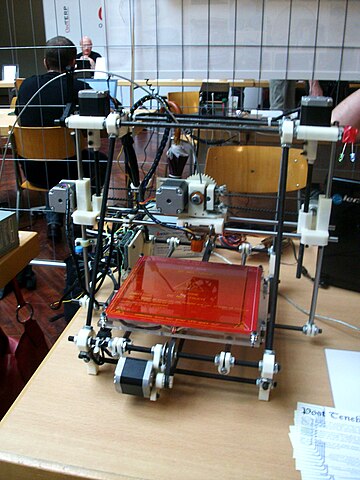
    image of 3D printer during the Rencontres mondiales du logiciel libre 2012, Geneva. Image courtesy of Wikimedia Commons.
    3D printer during the Rencontres mondiales du logiciel libre 2012, Geneva. Image courtesy of Wikimedia Commons.

    3D print technology, also known as additive layer manufacturing, is a rapidly developing technology with applications in manufacturing, engineering and academic research. It is sometimes available to university students on relevant courses – such as creative product design or engineering courses. For example UWE Bristol already has 3D printers within the Faculty of Technology and in the leading Centre for Fine Print Research.

    The machine, a triple head smoked 3DTouch, will be situated in the main library on the Frenchay Campus, where it will be available for all students and staff to use. During term time the UWE library has over 2,000 users per day.

    This new initiative will enable students to engage with the latest 3D print technology and develop their understanding of how it can be used in different subject areas. Students will be able to ‘draw’ their design in a 3D CAD package. The file will then converted through a process that will make it readable by the 3DTouch printer using free downloadable Axon software. When it is printing the 3DTouch print head moves back and forward, building up layers of thermoplastic polymer, as it prints the 3D object layer-by-layer.

    Andrew Bathchelor, UWE Senior lecturer in Product Design, says, “This initiative offers a valuable new resource for students. By linking with Bits from Bytes we are able to bring the concept of 3D printing to all students. Many of our Creative Product Design, Engineering and Fine Art Students, are already familiar with this technology, and use it within their academic work in their own departments. However, by offering this to the wider student body, we hope to stimulate usage of this technology and help students develop their understanding of how it can be applied. We hope students will come up with interesting applications, relevant to their subject. For example our students who are training to be teachers can familiarise themselves with technology that their pupils may have access to in the future. In addition Architecture and Planning students may choose to use the technology to ‘print’ out models for project work. We are sure UWE students will be inventive once they begin to see the possibilities of this technology. The 3DTouch will enhance the extensive range of resources we offer to students though UWE’s library service.”

  • Snow in Bristol

    A snowflake under the microscope
    A snowflake under the microscope. Picture courtesy of Wikimedia Commons.
    It snowed in Bristol yesterday, as it did over a large part of the UK. No more than 2-3 inches of the frozen white stuff caused complete chaos with bus services withdrawn, schools closed and similar over-reactions. A friend called me yesterday afternoon: he works in Geneva and told me that several times that amount – nearly 2 feet in fact – fell there on Tuesday afternoon and life continued as normal.

    When snow settles in the Bristol area, it does something unique that’s not repeated elsewhere in the country or in the English-speaking world (to the best of my knowledge. Ed.): it pitches. When it’s snowing, Bristolians have been known to confuse people from elsewhere simply by asking, “Is it pitching?”

    Chambers 21st Century Dictionary defines the verb to pitch as follows:

    pitch verb (pitches, pitched, pitching) 1 to set up (a tent or camp). 2 to throw or fling. 3 tr & intr to fall or make someone or something fall heavily forward. 4 intrans said of a ship: to plunge and lift alternately at bow and stern. 5 tr & intr said of a roof: to slope • is pitched at a steep angle. 6 to give a particular musical pitch to (one’s voice or a note) in singing or playing, or to set (a song, etc.) at a higher or lower level within a possible range • The tune is pitched too high for me. 7 to choose a level, e.g. of difficulty, sophistication, etc. at which to present (a talk, etc.) • was pitched too low for this audience. 8 a cricket to bowl (the ball) so that it lands where the batsman can hit it; b golf to hit (the ball) high and gently, so that it stays where it is on landing; c tr & intr, baseball said of the pitcher (sense 1): to throw the ball overarm or underarm to the person batting. 9 to pave (a road) with stones set on end or on edge.

    Out of these possible definitions, from whence could this bit of Bristolian dialect come? Sense 9 above, i.e. paving in the sense of covering something over, seems a strong possibility.

    In addition, users of the WordReference Forum have also discussed what snow does when it settles, including pitching in Bristol. In this thread, one user, Loob, suggests that Bristol’s pitching could have originated from Somerset since Somerset dialect for to lie is to pitch.

    Pitch itself comes from the 13th century Middle English verb picchen, meaning to throw or put up.

    One final point: whatever snow does where you are – pitch, settle,lie or anything else – don’t forget to let your inner child enjoy it!

  • Are social media destroying the rest of the internet?

    That was one question discussed yesterday evening over a couple of pints of Cotswold Spring’s Stunner ale in Bristol’s Seven Stars pub with a couple of friends from the Easton Cowboys. More specifically, it the question could be rephrased as: are the likes of Facebook and Twitter pulling in so much traffic that they detract from everyone else’s content?

    Two of us run websites, so the matter is quite pertinent and can be broken down into a couple of simple aspects.

    Firstly, some people thank that if they just post on their organisation’s Facebook wall, everyone in that organisation will see it. They are, of course, mistaken. Some people avoid Facebook for privacy reasons, in addition to which Facebook’s APIs are so obscure, it’s difficult for an organisation’s webmaster to scrape content from Facebook and place it on the organisation’s website.

    Turning to Twitter, is the ubiquitous 140 character tweet replacing proper debate on blogs? We noted that if one blogs and tweets a link to the post, feedback is more likely these days to come via tweets than from actual comments on the blog. One of the great aspects of blogging is that comments on posts can encourage debate. This debate has now been reduced to soundbites of no more than 140 characters. However, the situation is more complicated than that. Whereas at one time, the ability to comment was restricted to blogs, the traditional media have now started to catch up, allowing comments on articles and thus have more interaction with their readers instead of just broadcasting at them.

    In answer to the question of whether social media are destroying the rest of the internet, only time will tell and the jury is still out. You can help the deliberations by commenting below.

    Finally, note that this discussion took place down the pub. Don’t forget that pubs, cafés and their cultural equivalents elsewhere in the world are the original social networking sites. 🙂

  • Is spring on its way?

    Celandines (aka Ranunculus ficaria) are normally one of the first signs of spring, emerging around Easter time when the trees overhead have no leaves and the ground around is clear of competitors. Celandines usually flower between March and May each year.

    However, even I was amazed to find celandines in bloom in Bristol on 3rd January on the Bristol & Bath Railway Path at Clay Bottom while coming back from a shopping trip to Fishponds. Gilbert White, the celebrated naturalist who chronicled the natural history of Selborne in Hampshire in the 1800s, only managed to record them as early as 21st February

    A celandine in bloom on 3rd January 2013
    A celandine in bloom on 3rd January 2013

    Is this unprecedentedly early blossoming yet more evidence of climate change? Comments welcome.

  • Henbury Loop petition

    It’s not very often I agree with a Tory – and even less often that I agree with an elected Tory MP – but Bristol North West MP Charlotte Leslie has started a petition to lobby for the inclusion of the Henbury Loop in any future local rail plans.

    Charlotte’s petition reads as follows:

    We, the under-signed [sic], believe that a Henbury ‘spur’ would be a disastrously missed opportunity of a generation; that a Henbury Loop Line would not only be well used, but transform Bristol’s transport infrastructure; and want to make the strongest possible case for demand for a Loop not a spur.

    Being a regular rail user, I’ve signed Charlotte’s petition.

    Perhaps you should too.

  • Bristol bus petition

    Upon moving to Bristol from Wolverhampton many decades ago, the most striking immediate difference I can recall was that Bristol’s bus fares were double those of Wolverhampton and the service provided by the Bristol Omnibus Company was far more unreliable than that of the West Midlands Passenger Transport Executive (WMPTE).

    Much has changed since those days: the Bristol Omnibus Company is now part of FirstGroup, whilst the WMPTE has been rebranded as Centro.

    What hasn’t changed over the decades is the exorbitant level of bus fares charged in Bristol and the unreliability of the bus service.

    image of a WorstBus vehicle
    Worst Bus: eye-watering fares, unreliable service.

    A Bristolian called Daniel Farr has now decided to challenge the high price and unreliable service provided by First Bus in Bristol by setting up a petition on the government’s e-petition site.

    The wording of the petition, with which I couldn’t disagree at all, reads as follows:

    The prices of First groups [sic] bus tickets in Bristol and the quality of their service do not match up. Their fares are the most expensive outside of London, but yet their buses are unreliable and often late. Local government does nothing to improve the service or lower the prices so we call on the government to force First to reduce their charges.

    Sign the petition.

    Finally, frustrated bus users in the city have also set up their own website – http://www.bristolbususers.co.uk/ – to campaign for better and cheaper bus services in the Bristol area.

  • The importance of local knowledge

    Bristol, for its sins, is afflicted with The Post as its (ahem!) newspaper of record.

    Yesterday’s online edition carries a glowing report of the opening of “a new £7 million care home which will treat patients with dementia has opened in south Bristol. Private firm Brunelcare has opened the new home in Whitehall after years of planning”.

    However, there’s one major problem with this story: Whitehall is a district of east Bristol, not one south of the river, a mistake which even the much-maligned Wikipedia manages to avoid.

    Needless to say, this absolute howler drew some very pointed comments from readers, of which this is perhaps the most sarcastic and biting:

    I suppose we must be grateful that the Post didn’t describe it as being in Plymouth. What a truly dreadful “newspaper”!

    Another comment drew comparisons with BBC Radio Bristol:

    Radio Bristol’s just as bad.

    Every weekday morning their travel woman tells of us of traffic queues IN KEYNSHAM on the A4 between Hicks Gate and Emery Road.

    This means that the Brislington Park and Ride, St Brendans College and the Brislington cricket and football grounds have all moved out of Bristol into Keynsham.

    Hicks Gate to the city boundary is a distance of 400 metres; city boundary to Emery Road is over 1200 metres.

    Another Radio Bristol presenter told us that Shirehampton is near Bristol and they all seem to believe that Avonmouth is outside the city too as it’s described as ‘near Bristol’ routinely on Radio Bristol and on the local ITV and BBC news programmes.

    Where do they think is it? North Somerset, South Gloucestershire, Gwent, Greater London?

    Oh for the days of Roger Bennett and John Turner, two highly competent broadcasters with an encyclopaedic knowledge of Bristol. Nowadays we get people who aren’t very professional (with one or two exceptions) whose knowledge of the local area is nil.

    Clearly the Post hacks are no different.

    Of course, both The Post and the BBC have shed staff in recent years and the wealth of local knowledge that former staff or those with long service has vanished, as a result of which the quality of local media has clearly suffered.

    To conclude here’s a bit of free advice for Bristol Post journalists: just because the paper’s now printed in Didcot, don’t make it look as if it’s written there too! 🙂

Posts navigation