In a move that will put yet another black mark against they city’s undeserved year as European Green Capital, the streets of Bristol are set to get even filthier than they are already.
Today’s Bristol Post reports that the number of street cleaners in Bristol has been cut by nearly a fifth since Bristol City Council took waste management and street cleansing back in-house last month from contractors Kier Group, those well-known supporters of former worker blacklisting outfit The Consulting Association.
Fly-tipping on Pennywell Road, Easton
According to the Post, the council-run Bristol Waste Company (BWC) has notified “30 to 40” agency workers at the Hartcliffe depot that they would no longer be required as of yesterday (Monday). This will cut their numbers by about one-fifth. These workers deal with street cleaning and collecting fly-tipping.
In addition, the Hartcliffe staff claim they have not been consulted on the cuts and accused the council of trying to save money at the expense of cleanliness (Bristol City Council has a long and proud tradition of avoiding and/or messing up consultation. Ed.).
Furthermore, the Hartcliffe depot staff also claim they been provided with inadequate equipment to do the job. One anonymous worker is quoted by the Post as saying:
Some of the guys haven’t been given clean gloves or protective gear, and many are still working with Kier equipment. The protective clothing is not adequate, and we have to deal with needles and dog poo and stuff.
If there are insufficient staff available at BWC for the job in hand, perhaps Bristol City Council could reassign staff from elsewhere: ideal candidates for redployment and kitting out with a fluorescent uniform, safety gloves, boots and a broom would be those working in the local authority’s overstaffed press and PR department.
In other Greenwash Capital news, it would appear that Bristol Mayor George Ferguson couldn’t really care less about the city’s cleanliness according to the tweet below from Kerry McCarthy MP.
Synonyms for unimpressed include apathetic, disinterested, unconcerned, undisturbed, untroubled and unmoved.
If Kerry’s report of her meeting with the Mayor is accurate, that is a most disturbing development in the person whose supposed job is to take care the best interests of the city and its welfare.
According to Wikipedia, Bing Translator “is a user facing translation portal provided by Microsoft as part of its Bing services to translate texts or entire web pages into different languages.”
Or it would be if only it could actually recognise languages accurately.
Twitter uses Bing Translator as an interface ostensibly to help users with languages they do not know.
However, Bing Translator still has some way to go before it recognises languages accurately, as shown by the following screenshot.
Whilst it is understandable that online machine translation tools can occasionally get confused between closely related members of the same language family (Google Translate has been known to confuse Norwegian and Danish. Ed.), this is the first time I can recall such a back end helper being a real tool and getting muddled over languages as distinct from one another as English and Norwegian.
Perhaps any passing Microsoft developers would care to explain this anomaly in the comments below.
Thank you for summiting [sic] your statement to Full Council in regards [sic] to the fly-tipping and litter issues you are currently experiencing in Easton.
Easton has historically been an area where greater resources have been needed, and this is still the case today: the Council provides more resources for this area to remove waste and litter than in most other parts of the city. The introduction of communal bins seems to have improved the situation in Easton; prior to their introduction there was more widespread fly tipping [sic] throughout the area. In some cases, however, this measure has led to fly-tipping occurring around the bins, as it has been observed in other parts of the city, from Clifton to St Pauls. The communal bin areas are proactively patrolled by our contractor, who responds to fly-tip and street cleansing reports made through Customer Services or submitted on webforms throughout Bristol. Training has been provided to our contractor’s operatives to search waste for evidence of its potential source & evidence is passed to Streetscene Enforcement Team to investigate.
We require the support of the public to help us identify offenders and would encourage all residents and visitors to Bristol to report incidents of fly-tipping they observe to Bristol City Council as soon as possible. To take enforcement action against offending individuals or businesses requires evidence and the more information we receive, the more likely we can build a case and target them. Recruitment is currently underway to return the Streetscene Enforcement Team to a full complement of 6 officers. This will allow for the officers to concentrate their activities within smaller areas and allow for more proactive work and operations. For instance, all businesses on Stapleton Road are currently in the process of being visited to check that they have relevant commercial waste contracts and make them aware that we are searching for evidence of commercial waste being deposited in the domestic communal bins. The Streetscene Enforcement Team continues to explore new ways of working with partners, both within the Council and local community, to target environmental crime and support improvements to the local environment. For this reason, we appreciate your efforts in working with us to achieve a cleaner Easton, and thank you for your patience while we effect the necessary improvements.
Yours sincerely,
(signed)
George Ferguson CBE
Mayor of Bristol
Having carefully examined the text of Hannah’s reply and the one I received, it can be confirmed that the two responses are identical, even down to the same typographical errors.
Whilst I am pleased to learn that IT skills in the Mayor’s office have now reached a level equivalent to those of novice computer users, it is disconcerting that the staff in the Mayor’s office still think it appropriate to draft the same response to 2 statements on the same subject that raised different points. This illustrates the continuing contempt by council officers for residents of the inner city – a contempt that should never have been allowed to develop in the first place, let alone persist down the decades.
Bristol City Council should not be allowed to get away with this.
At the same full council meeting there were 3 statements from campaigners trying to prevent part of the River Frome flood plain being used for luxury housing by Colston’s School. I wonder if they received identical responses too. If any of those campaigners did, kindly mention it in the comments below.
England won the toss, elected to bowl first and put Australia into bat. Before lunch Australia were all out for 60 runs (including extras), clocking up the worst batting performance by an Australian team in an Ashes match for some 8 decades.
If I couldn’t believe my ears, one can just imagine how well such a shambolic performance with the bat went down in the Australian media.
The Sydney Morning Herald‘s sports headline writer perhaps encapsulated feelings best with the back page headline “It’s Pomicide“, as per the photograph below.
Whilst I take a rather ambiguous attitude to newspaper headline writers and their frequently inappropriate use of puns, the invention of Pomicide strikes me as most apposite. Should I recommend it to the Oxford English Dictionary for its word of the year accolade?
Bristol Mayor George FergusonFollowing my submission of a statement to last month’s full council meeting (posts passim), at which Hannah Crudgington’s video statement on fly-tipping received a standing ovation from Labour councillors, I’ve now received a written reply to my statement from Bristol’s elected Mayor, George Ferguson. Even though I had no opportunity to present my statement verbally to councillors due to the incompetent and thoroughly dreadful chairing of the full council meeting by Lord Mayor Clare Campion-Smith, all those submitting statements were promised a written response.
The response to my written statement has now been received and is reproduced in full below for the information and amusement of passing readers.
Dear Mr Woods,
Thank you for summiting [sic] your statement to Full Council in regards [sic] to the fly-tipping and litter issues you are currently experiencing in Easton.
Easton has historically been an area where greater resources have been needed, and this is still the case today: the Council provides more resources for this area to remove waste and litter than in most other parts of the city. The introduction of communal bins seems to have improved the situation in Easton; prior to their introduction there was more widespread fly tipping [sic] throughout the area. In some cases, however, this measure has led to fly-tipping occurring around the bins, as it has been observed in other parts of the city, from Clifton to St Pauls. The communal bin areas are proactively patrolled by our contractor, who responds to fly-tip and street cleansing reports made through Customer Services or submitted on webforms throughout Bristol. Training has been provided to our contractor’s operatives to search waste for evidence of its potential source & evidence is passed to Streetscene Enforcement Team to investigate.
We require the support of the public to help us identify offenders and would encourage all residents and visitors to Bristol to report incidents of fly-tipping they observe to Bristol City Council as soon as possible. To take enforcement action against offending individuals or businesses requires evidence and the more information we receive, the more likely we can build a case and target them. Recruitment is currently underway to return the Streetscene Enforcement Team to a full complement of 6 officers. This will allow for the officers to concentrate their activities within smaller areas and allow for more proactive work and operations. For instance, all businesses on Stapleton Road are currently in the process of being visited to check that they have relevant commercial waste contracts and make them aware that we are searching for evidence of commercial waste being deposited in the domestic communal bins. The Streetscene Enforcement Team continues to explore new ways of working with partners, both within the Council and local community, to target environmental crime and support improvements to the local environment. For this reason, we appreciate your efforts in working with us to achieve a cleaner Easton, and thank you for your patience while we effect the necessary improvements.
Yours sincerely,
(signed)
George Ferguson CBE
Mayor of Bristol
What strikes me about the response – apart from its occasionally abysmal English usage – is firstly its emollient, placatory tone: to begin with, it commiserates with me for the “fly-tipping and litter issues you are currently experiencing in Easton“. It’s not just now that I’m experiencing those so-called issues; I’ve watched the area get filthier for the last 4 decades!
Secondly, the response manages to duck a couple of major points, namely the disparity between the number of enforcement officers compared with the Council’s excessively large press, PR and communications staff (posts passim), as well as the response (if any) of council officers and Assistant Mayor Daniella Radice to ideas from elsewhere around the UK and world for combating fly-tipping (these have probably been kicked into the long grass by both the Assistant Mayor and officers under time-honoured “not invented here” rules. Ed.).
As the response was unsatisfactory, I shall be attempting to make another statement to full council in September and will draw the Mayor’s attention to the shortcomings in the response.
Finally, Hannah Crudgington received a reply to her video statement that was almost identical to mine. Isn’t it good to know that IT skills down the Counts Louse have reached the cut and paste level? 😉
One of the great tools not available to previous generations of those producing print for public consumption is the spell checker – an application program that flags words in a document that may not be spelled correctly. Spell checkers may be stand-alone, capable of operating on a block of text or as part of a larger application, such as a word processor, email client, electronic dictionary or search engine.
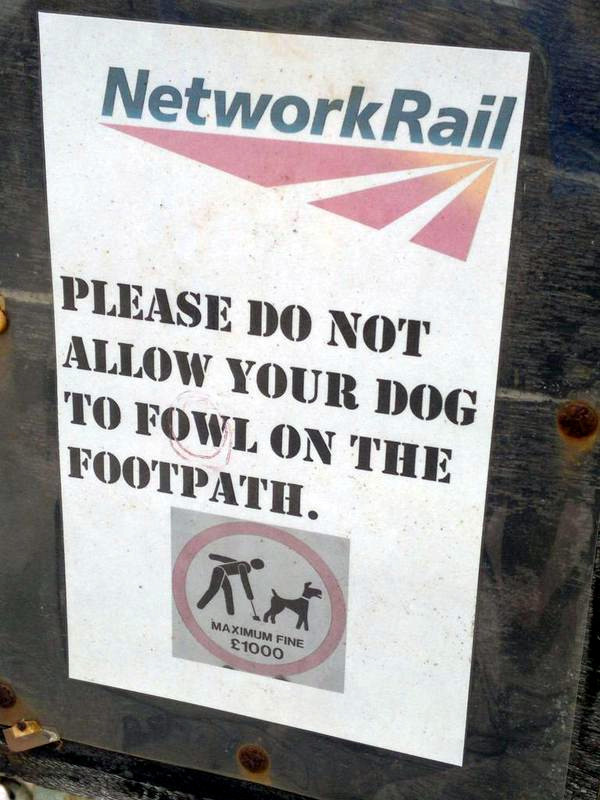
However, some people and/or organisations still seem reluctant to use them, such as UK railway infrastructure operator Network Rail, which chickened out on the occasion shown below and thus qualified for a residency in Homophone Corner. 🙂
Last weekend saw the staging of BarnCamp 2015 (in which Bristol Wireless’ volunteers have been involved since its inception. Ed.). Running from Friday 19th June to Sunday 21st, BarnCamp was as usual a low-cost rural DIY skillsharing event open to everyone, including UK activists, campaigners, people involved in social and community groups and anybody else with an interest in technology and how to subvert it to put it to good use.
According to the sales pitch: “All skill levels are invited and we promise that workshops are not too geeky due to our infamous nerd gag” (of which more later. Ed.).
Once again we were the guests of Highbury Farm, a housing co-operative set in some 30 acres of unimproved but rather steep grassland at Redbrook in the beautiful Wye Valley south of Monmouth.
Looking north towards Monmouth from Highbury Farm
Your correspondent formed part of the forward crew who went to site on Wednesday to set up the event. This year a few more of us were on hand to ensure that all the essential infrastructure – large tents for workshops, signage, kitchen, other refreshment facilities, camp fire, showers and the like – was all in place for the first arrivals. Indeed it was more or less complete by lunchtime on Thursday. Well done all!
Once into the event proper, each day started with breakfast, followed by a plenary session, then workshops, lunch, more workshops and concluding with supper and socialising.
The workshops this year had the usual variety: an introduction to satellite communications, basic electronics, using WordPress and OpenStreetMap, to mention but a few. There were even sessions on basic self defence, whilst Ben’s ever-popular wild food walk took place on no fewer than 3 occasions.
Your correspondent was in charge of building the nightly campfire, a duty that occasionally involved some sheltering of the previous night’s embers from the rain, whilst even the woodpile showed its geeky side.
The pyromaniac’s equivalent of the locked screen
The woodpile geeking out wasn’t the only bit of strangeness occurring on site during BarnCamp. There was also the the intriguing sounding shamanic laptop massage that happened somewhere in the surrounding woodland, for which scant photographic evidence exists.
Shamanic laptop massage
What’s happened to the nerd gag? And what is it in the first place? This was a standard implemented some years ago to stop the less technical becoming too intimidated to the use of too much jargon by the more technically adept. Workshop presenters are encouraged to explain things properly if anyone so asks; this year there was even a space on the information wall where BarnCampers could share the jargon they had just acquired.
The jargon buster
Nevertheless, there was one workshop – Sunday morning’s session on server optimisation – that not only ripped off the nerd gag, but set light to it and threw it away! (And that was just with the first slide of the presentation! That one slide contained more technical acronyms than the rest of the programme put together. Ed.) However, this was perhaps the most jargon-laden session of the weekend and the most geeky, but it did come with lots of laughs… as long as you could get the jokes.
I hope all my fellow BarnCampers had as good a weekend as I did and once again my thanks go out to the good folk at Highbury Farm for their friendliness and hospitality. See you at the next one! 🙂
This blog has discussed homophones before (posts passim). Homophone corner is a space to which people who cannot distinguish their homophones are banished to consider the errors of their ways – rather like the corner of the classroom to which misbehaving children were exiled during my primary school days.
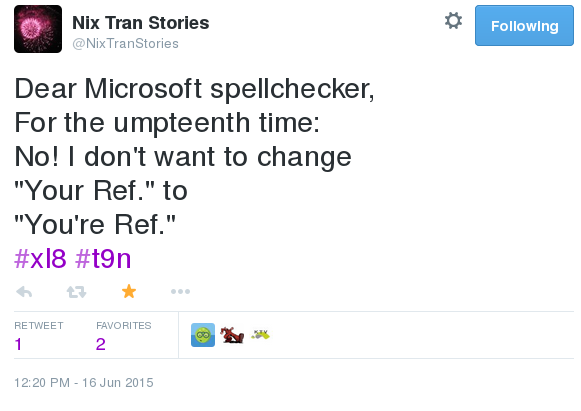
It now appears as though the curse of the homophone is spreading to the giants of the technology world, as shown by the following tweet from Nix Tran Stories.
I’ve used Microsoft Word/Office since the days of Windows 3.1 and its spelling and grammar checking tools have in my opinion never been particularly good: I’ve always run rings around them; and now it appears that the spellchecker has been coded by an illiterate.
I suppose the least I could do is pat the leader of the MS Office team on the shoulder and mouth the platitude “their, there, they’re!“. 😉
In politics passion often rises to the surface in the rough and tumble of debate; and that’s exactly what happened in the New Zealand parliament in the case of Ron Mark, a member of parliament for the conservative New Zealand First party.
The Mirror reports that Mr Mark became irritated with muttering from across the chamber during a pre-budget question time debate in a tense parliamentary session.
Ron Mark was interrupted by jeering from the Government benches and muttered “shut the f**k up” under his breath.
This went unnoticed by his fellow members, but a sign language interpreter who had been invited to parliament as part of sign language awareness week did hear his outburst and signed it for all to see.
Mr Mark later apologised for his unparliamentary language.
It’s the first Monday of October 1973. With a sense of trepidation, an 18 year-old lad leaves home, a large proportion of his possessions and a heavy set of books in a rucksack on his back. He’s off to Wolverhampton in the Black Country to join the second ever intake on the BA Modern Languages (BAML) course being offered by Wolverhampton Polytechnic.
Let’s fast forward to May 2015. With a sense of trepidation a 59 year-old man leaves his home in Bristol, a laptop in a rucksack on his back and a suit in a holdall in his hand. He’s off to Wolverhampton to reunite with the second ever intake on the BA Modern Languages course once offered by Wolverhampton Polytechnic.
There have been lots of changes in the meantime. The polytechnic has transformed into the University of Wolverhampton. Wolverhampton itself has changed from a large industrial town with belching blast furnaces and gained city status. The Black Country either side of the railway between Birmingham and Wolverhampton – once a realistic implementation of a medieval painter’s vision of hell with flames, smoke and smut – is now de-industrialised with leafy areas interspersed with pleasant housing.
Sticking with the leafy pleasantness, the reunion is being held at The Mount Hotel in the Tettenhall Wood area of Wolverhampton, not a frequent haunt of student days when town centre pubs and night clubs were preferred to comfortable, content suburbia.
The Mount is a grade II listed manor house that was originally the home of Mander family of Wolverhampton (who made their money from paint and varnish. Ed.), which acquired the Mount in 1890 for £5,000 and refurbished it extensively. In 1929 the then master of the house Charles Tertius Mander was unfortunately killed in a hunting accident, leaving his wife Mary a widow. The Mount was far too large for post-war life without servants and the house was sold by Charles Marcus Mander at auction in 1952 after being in the family for just ninety years and started its new life as a hotel.
Once settled in, the minor worries started: would I recognise anyone – and would they recognise me? The rest of the crew were veterans at reunions, having held a couple in the intervening years, whilst I was the novice tonight. Standing outside, I scrutinised the faces of those passing, trying to see if any matched features whose recollection was dimmed by nearly 4 decades, whilst that same amount of time had etched its effects on the faces of my contemporaries.
At table: Jill, Steve and Stuart. Photo courtesy of Jill Easton.In all honesty I shouldn’t have worried: as we assembled at 7.00 p.m. for pre-dinner drinks, the memory went into action and I readily recognised most of the faces familiar from of old, although most now came complete with a partner. There were even a few lecturers there. Apologies to those I miss, but these included course director Alan Dobson, French lecturer Stuart Williams and politics lecturer Harvey Wolf.
The 3 courses of dinner were most pleasant: I was seated between Jill Easton (née Marshall) and Stuart Williams. The meal itself, with 3 choices for each course, was delicious and passed in leisurely fashion. Between the main course and dessert a hiatus occurred for the obligatory speeches.
First on his feet was course director Alan Dobson. He passed on greetings from John White, the former head of the poly’s department of languages and praised him for his foresight in establishing the modern languages degree course; and once more trepidation intervened. Alan explained the sense of trepidation in establishing the course. At that time Wolverhampton didn’t exactly have a great reputation. It was the but of jokes. As an academic institution, the polytechnic didn’t exactly have the prestige of a traditional university, something not helped by the presence in those days of a sleazy massage parlour over the road from campus.
The teaching accommodation often left something to be desired in those days. Alan reminded us of the long-vanished St. Peter’s Hall, whose top floor was leased to the polytechnic for teaching. It was invariably freezing cold in the autumn and winter and the landlord’s use of the building’s heating system was a juggling act: downstairs was leased as a potato store and the stock needed to be kept cool. As students we were probably regarded as cool enough in one sense, but fingers stiff with cold are not best suited to taking lecture notes.
Alan was followed by Paul Sutton. Paul and his wife Gwenda had done most of the organisation of the event (and done it splendidly. Ed.). Of those in the 1973 course intake, most had been located and contacted: only 6 remain lost. One of our number, Viv Allum, sadly passed away a number of years ago. The development of the internet had been of great assistance in finding folk; Sheila Searle had done most of the detective work, I believe.
Paul praised the quality of the education we’d received and the skills gained, which have seen many of the alumni employed in fields far removed from languages. The fact most of us have been continuously employed since graduation is ample evidence that the investment in human capital made in those years at Wolverhampton had been amply repaid many times over with interest.
Paul recalled life in Wolverhampton in 1973 when we arrived: beer at 13p a pint in the Union bar, Derek Dougan taking to the field for Wolverhampton Wanderers F.C. (his slipping into the Union Bar for a quick pint was not unknown either. Ed.), Queen supporting Mott the Hoople at Wolverhampton’s Civic Hall shortly after our arrival on campus.
He also reminisced fondly of the polytechnic’s first halls of residence: Brinsford Lodge. These former munitions factory buildings helped accommodate students from 1964 to 1982. Others have started documenting student life at Brinsford, including Richard Elliott’s Brinsford pages and brinsfordlodge.co.uk.
Some of the luxurious student accommodation at Brinsford in the early 1970s. Photo courtesy of Tim Baker.
Paul mentioned that there would be a further reunion in 2 years’ time to mark the 40th anniversary of our graduation. Responsibility for organising it would fall to the first member of the student body to head off to bed!
With speeches, dessert and coffee out of the way, it was time for dancing and the old crew proved that time had not diminished their enthusiasm for partying. The inevitable group photographs were taken, like the example below.
Class of ’73. Well, a lot of them anyway! Course director Alan Dobson is on the far left of the picture. Photo courtesy of Wendy Jackson.
Some group photos even took a sideways look.
An alternative group shot. Photo courtesy of Paddy Ring.
The dancing continued till 1.00 a.m., after which the night owls chatted the darkness away until long after dawn peeped over the horizon. However, we weren’t just reminiscing but discussing contemporary matters and the future too.
Breakfast on Sunday morning was a subdued affair for most.
It was wonderful to meet the BAML crew again. My time spent on the course with you represents an important stage of making me the person I am today. I now realise what I missed by not attending previous reunions; I’ll definitely be at the 2017 one as long as there’s breath in my body.
Thank you all for a brilliant weekend. 😀
Update 13/05/17: The comment below arrived yesterday (well after the end of the period for submitting comments. Ed.) from Gary (Gaz) Peters, another of the class of ’73.
Steve, just seen the blog on Wolves Poly 73. Really brought back memories and I wish that I had been found when you were trawling the net for BAML 73 alumni! I have sadly lost touch with everyone from those halcyon days and have regretted it for a long time. Do you know when the next reunion is? Would love to meet up with everyone. Very best wishes, Gary (Gaz) Peters
Look forward to seeing you again as the next get-together, Gaz! 😀







 In politics passion often rises to the surface in the rough and tumble of debate; and that’s exactly what happened in the New Zealand parliament in the case of Ron Mark, a member of parliament for the conservative


