politics

  • Crapita makes one L of a mistake

    image of Scarborough Justice CentreCapita Translation & Interpreting has made yet another linguistic cock-up, landing the taxpayer with a bill for £3,000 when asked to supply interpreters for a Lithuanian accused of stealing two bags for life worth 20p, according to Thursday’s Yorkshire Post.

    Tadas Tarkutis was accused of stealing these low value items from Sainsbury’s in Scarborough and arrested. A Lithuanian interpreter was arranged to attend the police station, making a 120 miles round trip from Harrogate.

    However, when Tarkutis appeared in Scarborough Magistrates Court the following morning the same interpreter was unavailable and Capita T&I arranged for a substitute – a Latvian interpreter who made a wasted 320 miles round trip from Rugby. Tarkutis was then remanded in custody overnight while a replacement interpreter was sought for the next day.

    This time Capita T&I were able to supply a Lithuanian interpreter, Tarkutis admitted the crime and was jailed for 6 weeks breach of a suspended sentence.

    One court source is reported by the Post as saying: “It was as if someone somewhere had just picked out a country that begins with ‘L’. It was ridiculous.”

    Quite.

    Capita describe as a company “you can rely on”. One can definitely rely on Capita to cock things up.

    The Yorkshire Post’s reporter refers throughout the piece to the linguists involved as translators. He or she – should they happen to visit this blog – definitely needs to read my illustrated guide to the difference between the two.

  • Ossmeter to reduce open source evaluation costs

    Q: what has the EU ever done for us?

    A: helped promote free and open source software!

    EU flagSeveral universities and companies are working collaboratively in the Ossmeter research project on a platform for evaluating and comparing open source software. The European Union is funding Ossmeter’s development to the tune of €2.6 mn. (out of total project costs of €3.4 mn. Ed.) and the software that is ultimately developed will be made available online as a free service and released as free software so it can also be deployed as an in-house quality management tool.

    The aim of the project is to reduce the costs of evaluating open source software. Collecting information from associated communication channels such as newsgroups, forums and mailing lists to identify whether user questions are answered in a timely and satisfactory manner, and to estimate the number of experts and users of the software are equally as important as the researchers’ objective, as is a comparison of several open source projects with regard to usage. The platform’s capability will be tested in three use cases.

    Ossmeter is being developed by nine European research and industry organisations:

    The Open Group is the over-all coordinator and the University of York provides the technical coordination.

    For more information on Ossmeter, read Joinup’s original post.

  • Greenwash: Bristol City Council’s favourite paint

    2015 sees the city of Bristol wearing the crown of European Green Capital.

    This award of European Green Capital is allegedly bestowed in recognition of the important role that local authorities play in improving the environment and their high level of commitment to genuine progress.

    However, is it deserved in the case of Bristol City Council?

    I have my doubts.

    Earlier today I discovered tree felling, thinning and scrub clearance had been going on within the last few days at Lawrence Hill roundabout.

    image of tree felling at Lawrence Hill

    image of tree works at lawrence hill

    This is the middle of the main bird nesting season in the British Isles.

    As regards protecting breeding birds and mitigating harm during the breeding season, Natural England’s advice (PDF, p. 4) is as follows:

    The main mitigation route to reduce the likelihood of harm to breeding birds is to undertake clearance or destruction of any vegetation or structure which may be used as a breeding site outside the bird breeding season when breeding birds are unlikely to be present (based upon habitat features) or where survey work has confirmed their absence. Avoidance of such features is best achieved through timing of work (see below) but may also be possible by temporarily preventing birds from using these features, before they start doing so. Examples include physical exclusion (preventing access to potential nest sites) or use of visual or audible deterrents. Such measures should only be undertaken following the advice of a suitably experienced ecologist, taking account of relevant legislation and welfare considerations.

    The bird breeding season will be dependent upon weather conditions and will vary from year to year, but in general is the period between early March and late August.

    Natural England is the government’s advisor on the natural environment, providing practical advice, grounded in science, on how best to safeguard England’s natural wealth for the benefit of everyone.

    Furthermore, a quick search of the city council’s website for scrub clearance bird nesting season returns 29,400 hits, with the first page seeming to consist of the council pontificating that no such works should be undertaken when birds are on the nest.

    However, it is clear from the pictures above that Bristol City Council’s clear modus operandi is “do as I say, not as I do“.

    The English language has a term for such an attitude: hypocrisy.

    There’s also a splendid fairly new English word specifically for a superficial or insincere display of concern for the environment shown by organisations: greenwash.

    Next year, Bristolians can bet their city will be coated in greenwash, liberally applied with big brushes and rollers by the city council, given its apparent hypocrisy when it comes to nature conservation.

  • Avon (still) calling

    The Heath government’s Local Government Act of 1972 radically overhauled local government arrangements in England and Wales.

    In particular, it redrew the map of the shire counties, some of which had been in existence in some form since medieval or Saxon times.

    coat of arms of Avon County CouncilOne of the Act’s results was the creation of the County of Avon, a non-metropolitan county, which survived from its creation on 1st April 1974 until its abolition on 31st March 1996, when it was succeeded by the present unitary authorities of Bristol, South Gloucestershire, Bath & North East Somerset.

    Despite its abolition and its failure to engage popular support during its existence (it was widely derided at the time as a “cardboard county”. Ed.), Avon is proving harder to eradicate than a vampire. Its legacy can be found all over the West of England and the defunct county’s former administrative area.

    In organisational terms, its name crops up in the following public and private bodies:

    In addition to the above, there’s still an Avon Coroner’s district, the Forest of Avon community forest project and one can by an Avonrider ticket on local bus services.

    Although it ceased to exist nearly two decades ago, many bodies still insist that Avon forms part of the postal address of places like Bristol in spite of the fact that the Royal Mail long since indicated that it was not necessary to include Avon as part of any address as Royal Mail itself had abandoned the use of postal counties in 1996.

    The inspiration for this post came from a conversation this morning on Twitter.

    Any further instances of the survival of Avon can be posted in the comments below.

  • Lack of interpreter delays Staffordshire court case

    image of gilded statue of Justice on top of Old BaileyMonday’s Stoke Sentinel reported that magistrates at the North Staffordshire Justice Centre in Newcastle under Lyme had to adjourn a case until 30th May to allow for an interpreter to be arranged for the defendant.

    Antonia Lakatos, of Gladstone Street, Basford, Stoke on Trent, is charged with theft of alcohol and clothing worth £345.15 from Asda in the Wolstanton district of Newcastle under Lyme, as well as going equipped for theft with an item used for de-tagging shop merchandise on 31st March.

    Will an interpreter turn up? After all, some of the interpreters working for Capita T&I cannot even be bothered to turn up for a case being heard by someone as senior as the President of the Family Division of the High Court of England and Wales (posts passim).

  • A ‘concerning state of affairs’

    image of Sir James MunbyYesterday’s Law Gazette reports that senior judge Sir James Munby, who is the President of the Family Division of the High Court of England and Wales, has described the arrangements for providing court interpreters under the contract between Capita and the Ministry of Justice as “unacceptable” after he was forced to abandon a final adoption hearing after Capita was repeatedly unable to provide interpreters for the Slovak-speaking parents.

    Sir James ordered Capita to explain why neither of the 2 interpreters booked for the 7th May hearing had attended. He described the response to the points he raised in his judgement (PDF) from Capita’s relationship director Sonia Facchini, as disclosing a “concerning state of affairs”, with 3 points “demanding notice”.

    In the first instance he noted: “The contractual arrangements between Capita and the interpreters it provides do not give Capita the ability to require that any particular interpreter accepts any particular assignment or even to honour any engagement which the interpreter has accepted.”

    Secondly, he drew attention to the short notice courts were given of any cancellation of a booking by a interpreter (2 pm on the day before the hearing). This gives the court insufficient time to make alternative arrangements.

    Thirdly, he noted the lack of suitably qualified interpreters. On the day in question, Capita needed 39 Slovak interpreters to cover the workload requested by the courts; Capita only had 29 suitably qualified Slovak interpreters on its books for court hearings that day, of whom a mere 13 were within a 100-mile radius of London’s Royal Courts of Justice.

    Defending his adjournment, Sir James stated: “Anyone tempted to suggest that an adjournment was not necessary might care to consider what our reaction would be if an English parent before a foreign court in similar circumstances was not provided with an interpreter.”

    Quite.

    When approached for a response to the learned judge’s remarks, both Capita and the MoJ made their usual, meaningless soothing noises that are not worth transcribing, let alone reading.

    In political terms, the responses by the MoJ to concerns about its contract with Capita are akin to the “Big Lie“. However, the lies told by its various spokespersons over the years are so preposterous, no-one with any sense is buying their propaganda.

  • Save Avonvale Road Victorian school

    There seems to be a passion for demolishing what’s left (and unlisted) of Bristol’s 19th century buildings at present (posts passim).

    The latest potential victim is the Victorian era school in Avonvale Road in St George.

    image of Avonvale School
    Avonvale School. Picture credit: Mariateresa Bucciante

    Bristol City Council, those champions of preserving the city’s heritage of past centuries (as long as it fits in with their particular view of what constitutes heritage. Ed.), together with Redfield Educate Together (who’ll be running the school to be opened on the site) and the builders, PPP ‘experts’ Skanska, have submitted a planning application proposing the demolition of the old Victorian school buildings and the building of a box-like, bland, modern replacement.

    The existing building has apparently been declared unsuitable by the city council’s Children and Young People’s Service, the trendy, modern moniker for what used to be the Local Education Authority.

    A petition has been organised to try and avert its demolition and the information below comes from it.

    The Victorian school currently occupying the site was designed in 1898 by the acclaimed local architect, Herbert J Jones, and it is a candidate for local listing. It is a local landmark in St. George, an area with a strong character and the building, in excellent condition, was used by the council until recently (isn’t it curious how the same building can be used and then regarded as unsuitable by the same body? Ed.).

    The petitioners believe, as recommended by English Heritage advice on reusing Victorian schools, that the building should be saved and adapted for the new school. If not large enough, other school buildings are available, such as the other school in Avonvale Road in Barton Hill.

    The advice from English Heritage is strong: “Where re-use for educational purposes has been ruled out, every effort should be made to find a new use. The aim should be to obtain the best return for the taxpayer consistent with government policies for protecting the historic environment.”

    The replacement defeats Bristol City Council’s draft policy DM26 which states that, “Development should contribute positively to an area’s character and identity, creating or reinforcing local distinctiveness.”

    The petition, which is addressed to Bristol City Council, concludes as follows:

    We acknowledge the urgent and strong need for a new school in the area and we very much support the reuse of this building and the search for more suitable sites, and for a school which is truly inspiring for the future generations of Bristolians.

    We believe you should reconsider your plan, looking for the advice of English Heritage’s experts independent from the proposal of a single developer.

    Sign the petition.

  • Keep Castle Park open

    One of the jewels of Bristol is Castle Park – a reasonably large green space in the middle of the city.

    In times gone by this was partly the heart of the medieval city and contains the ruins of Bristol Castle. It also used to be the city’s main shopping area before World War 2. It lost that status when Broadmead (virtually unscathed by bombing) was developed as the city’s central shopping area. The construction of this bland, uninspiring mid-20th century retail development required the demolition of an area of Victorian, Georgian and Tudor buildings.

    image of Castle Park, Bristol
    The west end of Castle Park, Bristol. Image courtesy of Wikimedia Commons

    For most of the past week, Castle Park has been closed to the public for a private commercial event, causing great inconvenience to those who use it regularly, such as cyclists and pedestrians making their ways to and from work or the shops, as well as more casual users wanting a bit of respite in pleasant surroundings in their lunch breaks.

    To try and prevent Bristol City Council from closing Castle Park in future for its pure commercial gain and allow citizens access to their parks at all times, a petition has now been started on the 38 Degrees website.

    The petition reads as follows:

    To Bristol City Council

    Following the complete closure of Castle Park (Bristol UK) for the 3rd year running, we propose that public parks should never be fenced off in their entirety for commercial events.

    Tens of thousands of people attending a music event can negatively affect local residents and will inevitably cause damage to this small park. Damage which takes time and money to repair, and that can ruin the enjoyment of the park for the general public for weeks to come.

    A park should be available for general public use at all times and even more so during School or Bank Holidays.

    We request that Bristol City Council only license commercial events to be held at more suitable venues and allow people access to public parks.

    Keeping parks open and accessible at all times is important because parks and green spaces have been shown to improve the well-being of local people and attract visitors from further afield.

    According to Bristol City Council’s Parks and Green Spaces Strategy, central Bristol Bristol is so lacking in green space that temporary park closures would further deplete Castle Park.

    Finally, parks are a public service provided by the council on behalf of the people of Bristol; they should not be exploited to the latter’s detriment as a means of generating revenue.

    Sign the petition.

  • Southwark Crown Court shambles

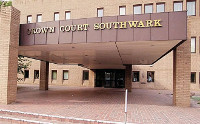
    image of Southwark Crown CourtThe report below – written by Heather Howe and reposted from Linguist Lounge – shows that the Crapita/MoJ court interpreting disaster is still rumbling on (posts passim).
    Chaos such as this is being repeated in magistrates and Crown Courts in England and Wales every day. Nevertheless, this shambles – as Heather Howe so aptly describes it – and criminal waste of public funds is not getting the attention it really deserves in the mainstream media.

    SOUTHWARK CROWN COURT – 23rd May 2014 serious matter listed not before 11am. No interpreter until 10.50 could be found therefore no assistance with conference with client and counsel. Into Court and started lengthy sentence hearing interupted [sic] by Jury returning in another matter and delayed until 12.30 ish. Returned to court and interpreter announces that he has to leave by 1pm. Case started but unable to finish and further interpreter sought. 2.15pm advised that only intepreter available was unqualified and without court experience. Further delays until about 3.30 when Court sat and considered adjourning case. All parties huge inconvenience and court empty for most of afternoon. An interpreter never arrived and we proceeded to sentence in the absence of interpreter and agreement of client. Lengthy conference will be required in prison with registered intepreter and full notes to explain sentence. Additional costs for all concerned. The last hearing at Southwark CC we have already complained that no interpreter arrived. That was simply a mention hearing and we managed after some delay and costs of empty courtroom. I am writing to the MP and the Court about this and lodging a formal complaint.

    There was a case I did in Northampton last year with 4 Columbian clients and multiple charges. Two interpreters arrived and refused to attend the cells for conference. Again one had to leave at lunchtime, delayed again and hours spent for counsel and prison staff while clients were seen. SHAMBLES.

  • Shredder poll: UKIP wins

    All election materials delivered to my home are recycled and those containing my personal detailed are shredded before recycling.

    Each election I keep a tally of the number of communications received from each candidate or party, which has acquired the name of the shredder poll over the years.

    Today the UK votes in elections for the European Parliament (posts passim). In addition, one-third of the council wards in Bristol are also up for election, although my ward of Lawrence Hill isn’t one of them.

    Click here for a full list of candidates for the European Parliament elections (PDF).

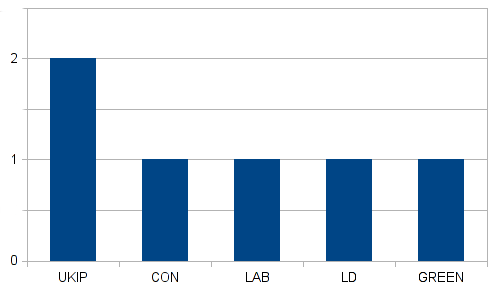
    The lack of a council election in my ward could account for the low level of election leaflets received in the run-up to the poll: a mere 6.

    The graphic below shows the results of the shredder poll.

    bar chart showing shredder poll results

    Well done UKIP! Perhaps this win will go some way to make up for your misguided #WhyImVotingUkip Twitter campaign.

Posts navigation