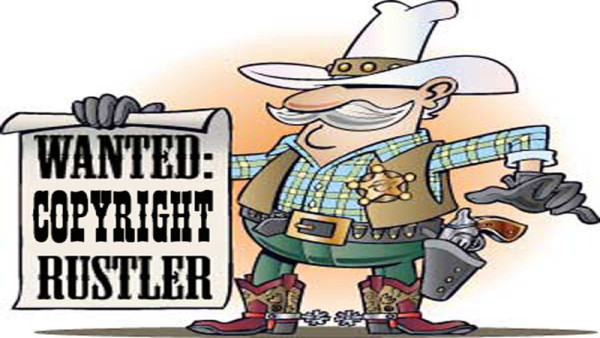
No Peanuts for Translators has posted a petition on Change.org to collect signatures for an end to copyright rustling – the deliberate deprivation of intellectual property rights for translators of literary works. Under copyright, literary translations are considered to be derivative works and their authors are entitled to royalties.
Recent research shows that translators’ copyrights are “rustled” one third of the time in trade and commercial publishing—and eighty percent of the time in university-press publishing.
Simply put, copyright rustling happens when a book publisher takes something from a translator that rightfully belongs to the translator alone: copyright to his or her work.
Some of the biggest copyright rustlers in 2014 also happened to be some of the biggest publishers of translations in English—Europa Editions, Atlantyca, New Vessel Press, Gallic Books, Columbia University Press, Skyhorse Publishing, Yale University Press, Bloomsbury, Routledge, and others. (See Copyright “Rustling” in English-Language Translation: How Translators Keep (and Lose) Rights to Their Work—Data from Translations Published in 2014; http://tinyurl.com/lzpz2cm.)**
Copyright rustling is not inevitable. It is not “standard industry practice.” It is not necessary for the translator-publisher relationship to function nor does it help publishers “afford” to publish translations.
Let’s cut through the nonsense. Copyright rustling is a symptom of translators’ lack of negotiating power and of publishers’ willingness to exploit that weakness to their own advantage.
No Peanuts! calls upon all publishers of translations in English:
* Take copyright off the table. Negotiate fair terms with translators for licensing the use of their copyright, but recognize that the translation belongs to the translator who is allowing you to use it.
* Take copyright off the table. Recognize translators’ legal and moral rights to their intellectual property.
* Take copyright off the table. Stop coercing translators by making copyright transfer a take-it-or-leave-it condition of publishing contracts.
Mutual respect always. Copyright rustling never!
(Learn more about this issue on the No Peanuts! blog: https://nopeanuts.wordpress.com/resistance/stop-copyright-rustling.) Or write: nopeanuts.fortranslators@gmail.com.
———————-
** At the close of the campaign, a copy of the petition & signatures will be delivered to the following publishers. If you’d like to contact them directly in the meantime, their addresses are listed in Copyright Rustling: http://tinyurl.com/lzpz2cm. Atlantyca, Bloomsbury, Cambridge University Press, Cistercian Publications, Columbia University Press, Duke University Press, Europa Editions, Fordham University Press, Gallic Books, Glagoslav Publications, Hackett Publishing, HarperCollins, Harvard University Press, Ignatius Press, Karnac Books, New Vessel Press, Palgrave/McMillan, Princeton University Press, Routledge, Rowman & Littlefield, Skyhorse Publishing, Stanford University Press, SUNY Press, Syracuse University Press, University of Chicago Press.
 Lampeter Town Council could have translation at its council meetings to allow more Welsh to be spoken after the mayor said she felt “guilty” that the council doesn’t use enough Welsh, according to a report in Cambrian News Online.


 Professional Interpreters for Justice (PI4J) is an umbrella group an umbrella group representing over 2,000 interpreters on the