politics

  • Oldham Evening Chronicle apologises to interpreters

    RPSI Linguist Lounge reports that on 2nd December, the Oldham Evening Chronicle published an apology to NRPSI interpreters on Page 2 of that day’s edition.

    The apology is reproduced below.

    image of apology scanned from Oldham Evening Chronicle

    It would appear that since publication of the original article, journalists at the Chronicle have learned the actual meaning of the word ‘cartel’.

    Oldham is the home town of Gavin Wheeldon, the founder of Advanced Language Solutions (ALS) which was subsequently sold to Capita and renamed Capita Translation & Interpreting. The latter is currently presiding over the fiasco commonly known as the Ministry of Justice framework agreement for courts and tribunals interpreting (posts passim).

  • Greens/EFA urge greater FOSS use in European Parliament

    European Parliament logoJoinup, the EU’s open source public sector news website, reports today that the European Parliament’s Greens/EFA Group is urging the European Parliament to make an earnest attempt to using free and open source software. In a letter to EP President Martin Schulz (PDF), which was released last week Friday, the group links free software and open standards to the Parliament’s transparency obligations.

    The text of the letter is reproduced below.

    Sir,

    Thank you very much for your reply to our letter of 10 July 2013 regarding Free Software and Open Standards in the European Parliament, further to the Decision on discharge in respect of the implementation of the general budget of the European Union for the financial years 2010 and 2011.

    We are very happy to have received the first, and ground-breaking, report on the matter, but we kindly remind you to ensure that the study is completed as well, as requested in the European Parliament resolutions of 10 May 2012 and 17 April 2013, on Parliament’s obligations, in particular under Rule 103 of its Rules of Procedure, with regard to Free Software and Open Standards.

    We have commissioned a second opinion on the report to better understand how we can contribute to the Parliament’s efforts in this field. Please find it attached. The opinion concludes that a study on Parliament’s transparency obligations under Rule 103 vis-à-vis its ICT-policies would “result in recommendations to what extent the use of FOSS and open standards is critical to adhere to these principles as a whole”.

    We believe that if, as the opinion suggests, these recommendations were to follow from the Rules of Procedure, it would serve the Parliament well to develop them.

    Thank you for taking immediate action to remedy the situation.

    Yours faithfully,

    (signed)
    Rebecca Harms

    (signed)

    Daniel Cohn-Bendit

    Co-Presidents
    Greens/EFA Group in the European Parliament

    No political organisation seems to be complete without a modicum of hypocrisy. In this instance, despite the Greens/EFA’s avowed espousal of free and open source software and open standards, readers may be interested to know that the PDF version of the letter was produced using the proprietary Nitro Pro PDF production software, which runs exclusively on the Windows operating system. 😉

  • The Eye looks at court interpreting

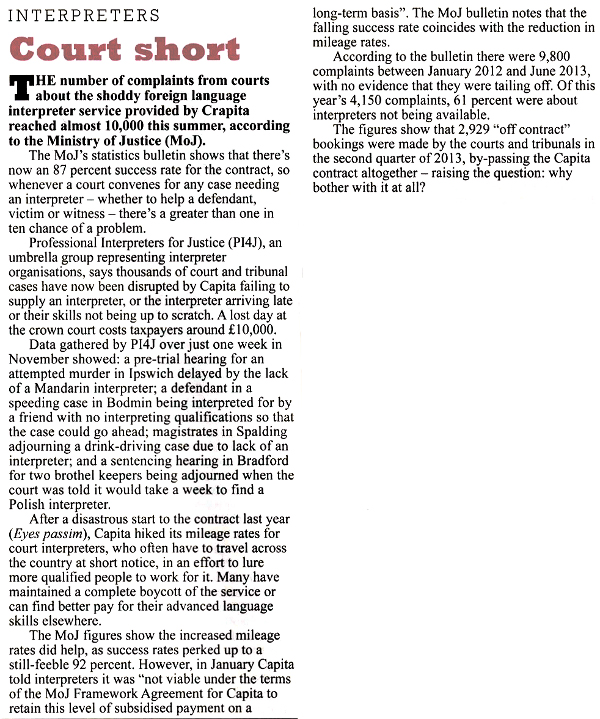
    The Ministry of Justice’s latest quarterly statistical bulletin on the use of language services in courts and tribunals (PDF), which was covered by this blog two weeks ago (posts passim), has also caught the attention of the latest issue of Private Eye.

    Describing it as “the shoddy foreign language interpreter service provided by Crapita“, The Eye’s piece notes there’s a greater than one in ten chance of trouble when a court makes a booking for an interpreter via the MoJ’s contract with Capita, with the piece reaching the conclusion why bother with the contract at all?

    Quite.

    Below is a scan on The Eye’s article.

    image of scanned Private Eye article

  • MoJ report reveals interpreter complaints increasing and costing millions

    image of gilded statue of Justice on top of Old BaileyA Ministry of Justice report (PDF) has published details of 9,800 complaints about its court interpreting contract with Capita Translation & Interpreting, with the report revealing that the numbers and frequency of complaints have increased this year. Capita has provided the service since 30 January 2012 and the Statistics Bulletin reveals that 3,786 (39%) of the complaints relate to interpreters not being available for courts or tribunal cases.

    The court interpreting service is essential for those whose first language isn’t English and who need help in understanding and communicating accurately in court cases and tribunals.

    Professional Interpreters for Justice (PI4J), the umbrella group representing interpreter organisations, says the Statistics Bulletin’s stated figure of an 87% “success rate” of completed requests hides the true picture of the thousands of court and tribunal cases where Capita T&I’s failure to supply an interpreter, or when an interpreter is late or of poor quality, is disrupting the delivery of justice and wasting tax payer’s money.

    In the second quarter of 2013 there were 1,957 complaints, 23% more than in the same period of 2012. The majority of these (64%) were about interpreters not being available. When compared with the same period of 2012, figures showed there was a fourfold increase this year, rising from 218 cases (April-June 2012) to 1,254 between April-June 2013.Read More

    Paul Wilson, Chief Executive of the Institute of Translation and Interpreting, which is part of the umbrella group PI4J, said: “The accumulated cost of all the delayed and abandoned cases which resulted in complaints needs to be offset against the stated savings the Ministry of Justice thinks it is making. A conservative estimate would be £10 million of wasted court time so far.”

    It costs approximately £10,000/day for a Crown Court trial and approximately £1,600/day for a magistrates’ trial or tribunal.

    For the first time the bulletin includes figures for the number of “off contract” bookings made by courts and tribunals instead of using Capita. For the three months April – June 2013, 2,929 bookings were logged. The Tribunals Service, which had its own automated system, accounted for 50% of these “off contract” bookings. Court clerks were asked to make a manual log.

    Geoffrey Buckingham, Chairman of the Association of Police and Court Interpreters, says: “It’s important to understand what these figures aren’t showing. We know for example that there are high numbers of sub-contract arrangements which Capita has put in place to prop up the contract. We hope the Ministry of Justice will recognise this sooner rather than later, so we can work on something better.”

    The Statistics Bulletin, published on 31 October, listed 9,800 complaints from 30 January 2012 to 30 June 2013. Of these, 39% (3,786) were because Capita could not supply interpreters for courts or tribunals, 16% (1,530) were because the booked interpreter did not attend, 15% (1,515) were because the interpreter was late and 4% (410) related to the quality of interpreting. The remaining 21% (2,042) complaints were explained as “time sheet errors, operational issues and other interpreter issues” (what’s an “interpreter issue”? Ed.).

    Three successive parliamentary inquiries by the National Audit Office, the Public Accounts and Justice Select Committees have been highly critical of Capita’s fulfilment of the contract, in addition tow which the Public Accounts Committee has begun further investigations.

    Keith Moffitt, Chairman of the Chartered Institute of Linguists, one of the organisations highly critical of the current approach, said: “The Ministry of Justice has dragged its heels on addressing the issues of this contract despite a series of official reports which have highlighted what it needs to do.”

    The majority of professionally qualified interpreters withdrew their services as a result of the outsourcing arrangement, which lowered the requirements for qualifications and experience whilst cutting interpreters’ fees and travel expenses to such an extent that many left the profession.

  • Linux: suitable for business and personal use

    image of Tux, the Linux kernel mascotThe Netherlands’ Nationaal Cyber Security Centrum (NCSC), part of the Dutch Ministry of Justice, has recently published a fact sheet (PDF) about Microsoft’s impending withdrawal of support for its ancient Windows XP operating system.

    The fact sheet urges users to switch to more modern operating systems as alternatives, but also says some interesting things about Linux, for example:

    Newer versions of Windows, such as Windows 7 are 8, are still well supported. The same is true of Linux-based operating systems like Ubuntu and Red Hat.

    When it comes to operating system updates and suitable uses for operating systems, the NCSC remarks as follows:

    In addition to the newer versions of Windows, there are other operating systems which are also regularly provided with updates. There are various Linux distributions which are suitable for personal and business use. Ubuntu and Red Hat are two popular examples of these. It is also possible to replace the computer itself, or you could also choose a computer with a Mac OS X operating system. These are supplied and supported by Apple. Even older versions of Mac OS X or Linux-based systems reach the “end of life” status from time to time. It is therefore also important for users of these operating systems to use a current version.

    The NCSC’s main target groups for this working paper are the Netherlands’ ministries, national government councils and service organisations, Joinup reports.

  • Spalding Magistrates Court – an interpreting black hole?

    image of Spalding Magistrates Court
    Spalding Magistrates Court
    The Ministry of Justice’s interpreting contract with Capita Translation & Interpreting is lurching along largely unseen by the general public, delaying and denying justice to many in contravention of Clause 40 of Magna Carta (posts passim) – one of the few clauses of that important legal document from 1215 still in effect today.

    Yesterday Lincolnshire’s Spalding Guardian (not to be confused with a similarly titled, typographically challenged offering originally from Manchester. Ed.) carried not one, but two reports of interpreters who missed assignments at Spalding Magistrates Court, which only sits day per week nowadays.

    Firstly, there’s the report of a 53 year-old man accused of stealing bolt croppers.

    The case of a man accused of stealing bolt croppers could not be heard by Spalding magistrates because there was no interpreter present.

    Secondly, the Spalding Guardian covered an adjourned drink-driving case involving a man called Piotr Nowak.

    His case is due to be heard on Thursday. There was no interpreter present at last week’s hearing.

    In spite of the constant stream of evidence to the contrary, the Ministry of Justice continue to assert that Capita T&I’s performance under the contract continues to improve.

    By that logic 2 + 2 = 5 (at least it does in Petty France, SW1. Ed.).

    Spalding may have an above average need for interpreters due to the high numbers of East European migrant workers employed in agriculture and food processing – something that must annoy the hell out of UKIP supporters.

  • Bring back British Rail

    British Rail logoThe fifth day of November is remembered in history for more than one thing. Not only was it the day in 1605 one Yorkshireman called Guido Fawkes was arrested in the cellars of Parliament with lots of black powder, it was also the day in 1993 when Parliament passed the Railways Act.

    The Act provided for the restructuring of the British Railways Board (BRB), the public corporation that then owned and operated the national railway system. A few residual responsibilities of the BRB remained with BRB (Residuary) Ltd., which was itself abolished in 2011.

    The legislation enabled the Secretary of State for Transport John MacGregor to transfer separated parts of the railway to the private sector. Passenger rail services were franchised to private companies including Virgin, FirstGroup and the coach companies Stagecoach and National Express. In addition, the national railway track and signalling company Railtrack was floated on the London Stock Exchange in 1996. British Rail’s track maintenance and renewal operations were sold to private companies, with contracts to provide infrastructure services to Railtrack. The three rolling stock leasing companies or ROSCOs, owners of the passenger rolling stock, were sold to management buy-out teams.

    Returning to the Act itself, it was a shambolic excuse for an act of parliament. Such was the level of tinkering involved, it became the second most amended piece of legislation in history. The Act has also been amended several times since then, most significantly by the Transport Act 2000, the Railways and Transport Safety Act 2003 and the Railways Act 2005.

    However, that’s not all: it set Britain’s railway back by more than two generations.

    We’re now in a situation where there’s no joined up thinking on the railway. Train operating companies have regional monopolies and if your journey involves the services of more than one operator, it’s unlikely your connecting service will be held for you to catch should your preceding train be running late.

    The railways were nationalised in 1948 because the ‘Big Four’ national regional railway companies – Great Western Railway, London and North Eastern Railway, London, Midland and Scottish Railway and the Southern Railway – plus 55 other railway undertakings were making such a dreadful mess of running the rail system.

    British Railways 1956 logotype
    The way things were: British Railways logotype from 1956

    We’re back in that state once again. We were in that state before the 1997 general election, in the run-up to which the Labour Party frequently promised to renationalise the railways, a promise upon which it then reneged once elected.

    On this 20th anniversary of rail privatisation it’s appropriate to draw attention to the work of Bring Back British Rail. Founded in 2009, Bring Back British Rail strives to popularise the common-sense idea of renationalising the ludicrously over-priced and over-complicated railway system, which the people of Britain have been left with as the result of the Major government’s privatisation. Its aim is to unite disgruntled rail passengers and disheartened rail employees all over the country, to demand a re-unified national rail network run for people instead of profit.

    Give it your support.

  • Face recognition advertising – sign the petition

    News broke yesterday that supermarket giant Tesco is set to install hi-tech screens that scan customers’ faces in petrol stations so that they can be fed targeted advertising. The screens will be provided by Amscreen, whose chief executive seems to think that implementing a system like “something out of Minority Report“, the dystopian science fiction film, is something of which to be proud. ( Here’s a hint for Alan Sugar’s son: that’s like recommending Nineteen Eighty-Four as a blueprint for running the United Kingdom. Ed.)

    It isn’t. What is being proposed is a gross intrusion of privacy and an affront to dignity.

    Naturally, this has caused a storm of outrage on social media.

    fall-apart Tesco signage
    Every little helps?

    However, it’s not just Tesco that’s planning this. Some parts of the UK’s healthcare sector are also planning to implement it.

    Fortunately, someone with some gumption and a great regard for their own and others’ privacy has set up a petition on the government’s e-petition website. The petition reads as follows:

    Face recognition software is about to be used to see what adverts you are looking at. It recognises your gender, age and will be used in GP surgeries, hospitals, dentists whilst you wait for your appointment and other public areas. This is a complete invasion of privacy.

    Sign the petition.

    Finally, let’s not forget how George Orwell described advertising in 1936 in Keep the Aspidistra Flying:

    Advertising is the rattling of a stick inside a swill-bucket.

  • Capita: still lost in translation?

    The Ministry of Justice has released statistics for the use of language services in courts and tribunals for the second quarter of 2013 (PDF).

    If Capita Translation & Interpreting still has a 98% performance target for filling all requests for language services for courts and tribunals, then the fact it is only filled 92% of requests in the quarter under review – as stated by the report – means they are still failing to fulfil the terms of their contract with the MoJ.

    Furthermore, the report gives figures for “off-contract” language service bookings for the first time.

    “Off contract” bookings are requests for translation and interpretation [sic] services made outside the Capita TI contract. Bookings for the service are made directly by the courts and tribunals – that is, not through the language service booking portal.

    In Q2 2013 – the first quarter for which data is held centrally – a total of 2,929 off contract bookings were made by criminal courts, civil & family courts and tribunals. This accounted for just under 7% of all bookings made for languages services in that period.

    Just over half (51%) of these bookings were made by tribunals, with a further 48% made by criminal courts.

    This blog will be keeping a close eye on the figures for “off contract” bookings in future. Any increase over subsequent quarters will mean that Capita T&I are living up to their parent company’s well-deserved nickname: Crapita.

  • Racist van: a load of tripe

    Earlier this year I blogged about the Home Office’s so-called racist van (posts passim). Yesterday along with most of the national media the BBC reported that the Home Office had admitted that just 11 illegal immigrants had left the UK as a result of its ill-advised campaign.

    Although the Home Office’s efforts were ill-advised and less than successful, its use of mobile billboards has inspired their use by others like the Tripe Marketing Board, as the picture below – allegedly from Lancashire – shows.

    Tripe van

Posts navigation