politics

  • Remembering the Real WW1

    On Tuesday 15th October, Bristol Radical History Group and Bristol Stop the War Coalition are jointly organising a public meeting entitled Remembering the Real WW1 at the Hydra Bookshop, 34 Old Market St, Bristol, BS2 0EZ (map). The event starts at 7.00 pm and entry is free, although there’ll probably be a whip-round for donations. More details here.

    The talk is being organised in advance of next year’s centenary of the start of World War 1, for which The British government plans to spend £55 million marking the occasion (and the centenary of other stages of the war). Comments from Prime Minister David Cameron calling for a ‘truly national commemoration’ stressing our ‘national spirit’ already suggest what he has in mind. He has even compared the government’s plans with last year’s Diamond Jubilee celebrations.

    What Cameron is forgetting is a phrase that I recall from 40 years ago this month, when I had just started doing political science as part of my Modern Languages degree, i.e. ‘war is the destruction of the fittest’. Indeed, the First World War is credited with being the first war in history where slaughter was conducted on an industrial scale due to advances in technology. In the Battle of the Somme alone (1st July-18th November 1916) claimed more 1,000,000 casualties, making it one of the bloodiest battles in the history of mankind.

    German dead at Guillemont
    German dead at Guillemont, September 1916. Picture courtesy of Wikimedia Commons

    For the majority of people in Europe, whether or not they were directly involved, WW1 was one of the twentieth century’s greatest disasters (and one whose repercussions are still being felt in international relations. Ed.). Already historians like Max Hastings have begun to argue that this was a war that had to be fought against German militarism and the costs in human life and destruction were worth paying. In contrast, radical historians have begun to uncover a multitude of both individual and mass forms of resistance to the war on all sides of the national divides. This resistance took the form of desertion, fraternisation, strikes and mutinies.

    Like most families, members of my own were involved in the conflict. Ted, my paternal grandfather was involved in the Gallipoli campaign, which by itself claimed 34,072 British dead and 78,520 wounded. On my mother’s side, my grandfather Alfred was rejected for military service on medical grounds, although my Auntie Doris informed me in a letter that one of Alfred’s brothers – whose name I cannot remember – deserted in France and was never heard from again by the family.

    Those British service personnel who survived the conflict were promised a ‘country fit for heroes to live in’ by ‘Welsh Wizard’ David Lloyd George‘s postwar government. They were sadly let down.
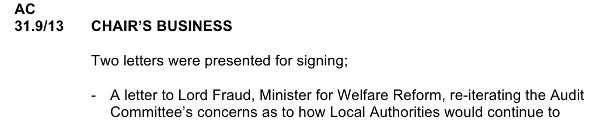
  • An apposite typo?

    I’m not a regular reader of the minutes of meetings of Bristol City Council’s Audit Committee. However, there’s an absolute corker of a typographical error on page 3 of the draft minutes of its 24th September 2013 meeting (PDF).

    image of BCC audit committee minutes

    Will anyone down at the Counts Louse (as real Bristolians call or) or City Hall (as the Mayor has renamed it) be eagle-eyed enough to notice?

    Under no circumstances Lord Fraud should not be confused with Lord Freud, a Conservative peer who only pretends to be a Parliamentary Under-Secretary at the Department for Work and Pensions with responsibility for welfare reform. 😉

  • BRH’s autumn programme announced

    pirate flag of BalckbeardBristol Radical History Group have announced their autumn programme of talks, gigs and meetings. Full details can be found at http://www.brh.org.uk/site/events/.

    The events themselves are as follows:

    ‘We are all in the gutter but some of us are looking at the drains’: An alternative explanation of the public debt

    Speaker: Alan Brown
    Date: Wednesday 9th October
    Time: 7:00 pm to 9:00 pm
    Venue: The Hydra Bookshop, 34 Old Market St, Bristol, BS2 0EZ (map)
    Price: Donation
    http://www.brh.org.uk/site/events/we-are-all-in-the-gutter/

    Remembering the Real WWI: Public meeting

    Date: Tuesday 15th October 2013
    Time: 7.00-9.00pm
    Venue: The Hydra Bookshop, 34 Old Market St, Bristol, BS2 0EZ
    Price: Free
    http://www.brh.org.uk/site/events/remembering-real-wwi-public-meeting/

    The Black Revolution

    Speakers: Jonina Abron-Ervin & Lorenzo Kom’boa Ervin
    Date: Wednesday 16th October 2013
    Time: 7.00pm
    Venue: Malcolm X Centre, 141 City Rd, Bristol, BS2 8YH (map)
    Price: Donation
    http://www.brh.org.uk/site/events/black-revolution/

    Global Revolts and Uprisings

    Speakers: George Katsiaficas and Geronimo
    Date: Thursday 17th October, 2013
    Time: 7:00 pm to 9:00 pm
    Venue: The Hydra Bookshop 34 Old Market St, Bristol, BS2 0EZ
    Price: Donation
    http://www.brh.org.uk/site/events/global-revolts-uprisings/

    Justseeds, Radical Art: Exhibition and discussion

    Speakers: Justseeds Art Collective (New York)
    Date: Tuesday 22nd October 2013
    Time: 7:00 pm to 9:00 pm
    Venue: The Hydra Bookshop, 34 Old Market St, Bristol, BS2 0EZ
    Price: Donation
    http://www.brh.org.uk/site/events/just-seeds-radical-art-group/

    James Connolly Songs of Freedom with Mat Callahan, Clayton Blizzard and Commander McNeil

    Date: Wednesday 23rd October 2013
    Time: 8.00 pm til late
    Venue: The Plough, 223 Easton Rd, Easton, Bristol BS5 0EG ‎(map)
    Price: TBC
    http://www.brh.org.uk/site/events/james-connolly-songs-freedom/

    Remembering the Dublin Lockout 1913-2013

    Speaker: John Newsinger
    Date: Thursday 14th November 2013
    Time: 7:00 pm to 9:00 pm
    Venue: Tony Benn House, Victoria Street, Bristol BS1 6AY (map)
    Price: Donation
    http://www.brh.org.uk/site/events/remembering-dublin-lockout-1913-2013/

    Book Launch: In Letters of Blood and Fire: Work, Machines and the Crisis of Capitalism

    Speaker: George Caffentzis
    Date: Tuesday 19th November 2013
    Time: 7:00 pm to 9:00 pm
    Venue: The Hydra Bookshop, 34 Old Market St, Bristol, BS2 0EZ
    Price: Donation
    http://www.brh.org.uk/site/events/in-letters-of-blood-and-fire/

  • Fundraiser for Felix Road tomorrow

    Tomorrow (5th October) the City Academy in Russell Town Avenue (map) will be holding a free community event from 12.00 noon to 4.00 pm. All proceeds from the event will be going to the campaign to save Felix Road Adventure Playground (posts passim), which is threatened with closure.

    flyer for Felix Road event

    There will be live music & performances, food, an active zone including bouncy castle & soft play and face painting.

    For further information contact Ananda Kellett by email on kelleta (at) cityacademy.bristol.sch.uk or telephone 0117 9413800.

  • Berlin geodata now available free of charge

    open data stickersThe official geodata of the Berlin Land Surveying Administration are now available free of charge, Heise reports. The data, such as the automated property register map, topographical official map series, aerial photographs and rectified digital photographs derived from these and information about standard land values, may be used for any commercial or non-commercial purpose according to a notice from Berlin’s Senate Administration for City Development & the Environment. The data can be acquired from the geodata portal.

    The previous complex terms of use have been abolished and replaced by new uniform terms of use, which permit commercial and non-commercial use of the data free of charge. Modest charges are levied for the provision of data that can only be made available offline. Fees are still charged for official information and extracts from the land register, as well as for permits and certifications.

    “Social topics relevant to the future such as climate, energy, mobility or demography are dependent on geodata. Berlin’s implementation of its open data initiative is being continued with the release of official geodata and an important contribution being made to the continuing opening up of the State,” explains Ephraim Gothe, State Secretary for Urban Development and the Environment.

    Mathias Schindler of Wikimedia Deutschland sees the move as a small revolution. “In particular, the (meta)data may be copied, printed out, used in presentations, processed and passed on to third parties, merged with one’s own or others’ data, associated with independent data sets and integrated in internal and external business processes and applications in public and non-public electronic networks – all with a source attribution obligation”, he explains in a blog post.

    The Berlin Senate published its open data strategy in February 2012. It set up its open data portal – the first in Germany in April 2012.

  • French government guiding public sector towards open data

    logo of French RepublicThe French Prime Minister has just distributed a circular promoting the opening up of public data, according to Le Monde Informatique. This was accompanied by a practical guide to assist public sector organisations in joining in this move.

    The “Vade-mecum sur l’ouverture et le partage des données publiques” (= Handbook on opening up and sharing public data) was published on 17th September 2013 by the Prime Minister’s office. Originating from the CIMAP (inter-ministerial committee for public [sector] activity modernisation) meeting of 2nd April 2013, the handbook has the aim of encouraging the public sector to open up their data fully by encouraging it to do so. At just 11 pages, the document is very short. It is also based on a provision in the ethical charter signed by each minister of the present French government upon entering office and which makes provision for opening up the data of each ministry as fully as possible.
    It also gives a reminder that open data should be referred to on the data.gouv.fr portal. This portal currently hosts 350,000 files according to the Prime Minister’s office.

    After having given a reminder of the issues and objective of opening up public data, the handbook sets out the legal forms for so doing, along with the methods and good practice. It concludes by setting out possible examples of the re-use of open public data.

  • Is there a backdoor in Linux?

    image of Linus Torvalds
    Linus Torvalds ponders answering another awkward question
    At this year’s LinuxCon held in New Orleans, Linus Torvalds and fellow kernel developers were asked whether they’d been approached by US security services to put a backdoor in Linux, thus compromising the operating system’s security, The Register reports.

    Linus responded to the question by saying no whilst at the same time nodding his head, thus indicating that he had been approached. He then resumed by completely denying any approach had been made. This was followed by another developer saying that such things couldn’t be discussed. Linus’ reaction is reminiscent of the reserve Marissa Mayer, CEO of Yahoo, on the NSA‘s Prism programme because any mention of it could be “treason”.

    Rumours of backdoors and other forms of hidden access routes in operating systems such as Microsoft Windows and security protection products have been in circulation for years. These rumours have been given a fresh lease of life following the recent revelations by NSA whistleblower Edward Snowden.

    Linus’ and the other developers answers have not exactly cleared the air as to whether Linux is as secure an operating system as its users are likely to believe. As The Register article points out:

    Worried netizens have become far more paranoid about the possibility of backdoors in the technology they use and this paranoia extends to both closed-source and open-source software.

    However, it is pointed out by The Register that security service agents who are rebuffed by developers then tend to leave them alone.

    Finally, there’s one point to consider: in open source anyone with the requisite skill is free to examine the code, modify and adapt it. On that principle, wouldn’t it therefore be more difficult to hide vulnerabilities and backdoors in open source products than closed, proprietary software?

  • Argentina introduces Huayra Linux

    The Argentine state has developed its own Linux distribution based on Debian GNU/Linux, Germany’s Heise reports. Huayra Linux (the word huayra is from Quechua and means wind) is part of the Conectar Igualdad programme, which is aimed at closing the digital divide in Argentina by equipping schools better. Three million netbooks were handed out to pupils and teachers under this programme between 2010 and 2012. Huayra Linux is an important building block for achieving this programme’s goals since it frees users from reliance on proprietary software suppliers, such as Microsoft.

    Huayra Linux logo

  • France’s Elysée Palace makes modest contribution to open data

    Le Monde Informatique reports that the website of the Elysée Palace, the official residence of the French president is taking a step towards open data. In a tweet on 16th September, it announced it was opening up its data in a new open data section of its website.

    picture accompanying tweet announcing Elysée open data site

    At present this open data section consists essentially of the diary of President François Hollande which has been appearing since last December at the top of the site’s home page in the form of a timeline. The data in this timeline are offered in two formats: XML and JSON.

    The Elysée is also releasing the origin of visits made to its website during the previous week in JSON format. Some 41% of its visitors originate from Google, 30% reach the site directly, 8% are referred by Twitter and 4% by the Elysée’s Facebook page. There are also daily statistics for the site’s servers (energy consumption, load) and visits displayed in graphical form: number of visitors, number of pages viewed per hour and the source of visits.

    Since the announcement of the the French government’s open data portal data.gouv.fr in February 2011, several public sector organisations, publicly-owned companies (e.g. SNCF and RATP) and local and regional authorities have opened up some of their data.

  • Switzerland launches open data portal

    Swiss state coat of armsThe Swiss Federal Government launched its open data portal opendata.admin.ch comprising over 1,600 public data sets, including election results, key figures for cantons and local authorities, as well as demographic information and data at the start of the Open Knowledge Conference 2013 in Geneva, the German technology news site Heise reports. The portal will provide a central point of access for the open data portfolio in Switzerland. The website already features the first applications based on the data made available.

    Open Data currently ranks fairly high up the Swiss political agenda: last week the National Council called for a master plan for open government from the Swiss Federal Council. The Swiss Federal Council in turn announced the development of a national open data strategy by 2014, which, amongst other things, should clear the way for the repeal of restrictive usage rights, as well as the abolition of fees on public data.

Posts navigation