politics

  • Version 2.0 of OGL released

    Reposted from Bristol Wireless.

    OGL symbolThe British National Archives announced last week that it has released version 2.0 of the Open Government Licence (OGL) following consultation on how the licence could be developed further to reflect new and emerging thinking on the licensing of public sector information.

    The OGL is an open licence allowing information to be used and re-used with virtually no restrictions. It is also part of the UK Government Licensing Framework (UKGLF), which was launched in 2010. A wide range of government and other public sector information can be used and re-used under the OGL, which also forms part of the UK government’s policy on transparency and open data.

    The basic terms and conditions of the Open Government Licence version 2.0 remain the same as the previous version in that it continues to:

    • permit use and re-use of information in any format for both commercial and non-commercial purposes without charge;
    • require re-users to publish an acknowledgment of the source of the information;
    • exclude personal information from the licence;
    • be compatible with other licensing models, such as Creative Commons, and conforms to the Open Definition*.

    What has changed is that National Archives have introduced a separate section of the licence headed ‘Non-endorsement’. This is designed to make it clear that the licence does not permit the re-user to suggest that their versions of the information enjoy any official status or have departmental endorsement.

    The National Archives is also introducing the OGL symbol, a simple way of identifying when information can be used and re-used under the terms of the Open Government Licence. The OGL symbol was developed by The National Archives with help from the Government Digital Service. The OGL symbol, at a glance, shows that information can be used and re-used under open licensing.

    * The definition seeks to define the terms “open”, “open data” and “open content” precisely in the context of data and content so as to ensure “interoperability between different pools of open material.”

  • Put Ada on a bank note

    Reposted from Bristol Wireless.

    The Bank of England recently announced that social and prison reformer Elizabeth Fry, who currently graces the English five pound note, is to be replaced by Sir Winston Churchill, leaving Elizabeth Windsor as the only woman shown on an English bank note – and that’s merely due to an accident of birth.

    Since the announcement, there have been calls from various quarters for another woman on English bank notes, in response to which the Bank of England (also known as “the Old Lady of Threadneedle Street“. Ed.) has hinted that 18th century novelist Jane Austen may be next to grace the back of the ten pound note.

    Naturally, this safe, predictable choice by the Bank of England hasn’t met with universal approval. Why stick with a female representative from the arts when there are plenty available from the sciences?

    image of Ada Lovelace
    Ada Lovelace
    We’ve written before about Ada Lovelace (news passim), who was an English mathematician and writer chiefly known for her work on Charles Babbage‘s early mechanical general-purpose computer, the analytical engine. Her notes on Babbage’s engine include what is recognised as the first algorithm intended to be processed by a machine; thanks to this, she is sometimes considered the world’s first computer programmer.

    A petition has now appeared on the government’s e-petitions site calling for Ada Lovelace’s achievements to be recognised by putting her on a bank note. The petition’s text reads as follows:

    Mervyn King, the Governor of the Bank of England, has announced Winston Churchill will replace social reformer Elizabeth Fry as the face of £5 notes. This means that, other than the Queen, there will be no women featuring on our English bank notes.

    A campaign is already underway to support women on English bank notes:

    http://www.change.org/en-GB/petitions/bank-of-england-keep-a-woman-on-english-banknotes

    We would like to propose Ada Lovelace – Founder of Scientific Computing – as the new face for the £10 note. A true champion of women in science and technology.

    The petition could do with your support. As this post goers to press, it has under 300 signatures (you might like to support the other petition to keep women on English bank notes too. Ed.)

    While we’re talking women on bank notes, how about these women from the sciences and engineering?

    Can you think of any more worthy candidates? Add them in the comments below.

  • France’s MIMO joins Document Foundation Advisory Board

    MIMO logoMIMO, the French inter-ministerial group devoted to the promotion of open source within government, has become a member of the Advisory Board of The Document Foundation, which produces the free and open source LibreOffice productivity suite, Numerama reports.
    MIMO, which was set up in 2005 by ADAE to facilitate the adoption of OpenOffice and then LibreOffice by civil servants, is thus becoming one of the 10 members of the Advisory Board with Google, Intel, Lanedo, Red Hat, SUSE, Freies Office Deutschland e.V., Software in the Public Interest (SPI), the Free Software Foundation (FSF) and the King Abdulaziz City for Science and Technology (KACST).

    The Document Foundation’s Advisory Board has no decision-making function within the Documentation Foundation, but has been established to represent the project’s major donors. It makes its recommendations to the Foundation’s Board, which makes the final decisions on the direction of LibreOffice. However, since its members support the project financially to the tune of $5,000-20,000 per year, the opinion of the Advisory Board does receive special attention.

    At present MIMO brings together the Ministries of Agriculture, Culture, Defence, the Economy, Ecology, Education, Finance, the Interior and Justice. Several public sector organisations have also joined the group, including CAF, DILA, ENA and the National Assembly. In total, 500,000 workstations have been equipped with free and open source office suites distributed by MIMO.

  • How the MoJ treats consultation submissions

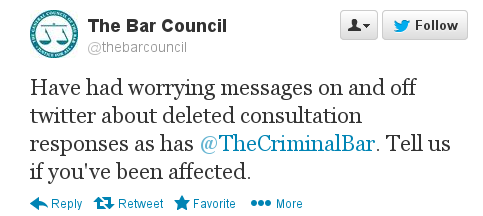
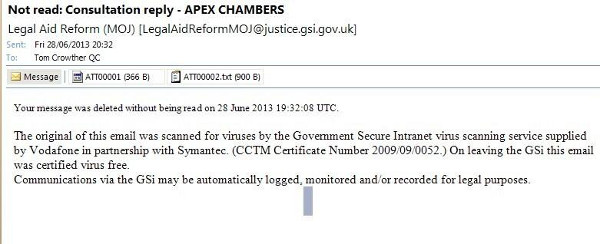
    Courtesy of the Criminal Bar Association’s Twitter account, evidence has emerged of the Ministry of Justice’s attitude to submissions to its recently closed consultation on its proposed changes to legal aid, which masquerade under the misleading title of ‘Transforming Legal Aid’ (posts passim).

    legal_aid

    The Criminal Bar Association isn’t the only organisation that has received such information: the Bar Council has too.

    image of Bar Council tweet of 28th June 2013

    Some cynics have already said that they knew the MoJ wouldn’t bother reading submissions. However, what the top screenshot shows is the deplorable lack of IT skills on show from the mandarins of Petty France: they are too thick to realise that their email system sends the originator a message if that email is deleted without actually being read!

    Update: Doughty Street Chambers has since tweeted that the MoJ are apparently saying the deletions are an “erroneous technical glitch” and nothing has been deleted, as well as that people have been emailing legalaidreformmoj@justice.gsi.gov.uk to ask for a copy of their response so the MoJ can prove they still have those consultation responses.

    Well, that second tweet from Doughty Street just shows how much confidence and trust in the MoJ has eroded.

  • Capita interpreter dispensed with in trial

    Reposted from RPSI Linguist Lounge.

    Marisa Allman writes:

    We started a 3 day hearing on 25th June with my client giving evidence via a Capita interpreter. To begin with she was unfamiliar with the process for taking the oath, simply reading it to the witness and asking for confirmation.

    It then quickly became apparent from the answers to questions posed that the witness was not being asked the question as it had been put in English. After about 40 minutes of questions the other party who was also Punjabi speaking indicated that the interpreter was not interpreting either the question or the response correctly. My own interpreter confirmed this. The witness also complained that the interpreter was confusing her. A decision was taken to dispense with that interpreter and put in a request for another, who arrived at 3:15. The first day of the hearing was therefore effectively lost.

    I can also tell you that in January or February this year I was involved in a case where the Turkish, unrepresented, father had travelled from Moldova for a final hearing. The interpreter called in sick on the morning of the hearing and Capita were unable to provide a replacement. My instructing solicitor was willing and able to find a replacement from another agency but this was not permissible because of the contract with Capita. No hearing took place, the hearing had to be adjourned to May.

  • Save Felix Road Adventure Playground

    Never having had children, my contact with local play facilities has been limited. However, I do remember having a lovely conversation about the history of Bristol’s Easton district with the late local historian Lionel Ellery a couple of decades ago at Felix Road Adventure Playground.

    The adventure playground itself is sited on what was once the north coalyard of Easton Colliery, which operated from 1824 until 1911. From 1913 to 1972 the adventure playground then site served as a stone yard for Bristol building firm Cowlin.

    Felix Road Adventure Playground was established in 1972 by a group of local parents concerned that their children should have a space to play.

    However, its future is now under threat due to funding cuts by Bristol City Council, meaning it can only open for 2 days a week.

    A petition has been organised to secure the playground’s future. You can sign it online here.

    Paper versions of the petition have been left at these places for signature:

    • Easton Business Centre;
    • EMAP (Action for Children);
    • Easton Community Centre;
    • The Plough;
    • The Jolly Roger;
    • The Queens Head;
    • The Olive Grove Cafe;
    • Cafe Joanna, Chelsea Road;
    • Totally Toys, Gloucester Road; and
    • Playful, Gloucester Road.
    image of Felix Rd Adventure Playground
    Felix Rd Adventure Playground

    The petition needs 3,500 signatures to trigger a debate of the matter in full council.

    What is particularly galling about this funding cut is that Felix Road is located in Bristol’s Lawrence Hill ward, reputedly the most deprived council ward in South West England.

    Meanwhile, play facilities in some more prosperous parts of the city are not having their funding cut to the same extent.

    It is believed that St Paul’s Adventure Playground in St Agnes – an area with similar deprivation to Felix Road – is also under the same threat due to funding cuts.

    Why are Bristol’s poorest districts always treated so badly?

    It’s almost as if the city’s great and good couldn’t care less about those not so fortunate as themselves.

  • Free software a priority in education says French parliament

    Marianne - symbol of the French RepublicThe Senate and the National Assembly, the two houses of the French parliament, have agreed to make free software a priority for education, according to Joinup, the EU’s public sector open source news website. This Wednesday last the National Assembly confirmed a proposal by the Senate urging higher education institutions to give preference to free and open source software. However, the plan still needs to be accepted by the government.

    France’s senators have been urging the government to make free and open source software a priority in education for the past 2 months. In response, the government has indicated that it is prepared to encourage schools and universities in the use of free software and open document formats. However, this is not enough for the Upper House, which wants free software to be mandatory.

    Last month senators unsuccessfully tried adding free software use to plans for reorganising state schools; this week the Senate included it in proposals for higher education and research.

    The first proposal was watered down by the government when it came up for discussion in the National Assembly. Senators are hoping to succeed this time as their plan has now been accepted by a joint committee of both houses. The proposal will be voted on next week.

    April, a French free software advocacy group, is following developments closely and has welcomed the Senate’s recognition of the importance of free software. “We hope that the government is not going to make any new attempt at reversing this encouragement.”

    Unfortunately, the French government is resisting the Senate’s push for free software, alleging that it breaks European procurement rules (really? That’s a strange interpretation of those rules. Ed.). April says such a requirement is perfectly legal. “It was validated by the Conseil d’État (French administrative supreme court) in its decision of 30th September 2011. We urge the French government to publish a detailed legal analysis.”

    Reposted from Bristol Wireless.

  • That’ll lean you!

    This blog has written before about politicians’ scrapes with technology and their apparent inability to cope with it (posts passim).

    Below is a screenshot of a tweet (since deleted) by Andrew Selous, the Tory MP for South West Bedfordshire commenting on Chancellor of the Exchequer Gideon Osborne’s comprehensive spending review in the House of Commons earlier today.

    Tweet by Andrew Selous MP
    Tweet by Andrew Selous MP

    Andrew should also know that the first rule about criticising others’ use of language is to make sure one’s own is impeccable (but they probably omitted to teach him that at Eton. Ed.).

    Hat tip: Phil Gibson.

  • Judge gets a relative to interpret as Capita cancels an interpreter

    Reposted from RPSI Linguist Lounge.

    Imran Majid writes:

    I’ve been stuck in court all day partly due to another cock-up by Capita. The District Judge was in a dilemma whether to carry on refusing to hear a bail application in the absence of an interpreter. This is the 2nd day, Capita cancelled an interpreter yesterday and then failed to send an Arabic interpreter today. The District Judge got an unqualified relative to interpret. So well done Grayling, you’ve saved the government some money there.

  • Genoa to use open source ‘wherever possible’

    Genoa coat of armsThe City of Genoa in Italy is now encouraging the use of free and open source software and is saving local taxpayers more than €100,000 per year, Lettera43 reports.

    The Municipality of Genoa has decided to promote the use of free software and open source to save more than €100,000 a year. The council has already begun to use free software for services such as email, civil registry (births, marriages and deaths) and its intranet.

    In addition, trials are underway in nursery schools with e-learning and the use of PCs with free software and new groupware tools.

    “Free software, basically free, is a software in which the source code is accessible to all, editable by all,” said councillor Isabella Lanzone. “It will help us to free ourselves from the monopolies of the big computer companies and limit local government costs.”

    Furthermore, Joinup, the EU’s public sector open source news site, writes that Genoa will use open source ‘wherever possible’. The council is to start using the image manipulation tool Gimp, document archive solutions 7Zip and PDFCreator, as well as testing the use of Quantum GIS, Kosmo, Postgres and PostGIS for its Geographical Information Systems (GIS).

    In addition, the council has announced it will be using Open Document Format as the standard format for its electronic documents.

    Finally, the city is to use Linux for a number of PCs meant to be used by council staff members that do not have access to a computer by default to enable them to access the council’s personnel resources.

Posts navigation