food

  • Sea greens

    Yesterday I left the confines of Bristol and travelled down to the Bristol Channel coast.

    While there I was there I made time to visit an area of salt marsh to forage for marsh samphire (also known as glasswort), which is currently in the midst of its short season, which consists of the months of July and August only.

    image of marsh samphire
    Marsh samphire (Salicornia europaea)

    Samphire can be eaten raw or cooked. In the latter instance, no salt needs to be added to the cooking water as the plant has an inherent high salt content. It has a fresh, salty taste, crisp texture and makes a great accompaniment to fish and shellfish dishes, eggs or such specialities as salt marsh lamb. As samphire gets older and larger, the core of the plant becomes more stringy and the succulent flesh has to be stripped off the stringy core.

    Until the start of the 19th century, marsh samphire also had industrial uses: before the introduction of the LeBlanc process for the industrial production of soda ash, marsh samphire ashes were long used as a source of soda ash (mainly sodium carbonate) for making glass and soap.

    As regards the origin of the noun samphire, it is believed to be a corruption of the French name herbe de Saint-Pierre, i.e. “St Peter’s herb”.

  • Barncamp – my highs and lows

    Late yesterday afternoon I returned from Barncamp 2013, โ€“ a weekend of “hacktivism, workshops, entertainment, politics and fun in the sun” held at Highbury Farm up the beautiful Wye Valley a few miles south of Monmouth. Barncamp itself was open to attendees from Friday 7th June to Sunday 9th June. As part of the production crew, I got to spend a couple of additional nights on site, wearing out the view. Barncamp is a joint production between HacktionLab, FLOSS Manuals and Bristol Wireless.

    The view up the Wye to Monmouth from the Barncamp site
    The view up the Wye to Monmouth from the Barncamp site

    My highs and lows of the event are listed below.

    The highs

    • Seeing the International Space Station (posts passim) pass overhead on the first evening.
    • Ben Green’s wild food walk – something I’d been promising myself to do for years. I ate wild garlic flowers for the first time while on Ben’s walk.
    • Not reading the online edition (or any other format) of the dreadful Bristol Post.
    • A fine pub lunch – steak and ale pie -at the Lamb & Flag after my visit to A&E in Abergavenny (see below).
    • Leading the Linux command line workshop on the Bristol Wireless mobile LTSP suite.
    • Seeing lots of people I haven’t seen since the last Barncamp, 2 years ago.
    • “Wow!” Charlie‘s one word tasting note for Laphroaig single malt whisky.
    • Getting a surprised reaction from some for annointing the campfire hearth with Laphroaig before lighting (humour an old hippy as he appeases the genus loci, will you? Thanks. Ed.).
    • Excellent beers all weekend (apart from the solitary pint of Nutcracker over at The Boat in Penallt).

    The lows

    • Getting knackered walking up and down the hill from the camping field to the barn and up and down to the village shop.
    • Not catching sight of the ravens I heard all the week.
    • Hitting myself on the left thumb with a lump hammer, requiring a trip to Neville Hall Hospital in Abergavenny and the insertion of 3 stiches (picture below).
    • Having to come back to Bristol and routine.
    Ouch!
    Ouch!

    And finally…

    A big thank you to the folks at Highbury Farm, our hosts for Barncamp, especially Tez for the comfrey to help with my war wounds. Hope to see you again soon.

  • Haggis – a poetic dish

    portrait of Robert Burns
    The Bard of Ayrshire. Picture courtesy of Wikimedia Commons
    Today, 25th January is the birthday of Robert (or Rabbie) Burns (1759 โ€“ 21 July 1796), Scotland’s most celebrated poet. He is widely regarded as the national poet of Scotland and is celebrated worldwide. He is the best known of the poets who have written in the Scots language, although much of his writing is also in English and a light Scots dialect, making his works accessible to an audience beyond Scotland. He also wrote in standard English and this brought out his bluntest political and civil commentaries.

    Burns is also regarded as a pioneer of the Romantic movement and after his death he became a great source of inspiration to the founders of both liberalism and socialism, as well as a cultural hero in Scotland and the Scottish diaspora around the world.

    Rabbie’s birthday is now traditionally celebrated by a Burns Night supper, of which haggis is an essential ingredient, traditionally accompanied by ‘neeps’ (turnips or swede) and ‘tatties’ (potatoes). One gets the impression that Rabbie was rather fond of haggis, since in 1786 he wrote “Address To A Haggis”, which is reproduced below.

    Fair fa’ your honest, sonsie face,
    Great chieftain o’ the pudding-race!
    Aboon them a’ yet tak your place,
    Painch, tripe, or thairm:
    Weel are ye wordy o’a grace
    As lang’s my arm.

    The groaning trencher there ye fill,
    Your hurdies like a distant hill,
    Your pin was help to mend a mill
    In time o’need,
    While thro’ your pores the dews distil
    Like amber bead.

    His knife see rustic Labour dight,
    An’ cut you up wi’ ready sleight,
    Trenching your gushing entrails bright,
    Like ony ditch;
    And then, O what a glorious sight,
    Warm-reekin’, rich!

    Then, horn for horn, they stretch an’ strive:
    Deil tak the hindmost! on they drive,
    Till a’ their weel-swall’d kytes belyve
    Are bent like drums;
    Then auld Guidman, maist like to rive,
    Bethankit! hums.

    Is there that owre his French ragout
    Or olio that wad staw a sow,
    Or fricassee wad make her spew
    Wi’ perfect sconner,
    Looks down wi’ sneering, scornfu’ view
    On sic a dinner?

    Poor devil! see him owre his trash,
    As feckles as wither’d rash,
    His spindle shank, a guid whip-lash;
    His nieve a nit;
    Thro’ blody flood or field to dash,
    O how unfit!

    But mark the Rustic, haggis-fed,
    The trembling earth resounds his tread.
    Clap in his walie nieve a blade,
    He’ll mak it whissle;
    An’ legs an’ arms, an’ hands will sned,
    Like taps o’ trissle.

    Ye Pow’rs, wha mak mankind your care,
    And dish them out their bill o’ fare,
    Auld Scotland wants nae skinking ware
    That jaups in luggies;
    But, if ye wish her gratefu’ prayer
    Gie her a haggis!

    Haggis, neeps and tatties.
    Haggis, neeps and tatties.
    I’m looking forward to some haggis, neeps and tatties this evening at The Volunteer Tavern in St Judes, Bristol, beautifully prepared by Mark the chef, as well as a wee dram or two to wash it all down. I’m also looking forward to the other courses, starting with cock-a-leekie soup or Scotch broth for starters finishing with cranachan for dessert.

    Furthermore, I might also have to find time to bone up on the Address above as I might have to do it.

    If you are celebrating Burns Night too, do enjoy it!

  • A traditional seasonal monologue

    In deference to the time of year, here’s a monologue – Christmas Day in the Workhouse – penned by George R. Sims in 1879.

    It is Christmas Day in the Workhouse,
    And the cold bare walls are bright
    With garlands of green and holly,
    And the place is a pleasant sight:
    For with clear-washed hands and faces
    In a long and hungry line
    The paupers sit at the tables,
    For this is the hour they dine.

    And the guardians and their ladies,
    Although the wind is east,
    Have come in their furs and wrappers,
    To watch their charges feast:
    To smile and be condescending,
    Put puddings on pauper plates,
    To be hosts at the workhouse banquet
    Theyโ€™ve paid for โ€“ with the rates.

    Oh, the paupers are meek and lowly
    With their ‘Thank’ee kindly, mum’s’;
    So long as they fill their stomachs
    What matters it whence it comes?
    But one of the old men mutters,
    And pushes his plate aside:
    ‘Great God!’ he cries; ‘but it chokes me!
    For this is the day she died.’

    The guardians gazed in horror
    The master’s face went white;
    ‘Did a pauper refuse his pudding?’
    ‘Could their ears believe aright?’
    Then the ladies clutched their husbands,
    Thinking the man might die
    Struck by a bolt, or something,
    By the outraged One on high.

    But the pauper sat for a moment,
    Then rose ‘mid a silence grim,
    For the others has ceased to chatter,
    And trembled every limb.
    He looked at the guardian’s ladies,
    Then. eyeing their lords, he said,
    ‘I eat not the food of villains
    Whose hands are foul and red:

    ‘Whose victims cry for vengeance
    From their dank, unhallowed graves.’
    ‘He’s drunk!’ said the workhouse master.
    ‘Or else he’s mad, and raves.’
    ‘Not drunk or mad,’ cried the pauper,
    ‘But only a hunted beast,
    Who, torn by the hounds and mangled,
    Declines the vulture’s feast.

    I care not a curse for the guardians,
    And I won’t be dragged away.
    Just let me have the fit out,
    It’s only Christmas Day
    That the black past comes to goad me,
    And prey my burning brain;
    I’ll tell you the rest in a whisper, –
    I swear I won’t shout again.

    ‘Keep your hands off me, curse you!
    Hear me right out to the end.
    You come here to see how the paupers
    The season of Christmas spend.
    You come here to watch us feeding,
    As they watch the captured beast.
    Hear why a penniless pauper
    Spits on your paltry feast.

    ‘Do you think I will take your bounty,
    And let you smile and think
    You’re doing a noble action
    With the parish’s meat and drink?
    Where is my wife, you traitors –
    The poor old wife you slew?
    Yes, by the God above us
    My Nance was killed by you!

    ‘Last winter my wife lay dying,
    Starved in a filthy den;
    I had never been to the parish, –
    I came to the parish then.
    I swallowed my pride in coming,
    For, ere the ruin came,
    I held up my head as a trader,
    And I bore a spotless name.

    ‘I came to the parish, craving
    Bread for a starving wife,
    Bread for a woman who’d loved me
    Through fifty years of my life;
    And what do you think they told me,
    Mocking my awful grief?
    That “the House” was open to us,
    But they wouldn’t give “out relief”.

    I slunk to the filthy alley –
    ‘Twas a cold, raw Christmas eve –
    And the bakers’ shops were open
    Tempting a man to thieve;
    But I clenched my fists together
    Holding my head awry,
    So I came home empty-handed,
    And mournfully told her why.

    Then I told her “the House” was open;
    She had heard of the ways of that,
    For her bloodless cheeks went crimson,
    And up in her rags she sat,
    Crying, “Bide the Christmas here, John,
    We’ve never had one apart;
    I think I can bear the hunger, –
    The other would break my heart.”

    ‘All through that ever I watched her,
    Holding her hand in mine,
    Praying the Lord, and weeping
    Till my lips were salt as brine.
    I asked her once if she hungered
    And as she answered “No,”
    The moon shone in at the window
    Set in a wreath of snow.

    ‘Then the room was bathed in glory,
    And I saw in my darling’s eyes
    The far-away look of wonder
    That comes when the spirit flies;
    And her lips were parched and parted,
    And her reason came and went,
    For she raved of her home in Devon,
    Where her happiest days were spent.

    ‘And the accents, long forgotten,
    Came back to the tongue once more,
    For she talked like the country lassie
    I woo’d by the Devon shore.
    Then she rose to her feet and trembled,
    And fell on the rags and moaned,
    And, “Give me a crust – I’m famished –
    For the love of God!” she groaned.

    I rushed from the room like a madman,
    And flew to the workhouse gate,
    Crying “Food for a dying woman!”
    And came the answer, “Too late.”
    They drove me away with curses;
    Then I fought with a dog in the street,
    And tore from the mongrel’s clutches
    A crust he was trying to eat.

    ‘Back, through the filthy by-lanes!
    Back, through the trampled slush!
    Up to the crazy garret,
    Wrapped in an awful hush.
    My heart sank down at the threshold,
    And I paused with a sudden thrill,
    For there in the silv’ry moonlight
    My Nancy lay, cold and still.

    ‘Up to the blackened ceiling
    The sunken eyes were cast –
    I knew on those lips all bloodless
    My name had been the last;
    She’d called for her absent husband –
    O God! had I but known! –
    Had called in vain and in anguish
    Had died in that den – alone.

    ‘Yes, there in a land of plenty
    Lay a loving woman dead,
    Cruelly starved and murdered
    For a loaf of parish bread.
    At yonder gate, last Christmas
    I craved for a human life.
    You, who would feast us paupers,
    What of my murdered wife!

    ‘There, get ye gone to your dinners;
    Don’t mind me in the least;
    Think of your happy paupers
    Eating your Christmas feast;
    And when you recount their blessings
    In your smug parochial way,
    Say what you did for me, too,
    Only last Christmas Day.’

    image of St James' Workhouse, London. Picture courtesy of Wikimedia Commons
    St James’ Workhouse, London. Picture courtesy of Wikimedia Commons

    Happy Christmas all.

  • It’s durian season

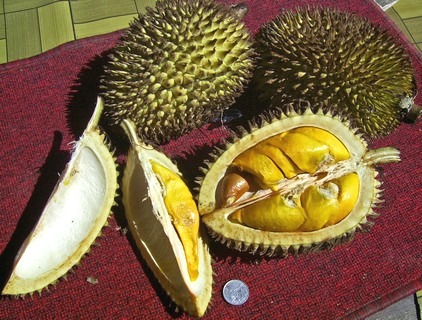
    Durian is perhaps the strangest thing I’ve eaten in nearly six decades on planet Earth. Many refer to it as the “king of fruits” as its taste and texture are wonderful, resembling an aromatic banana custard, but at the same time it has a distinctly off-putting smell somewhat akin to a mixture of rotting flesh and faeces. Indeed, durian is so smelly that it’s not allowed on public transport in Singapore and hotels, hospitals and other public buildings in other countries. In addition, as you can see from the image below, it looks like a weapon or munition designed by a botanist.

    Image of durian fruit
    Durian – image courtesy of Wikimedia Commons

    My friend Mr Wong has let me know that it’s now the height of the durian season in his native Borneo and according to a Borneo Post report, “There are so many durians coming in daily that Sibu Central Market is being flooded with the king of the fruits”.

    This glut on durians means aficionados in Borneo can indulge their passion for as little as the equivalent of 10p per fruit, as opposed to the prices charged by oriental supermarkets in the UK, which often run to double figures in pounds sterling.

  • Forbidden food

    Throughout human history there has always been forbidden food – the fruit of the tree of knowledge in the Old Testament, the various dietary restrictions imposed upon devotees by religion (e.g. kosher, halal, etc.) and the like.

    In addition to these there are other prohibitions imposed by other considerations, such as the cost of getting something to market. Other factors include whether something is (or is regarded as) a local speciality and is hence doesn’t travel – or not very far anyway. One such English local speciality is not available as far south as Bristol*, although it does travel north into Lancashire (it’s available in Sainsbury’s in Darwen by Blackburn. Ed.); and that’s the North Staffordshire oatcake.

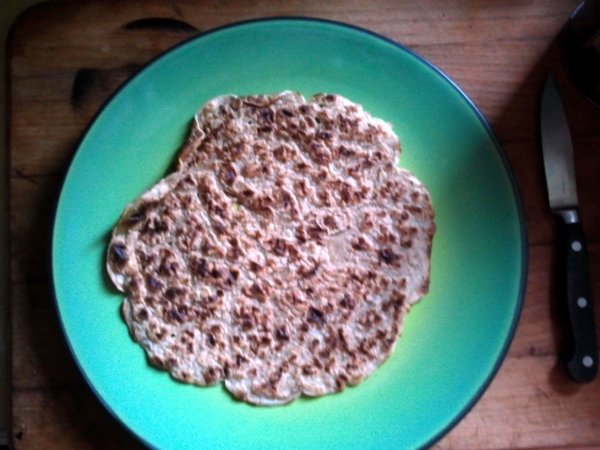
    Staffordshire oatcake before filling
    North Staffordshire Oatcake awaiting filling

    According to Wikipedia, a North Staffordshire oatcake is a type of pancake made from oatmeal, flour and yeast. It’s cooked on a griddle or ‘baxton’. The oatcake is a local speciality in the North Staffordshire area of England. They are normally referred to as Staffordshire oatcakes or possibly Potteries oatcakes by non-locals, because they were made in this area. In and around Staffordshire and Cheshire they are often simply known as oatcakes.

    North Staffordshire exiles are fortunate that they can now order this local delicacy online from such companies as Newcastle’s North Staffs Oatcakes Ltd and Biddulph’s Povey’s Oatcakes, to name but two.

    As regards the location of oatcake shops in the Potteries and surrounding area, My Tunstall has helpfully provided an oatcake shops map. Earlier this year, a legendary oatcake shop, the Hole in the Wall closed due to a council compulsory purchase order. It was so called because the oatcakes were served to customers in the street via the front window and Stoke City Council should hang its head in shame at its destruction of the area’s heritage. Vic, my late stepfather, used to buy his oatcakes at the Hole in the Wall.

    The furthest recorded oatcake shop from the banks of the Trent can be found in Auckland, New Zealand, where an expatriate Leek resident has set up business.

    My oatcakes were bought from TJ Oatcakes & Sandwich Bar of 589 Leek Road, Hanley, ST1 3HD (map), just a short walk down the hill from my mother’s place. At TJ’s the oatcakes come in half dozen packs and are packaged in unbranded, anonymous clear plastic bags.

    Turning to the oatcake’s history, the oatcake is believed to date back to at least the 17th century when the oatcake was the staple diet of North Staffordshire people. It is thought that due to long hard winters, farmers grew oats instead wheat; the farmers’ wives would then bake the milled flour mixture on a bakestone for family members and farm workers. At that time oatcakes were quite likely to be eaten with lard, fat or cheese. During the 19th Century a cottage industry sprang up, with oatcake makers often making more than was needed and taking them in baskets to sell in the markets and streets. In the 20th century the more successful bakers built brickrooms in their yards in which to bake oatcakes from. Their front rooms would then serve as the the shop front, selling oatcakes through the sash windows, as in the Hole in the Wall above.

    Oatcakes are traditionally served with fillings such as cheese, tomato, onion, bacon, sausage and egg, plus brown or tomato sauce. They can also be eaten with sweet fillings such as golden syrup, jam or banana, but this is less common and is frowned upon by traditionalists. Mine were consumed in traditional manner, but with mushrooms added to the sausage/bacon filling. ๐Ÿ™‚

    * = If anyone does find anywhere in Bristol selling North Staffordshire oatcakes, please let me know. Thanks!

Posts navigation