• Dumb Britain surfaces in Easton

    For many years – longer than your ‘umble scribe chooses to remember – satirical magazine Private Eye has featured a column entitled Dumb Britain, which documents the hilariously wrong and ingorant answers given by contestants on television quiz shows.

    However, dumbness in the form of lack of knowledge, intelligence or common-sense is not confined to the small screen; myriad examples may be found in real life, as evidenced by the photograph below taken in St Mark’s Road (note the apostrophe, Bristol City Council! Ed.) in Easton last week when the street was undergoing road works.

    Junction of St Mark's Road and High Street whowing No Entry sign plus Road Ahead Closed sign.

    Maybe Private Eye should expand the criteria for Dumb Britain.

  • Status milestone for Kernewek, plus Scots and Gaelic

    The last week has been a good one for specific regional languages in the Untied* Kingdom, namely Kernewek (Cornish), Scots and Gàidhlig (Scots Gaelic).

    Firstly, Kernewek.

    Cornwall County Council has announced that Kernewek will be recognised alongside Welsh, Irish Gaelic and Scots Gaelic after the government recommended it for Part III status – the highest level of protection under European treaty.

    This outcome is the result of years of hard work by Cornwall Council, community groups and cultural organisations dedicated to protecting Kernewek. It officially recognises the importance of Cornish as a living language and a core part of the county’s cultural identity.

    Cornish language receives Part III status. Kernwek gets same recognition as Welsh, Irish Gaelic and Scots Gaelic

    Since 2002, there has been a Kernewek revival across the county.

    In 2024-2025, over a million searches were made using the online Cornish dictionary and Cornwall Council’s Cornish Language Team received more than 650 requests, translating more than 32,000 words into Kernewek – up 22% from the previous year.

    In addition, more than 200 people sign up for Kernewek classes each year and almost 6,000 schoolchildren are having fun with the Cornish language through the Go Cornish for Primary Schools programme, commissioned by Cornwall Council.

    “This is brilliant news for Cornwall. Achieving Part III status reflects years of hard work by Cornwall Council, our partners and the many community groups who have fought to keep the Cornish language alive. To see Cornish recognised alongside Welsh, Scottish Gaelic and Irish Gaelic is something we can all be extremely proud of,” remarked council leader Leigh Frost.

    Meanwhile in Scotland the Gaelic and Scots languages have gained official status in an “historic milestone”. Nation.Cymru reports that this one of a range of measures which come into force on November 30 (which also happens to be St Andrew’s Day. Ed.) through the Scottish Languages Act.

    “St Andrew’s Day is a fitting time to celebrate Scotland’s identity by recognising Gaelic and Scots as official languages,” said Scotland’s Deputy First Minister Kate Forbes.

    Ms Forbes also stated: “To support the continued growth of both languages the Scottish Government has already allocated £35.7 million for Gaelic and Scots initiatives this year, ensuring that this milestone translates into meaningful change for communities across the country.”

    Other measures in the Act include supporting the creation of areas of linguistic significance in Gaelic communities so that ministers can better target policies to support the language.

    Latest census statistics show that 130,161 people in Scotland had some Gaelic skills in 2022, an increase of 43,105 from 2011, whilst the same source also reveals that 2,444,659 people in Scotland had some Scots skills in 2022, an increase of 515,215 from 2011.

    * = Not a typographical error.

  • Evolution

    Life forms are not the only things that undergo evolution, i.e. a change in characteristics over generations and/or time.

    This is also true of technology. One only has to compare and contrast one’s present operating system and its applications and what was in use twenty years ago, for example.

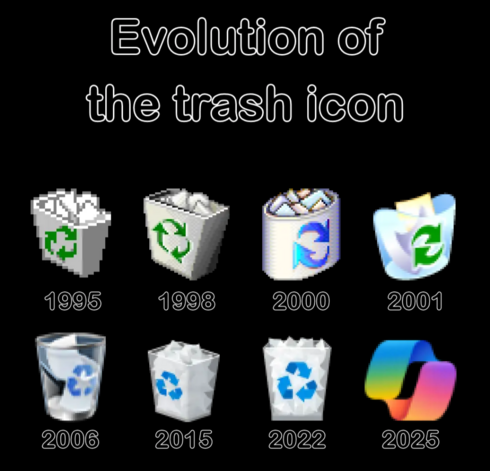
    That brings us neatly to the graphic below acquired from social media, which sarcastically tracks the progress of the trash icon on Microsoft’s Windows desktop over the decades.

    Evolution of the trash icon through various Windows releases and ending with the Copilot AI icon

    For those unfamiliar with the final icon on the bottom right, it’s that of MS’ Copilot generative artificial intelligence chatbot, which has not been without criticism. Indeed, one Microsoft Tech Community post has even called the software a “frustrating flop in AI-powered productivity“.

    More specifically, the post states:

    Here’s the problem: when you ask Copilot to alter a document, modify an Excel file, or adjust a PowerPoint presentation, it’s practically useless. Instead of performing the tasks as requested, it often leaves you hanging with vague suggestions or instructions. Users don’t want to be told how to perform a task—they want it done. This is what an AI assistant should do: execute commands efficiently, not just offer advice.

    If the MS tech enthusiasts are less than impressed, your ‘umble scribe need say no more!

  • Commission eyes up Microsoft and Amazon – again

    EU flagLast week the EU Commission announced it had opened three market investigations into cloud computing services under the Digital Markets Act (DMA). Two of these investigations will assess whether Amazon and Microsoft should be designated as gatekeepers for their cloud computing services, Amazon Web Services and Microsoft Azure under the DMA, i.e. whether they act as important gateways between businesses and consumers, despite not meeting the DMA gatekeeper thresholds for size, user number and market position. The third market investigation will assess if the DMA can effectively tackle practices that may limit competitiveness and fairness in the cloud computing sector in the EU.

    sticker text reads there is no cloud just other people's computers
    Market investigations into Amazon Web Services and Microsoft Azure

    Recent analyses of cloud markets seem to indicate that tMicrosoft Azure and Amazon Web Services occupy very strong positions in relation to businesses and consumers. The Commission will also assess if certain features of the cloud sector may further reinforce the position of Microsoft Azure and Amazon Web Services.

    If the Commission finds that Microsoft Azure and Amazon Web Services qualify as important gateways under the DMA, these would be added to the list of core platform services for which Amazon and Microsoft have already been designated as gatekeepers.

    Market investigation on the DMA’s application to cloud markets

    Furthermore, the Commission is also gathering information from relevant market players to assess whether the current obligations under the DMA are effective in addressing practices that limit competitiveness or are unfair in the cloud sector. Amongst other things, the investigation will cover obstacles to interoperability between cloud computing services, limited or conditioned access for business users to data, tying and bundling services and potentially unfair contractual terms.

    Next Steps

    Should the Commission conclude Microsoft and Amazon meet the criteria to be designated as gatekeepers for their cloud computing services under the DMA, Amazon and Microsoft would have six months to ensure full compliance of their designated cloud computing services with the DMA obligations.

    The market investigation on the DMA’s application to cloud markets will result in a final report to be published within 18 months, which may propose the update of DMA obligations in respect to cloud by way of a delegated act pursuant to Article 12 and 49 DMA.
  • Advice to an elderly aunt in legal difficulties

    Panorama logoPanorama is a current affairs documentary news programme broadcast by the BBC. First aired in 1953, it is the world’s longest-running television news magazine programme.

    However, Panorama’s longevity has not shielded it from controversy, especially when it has committed a foolish act, as has come to light in the past few days.

    A Panorama programme broadcast in Novermber 2024 about one of the runners’ suitability as a candidate for the presidency of the United States touched on the storming of the US Capitol on 6th January 2021 following an inciteful speech given to rioters by the disgraced former 45th president and current disgraceful 47th president of the United States of America, insurrectionist, convicted felon, adjudicated sexual predator, business fraudster, congenital liar and golf cheat commonly known as Donald John Trump, who is on a personal mission to Make America Grate Again (or something similar. Ed.).

    Panorama’s great sin was to edit Trump’s speech (a necessity for the sake of coherence in most instances whenever President Felon opens his north and south for more than 10 seconds. Ed.) so it appeared even more inciteful than it already was, even though the hardcore MAGA louts had no intention of peacefully protesting. The editing was criticised in an internal BBC report, which somehow found its way into the hands of the Telegraph. Often regarded as the in-house journal of the Conservative Party, the Telegraph is no great fan of Auntie.

    Once the leaked memo’s contents became known the media, media spokespeople and politicians all reacted. In particular, Karoline Leavitt (President Rapist’s Mouth of Sauron. Ed.) characterised the BBC as “100% fake news”.

    Heads rolled as a consequence of the subsequent furore, namely those of the Director General Tim Davie and the broadcaster’s head of news, Deborah Turness.

    However, that was not the end of the fallout. tRump, a man with a very thin skin and a vindictive lust for vengeance against every perceived slight, has threatened the BBC with a lawsuit for $1 bn. if there is no retraction of the “false, defamatory, disparaging, misleading, and inflammatory statements” allegedly made by Panorama.

    The letter from President Golf Cheat’s lawyers state that the demand is being made under Florida Statute § 770.011, which as far as your ‘umble scribe’s limited legal knowledge stretches, is not applicable under the law of England and Wales. If defamation litigation is planned in Florida, it would not stand a chance if the Panorama programme in question – Trump: A Second Chance? – has not been broadcast in Florida itself.

    Furthermore, if the case were held in England and Wales under the applicable law, there’s a further snag: a term limiting litigation for libel cases. The Independent notes that when interviewed by the BBC, British media lawyer Mark Stephens explained as follows:

    The UK defamation claim is now out of time. He had one year from Monday October 28, 2024, when Panorama aired so he is 14 days out of time or so in the UK.

    President Business Fraud’s lawyers’ letter to the BBC merits a reply, of course. Your correspondent’s opinion is that Auntie’s legal advisers should reply along the lines of the 1971 Arkell vs. Pressdram case. Pressdram is the proprietor of the satirical magazine Private Eye and its reply in this matter was as follows.

    We acknowledge your letter of 29th April referring to Mr J. Arkell. We note that Mr Arkell’s attitude to damages will be governed by the nature of our reply and would therefore be grateful if you would inform us what his attitude to damages would be, were he to learn that the nature of our reply is as follows: fuck off.

    The case was subsequently dropped.

  • Core VLC developer receives European SFS Award 2025 at SFSCON

    VLC logoThe VLC media player is a great piece of software which your ‘umble scribe has been using since he was rookie on Windows 9* machines

    What makes it greater is that it’s open source software and is one of the recommendations on my free and open source software page.

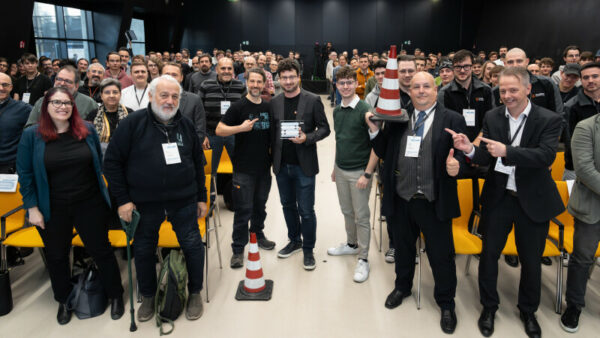
    It’s just been announced that the Free Software Foundation Europe (FSFE) and the Linux User Group Bolzano-Bosen-BUlsan (LUGBZ) have presented VLC president and core developer Jean-Baptiste Kempf with the European SFS award at the Bozen Free Software Conference (SFSCON) for his long-term dedication to the project. What began as a student initiative has, through his continuous effort, evolved into one of the most widely used media players with hundreds of millions of users worldwide.

    Jean-Baptiste Kempf  receives his award.
    Picture by NOI Techpark – Marco Parisi CC-BY-SA 4.0.

    Born as a student project in 1996, this software has evolved into an essential, all-in-one media player that plays almost anything effortlessly. Originally a simple network streaming client, it has grown into a powerful universal media player that continues to evolve and impress.

    For many people running non-free operating systems, it was the very first Free Software they ever installed. For many people running Free Software, it saved them from installing and booting into a proprietary operating system”, declared FSFE president Matthias Kirschner during the award ceremony.

    Jean-Baptiste Kempf joined the project as a student and when it was in danger of dying after the graduation of its original developers, he took the reins. With the help of other core developers, he transformed it into the indispensable media player we enjoy on today.

    Over the years, Mr Kempf has become not only the president of VideoLAN, which hosts the project itself, but also one of the lead developers of VLC media player and the founder of VideoLabs. “It’s small, fast, friendly, and seems to understand everything you throw at it. I have always thought of it as the program that eats everything”, said Raphael Barbieri, a member of LUGBZ, during the winner’s announcement.

    Accepting the award, Mr Kempf said: “I am extremely honoured to receive the European SFS Award. The Free Software multimedia community is quite niche and unknown, but we work hard so that video content can be free, can be played and processed. The work done around the VideoLAN community has been tremendous, despite its little resources. I want to thank the whole VideoLAN and FFmpeg teams, who spend their time on those projects, often with little recognition“.

    The European SFS Award recognizes individuals whose work has made a significant and sustained difference in advancing Free Software across Europe. Since 2023 it has been presented jointly by LUGBZ and the FSFE and honours those whose efforts strengthen software freedom, community building and the ethical foundations of technology.

  • Australia initiates consumer protection proceedings against Microsoft

    Microsoft 365 ;ogoThe Australian Competition & Consumer Commission, which is responsible for ensuring individuals and businesses comply with Australian competition and consumer protection laws has announced that it has initiated proceedings in the Federal Court against Microsoft Australia and its parent company Microsoft Corporation for allegedly misleading approximately 2.7 million Australian customers when giving notice of subscription options and price increases after it integrated its Copilot AI assistant into Microsoft 365 subscription plans.

    The ACCC alleges that since 31st October 2024, Microsoft has told Microsoft 365 Personal and Family plan subscribers with auto-renewal enabled that to maintain their subscription, they must accept the integration of Copilot and pay higher prices for their plan, or else cancel their subscriptions.

    Copilot logoFollowing the integration of Copilot, the annual subscription price of the Microsoft 365 Personal plan increased by an eye-watering 45% from $109 to $159. In contrast, the annual subscription price for the Microsoft 365 Family plan increased by a mere 29% from $139 to $179.
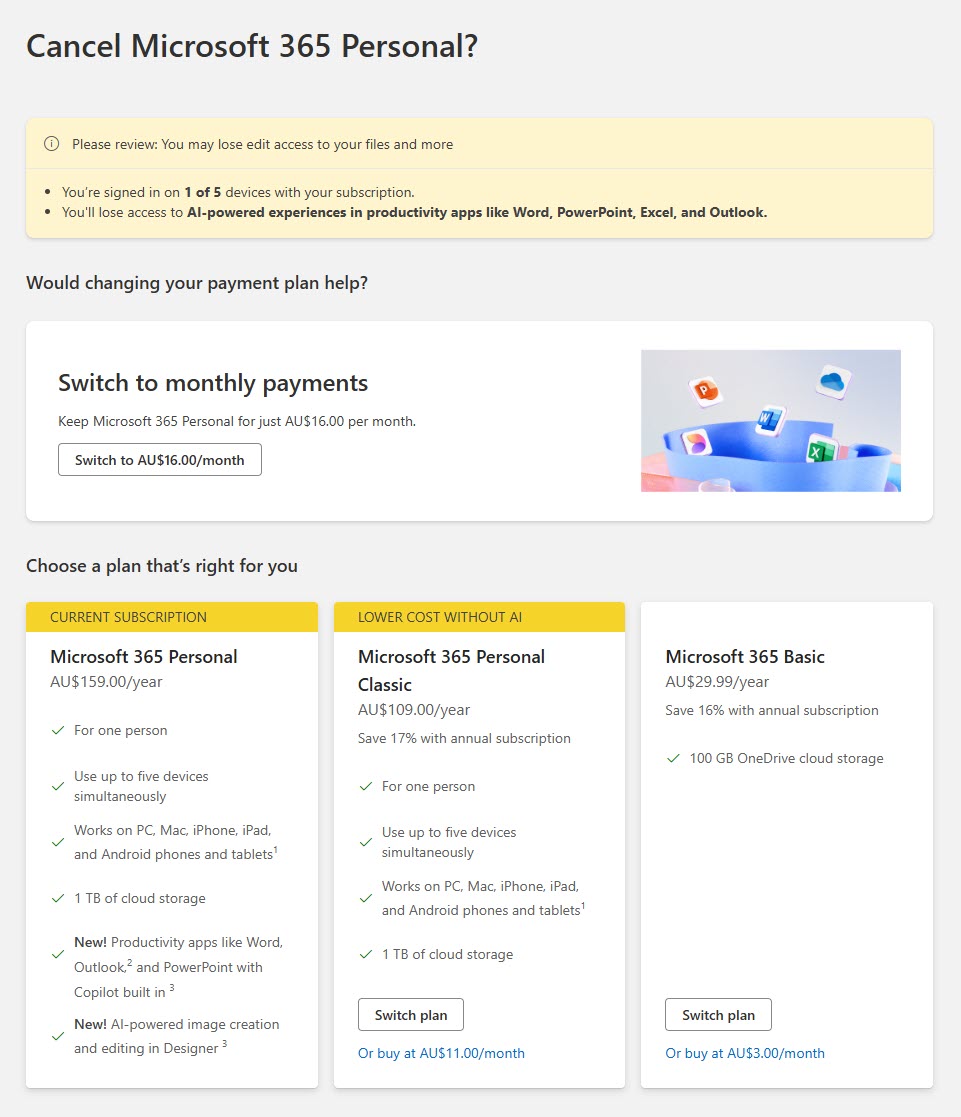

    Microsoft’s communications with subscribers did not refer to the existence of the “Classic” plans without Copilot integration and the only way subscribers could access them was to begin the process of cancelling their subscriptions. This involved accessing the subscriptions section of their Microsoft account and selecting “Cancel subscription”. It was only on the following page that subscribers were given the option to move to the Classic plan instead.

    MS cancel subscription screenshot
    Click on the image for the full-sized version

    Maximum penalties

    Should Microsoft lose the case, the maximum penalty for each breach of the Australian Consumer Law is the greater of the following three options:

    • $50 million;
    • three times the total benefits that have been obtained and are reasonably attributable; or
    • if the total value of the benefits cannot be determined, 30 per cent of the corporation’s adjusted turnover during the breach turnover period.

    For Microsoft Australia, not to mention its parent company, the emphasis in the word consumer is firmly on its first three-letter syllable.

  • LibreOffice 25.2.7 released

    The Document Foundation (TDF) has today announced the release of LibreOffice 25.2.7, the final maintenance release for the LibreOffice 25.2 family, which is now available for download. Users of LibreOffice 25.2.x should update to LibreOffice 25.8.x, as LibreOffice 25.2.x is approaching the end of its support period.

    Libre Office banner

    LibreOffice 25.2.7 fully supports two ISO document format standards: the open ODF or Open Document Format (ODT, ODS and ODP) and the closed proprietary Microsoft OOXML (DOCX, XLSX and PPTX) formats.

    Products based on the LibreOffice Technology are available for all major desktop operating systems (Windows, macOS, Linux and ChromeOS), mobile platforms (Android and iOS) plus the cloud.

    For business use, TDF recommends a LibreOffice version optimised for businesses from one of its partner companies, with dedicated value-added features and other benefits such as service level agreements (SLAs) and security patch backports for three to five years.

    Manuals for the LibreOffice 25.2 family are also available in many languages for download. Furthermore, end users can get first-level technical support from volunteers on the user mailing lists and the Ask LibreOffice website.

    Finally, LibreOffice users, free software advocates and community members can support The Document Foundation and the LibreOffice project by making a donation.

  • ICC to ditch Microsoft

    The International Criminal Court (ICC/CPI) in The Hague wants to become independent of US technology out of fear of reprisals from Donald Trump, the vindictive and bullying forty-seventh president of the United States (who is on a mission to Make America Grate Again, or something similar. Ed.), German news site heise reports.

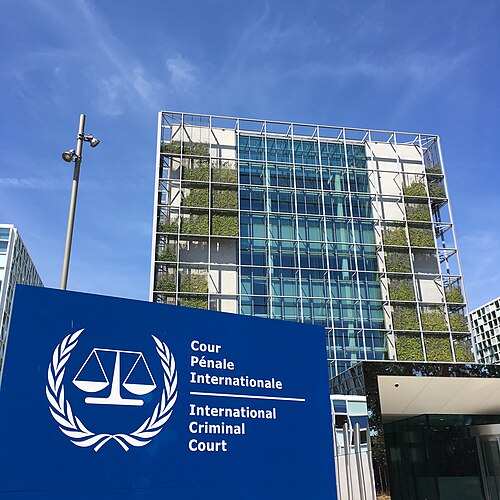
    The International Criminal Court in The Hague
    The International Criminal Court in The Hague.
    Image courtesy of Wikimedia Commons.

    The institution plans to replace the Microsoft software currently used in its workplaces with OpenDesk, an open source software suite currently being developed by Zendis, a company owned by the German Federal government.

    The decision was taken due to the sanctions imposed by the current US Trump regime against court employees such as Chief Prosecutor Karim Khan, under which Microsoft simply blocked Mr Khan’s access to email account. He was therefore forced to switch to the Swiss email service Proton. Back in May the ICC/CPI stated its work had virtually been paralysed due to its heavy reliance on service providers like Microsoft.

    Furthermore, it is believed the US government in Washington is considering further measures against the International Criminal Court, which could also severely restrict its ability to function.

    Achieving Digital Sovereignty

    While the International Criminal Court only has 1,800 employees that need to be freed from dependency on US software, this can be regarded as a sign that geopolitics is increasingly concerned with technology. Business and politics recognise the dependence on US tech companies is a problem, particularly because the current US regime is using technology as a bargaining chip.

    The ICC/CPI is not alone in moving away from the Beast of Redmond: for example, the German Army has also concluded a framework agreement with Zendis for “sovereign communication and collaboration solutions” such as OpenDesk.

  • High gains grifter

    In the May 2024 general election, the constituency of Clacton returned a member of parliament to the House of Commons, not just an ordinary MP, but a party leader, in this instance one Nigel Paul Farage, head honcho of Reform UK, the latest incarnation of the Farage Fascist Fan Club (see also UKIP and the Brexit Party. Ed.).

    During his days as a member of the European Parliament, Farage was not the most regular attendee in the debating chamber, although he was more than prepared to take the parliament’s generous salary and allowances, even misusing the latter for his own ends rather than those for which they were intended.

    Anyway, enough of past history, let’s come up to the present. Since being elected to the green leather benches, Farage has had difficulty finding the Palace of Westminster to do the job he’s supposed to do for the good burghers of Clacton. Furthermore, he’s also had problems finding Clacton, although his partner has bought a house in the constituency, although the source of the funds for the deal is unsure.

    However, just because he’s happy to take his MP’s salary of nearly £94,000 per year for the work he is expected to do for his electorate and mostly manages to avoid, this does not mean Farage is workshy. Indeed, one glance at his Register of Financial Interests (which runs to two pages. Ed.) reveals the Reform leader is earning over £1m from sources other than the largesse he receives courtesy of the taxpayer.

    This has prompted the Led By Donkeys collective (posts passim) to film a video of his extra-parliamentary earnings and trundle it around the streets of Clacton, as well as its being circulated on social media.

    This latest activity has not escaped the attention of the local media, including the Clacton Gazette, which prefers to refer to Farage’s income declared in the parliamentary register as a claim from Led By Donkeys. This places the Clacton Gazette in clear breach of article 1 – accuracy – of the IPSO guidelines. The Gazette claims (their word. Ed.) to be regulated by IPSO, another of the UK’s regulators, all of whom seem to come with rubber teeth as standard equipment.

    Furthermore, in the comments below the piece most of the constituents of Nigle, as some call their dishonourable member, seem to believe he can do no wrong.

Posts navigation