• Gerrymander, Jacob?

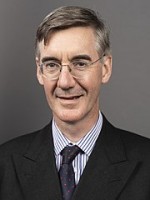
    Jacob Rees-MoggJacob Rees-Mogg, whom the voters of North East Somerset were foolish enough to elect as their Member of Parliament, has a reputation for not living in the present. So much of a problem that Tim Fenton of Zelo Street refers to him as “the member for times past“.

    It now appears Jacob has trouble in understanding the English language too.

    Yesterday’s Independent carries a report on The Mogg’s speech to the far-right National Conservatism conference yesterday in which he criticised the new voter photo ID rules that were introduced in time for the recent local government elections in England, elections in which the Tories did particularly badly, losing over 1,000 council seats.

    In his speech, The Mogg stated the following:

    Parties that try and gerrymander end up finding their clever scheme comes back to bite them – as dare I say we found by insisting on voter ID for elections.

    We found the people who didn’t have ID were elderly and they by and large voted Conservative, so we made it hard for our own voters and we upset a system that worked perfectly well.

    Gerrymander, Jacob?

    Voter suppression, surely?

    It’s at this point that a dictionary comes in handy. The dictionary definition is “to divide an area into election districts (= areas that elect someone) in a way that gives an unfair advantage to one group or political party.”

    One would have thought someone who has been a politician as long as The Mogg would know that, but poor old Jacob was badly educated, first at Westminster Under School, followed by Eton College and finally at Trinity College, Oxford.
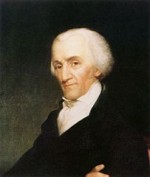
    Portrait of Elbridge GerryAs regards gerrymander itself, it has an interesting etymology. It’s a portmanteau word originating from the USA in 1812. The gerry element is a reference to Elbridge Gerry, one of the country’s Founding Fathers, whilst the mander element is derived from salamander.

    While Governor of Massachusetts, Gerry signed into law a bill that rearranged the state’s electoral districts to give advantage to the Democratic-Republican Party, although Gerry himself was said to disapprove of the practice. When mapped, one of the contorted districts in the Boston area was said to resemble a mythological salamander. Thus the term was born with its spread and popularity sustained by a political cartoon depicting a strange animal with claws, wings and a dragon-like head that supposedly resembled the oddly shaped district.
  • Bristol Live exclusive – Scillies move south

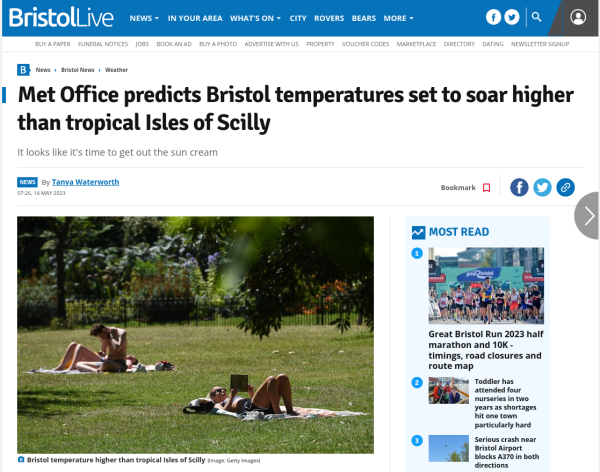
    Today’s Bristol Post contains a hidden exclusive tucked away in an article about the local weather forecast.

    Met Office predicts Bristol temperatures set to soar higher than tropical Isles of Scilly

    Tropical Isles of Scilly?

    Last time your ‘umble scribe looked, the Scilly Isles were an archipelago 45 km south-west of the Cornish peninsula. This means either the British Isles have migrated south towards the equator or the reverse has happened, i.e. the equator has moved north towards dear old Blighty, as there’s is now way in which the Scillies merit being defined as tropical. In either case plate tectonics has been working overtime or planet Earth has tilted drastically on its axis recently.

    The definition of tropical is from or relating to the area between the two tropics.

    The two tropics are defined in latitude by the Tropic of Cancer in the Northern Hemisphere at 23°26′10.5″ (or 23.43625°) N and the Tropic of Capricorn in the Southern Hemisphere at 23°26′10.5″ (or 23.43625°) S. The Scillies lie at a latitude of 49°55′N. On the other hand, it’s not a hidden exclusive but bad journalism, possibly influenced by belonging to the Reach plc stable, which also includes the Daily Brexit (which some still call the EXpress. Ed.), a title long renowned for lurid and misleading coverage of matters meteorological.

  • Here is the BBC ‘news’

    If, dear reader, you thought news content of the ‘man stubs toe on pavement‘ variety and gossip about alleged celebrities was confined to titles in the Reach plc and Newsquest Media Group media stables, it might be time to think again.

    The BBC has long vaunted the quality of its news coverage. However, its reputation has long been questioned; and not merely because of its proximity to and membership of the British Establishment, about which the late historian A.J.P. Taylor once remarked:

    The Establishment draws in recruits from outside as soon as they are ready to conform to its standards and become respectable. There is nothing more agreeable in life than to make peace with the Establishment – and nothing more corrupting.

    Anyway, back to Auntie…

    By trying to make the news accessible to all, it has invariably indulged in omission and simplification, actions that could be covered by the phrase ‘dumbing down‘. If one wants in-depth analysis of the news, the BBC is not the place to look. Try the broadsheet newspapers or weekly political and economics journals instead.

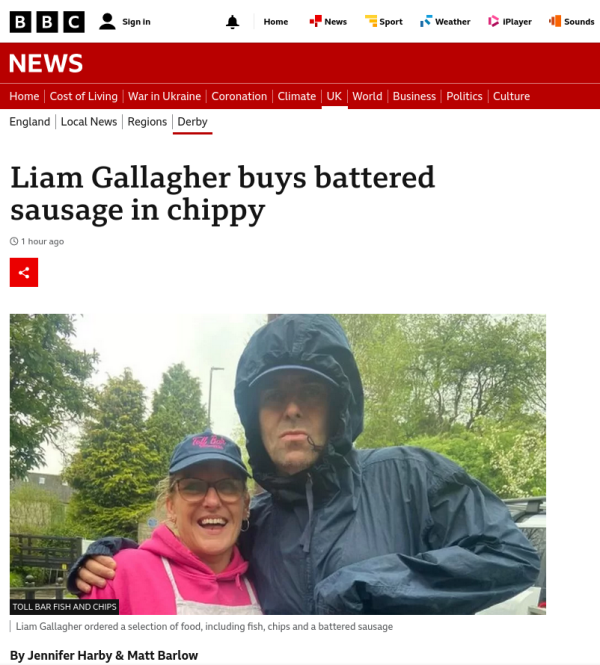
    The combination of irrelevant non-news and dumbing down was exemplified this week by one article yesterday on the BBC ‘News‘ website, as per the screenshot below.

    Headline reads Liam Gallagher buys battered sausage in chippy

    Even more remarkably, this non-story of nearly 270 words, which also drops more names than the prominent member of a 1960s tribute band mentioned in the headline, took two so-called journalists to write it.

    Most likely in crayon. 😀

  • EU Parliament wants to protect Free Software in AI regulation

    FSFE logoToday the Free Software Foundation Europe (FSFE) reports that the European Parliament’s two competent committees – the Committee on Internal Market and Consumer Protection (IMCO) and the Committee on Civil Liberties, Justice and Home Affairs (LIBE) – today voted by a large majority to protect Free Software in the EU’s AI Regulation. Furthermore, non-profit organisations and small Free Software projects up to the size of micro-enterprises, are largely to be exempted from this regulation.

    In addition, the FSFE comments that this principle must be anchored in the Cyber Resilience Act and Product Liability Directive and the parliament’s forthcoming votes.

    Alexander Sander, FSFE’s Senior Policy Consultant, explains as follows:

    Instead of putting the responsibility on the Free Software developers, it should be put on the companies that profit from it on the market. Smaller organisations and non-profit activities, for example by foundations, must be excluded. With this vote, the Members of the European Parliament are thus recognising the reality of Free Software development and trying to protect it. The principle of transferring responsibility and liability to those who profit on the market instead of focusing on developers must also be anchored in the Cyber Resilience Act and the Product Liability Directive. This is the only way to not only protect Free Software and its contributors but also consumers and customers.

    The final vote on the AI Act is expected in the next few weeks, after which discussions on the final text will take place between the Parliament, Council of Ministers and the Commission. The Parliament is currently discussing the amendments to the Cyber Resilience Act and the Product Liability Directive which have been submitted.

  • The writing on the wall

    Expressing political opinions on walls is a practice that reaches back at least 2,000 years to Roman times – as in the case of Pompeii and other Roman towns and cities – and possibly even earlier.

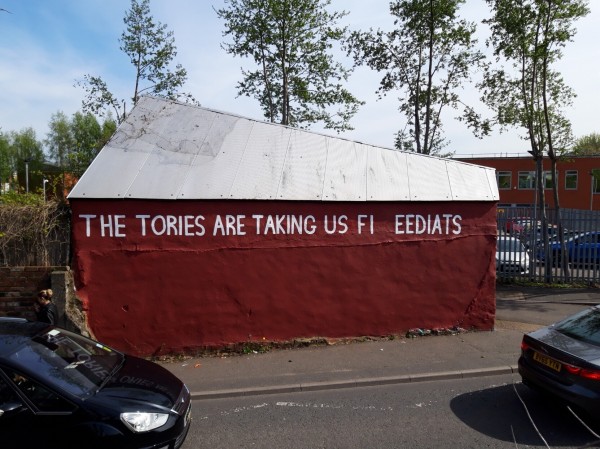
    One wall at the start of Whitehall Road in Bristol has displayed various messages – all of them anti-Conservative – over the years (see posts passim here and here. Ed.), of which the one below is the latest.

    The Tories are taking us fi eediats

    It appeared some time before last week’s English local government elections. However, your ‘umble scribe does not know the extent to which this particular slogan contributed to the Nasty Party’s disastrous losses of over 1,000 council seats and – more locally – its loss of overall control of South Gloucestershire seeing as it lies on a well-used commuter and bus route between the city and that neighbouring local authority.

  • Auntie crosses the Atlantic

    The BBC has always prided itself on the high standard of its English, both spoken and written.

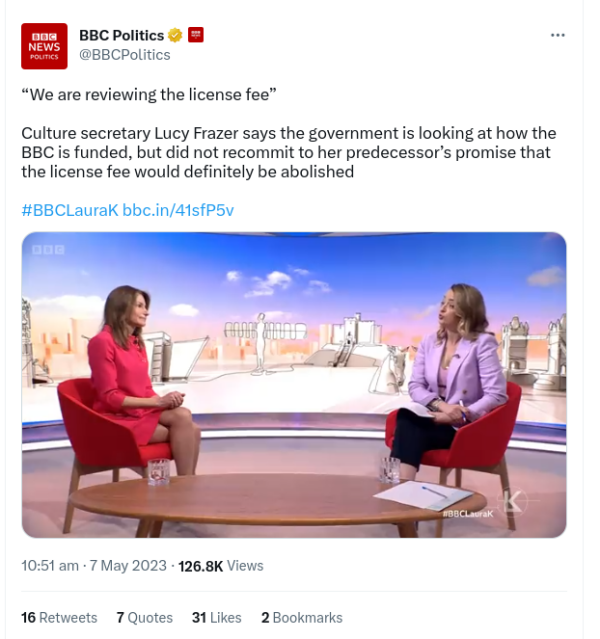
    However, that may well a thing of the past if one of today’s social media offerings from the BBC Politics Twitter account (byline: the best of the BBC’s political coverage. Ed.) is to be believed.

    Tweet reads “We are reviewing the license fee” Culture secretary Lucy Frazer says the government is looking at how the BBC is funded, but did not recommit to her predecessor’s promise that the license fee would definitely be abolished.

    Yes, you did read that correctly; license [sic]; twice; in two sentences.

    Either Auntie is employing an American to curate the BBC Politics Twitter account or an illiterate.

    If the latter, some remedial English lessons are clearly needed, as well as practice, particularly if use of the verb to practise is contemplated in future. 😀

    In amongst the predictable responses from licence fee objectors and refuseniks, numerous replies to the tweet pointed out the basic orthographic difference between British and American English. However, no acknowledgement or correction of the error has been forthcoming over 10 hours after the original tweet was posted.

  • The poorest he…

    Thomas RainsboroughIn 1647 during the English Civil War a series of discussions – the Putney Debates – was held in St Mary’s Church, Putney between 28th October and 8th November about the political settlement that should follow Parliament’s victory over Charles Stuart, the arrogant autocrat commonly referred to by history as Charles I.
    A transcript of the discussions can be found here.

    The main participants in the debates were senior officers of the New Model Army who favoured retaining a monarch within the framework of a Constitutional monarchy, and radicals such as the Levellers who sought more sweeping changes, including One man, one vote and freedom of conscience, particularly in religion.

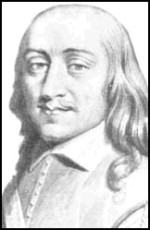
    Amongst those Levellers whose words were transcribed is Thomas Rainsborough (pictured right), a colonel in the army, who is on record as favouring government by the consent of the governed, as expressed below.
    I think that the poorest he that is in England hath a life to live, as the greatest he; and therefore truly, sir, I think it’s clear, that every man that is to live under a government ought first by his own consent to put himself under that government; and I do think that the poorest man in England is not at all bound in a strict sense to that government that he hath not had a voice to put himself under; and I am confident that when I have heard the reasons against it, something will be said to answer those reasons, in so much that I should doubt whether he was an Englishman or no that should doubt of these things.
    Rainsborough was in particular supported by John Wildman and Edward Sexby. Sexby’s most salient contribution to the debates is as follows:
    Our case is to be considered thus, that we have been under slavery. That’s acknowledged by all. Our very laws were made by our Conquerors… We are now engaged for our freedom. That’s the end of Parliament, to legislate according to the just ends of government, not simply to maintain what is already established. Every person in England hath as clear a right to elect his Representative as the greatest person in England. I conceive that’s the undeniable maxim of government: that all government is in the free consent of the people.

    These sentiments were opposed by senior officers in the New Model Army, particularly Henry Ireton, and especially as they feared universal suffrage would remove the privileges that property ownership bestowed upon them.

    In saying so, Rainsborough, Wildman and Sexby were men well ahead of their time, given the extremely limited nature of the franchise in those distant days. The franchise was not really increased to any great extent until the so-called Great Reform Act of 1832, which extended the right to vote (but still limited it by a property qualification) and abolished the so-called rotten boroughs. Even after the extension of the franchise, in a city the size of Bristol with a population at the time of over 100,000, only 15,000 had the vote. Working class men like my two grandfathers did not receive the vote until after World War One. At the same time the franchise was also extended to women over 30.

    The incompatibility of monarchy with democracy was highlighted and put to good comedic effect by the Pythons in their 1975 film Monty Python and the Holy Grail.

    You enjoy your bling bonnet day at our expense, Mr Mountbatten-Windsor, but just remember one thing: WE didn’t vote for you!

  • Behind the wheel …of a pub

    Down at the Temple Way Ministry of Truth, the ambiguity department has been hard at work.

    Again (posts passim).

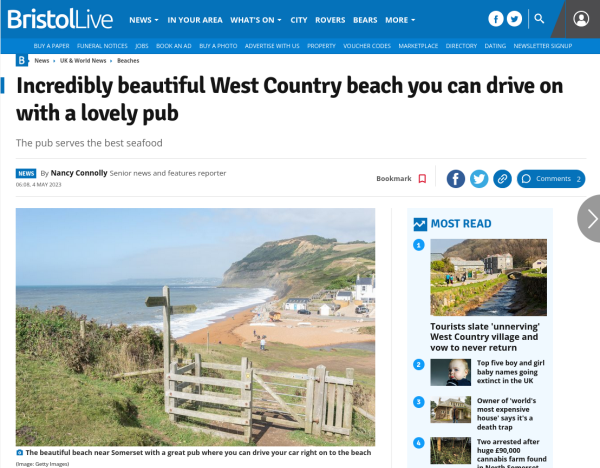
    Headline - Incredibly beautiful West Country beach you can drive on with a lovely pub

    One commenter rejoicing in the name saveenergy decided to have some fun with this latest illiteracy from the Post, as follows:

    “beach you can drive on with a lovely pub”

    What if you don’t drive a lovely pub ??

    Is it exclusively for drivers of lovely pubs, or can I drive my spit & sawdust bar on this beach; Are taverns, ale houses, inns & wine bars excluded ???

    We need to know.

    “There is a great pub right on the sea”

    How do they stop the drinks spilling when the sea is choppy ??

    Well done, sir or madam. Your ‘umble scribe could not have mocked the piece better himself. 😀

  • Community litter pick this Saturday

    Your ‘umble scribe will be ignoring all that nonsense in London SW1 involving Mr & Mrs Charles Mountbatten-Windsor for something far more vital to the health of the nation.

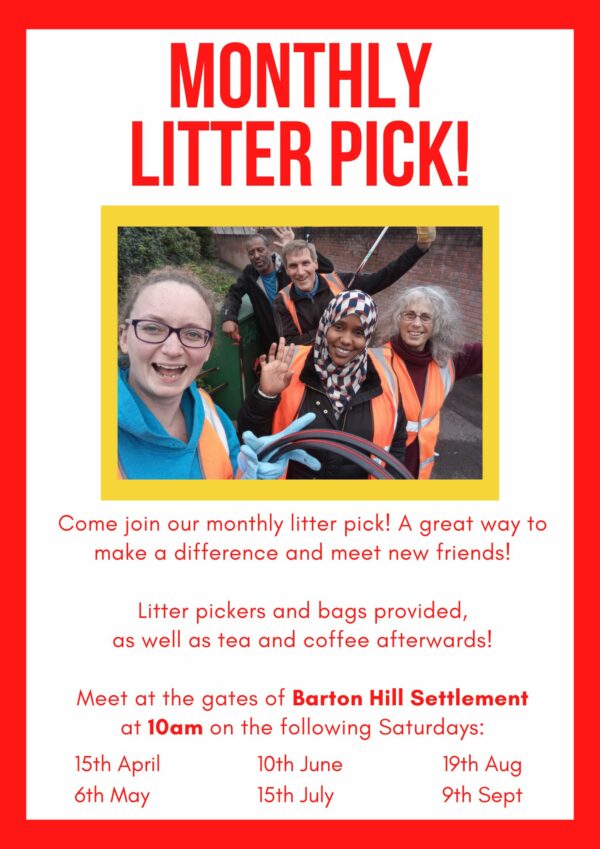
    Their bling bonnet day in Westminster unfortunately clashes with a regular event of local importance – the monthly Barton Hill community litter pick.

    Barton Hill community litter pick poster
    Stuff the coronation. This IS important!

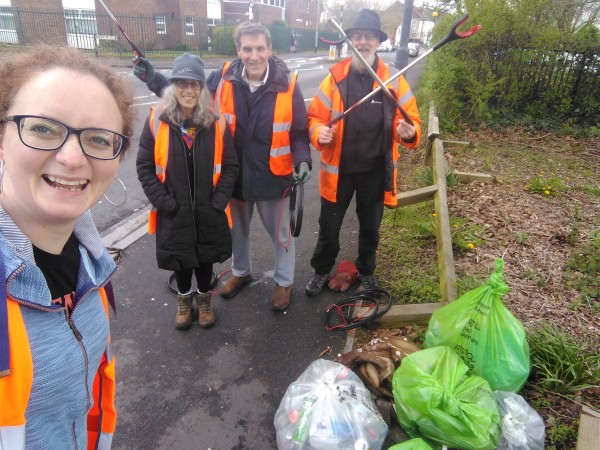
    Last month four of us turned out for an hour’s cleaning, managing to clear several bags of litter (as well as reporting half a dozen instances of fly-tipping. Ed.), having a bit of gentle exercise with tea and coffee afterwards, all punctuated by good company and good conversation.

    The end of April's litter pick

    If you can join us outside the Wellspring Centre (formerly the Settlement) at 10.00 am on Saturday, we’d be very pleased to see you.

  • Firefox Focus – first impressions

    Your ‘umble scribe is a great fan of the free and open source Firefox web browser and has been using the desktop version since version 0.x many years ago. One of its major attractions has been its emphasis on security and privacy.

    Until recently it was also the default browser on my smartphone, until I discovered Firefox Focus. Firefox Focus is a free and open-source privacy-focused mobile browser based on Firefox which is available for Android and iOS devices. First released in December 2015, it was initially a tracker-blocking application for mobile iOS devices, but was developed into a minimalistic web browser shortly afterwards.

    Firefox Focus iconAccording to Mozilla, Firefox Focus is a dedicated privacy browser with automatic tracking protection. meaning web pages load faster and your data stays private. It’s also easy to delete history, passwords and cookies, so advertisers and other ne’er-do-wells don’t follow you around online. Just tap the erase button on the search field and all that data is gone. Tracking protection is also very strong. The browser blocks a wide range of common trackers by default, including social trackers and those sticky ones that come from things like Facebook ads.

    After using Firefox Focus for one week, I can say I’m impressed with the way it works. Although it required me to learn how to use tabbed browsing (hint: hold down a link in your search results and a menu appears, offering the option to open the link in a new tab. Ed.), once that was cracked, I was away. As for fast page loading, that’s not disappointing either, even on notoriously slow-loading sites, like that of Bristol City Council, which still seems to be powered by a horse turning a shaft in the basement of the Counts Louse (which some call City Hall. Ed.). 😉

    If you value your privacy and security, I’d recommend Firefox Focus on your mobile device.

Posts navigation