Communication between the phone and the presentation rendering system will be handled via Bluetooth, according to a presentation given by LibreOffice developer Michael Meeks to FOSDEM 2013 in Brussels over the last weekend.
Crime has certainly changed since the heyday of the fictional Sgt. DixonAs this blog has previously noted (posts passim), from the author’s lofty perch in Bristol, North Somerset is a part of the UK that seems to live in an alternative reality (could this have something to do with the consumption of cider? Ed.).
Notwithstanding that, one could legitimately ask which is the greater crime: two irate petrolheads making idiots of themselves or the waste of police time and resources involved in its investigation?
Johannes GutenbergIt was said in the past that the development of the printing press and movable type by Johannes Gutenberg in 1450 was one of the great stimuli to the growth of human knowledge. Gutenberg’s work has been credited with laying the material basis for the modern knowledge-based economy and the spread of learning to the masses.
It has been mooted for several years that the development of the internet and online technologies will have an even greater impetus than the development of the printing press and movable type.
Gutenberg’s original work has in the internet era inspired the work of Project Gutenberg. I’ve written of Project Gutenberg before (posts passim). Project Gutenberg is the first and largest single collection of free electronic books or ebooks. The late Michael Hart, founder of Project Gutenberg, invented ebooks in 1971. Project Gutenberg’s ebooks are public domain, i.e. the copyright on the original works has expired, at least in the U.S.A., the jurisdiction to which Project Gutenberg is subject. Project Gutenberg has various sister projects, e.g. in Germany, Canada and Australia, which also publish books in the public domain subject to the terms of copyright legislation in their respective countries.
Copyright has a history that extends almost as far back as Gutenberg’s press. As a legal concept, its origins in Britain were from a reaction to printers’ monopolies at the beginning of the 18th century. Charles II was concerned by the unregulated copying of books and passed the Licensing of the Press Act 1662 by Act of Parliament,which established a register of licensed books and required a copy to be deposited with the Stationers’ Company, essentially continuing the licensing of material that had long been in effect. The first actual implementation of copyright as it is known today was the Statute of Anne (full title: “An Act for the Encouragement of Learning, by Vesting the Copies of Printed Books in the Authors or Purchasers of such Copies, during the Times therein mentioned.” Ed.), enacted in 1710. Under this statute copyright was limited to a term of 14 years.
Orwell – in the public domain since 2000 in Canada & AustraliaMuch has happened to copyright since the Statute of Anne. It has been introduced to jurisdictions throughout the world. It has also grown considerably in its term from the original 14 years. In the UK copyright exists on works for the author’s life plus 70 years. Canada is slightly more generous to the public domain: copyright is the author’s life plus a mere 50 years. This means that the works of (say) George Orwell, who died in January 1950, have been in the public domain in Canada since 2000, whilst in the UK they won’t enter the public domain until 7 years’ time in 2020.
The internet drives a coach and horses through differences in the length of copyright terms enshrined in national copyright legislation: if I so wanted I could freely download public domain copies of Orwell’s works from the Gutenberg sites in Australia or Canada to my hard drive in the UK; and I doubt very much whether those sites would stop me by blocking my IP address.
As the internet is such a great leveller, perhaps the best way forward is to implement changes to copyright terms so as to harmonise them at a consistent number of years. Whilst previous adjustments have been upwards (much to the benefit of major media corporations, such as those churning out Hollywood’s fantasy world/world view), a move in the opposite direction might be appropriate now. What would be so wrong with a maximum worldwide copyright term of 50 years? Wouldn’t that be long enough to make money off one’s created work? After all, other intellectual property rights have far shorter terms than copyright. For instance, the term of protection for a patent – another (and in my opinion more important) intellectual property right – is generally twenty years, whilst trade marks – so vital for commerce – are normally registered for a (renewable) term of ten years.
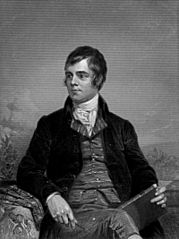
The Bard of Ayrshire. Picture courtesy of Wikimedia CommonsToday, 25th January is the birthday of Robert (or Rabbie) Burns (1759 – 21 July 1796), Scotland’s most celebrated poet. He is widely regarded as the national poet of Scotland and is celebrated worldwide. He is the best known of the poets who have written in the Scots language, although much of his writing is also in English and a light Scots dialect, making his works accessible to an audience beyond Scotland. He also wrote in standard English and this brought out his bluntest political and civil commentaries.
Burns is also regarded as a pioneer of the Romantic movement and after his death he became a great source of inspiration to the founders of both liberalism and socialism, as well as a cultural hero in Scotland and the Scottish diaspora around the world.
Rabbie’s birthday is now traditionally celebrated by a Burns Night supper, of which haggis is an essential ingredient, traditionally accompanied by ‘neeps’ (turnips or swede) and ‘tatties’ (potatoes). One gets the impression that Rabbie was rather fond of haggis, since in 1786 he wrote “Address To A Haggis”, which is reproduced below.
Fair fa’ your honest, sonsie face,
Great chieftain o’ the pudding-race!
Aboon them a’ yet tak your place,
Painch, tripe, or thairm:
Weel are ye wordy o’a grace
As lang’s my arm.
The groaning trencher there ye fill,
Your hurdies like a distant hill,
Your pin was help to mend a mill
In time o’need,
While thro’ your pores the dews distil
Like amber bead.
His knife see rustic Labour dight,
An’ cut you up wi’ ready sleight,
Trenching your gushing entrails bright,
Like ony ditch;
And then, O what a glorious sight,
Warm-reekin’, rich!
Then, horn for horn, they stretch an’ strive:
Deil tak the hindmost! on they drive,
Till a’ their weel-swall’d kytes belyve
Are bent like drums;
Then auld Guidman, maist like to rive,
Bethankit! hums.
Is there that owre his French ragout
Or olio that wad staw a sow,
Or fricassee wad make her spew
Wi’ perfect sconner,
Looks down wi’ sneering, scornfu’ view
On sic a dinner?
Poor devil! see him owre his trash,
As feckles as wither’d rash,
His spindle shank, a guid whip-lash;
His nieve a nit;
Thro’ blody flood or field to dash,
O how unfit!
But mark the Rustic, haggis-fed,
The trembling earth resounds his tread.
Clap in his walie nieve a blade,
He’ll mak it whissle;
An’ legs an’ arms, an’ hands will sned,
Like taps o’ trissle.
Ye Pow’rs, wha mak mankind your care,
And dish them out their bill o’ fare,
Auld Scotland wants nae skinking ware
That jaups in luggies;
But, if ye wish her gratefu’ prayer
Gie her a haggis!
Haggis, neeps and tatties.I’m looking forward to some haggis, neeps and tatties this evening at The Volunteer Tavern in St Judes, Bristol, beautifully prepared by Mark the chef, as well as a wee dram or two to wash it all down. I’m also looking forward to the other courses, starting with cock-a-leekie soup or Scotch broth for starters finishing with cranachan for dessert.
Furthermore, I might also have to find time to bone up on the Address above as I might have to do it.
If you are celebrating Burns Night too, do enjoy it!
According to the German IT news website Heise Online, the guardians of the French language known as the Commission Générale de Terminologie et de Néologiehave thought up (PDF, French) their own word for the English term “hashtag” which is widely used on the internet, particularly on the social media site Twitter. In the language of Voltaire the term for the keyword in tweets will in future be officially termed “mot-dièse”. “Dièse” is French for the hash symbol “#”, with which keywords in tweets are labelled, whilst “mot” is “word”, of course.
This attempt to preserve the purity of the French language was mainly met with ridicule on the internet. Heise’s report states that one Twitter user’s reaction after the publication of the new word in the French Official Journal on Wednesday, 23rd January was: “Apart from people of 70, who is seriously going to use this term?”
Will it catch on? Only time will tell; ultimately it’s those who use the language that determine its direction rather than any committee.
Update: since I first posted this article my French friend Julien has emailed to say: “Why the heck didn’t they choose the same word as Canada? “Mot-clic” makes way more sense…”. I cannot argue with that. 🙂
Spanish IT services company ElkarMedia S.L. reports (Spanish) that the municipality of Azpeitia in Spain’s Basque Country will be avoiding the maintenance costs involved in using Microsoft Office and saving up to €30,000-40,000 in 3-4 years since the company installed the free and open source LibreOffice office suite on the council’s computers.
LibreOffice for all your office suite needs: word processing, spreadsheets, presentations, database, drawing and formulas
In addition, ElkarMedia also provided training for council employees to enable them to use the new software.
The council has also made the following two decisions:
Any computers bought in the future will have a free and open source operating system. This will result in a saving of €100 per machine by avoiding the cost of a Microsoft Windows licence;
Servers will also use a free operating system; the council’s servers are replaced every 4-5 years and this will produce a saving of €5,000.
As an increasing number of court interpreters working for Capita/ALS have decided to withdraw their services, the following call to action has now gone out to interpreters signed up to the Ministry of Justice’s contract with ALS/Capita as part of the ongoing fiasco of court interpreting services in England and Wales (posts passim). The strike call – for that’s what it is – has been reproduced “as is”.
Dear ALS/CAPITA colleagues,
How have you embraced the ‘reward’ offered to you by Capita (former ALS) for all your hard work over the last 13 months or so? This so called ‘reward’ now translates into you having to drive long distances day or night for actually less than 20p per mile and robbed of your travel time every time (the calculation is made on the basis you are not paid for the first 2 hours and the first 20 miles of your return journey to the assignment venues). What rights or authority does ALS/Capita have to help themselves to the money they charged HMCTS for travel expenses whilst those amounts have not been paid to us in full from the very beginning and slashed furthermore with effect from January 8th 2013?
If we were to quantify the number of miles and hours of travel time they have not paid us in the last 13 months, we would quickly see that the amounts they help themselves to on our backs are quite copious to say the least. These amounts may well be part of the hundred millions of pounds in profit they parade on their website as being a financial success.
We, a large and increasing group of CAPITA (former ALS) interpreters covering different
languages in various parts of the country have decided that enough is enough and since the
January 7th 2013 we have stopped providing any kind of assistance and/or interpreting. We strongly believe that most of you one way or the other have already informed CAPITA’s language coordinators that you simply cannot afford to carry out any assignments at their imposed shameful rates of pay but despite that they have still pestered you with calls offering you even more interpreting assignments. The number of assignments offered to most of you has increased simply because a large number of interpreters like us have refused to take them on.
We have been informed that after the January 7th on numerous occasions some of our colleagues interpreters have been pressured and psychologically intimidated by the language coordinators and/or management by being told that ‘a note of your refusal to cooperate will be added to your profile which may affect your chances of getting any interpreting assignments for a long time’. This in itself is unacceptable and should be reported to the appropriate authorities with utmost haste. If you have suffered this kind of bullying please report it to us as soon as possible. It is time for all the appropriate bodies/govt. agencies to see CAPITA’s steel claw wrapped in velvet cloth and the proverbial bull set free in a China shop. It is time to join our brothers on NRPSI and it is now time to join their admirable efforts to show the entire political echelon what kind of ‘beast’ of a company they have entrusted to provide such an important public service and to look after the professionals and skilled linguists doing the ‘foot soldier’s work’.
We also ask ourselves how on earth did we fall for some of their pitiful tricks they have been playing on us – i.e. posting a job for a couple of minutes only to withdraw it or make it look as if it had been assigned to an interpreter only to create pressure and a false feeling that if you did not accept the assignment immediately no matter what conditions there would be others willing to jump at the opportunity.
How many times did we have to query payments which had already been purposely miscalculated by staff (‘because Google says so’) only to find that the travel allowance was ridiculously low? How many times were your payment queries ignored for days or weeks on end with for sole purpose to mentally wear you down and make you give up contacting them again which resulted in you accepting any payment just to spare yourself the mental torment.
Despite all criticism launched at us (in the forums we have been called all sorts of names such as “capita slaves”, “terps”, etc.) and despite the unacceptable rates of pay we have been conditioned to accept we are confident that most of us have put in a lot of effort and dedication and we have strived to provide the best service we could have provided. We must think of the public we have served so far, we must bear in mind that whilst we interpret at police stations, courts, tribunals, etc. other people’s future is at stake and we have to admit that an unmotivated, despised and unrewarded professional will not provide the best service. We would not allow a relative or a family member to be offered the services of a low paid, unmotivated, stressed individual so why should we carry on pretending that it is all fine when deep inside we are all totally unhappy and disgusted with the way ALS and Capita has treated us. We are at risk of jeopardizing and possibly ruining other people’s life by carrying on working for such a dismal pay.
We hope that you join the movement and follow our action and we take this opportunity to reassure you that we share your concerns and anger caused by the unacceptable way you are being treated. Looking back we realise and feel ashamed about how easily and unconditionally we all blindly accepted the payment ‘leftovers’ they threw at us and the endless lies they have been feeding us with from the very beginning. If you have read this far we are confident that you identify yourselves with the situations we highlighted and we hope you have the strength to join us in order to regain our self-respect.
PROPOSALS
CPD training as mentioned in the agreement;
mileage to be paid at 40p per mile (which just covers the cost of fuel) as stated in February 2012 and promised to be permanent;
two or three hours minimum payment for all local jobs;
door to door mileage for all assignments;
full travel time paid;
public transport expenses paid on submission of relevant receipts;
Reassessment of travel allowance each year in line with real cost increases.
This can only be achieved by joining forces.
We plan to stage a strike for two weeks or more during which we will ask all interpreters to refuse any interpreting assignment. We all have families to support, rents to pay, heating bills, car insurance and petrol costs, car maintenance, etc. and we understand it is going to be tough but it cannot be tougher and it cannot cost us more that it has cost us so far as you will probably agree. We need to stand together in solidarity to protect and promote our common interests in the future. E-mail us to discuss the proposals and receive further information on how you can take part in our action and express any concerns or ideas you may have. A Twitter account will soon be set up to coordinate our actions and our quest for JUSTICE! Do not feel intimidated by Capita, they don’t own you, slavery has long been abolished and modern slavery
must not be tolerated any longer!
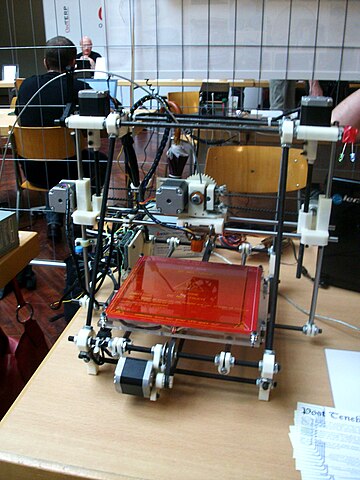
It is believed to be the first 3D printer in a UK academic library. The new initiative is made possible through a machine donation from 3D Systems Ltd.
3D printer during the Rencontres mondiales du logiciel libre 2012, Geneva. Image courtesy of Wikimedia Commons.
3D print technology, also known as additive layer manufacturing, is a rapidly developing technology with applications in manufacturing, engineering and academic research. It is sometimes available to university students on relevant courses – such as creative product design or engineering courses. For example UWE Bristol already has 3D printers within the Faculty of Technology and in the leading Centre for Fine Print Research.
The machine, a triple head smoked 3DTouch, will be situated in the main library on the Frenchay Campus, where it will be available for all students and staff to use. During term time the UWE library has over 2,000 users per day.
This new initiative will enable students to engage with the latest 3D print technology and develop their understanding of how it can be used in different subject areas. Students will be able to ‘draw’ their design in a 3D CAD package. The file will then converted through a process that will make it readable by the 3DTouch printer using free downloadable Axon software. When it is printing the 3DTouch print head moves back and forward, building up layers of thermoplastic polymer, as it prints the 3D object layer-by-layer.
Andrew Bathchelor, UWE Senior lecturer in Product Design, says, “This initiative offers a valuable new resource for students. By linking with Bits from Bytes we are able to bring the concept of 3D printing to all students. Many of our Creative Product Design, Engineering and Fine Art Students, are already familiar with this technology, and use it within their academic work in their own departments. However, by offering this to the wider student body, we hope to stimulate usage of this technology and help students develop their understanding of how it can be applied. We hope students will come up with interesting applications, relevant to their subject. For example our students who are training to be teachers can familiarise themselves with technology that their pupils may have access to in the future. In addition Architecture and Planning students may choose to use the technology to ‘print’ out models for project work. We are sure UWE students will be inventive once they begin to see the possibilities of this technology. The 3DTouch will enhance the extensive range of resources we offer to students though UWE’s library service.”
A snowflake under the microscope. Picture courtesy of Wikimedia Commons.It snowed in Bristol yesterday, as it did over a large part of the UK. No more than 2-3 inches of the frozen white stuff caused complete chaos with bus services withdrawn, schools closed and similar over-reactions. A friend called me yesterday afternoon: he works in Geneva and told me that several times that amount – nearly 2 feet in fact – fell there on Tuesday afternoon and life continued as normal.
When snow settles in the Bristol area, it does something unique that’s not repeated elsewhere in the country or in the English-speaking world (to the best of my knowledge. Ed.): it pitches. When it’s snowing, Bristolians have been known to confuse people from elsewhere simply by asking, “Is it pitching?”
pitch verb (pitches, pitched, pitching) 1 to set up (a tent or camp). 2 to throw or fling. 3 tr & intr to fall or make someone or something fall heavily forward. 4 intrans said of a ship: to plunge and lift alternately at bow and stern. 5 tr & intr said of a roof: to slope • is pitched at a steep angle. 6 to give a particular musical pitch to (one’s voice or a note) in singing or playing, or to set (a song, etc.) at a higher or lower level within a possible range • The tune is pitched too high for me. 7 to choose a level, e.g. of difficulty, sophistication, etc. at which to present (a talk, etc.) • was pitched too low for this audience. 8 a cricket to bowl (the ball) so that it lands where the batsman can hit it; b golf to hit (the ball) high and gently, so that it stays where it is on landing; c tr & intr, baseball said of the pitcher (sense 1): to throw the ball overarm or underarm to the person batting. 9 to pave (a road) with stones set on end or on edge.
Out of these possible definitions, from whence could this bit of Bristolian dialect come? Sense 9 above, i.e. paving in the sense of covering something over, seems a strong possibility.
Over on his Computerworld blog, Richi Jennings reports that the next release of the ubiquitous Microsoft Office suite – Office 2013 – is drawing nigh.
However, he also points out that a huge price increase is in the offing for those that decide to update to the new version.
But beware: The leaked Office 2013 pricing makes it seem that you’ll pay a lot more with the subscription model than buying the traditional, packaged software — as much as four times more!
Perhaps this would be a good time for those thinking of upgrading to change their choice of office suite instead. Why not take a look at an open source office suite, such as LibreOffice or OpenOffice – the office suite from which LibreOffice was forked? As long as you’re not heavily reliant upon MS Office macros, the change should not be too painful. I’ve been working with both LibreOffice and OpenOffice for well over 7 years and none of my clients has noticed any difference.
Both come with all the common elements of an office productivity suite – word processor, presentation package, spreadsheet, database, and the like and both can read and write MS Office formats. In addition, both work natively with the Open Document Format (ODF), an approved ISO international standard which is gaining more acceptance and wider use amongst governments and local authorities around the world as it will still be readable in years to come – unlike MS Office formats, whose useful life is purely dependent on Microsoft’s whim.
 Online tech news website The H reports that the developers of LibreOffice, whose version 4.0 is due for release within days (posts passim), are also planning to release the “Impress Android Remote” application that will enable the office suite’s presentations to be controlled from Android smartphones.
 Communication between the phone and the presentation rendering system will be handled via Bluetooth, according to a presentation given by LibreOffice developer Michael Meeks to FOSDEM 2013 in Brussels over the last weekend.