In December 1921 the Anglo-Irish Treaty established the Irish Free State as a largely self governing and autonomous dominion within the British Empire. It came into existence one year later on 6th December 1922. This marked the first step towards Irish independence and the beginning of the end of English meddling on the island of Ireland which had started with the Anglo-Norman invasion back in the 12th century, i.e. some eight centuries.
As a political entity, the Irish Free State endured until the end of December 1937 when a new Irish constitution was adopted and the state became a de facto republic.
However, news of these events between eighty and one hundred years ago still seem not to have reached some remote areas of Englandshire, like the county of Shropshire and its main local newspaper, the Shropshire Star, which today published this story under the UK News category (screenshot below).
It’s clearly going to take centuries for the British/English to lose their tendency to regard large swathes of the world and other peoples’ countries as belonging to the British/English state.
According to Wikipedia, “A county is a type of officially recognized geographical division within a modern country, federal state, or province.”
Within England shires were established in the Anglo-Saxon period, shires were established as areas used for the raising of taxes and usually had a fortified town at their centre. This became known as the shire town or later the county town. In many cases, the shires were named after their shire town (for example Bedfordshire).
Middlesex is one of the thirty-nine historic counties of England. Its name is derived from its origin as a homeland for the Middle Saxons in the early Middle Ages, with the county subsequently part of that territory in the ninth or tenth century. As a county it managed to survive for the best part of a millennium, finally being abolished by the London Government Act 1963, which came into force on 1 April 1965.
The cardboard county of Avon has a rather different history to the former shire named after the home of the Middle Saxons. It was a non-metropolitan and ceremonial county in the west of England which existed between 1974 and 1996. Named after the Bristol Avon, it comprised the cities of Bath and Bristol plus parts of south Gloucestershire and Somerset, which formed the other two local authorities – Northavon and Woodspring – within the county. Avon proved to be deeply unpopular, with locals bemoaning in some instances Bristol’s loss of county status in its own right, as well as traditional affiliations to both Gloucestershire and Somerset respectively. In 1996, the county was abolished and its administrative area split between four new unitary authorities: Bath and North East Somerset, Bristol, North Somerset and South Gloucestershire.
Although both Middlesex and Avon have officially been abolished that does not mean their use has been discontinued, usually by the uninformed. There are still organisations out there which believe Bristol is part of Avon and that the county named after the Middle Saxons still exist. One of these is currently in the news.
One of those organisations is Pizza Hut, which has announced a number of closures of its outlets in the Untied Kingdom, as reported by the Bristol Post/Live.
All told, 68 Pizza Hut restaurants will close after the company behind its the US brand’s UK venues entered administration. These include the following five outlets in the aforementioned non-existent counties, as listed by Bristol’s paper of (warped) record:
Bristol, Avon;
Cribbs Causeway, Avon;
Enfield, Middlesex;
Feltham, Middlesex; and
Hayes, Middlesex.
A few news outlets, such as the BBC, actually took the trouble to remove the erroneous county labels instead of blindly copying and pasting the list verbatim from the original press release.
For those still in need of a junk food fix, plenty of other pizza outlets are still open to the public in both real and non-existent counties. 😀
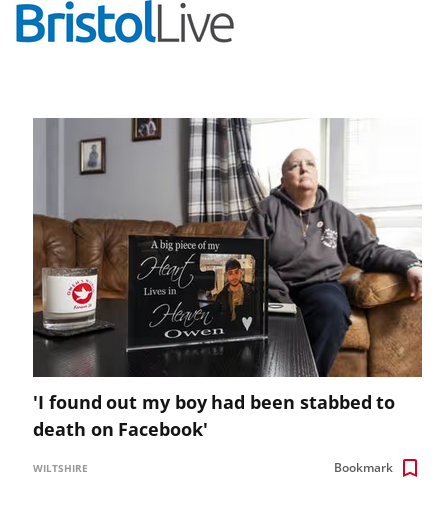
Reports about unexpected or unexplained deaths are not exactly uncommon fare for the local press anywhere.
However, what made this particular incident unusual was the manner in which the reporter chose to represent the subsequent action of the police after attending the incident, as quoted directly from the piece itself.
Efforts are currently ongoing to identify him in order to update his next of kin.
Update?
Use of appropriate language is just as important in writing for the local media as it is to a scientist writing a paper or an author penning a work of fiction. The poor man’s next of kin are not like software or kitchen cabinets!
For the benefit of any passing media studies graduates pretending to be journalists, you would have been told by any half-decent sub-editor that relatives and the next of kin are either notified or informed of their loved one’s untimely demise. Lumping grieving family in with software that needs a bug fix is not only very bad English indeed, but abysmal writing not worthy of being classed as journalism.
Yesterday’s Guardian carried a piece entitled Most of Great Britain’s major rail operators are back in public hands – is it working?.
At this point it would be easy – and flippant – to refer to Betteridge’s Law of Headlines, but your ‘umble scribe wishes to delve further into the substance of the article without invoking said law and saying no.
Given that the map handily provided to illustrate the article manages to miss the line to Oban, one might question the accuracy and utility of the entire piece.
Rail privatisation was a project undertaken with subsequent disastrous results by the Conservative government of John Major. It separated management of the track from the running of rail services of said track. It has resulted in services that no longer serve the travelling public (e.g. no holding a local service if the train from London is running late, especially if they services involved are provided by different operating companies. Ed.).
Ever since the end of the Covid pandemic some renationalisation has been undertaken. As train operating company franchises have expired, the services themselves have been taken back into public ownership, mainly due to concerns over financial woes and poor performance. This process started under the last Conservative government. In Cymru and Scotland, where transport is a devolved matter, Trafnidiaeth Cymru/Transport for Wales and ScotRail were both nationalised by the Welsh and Scottish devolved governments in 2021 and 2022 respectively, since when the latter abolished peak fares on its services in September 2025.
Withing England the pace of renationalisation has accelerated under the present Labour government, with three operators appearing in the public books since May: South Western Railway, C2C and Greater Anglia.
The next stage, according to the Guardian article, is the establishment of a new state-controlled company called Great British Railways, expected next year, which will manage rail infrastructure and services.
The logo for Great British Railways is a real dog’s dinner, consisting principally of the old British Railawy InterCity logo from 1966, combined with that Bloody Butcher’s Apron that some call the Union Jack.
Given that services are already nationalised in Cymru and Scotland, your ‘umble scribe wonders if what is being proposed is actually applicable to those devolved administrations. Although the information the government has released to date states it is applicable to England, Cymru and Scotland, all the announcements made to date all relate to train services provided solely in England.
Your correspondent believes this indicative of the centuries-old English colonial attitude to the island of Great Britain and perhaps a more apposite name for the government’s intentions would be English Railways minus the Great (which frequently happens to be grate. Ed.) with the corresponding logo in the colours of the flag of St George.
If any passing readers can supply more details about the ownership of infrastructure and provision of services in either Scotland or Cymru or how Great British Railways is likely to develop, kindly comment below.
Slow news days are typically when a lot of ‘filler‘ material (like food hygiene ratings if your name is the Bristol Post/Live. Ed.) is published to fill the otherwise empty space in a traditional dead tree publication.
However, this tendency and the phrase itself seem to have adapted without any trouble to the digital age and online publishing.
A fine example of this was apparent when your ‘umble scribe visited the Shropshire Star website earlier today and scrolled down the news page as far as the Motors news section.
Click on the image for the full size version.
The observant visitor will notice there is not a tinned, motorised three piece suite in sight in any of today’s stories for petrolheads!
A return visit at 14.00h revealed the pace of news had picked up: one of the pieces shown above was finally replaced by a motoring article.
A huge new floor mural celebrating Bristol’s ‘past, present and future’ has been unveiled in The Centre as the focus for the area that previously had fountains on it.
This new artwork, produced by the artist Oshii and a team of fellow artists put together by the Bedminster urban art festival organisation UpFest, is absolutely stunning and covers an area more than 700m2.
Image courtesy of Our Common Ground
But is it mural? asks the wordsmith who resides inside your ‘umble scribe.
The answer is a definite no in the strictest sense. The Tate, somewhat of an authority in the art world defines a mural as follows:
A mural is a painting applied directly to a wall usually in a public space.
Bristol’s latest public artwork is executed in paint and is in a public space, but it’s on the ground, not a wall or ceiling, so is not strictly a mural in the accepted sense of the word, hence the less than accurate floor mural devised by the Post.
It’s not a mosaic, one of the only forms of decorative artwork applied to a flat horizontal surface as no tiles (also known as tesserae. Ed.) are used in its creation.
Perhaps the term painted pavement would be a better term in view of the existence of the Cosmati Pavement before the grand altar in Westminster Abbey.
Cosmati Pavement in Westminster Abbey. Image courtesy pf Wikimedia Commons
If readers can come up with a more accurate and apposite term for the Centre’s newest artwork (which makes a refreshing change from statues of the dead white males so beloved of our Victorian forebears. Ed.), please feel free to post suggestions in the comment below.
The Labour Party under ‘Sir’ Keir Starmer appears to be abandoning its egalitarian attitudes in an effort to out-Reform the racists, xenophobes and bigots of Reform UK, the latest incarnation of the Nigel Farage Fan Club.
This has been very clear in recent days.
Last week Farage announced a Reform government (God forbid! Ed. would abolish indefinite leave to remain for foreigners in Britain, including those who already benefit from it.
This policy announcement was condemned by Starmer who is reported to have described it as racist and immoral.
However racist and immoral the prime minister may consider Reform’s policy to be, this has not stopped his own Home Secretary from taking a leaf out of Reform’s playbook: yesterday Home Secretary Shabana Mahmood announced that the qualifying period for indefinite leave to remain would be doubled from the present five to ten years.
Today saw yet another disappointing utterance from what passes for the government of the day. Kindly step forward with no shame at all the Chancellor of the Exchequer, one Rachel Jane Reeves.
Having allegedly studied Politics, Philosophy and Economic (also known as PPE. Ed.) at New College, Oxford, an alleged elite university, Rachel should really know better. Supporting racist policies makes one racist. To deny that simple fact is equivalent to someone saying ‘I’m not racist, but (insert_instance_of_racism_here).
Your ‘umble scribe has been on this earth for seven decades, but never can he remember a time when the calibre of both the world’s and the country’s politicians has been so abysmal.
Antifa or anti-fascist is a noun with the following definitions:
a political movement whose followers are left-wing activists who oppose fascist authoritarianism, capitalism, and extreme right-wing ideologies such as nationalism, xenophobia, and white supremacy; and
a group of such activists, or a member of such a group.
Opposition to fascism has grown in recent years with the increasing prominence of extreme right wing politics and politicians, particularly in western democracies.
Not least of these prominent extreme right wing politicians is the disgraced former 45th president and current disgraceful 47th president of the United States of America, insurrectionist, convicted felon, adjudicated sexual predator, business fraudster, congenital liar and golf cheat commonly known as Donald John Trump, who is on a personal mission to Make America Grate Again (or something similar. Ed.).
The Donald has made no secret in the past of his hatred for those expressing anti-fascist sentiments and standing up to his extreme authoritarian regime; and if you are opposed to anti-fascism, Donny, you know what that makes you, don’t you?
The Tangerine Tyrant has now gone further than he ever has before, posting the following on Truth Social his social media platform that defies nominative determinism.
Yes, you read that correctly. A noun is now ‘A MAJOR TERRORIST ORGANIZATION’.
Just like antifa, organization (to use the US-EN spelling) is a noun. Amongst others, it has the following definition.
A group of persons organized for some end or work; association.
As is usual when The Donald starts throwing his weight about on social media, there has been some criticism, particularly from those with expertise in terrorism, not to say outright ridicule, but more on the latter presently.
The most clear criticism your ‘umble scribe has seen has emanated from ex-US Navy man Malcolm Nance who replied to Trump’s invective as shown below.
As regards the mockery of Trump’s flawed logic, untold numbers of social media users have posted about members of their families who have been involved in anti-fascist actions.
Your correspondent also posted a photograph of a prominent anti-fascist activist from 1942.
Major-General Dwight D. Eisenhower photographed in 1942. Image courtesy of Wikimedia Commons.
Those of us with long memories have not forgotten the last time Uncle Sam displayed noun-based hostility. In 2011, the war on terror was declared by then President George W. Bush and resulted in such horrors as the Guantanamo Bay detention camp (which has yet to close. Ed.) and so-called extraordinary rendition, i.e. the state-sponsored abduction of people in a foreign jurisdiction and transfer to a third country, usually for interrogation linked to the use of torture.
Taking all the above into account, one has to credit Trump with one thing: he’s doing a great job of making America grate.
Update 23/09/2025: It was announced overnight that Trump has issued an executive order designating the aforementioned noun as a domestic terror organisation. In the text of the executive order, a common Trump playbook tactic is apparent – accusing one’s opponents of exactly the kinds of actions – e.g. doxing and physical assault – his MAGA louts have been inflicting on their perceived opponents for years. Anyway, the very best of luck on your witch hunt against a noun and an idea, Donny! Your action is reminiscent of another Don and his epic quest against windmills* in La Mancha.
Today The National reported that the Liberal Democrats had written to broadcast regulator Ofcom to complain about the BBC’s excessive coverage (one might even say cheerleading. Ed.) of one Nigel Paul Farage, liar, charlatan, racist, Brexit cheerleader and chief honcho of alleged political party Reform UK.
Max Wilkinson, the Lib Dems’ culture and media spokesperson, has remarked: “The BBC is following Farage around like a lost puppy and the resulting wall-to-wall coverage is giving legitimacy to a man who wants to do to Britain what Trump is doing to America.”, as well as stating that the broadcaster is compromising its reputation.
Furthermore, the party states that it only receives a fraction of the coverage given to Farage and his fan club despite the Lib Dems having eighteen times as many MPs.
The full text of Mr Wilkinson’s letter is as follows:
Dear Melanie Dawes,
I’m writing to you to urge you to review whether the high volume of coverage of Reform UK by the BBC is in line with broadcast guidance.
The BBC is an important part of our national story. Research carried out this May revealed what many of us know instinctively: that the BBC is the most respected broadcaster in the world – ranking first across the globe for trust, reliability and independence. Its mission is to act in the public interest. The corporation is governed by Royal Charter.
By paying such disproportionate attention to Nigel Farage’s latest outfit, Reform UK, the BBC is compromising its reputation. To many licence fee payers, the broadcaster gives the impression that hangs on every word uttered by Nigel Farage, despite his party’s scant representation in Parliament. Most recently, we have seen Reform enact bans on journalism and spread dangerous untruths at its autumn conference, linking Covid vaccination jabs to cancer.
The coverage of my party, the Liberal Democrats, has been disproportionately low. The broadcaster’s online platform, BBC Online, mentions Nigel Farage three times as frequently as it does Ed Davey. In Parliament the Liberal Democrats represent eighteen times as many constituencies as Reform UK.
This discrepancy does real damage to the BBC’s reputation as a fair, independent broadcaster and its ability to abide by its own charter. By giving Reform lift and airtime that is denied to other parties, the BBC assists Reform’s poll rating – an interference in politics that goes against its chartered responsibility.
This country deserves fair, proportional and balanced journalism. Currently the BBC is required by its regulator to deliver this in the regulated period: the election seasons where state broadcasters are required to give proportionate coverage to political parties, based on their parliamentary heft. Our petition sets out proposals for an extension of this regulation, to year-round – a plan that would give the electorate the respect it deserves by consistently providing fair coverage across the political spectrum.
I urge you to consider our proposal.
Yours sincerely
Max Wilkinson MP
Liberal Democrat Spokesperson for Culture, Media and Sport
The National is not the only media outlet to notice the disproportionate airtime Farage receives. Middle East Eye has also noticed the disparity, particularly with regard to Farage’s appearances on the BBC’s Question Time topical debate programme. It states:
As just one example of this systematic effort to force Farage on the country, Jeremy Corbyn has been on BBC Question Time three times in 42 years as an MP. Left-wing MP Zarah Sultana has never been on it. Farage, who was elected an MP only last year, has appeared 38 times.
Ofcom guidance to broadcasters states they must “not give undue prominence to the views and opinions of particular persons or bodies on matters of political or industrial controversy and matters relating to current public policy in all the programmes included in any service taken as a whole“.
It sounds like Auntie is definitely in breach of Ofcome guidelines. However, the rest of the British media also give Farage a very soft ride and seem reluctant to press him on the feasibility of his party’s policies and his own abhorrent opinions.
Indeed, the harshest criticism of Farage in recent times has come from Democrat Senator Jamie Raskin, when Farage skived off doing the job he’s supposed to be doing in parliament to appear before a US congressional hearing on censorship. Mr Raskin did not pull any punches.
The British media ought to take a leaf out of Senator Raskin’s book.
No further comment is required apart from saying that in the film, Clees and his companions within the castle were all playing forrins, insulting and humiliating Arthur and his knights of the round table.