LibreOffice developers have released a series of videos to reveal what’s new in the latest release of the free and open source office suite (posts passim).
New features – general
New features – Writer word processor
New features – Calc spreadsheet
New features – Impress presentation software
The release notes for LibreOffice 5.2 are available on the Document Foundation wiki.
The time-honoured business practice of top executives celebrating POETS Day on the fairway has come in for criticism from an unlikely source.
At a Conservative Way Forward event at Westminster last week, the current international trade secretary and disgraced former defence secretary Dr Liam Fox MP is reported to have said:
We’ve got to change the culture in our country. People have got to stop thinking about exporting as an opportunity and start thinking about it as a duty – companies who could be contributing to our national prosperity but choose not to because it might be too difficult or too time-consuming or because they can’t play golf on a Friday afternoon.
Meanwhile in golfing “olds”, in April 2015, the disgraced former defence secretary Dr Liam Fox MP tweeted the photo below when standing for re-election.
There’s an old adage about glass houses and stones, isn’t there?
The latest Easton & Lawrence Hill Forum held on Wednesday evening at Easton’s Pickle Factory attracted some 40 lively, vocal residents who’d come along to the event whose theme was waste management and its attendant problems such as litter and fly-tipping.
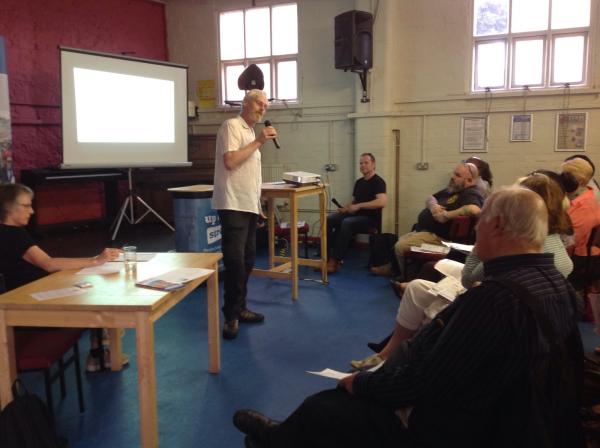
After the initial announcements, your ‘umble scribe was first out at the front of the hall to administer death by PowerPoint, giving a brief history of Tidy BS5, its activities and successes over the past two and a half years and calling for residents to act as the eyes and ears of Bristol City Council to combat fly-tipping, report litter and urging them to report other environmental crimes that blight the inner city such as fly-posting, dog fouling and graffiti. The Tidy BS5 slot finished with a showing of the “Green Capital Tale of Two Cities” video produced for viewing at full council last year.
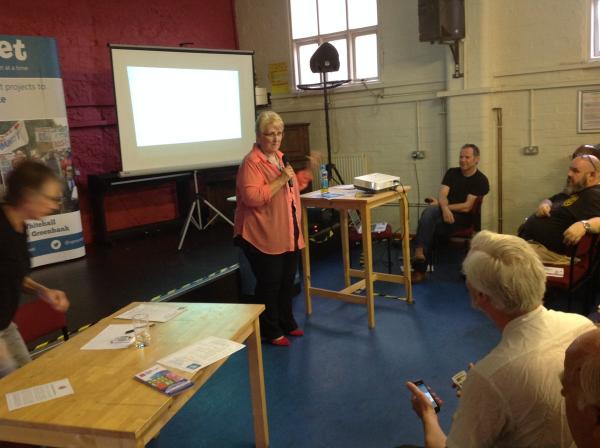
I was followed on the microphone by Tracy Morgan, CEO of Bristol, the wholly-owned council waste company responsible for keeping the bins emptied and the streets tidy.
This was the main talk of the evening and Tracy gave some background of Bristol Waste’s work, which stretches from carrying out some 17 mn. waste collections around the city to clearing its streets of dead animals. Those collections yield an annual total of 140,000 tonnes of waste and recycling, of which 53,000 tonnes is sent for recycling or composting.
Tracy remarked, “We want to create a cleaner, greener Bristol… but waste is a shared responsibility,” before going on to the main point of her presentation – the 12 weeks-long trial to remove communal bins (otherwise known as skipbins or 1280l Eurobins. Ed.) from the Stapleton Road corridor.
The communal bins were introduced some years ago with a typical botched BCC consultation to attempt to tackle the problem of fly-tipping in the area. The communal bins consultation carried out last year (posts passim) clearly revealed that the introduction of the communal bins had failed in this respect.
Instead of the thrice-weekly communal bin collections, those streets where residents have sufficient storage space will be issued with 180l wheelie bins to be emptied fortnightly. Where this is not possible, residents will be given rubbish bags (hopefully gull-proof. Ed.) for collection on Mondays, Wednesdays and Fridays, to be put out at a certain time.
After Tracy’s presentation came questions and comments from the audience to a panel comprising, Tracy, Tom Ward from enforcement and myself.
There was lots of intelligence offered to Tom, particularly as regards fly-tipping along the Lawrence Hill/Church Road corridor, although the main concern was the Stapleton Road trial and the communal bins.
One resident spoke passionately for retaining on Claremont Street and Seymour Road (which are regularly abused, like all the other communal bins within the proposed trial area. Ed.). However, I feel she’s on a hiding to nothing with her desires and she was the only person in the room defending the communal bins that other residents described as the bane of their lives and a health hazard since they attracted rats.
Other residents wanted to see more litter bins, particularly in parks and along the Bristol & Bath Railway Path, whilst the operation of the St Philips Recycling Centre (e.g. no pedestrian access) and the surly, unhelpful attitude of the Centre’s staff were also mentioned to Tracy for attention, as were the habit of recycling crews leaving “offerings” in the streets for the local gods and the reaction of certain street sweepers to local residents trying to help them.
No doubt this will be a matter to which forthcoming Neighbourhood Forums will return.
The photos used in the post are by kind permission of Up Our Street.
Speculation about the demise of Apache OpenOffice may be premature (posts passim).
German IT news site heise reports that a mailing list for new developers has been set up.
By establishing this new list, the OpenOffice team wants to make entry to the open source project easier for programmers.
OpenOffice 4.0- not quite the end of the line, possibly.
After recent discussion of a possible end for the free and open source OpenOffice productivity suite, more developers who are interested in helping with future development have approached the project. The Apache Software Foundation (ASF) has now established a recruitment mailing list to facilitate their access to the source code. Via the list, newcomers will receive answers to questions and suggestions about their next steps from more experienced developers.
The situation does remind your correspondent of the predicament of one Samuel L. Clemens, better known to the world as the author Mark Twain.
The Document Foundation (TDF) has celebrated the opening session of LibOCon (which is currently taking place in Brno. Ed.) with the announcement of LibreOffice 5.2.1, the latest release of the LibreOffice 5.2 family.
LibOCon is a showcase for the LibreOffice project’s activity and will feature over 60 talks in three days, covering development, quality assurance, localisation, Open Document Format (ODF), marketing, community and documentation, a business session in Czech focused on major LibreOffice deployments, as well as a meeting of the Open Source Business Alliance (OSBA).
LibreOffice 5.2.1, which is aimed targeted at technology enthusiasts, early adopters and power users, provides a number of fixes over the major release (5.2) announced in August. For all other users and enterprise deployments, TDF suggests LibreOffice 5.1.5 “still”, with the backing of certified professional support.
Download LibreOffice
LibreOffice 5.2.1 is available for immediate download, whilst LibreOffice users, free software advocates and community members can support the work of The Document Foundation with a donation.
When your ‘umble scribe first started using the GNU/Linux operating system over a decade ago, the default office suite for most Linux distributions was OpenOffice.
However, it now looks as if OpenOffice just could be heading towards the software graveyard if other members of the development team concur with an email from the chairman of the OpenOffice Project Management Committee, Dennis Hamilton, as reported by LWN.net.
OpenOffice 4.0. The end of the line?
A long history
To find the earliest origins of OpenOffice, one has to go back nearly 30 years to 1985 and an early office suite called Star Office. The timeline below shows the genesis of OpenOffice and other packages from StarOffice 1.0. StarOffice itself survived as a proprietary software package until discontinued by Oracle in 2011.
Timeline showing Open Office and other derivatives of StarOffice. Click on image for the full-sized version. Timeline courtesy of Wikimedia Commons
To understand the various twists in the OpenOffice story, one also needs to know that StarDivision, the creator of StarOffice, was acquired by Sun Microsystems in 1999, whilst Sun Microsystems was in its turn taken over by Oracle Corporation in 2010.
After the 1999 takeover of StarDivision, Sun released a free and open source version of StarOffice as OpenOffice.org under both GNU LGPL and the SISSL (Sun Industry Standards Source License). OpenOffice.org supported proprietary Microsoft Office file formats (though not always perfectly), was available on many platforms (Linux, Microsoft Windows, Mac OS X and Solaris) and became widely used in the open source community. OpenOffice.org had native support for the OpenDocument format (ODF).
Following Oracle’s takeover of Sun Microsystems in 2010, some members of the OpenOffice.org project became worried about its future with Oracle. As a consequence they formed The Document Foundation and created the LibreOffice fork. The LibreOffice brand was hoped to be provisional, as Oracle had been invited to join The Document Foundation and donate the OpenOffice.org brand to the foundation.
Oracle’s response was to demand that all members of the OpenOffice.org Community Council involved with The Document Foundation step down from the Council, citing a conflict of interest. This prompted many community members decided to leave for LibreOffice, which already had the support of Red Hat, Novell, Google and Canonical. LibreOffice produced its first release in January 2011.
In June 2011 Oracle donated the OpenOffice.org trade marks and source code to the Apache Software Foundation, which Apache then re-licensed under its own open source licence. IBM donated the Lotus Symphony codebase to the Apache Software Foundation in 2012. The developer pool for the Apache project was seeded by IBM employees and the Symphony codebase was incorporated into Apache OpenOffice.
However, Apache OpenOffice has not flourished, whilst LibreOffice has gone from strength to strength, OpenOffice has languished. LibreOffice releases updates every few months, whereas the last major update to Apache OpenOffice was in September 2015. Furthermore, a hotfix released at the end of August to remedy a memory problem has still not been announced by the project on its home page.
Apache applies pressure
In the meantime the Apache Software Foundation has been applying increasing pressure due to security concerns and has since demanded monthly reports (instead of the previous quarterly reports. Ed.) as to how problems can be solved.
In his email Hamilton describes in detail what the retirement of the OpenOffice project could look like and what consequences will be involved for the source code, downloads, website, mailing lists and other matters. For the time being Hamilton only wants to start a discussion. A decision to end the OpenOffice project has still not been taken, although it is already being suggested that the project should consider donating the OpenOffice trade mark registration to the LibreOffice project.
For local news Bath, Bristol’s near neighbour, is served by the Bath Chronicle. Like the Bristol Post, the Chronicle is part of the Local World group and shares its close neighbour’s reputation for (lack of) accuracy.
Today’s Bath Chronicle carried an exclusive, but readers had to read the caption under the photograph accompanying the report to realise it.
Bath Spa railway station used to look as shown in the photograph below.
Bath Spa railway station. Image courtesy of Wikimedia Commons
Close observation of today’s Bath Chronicle report, especially the photo caption, reveals there is no nowhere for InterCity 125s or any other passenger rolling stock to stop where Bath Spa station once stood.
The site of Bath Spa railway station according to the Bath Chronicle
For the life of me I cannot understand why the Chronicle ignored the disappearance of a major piece of transport infrastructure and had its piece concentrate on delays to train services between the West of England and London Paddington. 😉
The right-wing Daily Mail national newspaper group – consisting of the Daily Mail and its sister publication, the Mail on Sunday – is not known for its love of foreigners.
The Mail group has been a consistent campaigner against Britain’s membership of the European Union, whilst in recent years it has consistently whipped up hysteria against migrants coming to Britain and/or the EU and foreigners in general.
As regards migrants, the Daily Mail was heavily criticised at the end of last year when a carton by Stanley McMurtry (“Mac”) linked the European migrant crisis (with a focus on Syria in particular) to terrorist attacks and criticised EU immigration laws for allowing Islamist radicals to gain easy access into the United Kingdom.
The New York Times compared the offending – and offensive – cartoon to Nazi propaganda, whilst Kate Allen, the director of Amnesty International stated the following to The Independent:
The Daily Mail’s cartoon is precisely the sort of reckless xenophobia that fuels the self-same fear and hate loved by those responsible for atrocities in Paris, Beirut, Ankara and elsewhere. Now more than ever is the time to stand together in defiance of the perpetrators of violence with all of their victims and reject this disturbing lack of compassion.
Another frequent target for the Mail group’s bile has been Britain’s overseas development aid programme, currently accounting for £12.2 bn. of the government’s budget, about which it has been moaning (although the Mail would call it campaigning. Ed.) for nearly as long as Europe.
According to figures from the government, the UK’s overseas development aid budget accounted for under 0.7% of gross national income in 2015. Today’s Independent reveals that foreign aid accounts for just 1.1% of the UK government’s expenditure.
However, such largesse is anathema to the Mail and Mail on Sunday and the latter has put its latest outpouring of bile against foreign aid on today’s front page, as shown below.
The Mail on Sunday – free xenophobic bigotry for every reader
Was the editor asleep when the front page was put together? Or is editor Georgie Greig blind to the irony of splashing a banner announcing the giving away of a “Free Giant Glossy Wall Map” above an attack on foreign aid. The map giveaway also proudly announces the reverse of the map shows “every flag”. This is presumably so Mail on Sunday readers will be able to identify both the countries and their flags to which foreign aid will no longer be going if it gets its narrow-minded, isolationist way.