On Wednesday 17th June an event called Reuse Recycle is being held at Easton Community Centre, Kilburn Street, Bristol BS5 6AW (map) from 3.30 pm to 6.30 pm.
The event will start with a meet-up at Easton Community Centre at 3.30pm for a litter pick of the area, after which it’ll back at the ECC for food, raffle, clothes swaps, bike repairs, Litterarti and stalls. Solon has dontated prizes for raffles and any proceeds will go towards the work of the Tidy BS5 campaign.
Housing association United Communities initiated the event and will be providing a trailer for the litter pick to sort recyclable materials out. They are also providing litter pickers.
For more information contact Tamsin (tamsin (at) unitedcommunities.org.uk) or Lorena (lorenal (at) eastonandlawrencehill.org.uk.
The sad news arrived earlier this week that French Linux gurus Madriva were being wound up (posts passim).
One of its community spin-offs, OpenMandriva, has now announced that its next release will be a tribute to its Mandrake heritage.
OpenMandriva’s history is well known. It was born at the end of 2012 with the help of the community and Mandriva SA to continue the work on the distribution after Mandriva SA could not continue to do so.
OpenMandriva has expressed its thanks to Mandriva SA for the latter’s initial support and it has wished former Mandriva employees well for the future.
The OpenMandriva Association was created to unite the distribution formerly known as Mandriva (aka Mandrake) and to return it to its roots through listening to peoples needs and getting closer to its users and developers. Since then OpenMandriva has been independent (though it still remains open to cooperative effort). It will continue to do this and will be releasing a new release of OpenMandriva Lx 3 (2015) in the near future that will include new features and an update of many of the core components.
OpenMandriva states that Mandrake was the first Linux distribution to make a free operating system available which could be installed and configured by anyone who could use a keyboard and a mouse. When many people first entered the “Linux” world, there were two types of distro: the ones that gave you headaches as soon as you put the CD in the drive; and Mandrake. The vision of Mandrake’s founder Gaël Duval created an operating system which undoubtedly allowed many, many people access to modern technology and in doing so added greatly to the strength of the free software community.
The Document Foundation, the organisation behind LibreOffice, the most popular free and open source office suite, has announced the release of a native application for viewing ODF documents on Android devices.
LibreOffice Viewer also offers basic editing capabilities, like modifying words in existing paragraphs and changing font styles such as bold and italics.
Editing is still an experimental feature which has to be enabled separately in the settings, and is not stable enough for mission critical tasks. Full-blown editing will be enabled in the future with
the help of LibreOffice’s steadily growing developer community. The editing features provided in the current release have been developed thanks to donations to The Document Foundation.
Feedback and bug reports for the app are very welcome to help developers improve its quality en route to a fully-fledged editor. Users are invited to report problems, using the bug tracker and attaching files that have triggered the issue at http://documentfoundation.hosted.phplist.com/lists/lt.php?id=N09VVkUAB00ABgsI.
LibreOffice Viewer uses the same engine as LibreOffice for Linux, OS X and Windows. This, combined with a new front-end based on Firefox for Android, reads documents similarly to a desktop version of LibreOffice.
LibreOffice Viewer has been developed by Collabora and Igalia, backed by Smoose, with contributions from Google Summer of Code students, together with The Document Foundation and the LibreOffice community. SUSE provided a key foundation of cross-platform support, whilst the Mozilla Corporation – makers of Firefox- made several core components available.
It’s your ‘umble scribe’s 60th birthday this week and to mark this occasion, Hilary and Andrew, my siblings conspired to take me away from Bristol for the weekend. When we were sorting out our late mother’s estate, we all expressed a wish for a sibling saunter in Staffordshire and this proved the ideal excuse.
Andrew and Hilary made the arrangements, whilst I researched walks and gave them 2 options – one involving a circular walk round the Head of Trent (the upper reaches of the Trent before it enters the city of Stoke on Trent. Ed.), the other a walk round the site of the Battle of Blore Heath, one of the first major battles of the Wars of the Roses, which was fought on 23rd September 1459.
In the end the Blore Heath won and found the assembled siblings outside the Loggerheads Hotel in Loggerheads ready to start walking the excellent route provided by the Blore Heath website. The route comprises a circuit of the main battlefield down its eastern flank along what would have been the Lancastrian line, then down through the valley which saw the most fighting. There is then a walk through woodland and up towards the quiet village of Mucklestone, where it is said that Queen Margaret watched the battle unfold.
Battle of Blore Heath – a summary
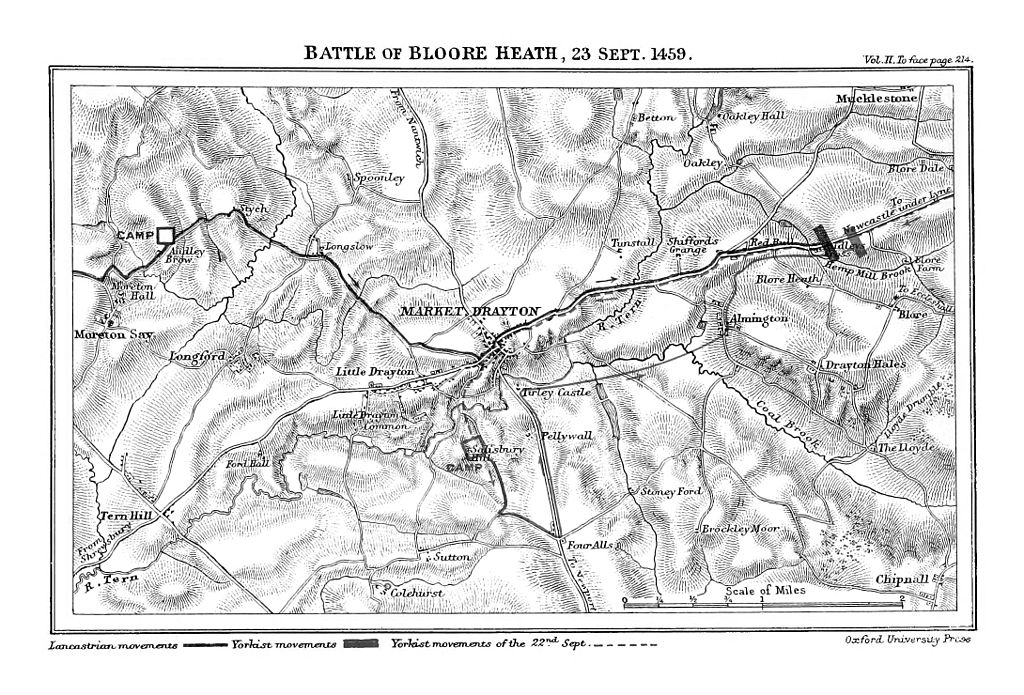
The battle occurred when the Yorkist force based at Middleham Castle in Yorkshire (led by the Earl of Salisbury) needed to link up with the main Yorkist army at Ludlow Castle in Shropshire. As Salisbury marched south-west through the north Midlands, Queen Margaret ordered Lord Audley to intercept them.
Audley chose the barren heathland of Blore Heath to set up an ambush. On the morning of 23rd September 1459 (Saint Thecla’s day), a force of some 10,000 men took up a defensive position behind a ‘great hedge’ on the south-western edge of Blore Heath facing the direction of Newcastle-under-Lyme to the north-east, the direction from which Salisbury was approaching.
Yorkist scouts spotted Lancastrian banners over the top of the ‘great hedge’ and immediately warned Salisbury. As they emerged from the woodland, the Yorkist force of some 5,000 men realised that a much larger enemy force was awaiting their arrival. Salisbury, instead of disbanding or withdrawing his army, immediately arranged his troops into battle order, just out of range of the Lancastrian archers. To secure his right flank, he arranged the supply wagons in a defensive laager, a circular formation to provide cover to the men. Fearing a rout, Yorkist soldiers are reported to have kissed the ground beneath them, supposing that this would be the ground on which they would meet their deaths.
The two armies were separated by about 300 metres of barren heathland. A steep-sided, wide and fast-flowing brook – the Wemberton or Hemp Mill Brook – ran between them. The brook made Audley’s position seemingly impenetrable.
Initially, both leaders sought unsuccessfully to parley in an attempt to avoid bloodshed. In keeping with many late medieval battles, the conflict opened with an archery duel between the longbows of both armies. At Blore Heath this proved inconclusive due to the distance between the two sides.
Salisbury, aware that any attack across the brook would be suicidal, employed a ruse to encourage the enemy to attack him. He withdrew some of his middle order just far enough that the Lancastrians believed them to be retreating. The Lancastrians launched a cavalry charge. After they had committed themselves, Salisbury ordered his men to turn back and catch the Lancastrians as they attempted to cross the brook. It is possible that the order for this Lancastrian charge was not given by Audley but it had the effect of turning the balance in favour of Salisbury. The charge resulted in heavy casualties for the Lancastrians.
The Lancastrians withdrew, and then made a second assault, possibly attempting to rescue casualties. This second attack was more successful with many Lancastrians crossing the brook. This led to a period of intense fighting in which Audley himself was killed, possibly by Sir Roger Kynaston of Myddle and Hordley.
The death of Audley meant that Lancastrian command fell to the second-in-command, Lord Dudley, who ordered an attack on foot with some 4,000 men. As this attack also failed, some 500 Lancastrians joined the enemy and began attacking their own side. At this point, all remaining Lancastrian resistance collapsed and the Yorkists had only to advance to complete the rout.
The rout continued through the night, with the Yorkists pursuing the fleeing enemy for miles across the countryside. Salisbury employed a local friar to remain on Blore Heath throughout the night and to discharge a cannon periodically in order to deceive any Lancastrians nearby into believing that the fight was continuing.
At least 2,000 Lancastrians were killed, with the Yorkists losing nearly 1,000.
Ramsay’s map of the battlefield from 1889. Click on the image for the full-sized version
The walk
Starting from Loggerheads, we skirted the borders of Burnt Wood (called “Rounhay wood” at the time of the battle. Ed.). We were following the route that the Yorkist forces would have taken. This top end of the walk was quite boggy, so good waterproof boots are recommended. From this high point of the walk there are fantastic views across Shropshire to the mountains of North Wales, some forty miles away. The landmark of the Wrekin is clearly visible to the SW and is about 20 miles away, as is the tower of St Mary’s Church in Market Drayton, some 4 miles away.
We continued downhill to the hamlet of Blore, where we turned onto a a lane and then from the edge of the hamlet followed the line of the ‘great hedge’ behind which the Lancastrian banners were seen. The hedge has been much reduced in stature by the invention of the flail mower, but experts believe it has been in situ for 1,000 years. Halfway along the hedge is a large horse chestnut tree from which Audley’s Cross – marking the spot where Lord Audley was slain – can be seen. We stopped for lunch near the end of the ‘great hedge’ roughly at the end of the Yorkists’ left flank.
The brothers dine near the end of the Lancastrian left flank. Picture courtesy of Hilary Midgley.
From the lunch stop we proceeded downhill across the fields downhill and around the southern edge of the battlefield towards Hemp Mill Brook and a crossing of both it and the A53, the latter being particularly dangerous due to its narrowness, bends and the speed of the traffic. At this point we deviated from the route and went up the A53 for a better view of Audley’s Cross (a cross has stood on that spot since the day of the battle. Ed.) before returning to the actual route of the walk.
Once over the A53 and back on the route, we followed a lane for a short while, then proceeded through Folly Wood to the outskirts of Mucklestone, entered the village and headed for the church.
Folly Wood – signage in dire need of maintenance
It was from the top of the Mucklestone church tower that Queen Margaret is said to have stood and watched her forces defeated. She is then supposed to have made good her escape in the direction of Eccleshall by forcing William Skelhorn, the village blacksmith, to reverse her horse’s shoes, thus confusing any pursuit. The anvil in the churchyard, which was retrieved from the smithy when the latter was demolished, commemorates this legend. The anvil is sited next to the grave of another, much later member of the Skelhorn family.
Anvil in Mucklestone churchyard. Picture courtesy of Hilary Midgley.
From Mucklestone we proceeded up a rough track called Rock Lane to return to our starting point in Loggerheads.
After the battle the victorious Lord Salisbury, anxious to press on towards Ludlow and the main Yorkist forces, moved south, camping on a hill on the outskirts of Market Drayton ever since known as Salisbury Hill. When we were children, this was the main hill in the town for sledging when it snowed. This delight is now out of bounds to today’s Drayton children, as the hill has been absorbed into the land occupied by the local golf club and the stile we used for access is no longer in situ.
After a most satisfactory walk we all retired to Newcastle-under-Lyme for a night in a hotel, preceded by an excellent curry and a couple of beers in Audley.
I’d like to thank my siblings, Andrew and Hilary, for making it a memorable weekend and suggest we plan other Staffordshire Saunter sometime soon. 🙂
Like a boomerang curry, the Snoopers’ Charter (posts passim) is back – and with a vengeance this time.
Home Secretary Theresa May, the woman who wants to read all your emailsWired UK reports that this morning’s Queen’s Speech setting out the government’s legislative programme for the next year. In her speech in the House of Lords, the Queen said new legislation would “modernise the law on communications data.”
The new legislation will be known as the Investigatory Powers Bill and will not only cover everything included in the previously-blocked charter, but also allow security services to intercept the content of communications in bulk.
The Bill will allegedly “provide police and intelligence agencies with the tools” to keep people safe, whilst changes will also be made to close “ongoing capability gaps” that the government believes prevent law enforcement and intelligence services from tackling terrorism and serious crime. The new bill would also introduce “appropriate oversight and safeguard arrangements.” The latter are long overdue.
Things were never easy for Mandriva, which was founded in 1999 as MandrakeSoft: with Mandrake Linux the company was originally aiming for a user-friendly desktop Linux. However, the major breakthrough for Linux on the desktop failed to appear and thus financial squeezes run like a strand through the company’s history in spite of the rapid expansion of the product portfolio for commercial solutions, German technology website heise reports.
The company did achieve a successful launch on the French stock market in 2001. However, MandrakeSoft had to apply for creditor protection only two years later. The company’s renaming as Mandriva took place in 2005 in the wake of the merger with Brazil’s Conectiva; Mandrake’s founder Gaël Duval left the company shortly afterwards due to a dispute.
There were financial problems once again in 2010 and Mandriva (at that time the company had over 70 employees) was looking for a buyer. Though an investor was eventually found, some 30 former Mandriva employees , developers and community members nevertheless founded the Mandriva fork Mageia at the end of that year. The fork was intended to ensure the continuity of Mandriva Linux since Mandriva’s commitment to its desktop Linux distribution had declined sharply. Insolvency loomed once again at the end of 2011, but was able to be repulsed ultimately with a recapitalisation.
The idea for OpenMandriva arose from the realisation that there was no money to be made with Linux for the desktop: an independent association was to continue producing Mandriva Linux as a community project. With Mageia and OpenMandriva there are now two community distributions, both of which have nevertheless lost some of their verve: the current Mageia 4 was released at the start of 2014; and OpenMandriva LX 2014.1 from September 2014. However, work is continuing on new versions of both distributions.
Mandriva is now in liquidation according to French company register societe.com. Lawyer Frédérique Lévy has been appointed as the administrator. The mandriva.fr and mandriva.com are no longer available.
Where litter belongs. Picture courtesy of Wikimedia CommonsFor as long as I’ve been going abroad to the mainland of Europe – some 45 years – one aspect that I’ve never failed to notice is just how clean other countries are compared with the United Kingdom. During my first visit to Germany in 1975 the streets – compared to those in UK – seemed clean enough to eat one’s dinner off.
It’s unfortunate that despite the decades of campaign efforts of Keep Britain Tidy and local campaigners throughout the country, the United Kingdom remains the dirty man of Europe. A stroll down any street or road in the country will readily confirm this if readers have any doubts.
A major element in littering is stuff dumped out of cars by the lazy and uncaring. This ranges from small stuff like cigarette butts to discarded fast food packaging from meals eaten on the move, right up to really nasty stuff such as used disposable nappies.
The UK is a very scenic country – why trash it?
Why indeed?
38 Degrees Petition
There are other people equally concerned about the amount of litter in the UK and a petition has just been posted on 38 Degrees.
The introduction to the petition reads:
This petition is calling for local councils in Yorkshire and across England to be given new powers to fine people who litter from vehicles. Littering shouldn’t be a consequence-free crime and enforcement acts as a deterrent as well as a punishment. The Government already approved the necessary legislation in 2014 but Defra has delayed producing the required regulations for over a year. This delay must end.
Why helping councils with enforcement is important
The petition’s explanatory text continues:
Clearing up litter costs Yorkshire councils over £77m a year, contributing to the national figure of over £800m. Clearing roadsides is particularly costly and dangerous, so preventing littering from vehicles is extremely important. Local councils said for many years that they needed new powers to fine people who throw litter from vehicles, as a £75 fine will make most people think twice before throwing litter again.
The existing law, in the Environmental Protection Act 1990, said the council needed to prove which person in the vehicle threw the litter – something that was mostly impossible. The Government agreed to introduce a new law, via the Anti-social Behaviour, Crime and Policing Act 2014, which meant local councils can issue a fine to the registered keeper of the vehicle, which is what happens when vehicles are caught speeding and or are parked in the wrong place.
To make sure councils know how to implement this new law, the Government needs to provide them with regulations. However, the department responsible – Defra – has delayed these regulations for over a year and councils are no nearer to being able to take action against litterers. This also means there are now two pieces of legislation on litter that are essentially useless.
The Secretary of State must make sure her officials are taking the required action to bring this legislation to life and to prevent further littering from vehicles.
It’s the first Monday of October 1973. With a sense of trepidation, an 18 year-old lad leaves home, a large proportion of his possessions and a heavy set of books in a rucksack on his back. He’s off to Wolverhampton in the Black Country to join the second ever intake on the BA Modern Languages (BAML) course being offered by Wolverhampton Polytechnic.
Let’s fast forward to May 2015. With a sense of trepidation a 59 year-old man leaves his home in Bristol, a laptop in a rucksack on his back and a suit in a holdall in his hand. He’s off to Wolverhampton to reunite with the second ever intake on the BA Modern Languages course once offered by Wolverhampton Polytechnic.
There have been lots of changes in the meantime. The polytechnic has transformed into the University of Wolverhampton. Wolverhampton itself has changed from a large industrial town with belching blast furnaces and gained city status. The Black Country either side of the railway between Birmingham and Wolverhampton – once a realistic implementation of a medieval painter’s vision of hell with flames, smoke and smut – is now de-industrialised with leafy areas interspersed with pleasant housing.
Sticking with the leafy pleasantness, the reunion is being held at The Mount Hotel in the Tettenhall Wood area of Wolverhampton, not a frequent haunt of student days when town centre pubs and night clubs were preferred to comfortable, content suburbia.
The Mount is a grade II listed manor house that was originally the home of Mander family of Wolverhampton (who made their money from paint and varnish. Ed.), which acquired the Mount in 1890 for £5,000 and refurbished it extensively. In 1929 the then master of the house Charles Tertius Mander was unfortunately killed in a hunting accident, leaving his wife Mary a widow. The Mount was far too large for post-war life without servants and the house was sold by Charles Marcus Mander at auction in 1952 after being in the family for just ninety years and started its new life as a hotel.
Once settled in, the minor worries started: would I recognise anyone – and would they recognise me? The rest of the crew were veterans at reunions, having held a couple in the intervening years, whilst I was the novice tonight. Standing outside, I scrutinised the faces of those passing, trying to see if any matched features whose recollection was dimmed by nearly 4 decades, whilst that same amount of time had etched its effects on the faces of my contemporaries.
At table: Jill, Steve and Stuart. Photo courtesy of Jill Easton.In all honesty I shouldn’t have worried: as we assembled at 7.00 p.m. for pre-dinner drinks, the memory went into action and I readily recognised most of the faces familiar from of old, although most now came complete with a partner. There were even a few lecturers there. Apologies to those I miss, but these included course director Alan Dobson, French lecturer Stuart Williams and politics lecturer Harvey Wolf.
The 3 courses of dinner were most pleasant: I was seated between Jill Easton (née Marshall) and Stuart Williams. The meal itself, with 3 choices for each course, was delicious and passed in leisurely fashion. Between the main course and dessert a hiatus occurred for the obligatory speeches.
First on his feet was course director Alan Dobson. He passed on greetings from John White, the former head of the poly’s department of languages and praised him for his foresight in establishing the modern languages degree course; and once more trepidation intervened. Alan explained the sense of trepidation in establishing the course. At that time Wolverhampton didn’t exactly have a great reputation. It was the but of jokes. As an academic institution, the polytechnic didn’t exactly have the prestige of a traditional university, something not helped by the presence in those days of a sleazy massage parlour over the road from campus.
The teaching accommodation often left something to be desired in those days. Alan reminded us of the long-vanished St. Peter’s Hall, whose top floor was leased to the polytechnic for teaching. It was invariably freezing cold in the autumn and winter and the landlord’s use of the building’s heating system was a juggling act: downstairs was leased as a potato store and the stock needed to be kept cool. As students we were probably regarded as cool enough in one sense, but fingers stiff with cold are not best suited to taking lecture notes.
Alan was followed by Paul Sutton. Paul and his wife Gwenda had done most of the organisation of the event (and done it splendidly. Ed.). Of those in the 1973 course intake, most had been located and contacted: only 6 remain lost. One of our number, Viv Allum, sadly passed away a number of years ago. The development of the internet had been of great assistance in finding folk; Sheila Searle had done most of the detective work, I believe.
Paul praised the quality of the education we’d received and the skills gained, which have seen many of the alumni employed in fields far removed from languages. The fact most of us have been continuously employed since graduation is ample evidence that the investment in human capital made in those years at Wolverhampton had been amply repaid many times over with interest.
Paul recalled life in Wolverhampton in 1973 when we arrived: beer at 13p a pint in the Union bar, Derek Dougan taking to the field for Wolverhampton Wanderers F.C. (his slipping into the Union Bar for a quick pint was not unknown either. Ed.), Queen supporting Mott the Hoople at Wolverhampton’s Civic Hall shortly after our arrival on campus.
He also reminisced fondly of the polytechnic’s first halls of residence: Brinsford Lodge. These former munitions factory buildings helped accommodate students from 1964 to 1982. Others have started documenting student life at Brinsford, including Richard Elliott’s Brinsford pages and brinsfordlodge.co.uk.
Some of the luxurious student accommodation at Brinsford in the early 1970s. Photo courtesy of Tim Baker.
Paul mentioned that there would be a further reunion in 2 years’ time to mark the 40th anniversary of our graduation. Responsibility for organising it would fall to the first member of the student body to head off to bed!
With speeches, dessert and coffee out of the way, it was time for dancing and the old crew proved that time had not diminished their enthusiasm for partying. The inevitable group photographs were taken, like the example below.
Class of ’73. Well, a lot of them anyway! Course director Alan Dobson is on the far left of the picture. Photo courtesy of Wendy Jackson.
Some group photos even took a sideways look.
An alternative group shot. Photo courtesy of Paddy Ring.
The dancing continued till 1.00 a.m., after which the night owls chatted the darkness away until long after dawn peeped over the horizon. However, we weren’t just reminiscing but discussing contemporary matters and the future too.
Breakfast on Sunday morning was a subdued affair for most.
It was wonderful to meet the BAML crew again. My time spent on the course with you represents an important stage of making me the person I am today. I now realise what I missed by not attending previous reunions; I’ll definitely be at the 2017 one as long as there’s breath in my body.
Thank you all for a brilliant weekend. 😀
Update 13/05/17: The comment below arrived yesterday (well after the end of the period for submitting comments. Ed.) from Gary (Gaz) Peters, another of the class of ’73.
Steve, just seen the blog on Wolves Poly 73. Really brought back memories and I wish that I had been found when you were trawling the net for BAML 73 alumni! I have sadly lost touch with everyone from those halcyon days and have regretted it for a long time. Do you know when the next reunion is? Would love to meet up with everyone. Very best wishes, Gary (Gaz) Peters
Look forward to seeing you again as the next get-together, Gaz! 😀
Coming into the Bristol Wireless lab this afternoon,I found that the weekend spring clean by 2 of our volunteers had thrown up a copy of “renewal“, bylined “the newsletter of Easton and Lawrence Hill Neighbourhood Renewal” dated March 2006, over nine years ago.
Turning to page 12, the subject matter seemed to have a familiar look to it, as per the scanned and cropped page below.
Fly-tipping, litter, rubbish, graffiti: these all sound like themes currently receiving the attention of the Tidy BS5 campaign by local residents and councillors, ably assisted and supported by Up Our Street.
The 2006 article then goes on to give telephone numbers for residents to call to deal with these matters. The telephone number for reporting street cleaning matters and abandoned cars, etc. has since changed to 0117 922 2100 and readers may find it more convenient to report these and other problems online.
The fact that so little has changed, reminds of a quotation from the late Tony Benn.
There is no final victory, as there is no final defeat. There is just the same battle. To be fought, over and over again. So toughen up, bloody toughen up.
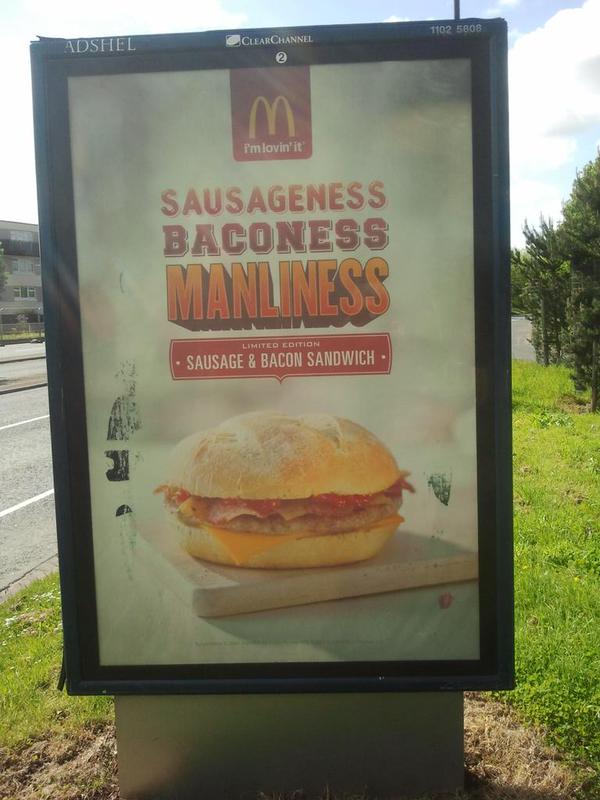
Perhaps taking its lead from a city centre café in Bristol (posts passim), multinational junk food chain McDonalds has now introduced sexism onto its menu.
The advertisement below was spotted on Easton Way, Bristol this morning.
Once again bacon and sausage are apparently foods exclusively for men. If any woman is ‘man enough’ to ask for them, what would that make her – a tomboy or a butch lesbian? Or simply unfeminine?


 LibreOffice Viewer also offers basic editing capabilities, like modifying words in existing paragraphs and changing font styles such as bold and italics.