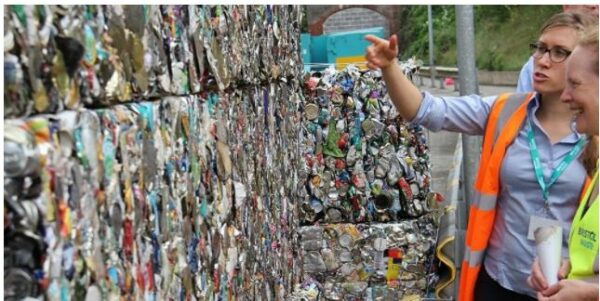
Bristol Waste is organising a series of monthly webinars dealing with all you wanted to know about waste, reuse and recycling in Bristol but were afraid to ask!
Image courtesy of Bristol Waste
People can sign up to learn from experts about what happens to their waste and recycling once it is put out for collection.
Since lockdown Bristol Waste has been running these very popular online sessions so as to give residents the chance to ask questions, dispel any myths and find out how to be recycling and waste superstars!
Every other month, there’s a general Q&A session, where people can ask about anything waste related, alternating with a specially themed webinar concentrating on a specific topic.
There is a special recycling event planned for Recycle Week and people can also sign up for a ‘festive special’ to learn how to be more sustainable over the holiday season.
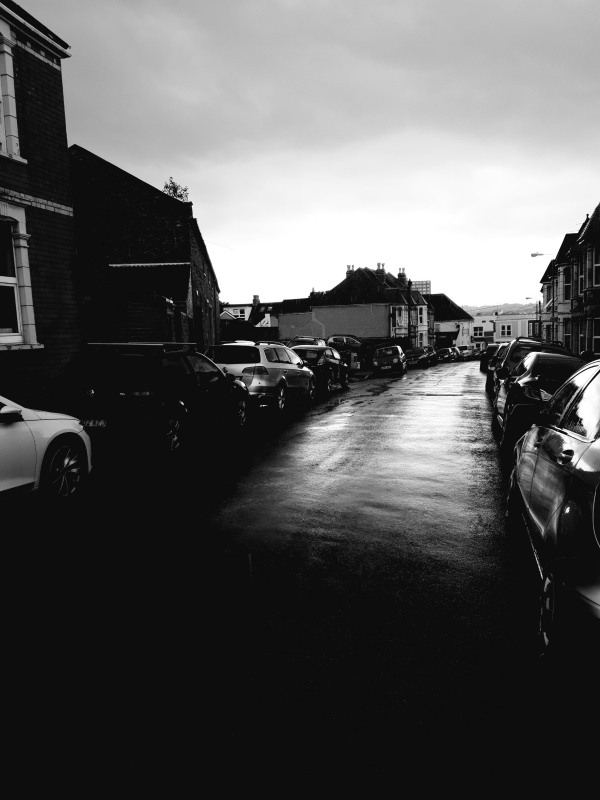
Never mind. It resulted in a spectacularly atmospheric photograph taken a few minutes from home and shown below in glorious black and white for additional impact.
The shot was taken looking westwards from the top of Eastbourne Road, Easton towards the higher ground of Cotham and Clifton.
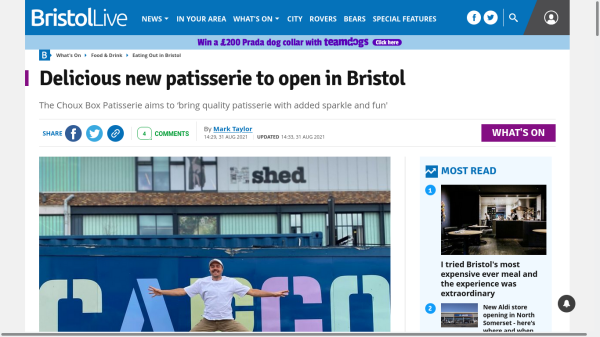
One of the mainstays of local news reporting has been the opening of new businesses in the locality.
And in this the Bristol Post is superficially no different from other regional titles.
However if one looks beneath the surface of such reporting, some divergences from other local press publications may be observed, in particular the lack of copy quality control.
More than a hundred 1980s retro video game arcades are on offer.
If games arcades really are on offer rather than poorly proofread copy, the shop would need a capacious stock warehouse, slightly more capacious than the facilities usually available in BS1. 😀
*= Pac-Man is in fact a 1990s video game, released on 31st May 1990. This other major howler in the piece could have been avoided by the use of a secret research technique know to the cognoscenti as 5 minutes’ Googling.
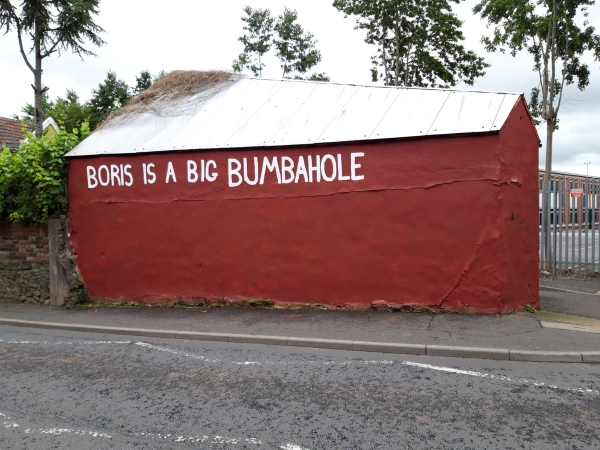
This blog has written before about the changing messages that appear on a garage wall at the apex of the junction of Russelltown Avenue, Cannon Street and Whitehall Road (posts passim).
The message has now changed again and reads as per the photo below.
According to Urban Dictionary, bumbahole is a synonym of arsehole in British English and asshole in American English.
One can safely assume that the Boris being referenced is none other than the superannuated Billy Bunter-like figure of one certain Alexander Boris de Pfeffel Johnson, who has been inexplicably promoted beyond his competence to the office of Prime Minister of the English Empire, a job he fulfils to his own satisfaction on a part time basis.
Among the less favourable characteristics of Bunter’s personality are gluttony, laziness, racism, deceit, sloth, self-importance and conceit, all of which have been extensively documented down the decades by others more eloquent than your ‘umble scribe (e.g. his former employer Max Hastings) as also being present in the part-time alleged prime minister’s character.
One of the staples of local news reporting is the activities of the emergency services – police, ambulance, coastguard, fire service – and in this regard Bristol Live – formerly the Bristol (Evening) Post is no exception.
Yesterday’s online edition reported on the fire service’s attendance at a possible incident on Colston Street (soon to revert to its original name of Steep Street after the city’s Victorian great and good renamed it after a slave trader. Ed.).
However, once again the reporter’s poor English is disappointing to read.
In the second paragraph readers are informed that
The alarm was sounded after what was believed to be an electric fire in Colston Street at around 8.22pm.
Where was the said domestic appliance left? In the roadway? On the footway/pavement?
Clarification was helpfully supplied by the fire service, whose spokesperson commented as follows:
Upon investigation, the issue was determined to be under the pavement and originating from an area of recently excavated electrical works.
So the fire, if it ever existed in the first place, was electrical, not electric.
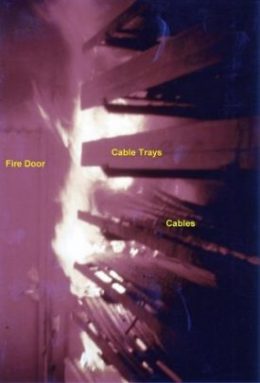
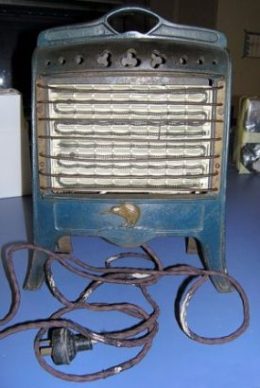
As an aid to passing hacks wishing to improve their vocabulary, there follows below a handy pictorial guide to the difference between the two. 😀
An electrical fire. Image courtesy of Wikimedia Commons.
An electric fire (aka electric heater). Image courtesy of Wikimedia Commons.
Bristol Live, formerly the Bristol (Evening) Post, aka the Temple Way Ministry of Truth, has an enduring reputation locally for the poor quality of some of its reporting.
The report gets off to a bad start with the headline boldly and falsely proclaiming Popular Weston-super-Mare seafront water park to close this month, making it sound as if the attraction is to close permanently, not temporarily.
Note too the use of popular, a term normally reserved by Bristol Live for failing cafés and restaurants.
However, the real howler in the piece occurs in the obligatory quotation from a Town Council spokesperson. In his second sentence he is quoted as saying:
We apologise for the incontinence and look forward to welcoming you back with new improvements ready for the summer holidays.
Whether the specified incontinence originated from any communication from the council, erroneous predictive text or any other source is unclear. Nevertheless, earlier in the piece readers are informed that “the water has remained off due to covid [sic] guidelines“, so the origin of any incontinence is unclear.
When the facility reopens, we are informed that the cost of admission is £2.50 per child.
In view of the purported incontinence, perhaps that ought to be raised to a Tena. 😉
One of the joys of reading the Bristol Post/BristolLive website is their hidden exclusives – the ones that are really newsworthy, but are buried in other pieces, such as in this example from Wednesday.
The flippant side of me wants to ask the journalist about the circumstantial details implied by the headline. What was a tree doing on the train in the first place? What kind of ticket was it sold? Where was it travelling from and to? Did it pay full price for the ticket or was it a railcard holder? Did it buy anything from the buffet during its journey? And ultimately why did it feel the need to stick a branch out of the window when the train was travelling at 75 mph, particularly as it resulted in a person’s death?
The tragic story of a life cut short by a moment’s carelessness has been turned upside down by sloppy headline writing, which implies that part of the tree was poking out of a train window was the cause of death, rather than the deceased being careless, leaning out of a train window being struck by lineside vegetation.
However, despite my flippancy above, I do realise and appreciate that it must be very distressing to the victim’s friends and family to have the read the circumstances of the incident so misrepresented by someone allegedly supposed to be working for an organ whic is supposed a trusted source of local news.
As the victim came from Penarth, WalesOnline, the Reach plc’s South Wales equivalent of BristolLive, has also carried the story, but with a clear and unambiguous headline.
Please take note, servants of the Bristol’s Temple Way Ministry of Truth.
Buses are Bristol’s major mode of public transport and as your ‘umble scribe is now in possession of a geriatric’s bus pass, he might actually get around to exploring their possibilities.
One linguistic peculiarity of using the city’s buses which must be perplexing to outsiders and visitors is the use of the term drive to denote the person in charge of the vehicle. This normally takes the form of the grateful form of address “Cheers Drive” as passengers get off at their intended stops.
It now seems that the buses themselves have also taken to addressing potential passengers in dialect, as per this photo courtesy of the WeLoveKeynsham Twitter account.
Of course, it’s not always been a smooth ride on the city’s buses.
Back in 1963, there was a boycott of the city’s buses led by youth worker Paul Stephenson and others over the Bristol Omnibus Company’s shameful and discriminatory refusal to employ black or Asian people.
Furthermore, the reliability of quality of services has been a perennial problem and formed the subject of Fred Wedlock’s song, Bristol Buses.
“The vision thing” is a comment made by George H. W. Bush ahead of the 1988 United States presidential election when urged to spend some time thinking about his plans for his prospective presidency.
The embracing of vision – with or without the thing – is widespread in public life in Britain at both local and national levels. Every party leader is expected to have one; and any plans for the wholesale remodelling of large areas of our town and cities are expected incorporate vision too.
An investigation into the prevalence of vision in the organs of the British state reveals just how ingrained use of the term is. A quick Google search for items containing “vision” on websites within the .gov.uk domain is revealing.
No, your eyes do not deceive you – 2.3 million instances of use.
Looking more locally, a recent search (mid-April) of the Bristol City Council website for the term returns a total of over 4,200 hits. It has probably risen since last month (and with all that evident ocular deployment, one would have thought that the inhabitants of the Counts Louse – which some refer to as City Hall – would realise there’s a major cleanliness problem with the city’s streets. Ed.).
With all that vision in use in the country, opticians and their colleagues must be raking in the money. 😀
Sie hatten Recht, Herr Bundeskanzler!
Or is it necessarily opticians and associated practitioners that should be profiting from this phenomenon? There is some scepticism about the benefits of visions.