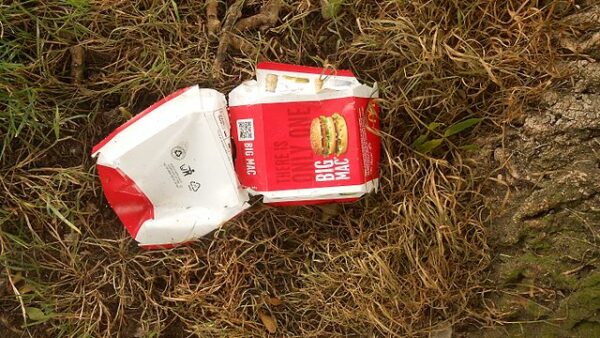
The BBC reports that Tesco is to introduce collection points for soft plastic packaging such as crisp packets, pet food pouches and bread bags at its stores in England and Wales.
This follows a successful trial in 2018 at 10 stores.
The roll-out will start with facilities being installed in 171 stores in south-west England and Wales.
Tesco is hoping to collect 1,000 tonnes of soft plastic a year and customers may return packaging from other retailers as well as its own packaging provided all packaging presented for collection is clean.
Soft plastic is notoriously hard to recycle and most currently ends up going to landfill or being incinerated.
Given Bristol’s wide range recycling collections, this type of plastic makes up the majority of my residual waste collected by the refuse lorry.
With this move, Tesco is finally living up to its “Every little helps” motto.
Another day and every regional newspaper in the country is replete with examples of one of its mainstays – reports of criminal cases being processed through the local courts of justice.
The details of one case in particular on the Bristol Live (formerly the Bristol Post. Ed.) website caught my eye for one single sentence.
In the relevant sentence we are told that the defendant*
stole his dad’s car keys without consent last October.
I have never before heard of an item being stolen with its owner’s consent, so let’s examine that sentence in detail.
We are told the defendant “stole his dad’s car keys“.
The dictionary definition of the verb to steal is “to take (the property of another or others) without permission or right, especially secretly or by force“. That definition includes the words without permission, i.e. without consent.
The lack of consent is implicit in verb’s definition, hence the qualification without permission is superfluous.
This brings us to another concept with which the author of the piece in question will be unfamiliar: tautology, i.e. “needless repetition of an idea, especially in words other than those of the immediate context, without imparting additional force or clearness“.
To some it may seem that I’m being overly pedantic, but as a linguist I’m all too aware that words matter as they are the only tools we have to convey meaning and in being the main source of information the press has a duty to use them properly.
* = Name omitted as having his name pop up once for a youthful misdemeanour in search engine results is enough without my adding to his woes.
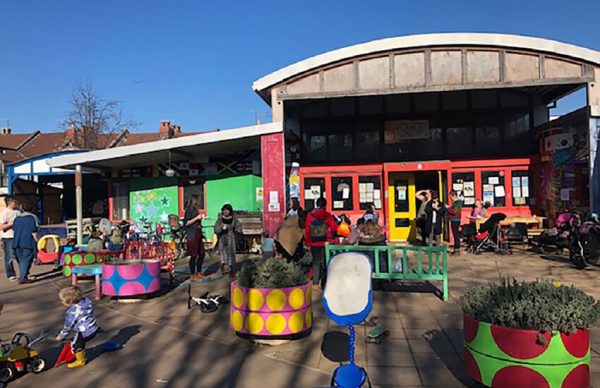
Local councillor Marg Hickman, who is also one of the trustees of Eastside Community Trust, has launched a crowdfunder to raise funds for Felix Road Adventure Playground, one of the Trust’s 2 sites in Easton, Bristol.
Felix Road Adventure Playground. Photo credit: Eastside Community Trust
Felix Road has been in existence for nearly as long as I’ve been in Bristol and provided a much-needed safe space for generations of local children to play, socialise and develop.
Marg writes:
Felix Road Adventure Playground is an inner-city playground supporting some of the most vulnerable and disadvantaged children, young people and families in Bristol. Felix Road is an inspiring beacon of inclusive play, a space where children and families can come together and celebrate diversity.
We need resources to continue to run our busy kitchen staffed by volunteers and providing much needed healthy and nutritious meals for children and families every day, and to help run a girls’ group for Somali young women.
I plan to walk or dance 10,000 steps each day in March. I would so appreciate you sponsoring me to reach my goal. Follow my progress on my Facebook page. Much love.
If you would like to support Marg, please visit her crowdfunding page and kindly give what you can.
Update: Marg’s efforts ended up raising over £2,500 for Felix Road. Well done if you also contributed.
The inspiration to write this post was what an old friend referred to on social media as the Town Planners’ Little Book of Tired Clichés.
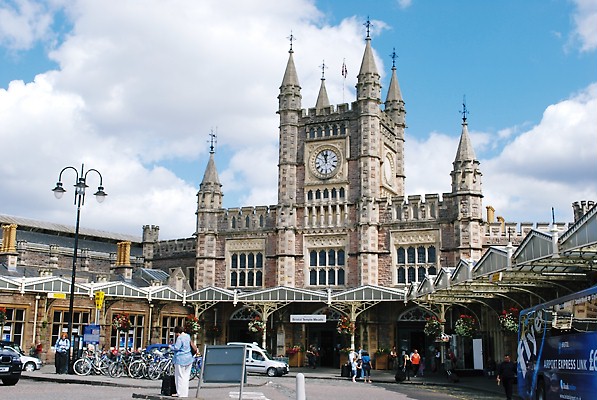
We were discussing a press report on long-term plans for Bristol Temple Meads, the city’s main railway station and its environs.
The report itself was written up from a press release issued by the literary geniuses employed in the Bristol City Council Newsroom down the Counts Louse (which some people now call City Hall. Ed.).
Bristol Temple Meads. Image courtesy of Wikimedia Commons
Whilst avoiding clichés has long been a given as advice for good creative writing, the various actors quoted in the Temple Meads piece seem to relish in their use.
Thus the surrounding area “will be rejuvenated with housing, shops and hospitality outlets creating a new area of the city where people can live, shop, visit and socialise”.
Note the exemplary use of rejuvenated.
In addition, how a new area of the city can be created by covering an existing but derelict city area in architecturally contrived arrangements of building materials is beyond me. If you have any clues, dear reader, please enlighten me via the comments.
Then there’s that essential element for anything involving urban planning – the vision thing. This is ably provided in this case in a quotation by Network Rail’s spokesperson: “We are delighted to be working with our partners on this significant regeneration project and Bristol Temple Meads station is at the heart of this vision.”
Helmut Schmidt, who served as the West German chancellor from 1974 to 1982, had a thing to say about visions: “Wer Visionen hat, sollte zum Arzt gehen“. In English: People who have visions should go to the doctor. Genau! Sie haben Recht, Herr Schmidt.
Needless to the whole glossary of hackneyed phraseology seems to have been upended into the phraseology mixing bowl to create something not only unappetising, but indigestible: ambitious; innovative; rejuvenate/rejuvenation; regeneration; gateway; transformation/transformative; integrate; blueprint; showcase.
And on the clichés go, marching tediously across and down the page.
There are nevertheless a couple of absolute gems in the piece to compensate for all this guff.
Firstly,there’s the timescale for the plans. We are are informed that “work is not expected to start for another decade with the expected completion not until 2041 at the earliest“. Thus all that hot air is being expended on something whose actual implementation is two decades in the future; if not more.
A well-known adage springs to mind: pigs might fly.
Secondly, there’s the promise of an integrated transport hub. Basically this means creating a major public transport interchange (as seen in sensible city’s where the local bus/tram serve the railway station). To my knowledge, there’s been talk of a transport hub/interchange at Temple Meads for at least 3 decades already, so for it actually to become a reality within 5 decades would entail the city’s infrastructure planning process moving at more than their usual slower than tectonic plates speed.
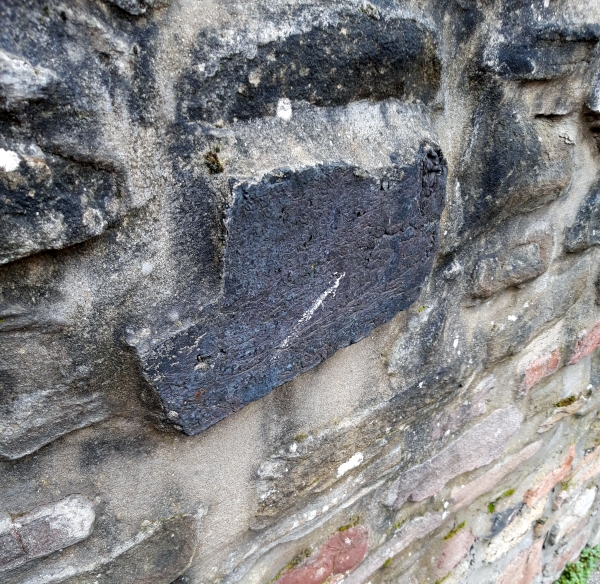
Walls made of stone blocks are not unknown in Bristol. Since medieval times the local grey Pennant sandstone has been a common building material, as in the wall shown below, which is situated in All Hallows Road in the Easton area.
Please note the second block down in the centre of the photograph; the purply-black one that isn’t Pennant sandstone.
It’s a by-product of a formerly common industry in Bristol and the surrounding area that only ceased in the 1920s – copper and brass smelting. Brass goods in particular were mass-produced locally and traded extensively, especially as part of the triangular trade during when Bristol grew rich on slavery.
Indeed it’s a block of slag left over from the smelting process. When brass working was a major industry in the Bristol area, the slag was often poured into block-shaped moulds and used as a building material when cooled and hardened.
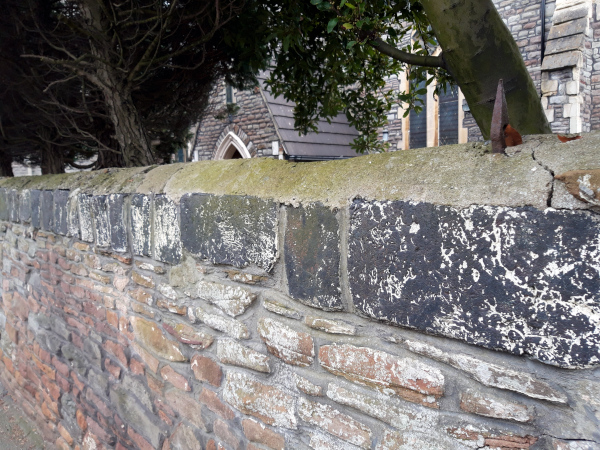
Stone walls were frequently capped with a decorative slag coping stones, as can be seen below on one of the walls of Saint Peter & St Paul Greek Orthodox Church in Lower Ashley Road. Otherwise the blocks were just used like ordinary stone blocks in masonry as above. In some instances, the blocks have been used as vertical decorative features in masonry.
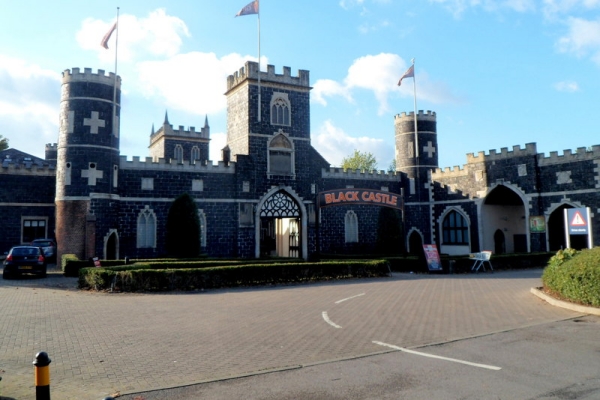
The finest example of the use of slag as a building material within the Bristol area is Brislington’s Grade I listed Black Castle pub (originally a folly. Ed.), where slag has been used extensively.
Black Castle, Brislington, Bristol. Image courtesy of Wikimedia Commons
So if you see any slag blocks in a wall in Bristol, you can be sure it usually dates to the 18th or 19th century, more usually the latter, when Bristol underwent a massive expansion.
There’s a link between Bristol’s brass industry and my home county of Shropshire in the shape of Abraham Darby I.
In 1702 local Quakers, including Abraham Darby, established the Baptist Mills brass works of the Bristol Brass Company not far from the site of today’s Greek Orthodox Church on the site of an old grist (i.e. flour) mill on the now culverted River Frome. The site was chosen because of:
water-power from the Frome;
both charcoal and coal were available locally;
Baptist Mills was close to Bristol and its port;
there was room for expansion (the site eventually covered 13 acres. Ed.).
In 1708-9 Darby leaves the Baptist Mills works and Bristol, moving to Coalbrookdale in Shropshire’s Ironbridge Gorge, the birthplace of the Industrial Revolution. In Coalbrookdale, Darby together with two business partners bought an unused iron furnace and forges. Here Darby eventually establishes a joint works – running copper, brass, iron and steel works side by side.
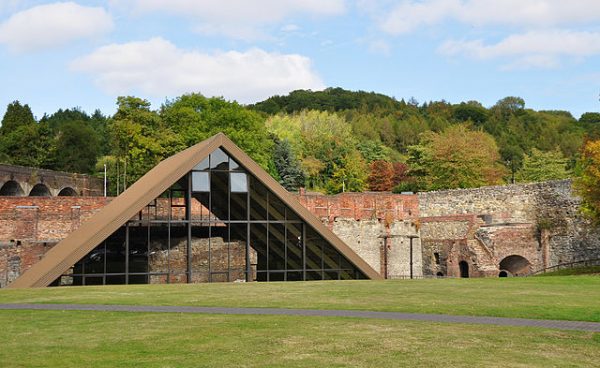
Below is the site of Darby’s furnace in Coalbrookdale today.
Darby’s blast furnace in Coalbrookdale. Image courtesy of Wikimedia Commons.
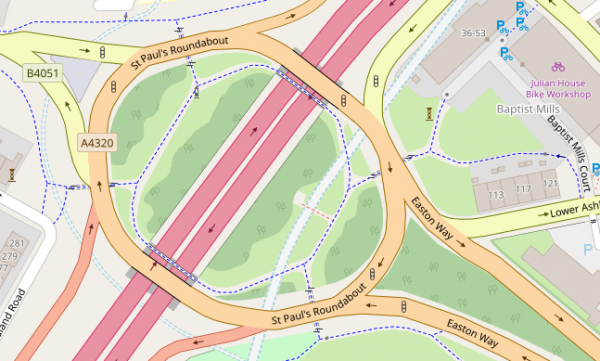
By contrast, here is what occupies the site of the brass works in Baptist Mills – junction 3 of the M32.
The site of the Bristol Brass Company’s Baptist Mills works. Image courtesy of OpenStreetMap.
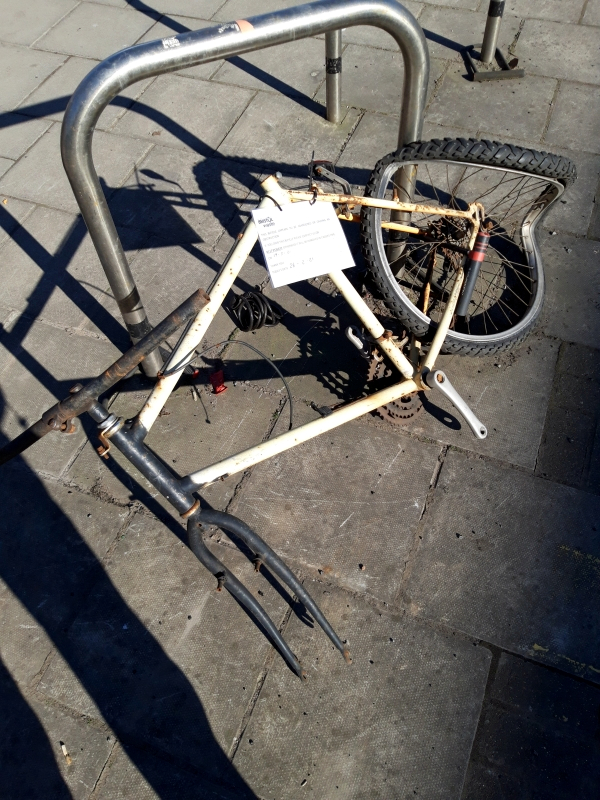
Here’s a wee update on the bike I reported on Lawrence Hill (posts passim).
Since reporting, a member of Bristol Waste staff has been out and affixed a removal notice to the bike, giving the owner – if any – a fixed period, in this case 21 days (3 weeks), in which to recover their property before it is removed.
Abandoned bike with removal notice attached to its top tube
I trust when it is removed, the 2 redundant D-locks also affixed to the stand are likewise removed at the same time. 😀
How many of us pay that much attention to road signs when out and about on our daily business on foot as pedestrians?
I mean really pay attention, not just to the instruction being given or the advice being offered by the road sign itself, but the actual words used.
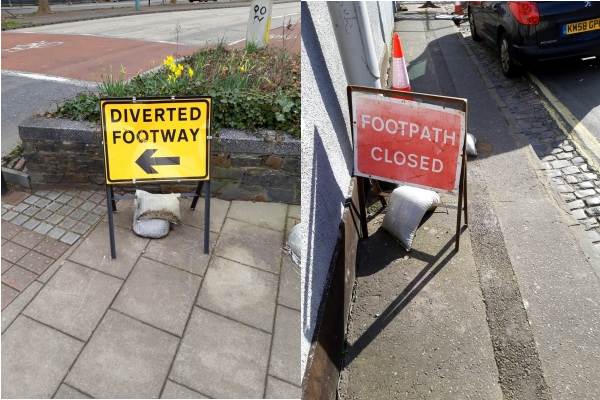
Take the two examples below, both taken during this past week on the streets of Bristol. Both are on a part of the highway used by pedestrians and generally referred to by the general public as the pavement (on which more anon. Ed.). But which – if any – is the correct term? Are footways and footpaths the same?
To answer the second question first, no; they are not the same.
If there’s one thing many decades of being a linguist has taught me, it is that terminology is important – the correct word used in the right context.
One generally has be a legislator, highway engineer or transport campaigner to know the difference between a footway and a footpath.
Fortunately, it is clearly defined in legislation, in this case the Highways Act 1980, which provides the following definitions:
“footpath” means a highway over which the public have a right of way on foot only, not being a footway; “footway” means a way comprised in a highway which also comprises a carriageway, being a way over which the public have a right of way on foot only.
In addition, Cheshire East Council provides the following information on its webpage entitled “What Are Public Rights of Way?“
You should be careful to distinguish between ‘public footpaths’ and ‘footways’. Pavements beside public roads are not public footpaths – it is better to refer to them as footways or simply pavements. Footways are not recorded on the Definitive Map as Public Rights of Way. A footway is really a part of the main highway which has been set apart for pedestrians.
Nevertheless, a caveat needs to be added to the clause where Cheshire East Council advises that “it is better to refer to them as footways or simply pavements“.
The caveat is that there’s a world of difference between what “pavement” denotes to ordinary mortals and professionals such as civil and highway engineers: for the former it’s the footway; for the latter more specialised use, Britannica gives the following definition:
Pavement, in civil engineering, durable surfacing of a road, airstrip, or similar area. The primary function of a pavement is to transmit loads to the sub-base and underlying soil.
Who would have thought two words on two such simple temporary road signs deployed for road works could be such a terminological minefield? 😉
In the middle of the week, Bristol City Council held its annual budget setting meeting.
As usual, it was riven with the traditional partisan ill feeling and rancour, as well as a rift over council housing rent increases within the ruling Labour group.
However, there was one glimmer of hope amongst the gloom. As a result of an amendment put forward by a group of Labour councillors, the council will be funding more enforcement officers to tackle the city’s seemingly insuperable environmental crime problems.
Later in the meeting, the original budget, with a Labour amendment for seven additional litter and fly-tipping enforcement officers, passed by just one vote 33-32.
Seven additional officers is a substantial increase in the complement of the enforcement team and one would hope that these additional resources will make a significant contribution to reducing levels of environmental crime within the city, as well as an increase in the woefully low number of prosecutions carried out, together with the issuing of more fixed penalty notices (FPNs).
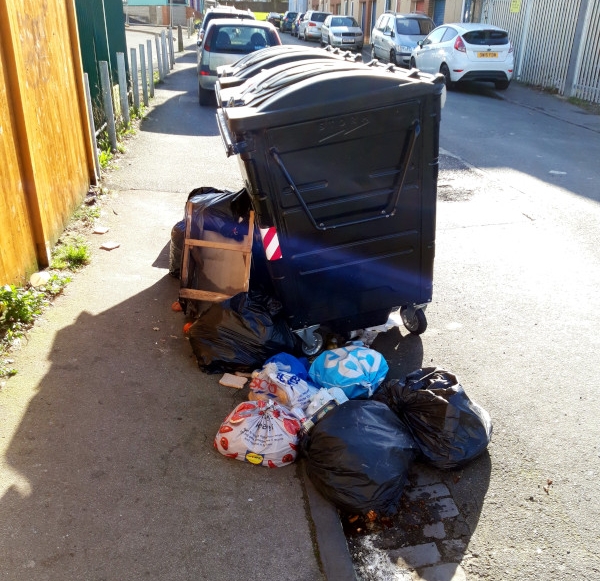
Fly-tipping in Morton Street
Fly-tipping in particular seems to have burgeoned during the lockdowns of the last year, fuelled in part by lower numbers of people on the street (and hence less casual surveillance/deterrence. Ed.), plus the twin booms of DIY projects and online shopping (the latter has also given rise to an increase in cardboard presented for recycling, according to Bristol Waste. Ed.).
PS: I’ve been informed the work I do in the local area was mentioned in the meeting when the amendment was discussed.
Update 14/07/21: Yesterday evening’s Bristol Clean Streets Forum meeting was informed that all the additional enforcement officers will be in post by the start of August.
in 10 years of campaigning for less litter and fly-tipping in east Bristol’s Lawrence Hill and Easton wards, one constant factor has been litter generated by takeaways, particularly the major franchises like Burger King, KFC and the like.
A petition has now been started on change.org to help tackle part of the problem, namely littering by their motorised customers, some of whom seem to have no compunction at just pitching the packaging their meal came in out of the vehicle window once their appetites have been sated.
Fast food litter. Image courtesy of Wikimedia Commons
The back streets of Easton and Lawrence Hill are a good mile of so from the nearest McDonalds, Burger King or KFC, but that does not stop litter from those outlets blighting the neighbourhood.
The relevant petition is entitled “Fast food restaurants to print vehicle reg on takeaway packaging to discourage littering” and reads as follows:
The recent break in fast food companies business has given us time to be able to start to clean up the streets once littered with empty McDonald’s bags, KFC boxes and other takeaway restaurant litter. KFC has been back open merely a couple of days and already pictures of carelessly discarded boxes are circulating on the internet. Let’s not slip back to where we were in terms of litter before the Covid lockdown. Let’s make compulsory that all drive through restaurants, who sell takeaway food, have to print the purchasers vehicle registration onto their bags or boxes. This will make it much easier to trace the litter back to the purchaser and result in a fine or preferably litter picking duties. I am proposing the idea of 3-4 stickers around the size of the bottom of the restaurants cup, printed with date/time and car registration, placed onto the bottom of the bags, cups and boxes to make it difficult for repeat litterers to remove their details without spilling the remaining contents into their cars/vans. The restaurants CCTV will back up this evidence with pictures of the driver and vehicle to provide solid evidence that they were the purchaser of said litter. The fine or community hours need to be big enough to cover costs of enforcement officers investigation times, resulting in nobody “slipping the net”. If we can reach 100,000 signatures I can show clear public interest and go straight to the Secretary of state for Environment, Food and Rural Affairs and demand change. As this could result in a fine for the offenders this will make it much more appealing to the government to pass as law and thus resulting in a cleaner environment for everyone to enjoy. Please help your local and national environment by merely signing this petition and sharing on social media platforms and as many large groups as you can, making a small but very needed step in the right direction. Thank you good citizens.
If the petition is successful, that just leaves how to resolve the problem of those on foot who litter after eating their takeaways whilst walking home… 🙁
 The BBC reports that Tesco is to introduce collection points for soft plastic packaging such as crisp packets, pet food pouches and bread bags at its stores in England and Wales.