Election leaflets from the Liberal Democrats are renowned amongst followers of politics for their inaccuracies, in particular their dodgy ‘bar chart’ graphs.
With the European Parliament elections later this month, sitting Liberal Democrat MEP for the South West Graham Watson has been getting his leaflets out. Those leaflets feature the picture below.
Here we have a typical picture of smiling Liberal Democrats campaigning for better rail services in Bristol. Keen watchers of politics will notice some familiar local LD faces, such as former Bristol councillor ‘Jolly’ Jon Rogers, sitting Bristol councillor Tim Kent and Bristol West MP Stephen Williams.
Keener eyes will also spot prominent local transport campaigner and Green Party member Julie Boston, as well as sitting Bristol Labour councillor Mark Bradshaw.
Ever since it reopened a couple of years ago with Peter Gibbs behind the bar, The Volunteer Tavern in the St Jude’s district of Bristol has gone from strength to strength and now provides excellent beers and fine food in a quiet oasis amid the city’s bustle.
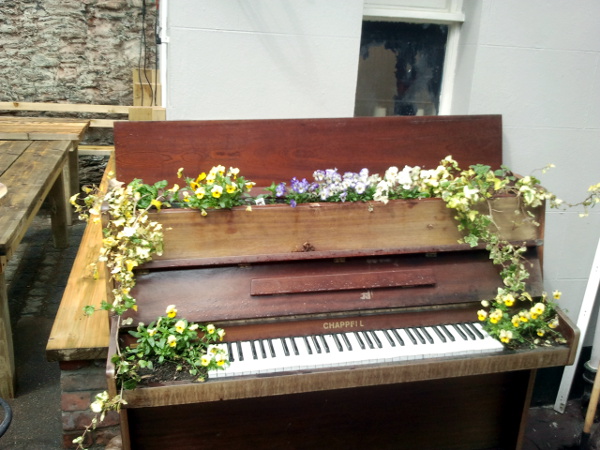
I was there on Sunday and noticed what is possibly the city’s most tuneful planter full of bedding plants.
I’ve heard of a player piano (also known as a pianola. Ed.), but never a planter piano!
Today’s online edition of the Bristol Post features a great headline to this story, as per the screenshot below.
There is however one thing wrong with the headline: it isn’t true since male tortoises – being reptiles – don’t have a penis, but a cloaca (which is the Latin word for sewer. Ed.) – an opening that serves as the only opening for the intestinal, reproductive and urinary tracts of certain species.
To be fair the fact that male tortoises have cloacas is indeed mentioned by the Post’s unnamed author in paragraph 2:
The four year-old spur-thighed tortoise is suffering from a prolapse of the cloaca which requires immediate treatment.
“Never let the truth get in the way of a good headline” seems to be a maxim of the British press at both local and national levels.
Finally, this blog wishes Cedric and his owner every success in remedying Cedric’s problem. 🙂
The Open Rights Group (ORG), an organisation which exists to preserve and promote your rights in the digital age, is holding a meet-up at 8.00 pm on Thursday 24th April 2014 at St Werburgh’s Community Centre, Horley Road, Bristol, BS2 9TJ (map).
The European Court has completed its preliminary examination of the case and has asked the British Government to justify how GCHQ’s practices and the current system of oversight comply with the right to privacy under Article 8 of the European Convention on Human Rights.
The court has also given the case a rare priority designation. The British government now has until 2nd May to respond, after which the case will move into the final stages before judgement.
Join ORG in Bristol to hear from Dan Carey, the solicitor for the application, as he explains what the challenge hopes to achieve and how it will progress from here.
We’ll also be hearing about the Don’t Spy On Us campaign from ORG’s Policy Director, Javier Ruiz, as ORG asks the public to sign its 6 key principles on mass surveillance.
The event will provide a fun and informal way to meet with other local ORG supporters, as well as an opportunity to learn about mass surveillance.
Please join the meetup group if you’re interested in coming along.
Below is a picture of part of an actual election leaflet delivered recently to somewhere in South Bristol by the local Liberal Democrats.
Is it a three horse race too, Lib Dems?
Note that local party hacks have omitted to change this generic national leaflet’s wording from ‘Anywhere Council’ to the name of the relevant local authority.
I for one would like to wish the candidate involved – [Insert Name Here] – every success.
Cabot Circus is hardly my favourite place in Bristol. It’s an out-of-town shopping centre with associated multi-storey car park plonked at the inner city end of the M32. It consists of 3 floors full of identikit national chain stores, plus CCTV and surly security guards to track and/or keep out those who have no intention of buying overpriced, mass-produced consumer tat they probably don’t want, definitely don’t need and most likely cannot really afford.
Today I noticed another reason for avoiding Cabot Circus – mobile phone surveillance.
Warning! Big Retail is watching you.
Note the exemplary use of newspeak: spying on your mobile is “in use at this site to improve our customer service“.
I’m not convinced by the bland assurance regarding personal data either, as will be explained below.
The Footpath technology in use in Cabot Circus has been developed by a company called Path Intelligence and is in use in a number of shopping centres around the UK, including Gunwharf Quays in Portsmouth, Princesshay in Exeter, the Buchanan Galleries in Glasgow, Bon Accord & St Nicholas in Aberdeen and The Centre, Livingston, all of which like Cabot Circus are operated by Land Securities Ltd. The surveillance system works through units placed in shops which detect the changing signals of mobile phones.
Unless people entering the shopping centre happen to see the warning signs (which are conveniently placed alongside lots of others telling the public what they’re not allowed to do, such as use skateboard, take photographs. Ed.) they’re probably unaware that their phones are being monitored.
According to Path Intelligence, the Footpath technology works as follows:
The vast majority of visitors to any given location now carry a mobile (cell) phone. To be able to make and receive calls, the telephone network must understand the phone’s geographical location. The technology behind this is complicated, but in basic terms, the phone and the network continuously ‘talk’ (ping) to each other (sending a unique signal), sending and updating information every time the location of the phone changes.
Footpath technology from Path Intelligence consists of discreet monitoring units able to read the anonymous signals that all mobile phones send. So we’re able to ‘see’ where the phone is (but not the data on it) and map its geographic movements from location to location accurately to within a few meters [sic]. In isolation the information isn’t very revealing but when aggregated, patterns and trends start to emerge. It’s those patterns and trends that are of interest in business planning.
The data collected is fed back to our data centers [sic] 24 hours a day, seven days a week, to be audited and have sophisticated statistical analysis applied. This results in continuously updated information on the flow of people in any monitored location.
As no source code is available for Footpath, no check can be made on its lack of ability to collect personal data or telephone numbers.
At present the technology is not capable of recording phone numbers or personal information, but this will probably change as the system improves and as highlighted by Big Brother Watch:
However, as technology improves, those facilities will become more accessible, and consumers need to have faith that the law protects their privacy. Uncertainty over when and how technology is being used only undermines trust and confidence in any system using mobile phones.
To avoid being tracked, turn off your mobile when visiting Cabot Circus or any other shopping centre operated by Land Securities.
However, there are more controversial items to be discussed. A mole down the Counts Louse has revealed that a new coat of arms and motto for the city have been proposed. Our new elected autocrat Mayor believes “Virtute et Industrial” (Virtue and Industry) is no longer appropriate given the changes he’s made since being elected and believes the city would be better served by the more apposite “Carpe Omnium” (Grab it all). He also believes the city’s coat of arms should be redesigned too, likewise to reflect his achievements.
For the benefit of readers I’ve mocked up the new motto and a new coat of arms to show what Bristol could be letting itself in for.
Bristol’s new coat of arms?
The council press office is denying rumours that the Cabinet is also discussing a motion to rename the city Georgetown in honour of the Mayor.
Avon Archaeology is currently conducting a dig on a site at the junction of Wade Street and Little Ann Street in St Judes that is going to be redeveloped for housing; it was most recently used as a secure car park.
Yesterday I managed to get a couple of pictures through the fencing around the site.
The red brickwork in the centre foreground is the remains of a collapsed vault, suggesting there was a cellar beneath the building.
The cobbled and accompanying paved footways are one of Bristol’s lost streets seeing daylight again.
The street itself was known as Pratten’s Court and can be seen on the following screenshot from the excellent Know Your Place website (posts passim) showing the 1880 Ordnance Survey map layer.
The housing around Pratten’s Court was originally developed in the 18th century and demolished some time in the first half of the 20th century. It does not show up on the 1946 aerial photographs layer on Know Your Place.
Avon Archaeological Unit carried out an assessment of the Wade Street area in 2000 which concluded as follows:
An archaeological desk-based assessment of sites on the north and south sides of the junction of Wade Street and Little Ann Street was carried out by Andrew Smith for the Avon Archaeological Unit in April 2000. The likely survival of palaeo-environmental evidence for the formation of the floodplain of the river Frome, for Romano-British activity and for the development of the area as artisanal housing in the early-eighteenth century was noted.
Further down Wade Street crosses the River Frome. Somewhere in this area a Roman Road, the Via Julia, which went from London to South Wales via Portus Abonae (now better known as Sea Mills. Ed.) crossed the Frome. In 1865 2 Roman lead pigs were discovered near the river. This find was reported in Part 23 of the Archaeological Journal in 1866. Know Your Place records this find as follows:
In 1865, during commercial excavations in Wade Street possibly associated with the construction of a stone revetment wall for the river Frome, two lead ingots of Roman date (one weighing 76 pounds and the other 89 pounds) were found. Both carried inscriptions with identical damage, which was taken to suggest that the ingots had been cast from the same mould. The inscription read “IMP’ CAES’ A[NTON]INI’ AUG’ PII P’ P”. One (89 pounds) passed into the possession of a Mr. Edkins and the other was taken to Sheldon, Bush shot works on Redcliff Hill. Mr. Arthur Bush subsequently donated this ingot to the British Museum (Anon. 1866). Elkington (in Branigan & Fowler, 1976 195) implies that the ingots were almost certainly produced by the Mendip lead-mining industry and points out that flaws on the Wade Street ingots establish that they were cast in the same mould as two of the four ingots found at Rookery Farm, Green Ore, near Wells in 1956 (Anon. 1957, 230-231). However, sampling of the ingot held by Bristol Museum and Art Gallery in 2001 by Vincent Gardiner as part of his postgraduate research into the technology and distribution of Romano-British lead pigs found that the isotopes present suggested an origin in the Bristol/Frome/Weston-super-Mare area.
Man taken to hospital after his car collided with road sign in Avonmouth
The first sentence outlines how the incident occurred:
A man in his 40s had to be removed on a spinal board after his car collided with a road sign in Avonmouth.
Note how the car’s occupant – presumably its driver – plays a passive role; the car apparently collided with a road sign of its own volition without any human intervention. One would almost think that cars and other motor vehicles are so capricious and flighty that conscious action by human beings is imperative to stop the public highway becoming a large linear scrapyard in next to no time and remaining such permanently.
Perhaps a more accurate headline would have been Man taken to hospital after driving into road sign.
Similar examples of this use of English can be found in any local paper in the country.
However, such language is not confined to the print media. An similar example from inside the BBC in Bristol was posted on Twitter this morning (screenshot below).
Note the absence of any human involvement in the incident: a horse was killed by a fast car. Was it an unoccupied, autonomous vehicle? A more accurate rendition would be that a horse was killed by a fast driver.
Then there’s the way large swathes of the media report collisions using the noun accident to describe them. In the vast majority of cases, there’s nothing accidental about them. According to RoSPA, 95% of all road ‘accidents’ involve some human error, whilst a human is solely to blame in 76% of road ‘accidents’.
an unforeseen event or one without an apparent cause
anything that occurs unintentionally or by chance; chance; fortune
a misfortune or mishap, esp one causing injury or death
It would seem that the third definition is the one relied upon by the media. Interestingly, the British police stopped using the term Road Traffic Accident (RTA) some years ago; the police now refer to a Road Traffic Incident (RTI) instead.
Perhaps the media should follow the example of the police if they wish to retain their alleged reputation for truth and accuracy.
The motto of the city of Bristol is Virtute et Industria (Virtue and Industry).
However, one feature of Bristol’s local dialect is the addition of a final, intrusive ‘L’ – a so-called terminal L – to words ending in a vowel.
Consequently, area, say, becomes ‘areal‘, whilst Clifton’s Princess Victoria Street mutates into Princess Victorial Street, so Industria naturally becomes Industrial.
The terminal L is beautifully illustrated in Virtute et Industrial, a song written by Adge Cutler (posts passim), and sung here by the late Fred Wedlock.


 The
The 


