Generating Genius in Bristol
This has just arrived via Twitter from Knowle West Media Centre.

It contains all the relevant information.
Some of us slightly older than 17 wouldn’t mind a free Raspberry Pi either!
This has just arrived via Twitter from Knowle West Media Centre.
It contains all the relevant information.
Some of us slightly older than 17 wouldn’t mind a free Raspberry Pi either!
For the first time scientists and engineers from an international collaboration led by Bristol University’s Dr Mark Thompson have generated and manipulated photons (i.e. individual particles of light) on a silicon chip – a major step forward in the race to build a quantum computer.
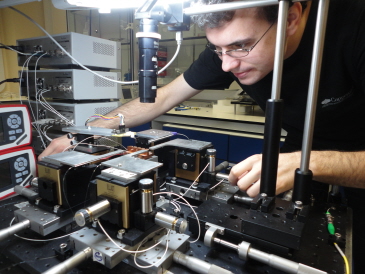 Quantum computers and quantum technologies in general are widely anticipated as the next major technology advance and are poised to replace conventional information and computing devices in applications ranging from ultra-secure communications and high-precision sensing to immensely powerful computers. Quantum computers themselves will probably lead to breakthroughs in the design of new materials and the discovery of new drugs.
Although still in their infancy, quantum technologies are making rapid process and a revolutionary new approach pioneered by Bristol University is exploiting state-of-the-art engineering processes and principles to make leaps and bounds in a field previously dominated by scientists.
Featuring on the front cover of Nature Photonics, this latest advance is one of the important pieces in the jigsaw needed to produce a quantum computer. Whilst previous attempts have required external light sources to generate photons, this new chip integrates components that can generate photons internally.
“We were surprised by how well the integrated sources performed together,” admits Joshua Silverstone, the paper’s lead author. “They produced high-quality identical photons in a reproducible way, confirming that we could one day manufacture a silicon chip with hundreds of similar sources on it, all working together. This could eventually lead to an optical quantum computer capable of performing enormously complex calculations.”
Group leader Mark Thompson explained: “Single-photon detectors, sources and circuits have all been developed separately in silicon but putting them all together and integrating them on a chip is a huge challenge. Our device is the most functionally complex photonic quantum circuit to date, and was fabricated by Toshiba using exactly the same manufacturing techniques used to make conventional electronic devices. We can generate and manipulate quantum entanglement all within a single mm-sized micro-chip.”
The group, which, includes researchers from Toshiba Corporation (Japan), Stanford University (USA), University of Glasgow (UK) and TU Delft (The Netherlands), now plans to integrate the remaining necessary components into a chip and show that large-scale quantum devices using photons are possible.
“Our group has been making steady progress towards a functioning quantum computer over the last five years,” said Thompson. “We hope to have within the next couple of years, photon-based devices complex enough to rival modern computing hardware for highly-specialised tasks.”
However, these are just the first steps. To produce useful quantum machines a new breed of engineers will be required: quantum engineers, individuals capable of understanding the fundamentals of quantum mechanics and applying this knowledge to real world problems.
Bristol’s newly established Centre for Doctoral Training in Quantum Engineering will train a new generation of engineers, scientists and entrepreneurs to harness the power of quantum mechanics and lead the quantum technology revolution. This innovative centre bridges the gaps between physics, engineering, mathematics and computer science, working closely with chemists and biologists while having strong links with industry.
A full copy of the research paper is available from Nature Photonics.
One really has to admire the journalists at the Bristol Post, getting the news out to the public 6 days a week, sometimes in the face of extreme adversity.
For instance, a Sunday morning is a bad time for the spellchecking software to have a dicky fit. After all, no IT support will be available until Monday.
Never mind, in the absence of a spellchecker, the Post’s Geoff Bennett ploughed valiantly on to produce this report, part of which is shown in the screenshot below.
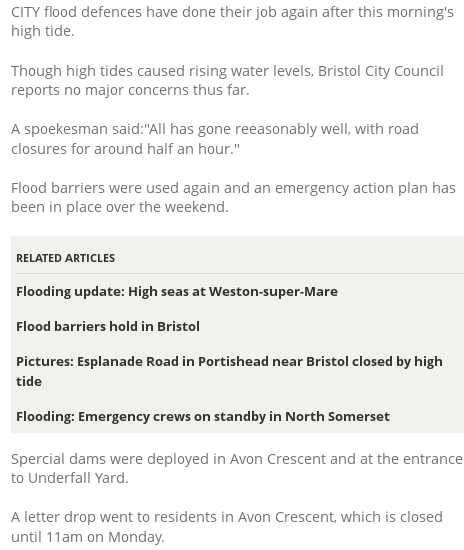
How long will it take before ‘spoekesman’, ‘reeasonably’ and ‘spercial’ are added to the Oxford English dictionary?
Whenever I get my first sight of snowdrops (Galanthus) each winter, my spirit lifts as this very unassuming little flower is the first to bloom each year and thus indicates spring cannot be far away.
It will soon be followed by crocuses, daffodils, tulips and other popular garden bulbs.

These snowdrops were spotted at Lawford’s Gate, Bristol on the site of the Lawford’s Gate House of Correction, a former prison lying outside the city of Bristol until the late Victorian era. Along with the city’s other gaols, it was a target in the 1831 Bristol Riot, when it was set alight. The prison also had a whipping post for punishing prisoners.
Once a place of punishment and misery, the site of the prison is now a pleasant green space with mature trees and – in January at least – the first heralds of spring.
There’s some bloke called Brendan Cole off something called Strictly Come Dancing on the television that’s currently got a show on at Bristol’s Hippodrome called ‘Licence to Thrill’, as shown by the publicity featured below.

Earlier today the Bristol Post’s review of the show featured a translation of the show’s title into American English, no doubt in a bid to help transatlantic visitors to Bristol (alternatively, it could have been caused by letting an American intern loose in the news room or a keyboard/software configuration cock-up. Ed.), as shown by the following screenshot.

The spelling of the headline has since been corrected.
Y’all have a nice day! 🙂
According to Collins English Dictionary, headline has the following definition as a noun:
a phrase at the top of a newspaper or magazine article indicating the subject of the article, usually in larger and heavier type
Here’s a headline from a piece in today’s Bristol Post (since corrected after being ridiculed by a sharp-eyed reader. Ed.).

When it comes to how to use a headline, dictionaries unfortunately do not give guidance regarding their making sense. 🙂
If you either travel into or out of Bristol from the south or sail into or out of the city docks, you’ll be familiar with the Plimsoll Bridge, a swing bridge built over the Cumberland Basin in 1965.

Unfortunately, there’s been some trouble with the bridge recently: during one recent rush hour swing some vital part broke and the bridge remained open – and closed to motor traffic – until the next day when it was cranked closed by hand.
The various repairs that need to be carried out will require several weeks and vessels with high masts will therefore not be able to get into and out of the docks for that period.
Yesterday the Bristol Post’s Michael Ribbeck reported on the latest stage of repairs.
His first sentence reads as follows:
A carriageway of a swing bridge in the centre of Bristol had to be closed overnight while repairs were carried out to lose joints.
Poor Michael! Not only does he have trouble with his vowels, as with the old Stork margarine advertisement, he can’t tell verbs from adjectives! 🙂
Besides its use in the agricultural context, the term ‘cowboy‘ has long been in use informally to describe a person who is an irresponsible or unscrupulous operator, as in the phrase cowboy builder.
Today’s Bristol Post carries a report where it’s uncertain as to who are the cowboys – the builders or the journalists who wrote the piece.
The report in question covers repairs and refurbishment works currently underway at the former home of Thomas Chatterton (20th November 1752 – 24th August 1770), Bristol’s renowned 18th century poet and forger of alleged medieval literary works.
With a sharp eye for inaccuracies, my attention was drawn to the following passage in paragraph 8:
Lathe and plaster is being used on the walls and re-rendering on the outside is being carried out with limestone instead of modern materials so the original stonework can “breathe”.
For anyone familiar with traditional building techniques, the 2 absolute howlers in there are immediately apparent.
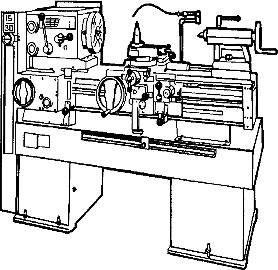
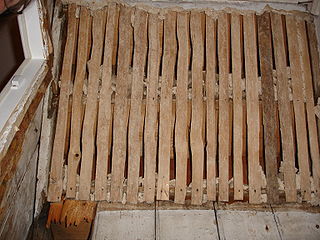
For anyone unfamiliar with traditional building techniques, such as passing Bristol Post journalists in search of enlightenment, here’s an illustrated guide showing where the authors went wrong.
Here is a lathe: this one is for working metal; other types can be used for wood and other materials.
Here are some laths, minus their original plaster coating.
This is limestone – a whole pavement of it.

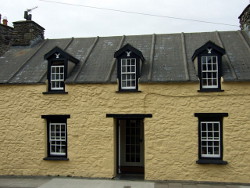
This is a house in St. Davids, Wales showing a traditional limewash finish, yellow ochre coloured in this case.
So far winter in Bristol has been not like winter at all; it’s been mostly mild and rather wet.
As a result some of the local trees – like this cherry in Castle Park (picture taken this morning. Ed.) – are somewhat confused and believe it’s spring already, judging by the display of blossom.

However, where Castle Park is concerned, it’s not just its cherry trees that are confused. Its custodians – Bristol City Council – are confused too.
According to the council’s Central Area Action Plan (CAAP) the western end of Castle Park is a prime development opportunity and has been earmarked for covering in concrete at a time when the city has enough empty shops, offices and other commercial space to cope with another recession besides the one that is allegedly now at an end.
This act of municipal largesse to developers comes in spite of the fact that over 95% of CAAP consultation responses relating to Castle Park were against any development that would mean building on the park and that it’s only some 5 or 6 years since the council encountered firm opposition from Bristolians the last time it proposed developing this bit of Castle Park.
Once again, there’s a petition against the development of Castle Park. Its preamble reads as follows:
As a resident of Bristol, I am dismayed at and object to the proposals in the current Bristol Central Area Plan to build on green space and to cut down some 40 mature trees in the St Mary le Port area of Castle Park and in the High St and Wine St which border it.
Whilst the old disused buildings there are indeed in need of refurbishment and bringing into use, I do not accept that to do so it is necessary to build on any of the existing green space surrounding the buildings or to cut down the trees, which is what the proposals would mean.
Further, this is hardly in line with Bristol being the European Green Capital in 2015.
‘Publish and be damned’ was the the reaction in 1824 of one Arthur Wellesley (1st May 1769 – 14th September 1852) when courtesan Harriette Wilson (whose clients included the then Prince of Wales, the Lord Chancellor and four future Prime Ministers. Ed.) threatened to publish her memoirs and his letters with the possibility of his reputation being damaged. Her decision to publish was based partly on the broken promises of her lovers to provide her with an income in her later years.
However, for the Bristol Post publish and be damned would appear to be its normal modus operandi – at least as far as the online edition is concerned. The hacks down at the Temple Way Ministry of Truth are far too eager to hit the ‘publish’ button when their work is far from ready for publication, as evidenced by this morning’s screenshot of this post, which may have been rectified by the time you visit the site.

Harriette Wilson’s memoirs are still in print. How long can the Post last?
Update, 9.00 am: the piece has been pulled and now returns a 404 error page. However, this does not mean it won’t rise again vampire-like from the crypt.
Update, 10.20 am: It’s back!