Bristol

  • Aspiring

    Bristol may be unique as a city for many reasons. One of these is the city’s tallest building: how many others can boast their tallest edifice dates back to the 12th century? Well, complete with its spire (built 1442), St Mary Redcliffe church – the one the tourists mistake for Bristol Cathedral and the selfsame one described by Queen Elizabeth I as “the fairest, goodliest, and most famous parish church in England” – still towers over every other building in the city at 89 metres (or 292 ft if you still work in old money. Ed.).

    Every now and again, some work needs to be done on the building’s fabric and I was extremely fortunate on Wednesday to spot some in progress way above my head.

    image of spire of St Mary Redcliffe complete with steeplejacks
    Bristol’s tallest building complete with human ants

    If you squint up the spire, you can see two steeplejacks at work, with the lower one actually carrying a ladder.

    The steeplejacks are from the family firm of Dawson Steeplejacks of Clutton in North Somerset. To coincide with the works the Bristol Post carried a feature on the 175 years-old firm and its work. The Dawson family have been steeplejacks for seven generations: now that’s is something to which to aspire!

  • Put icons back in church where they belong

    Once upon a time the only place one would see anything “iconic” was in a Greek Orthodox or Russian Orthodox Church. A gilded frame, copious amounts of gold leaf and a halo or haloes were usually involved.

    However nowadays – much to my dismay – something just has to exist to be regarded as an icon: no veneration is necessary and the word has become hackneyed and synonymous with lazy journalism, as in this piece from today’s Bristol Post, where the undeserving victim is traditional British fish and chips.

    Let’s see what the Guardian Style Guide says about iconic:

    In danger of losing all meaning after an average three appearances a day in the Guardian and Observer, employed to describe anything vaguely memorable or well-known – from hairdressers, storm drains in Los Angeles and the Ferrero Rocher TV ads to Weetabix, the red kite and the cut above the eye David Beckham sustained after being hit by a flying boot kicked by Sir Alex Ferguson. Our advice, even if our own writers rarely follow it, is to show a little more thought, and restraint, in using this term.

    Turning to icon, the Style Guide lists the following objects which were described in the Guardian as “iconic” in a single fortnight in 2010:

    Archaeopteryx
    bluefin tuna
    Castro’s cigar
    David Beckham wearing an anti-Glazer scarf
    Grace Kelly in casual wear
    Imperial War Museum North
    Liberty prints
    limestone stacks in Thailand
    Nigel Slater
    Mad Men
    Variety
    the John Hughes films Breakfast Club, Ferris Bueller’s Day Off and Weird Science
    postboxes
    prints of the Che Guevara image
    Stephen Fairey’s Obama Hope design
    the parliamentary constituency of Hove
    the Brandenburg Gate
    Bach’s St Matthew Passion
    a community-owned wind turbine
    Kraft cheese slices
    salmon farming
    the blue and white stripes of Cornishware pottery
    Penarth Pavilion, Cardiff
    the Norwegian church and Pierhead Building in Cardiff Bay
    a multimillion-pound arena in Leeds
    a “rock-built engine house at Bottalack near St Just”
    the Royal Albert Hall
    wind turbines (“iconic renewable energy technology”)
    Wembley Arena
    the video for Kylie Minogue’s Can’t Get You Out of My Head

    This abuse of language has gone on far too long. Let’s put icons back where they belong: in an Orthodox church, in a gilt frame and covered in gold leaf; is that too much to ask?

  • Bristol City Council – heritage vandals

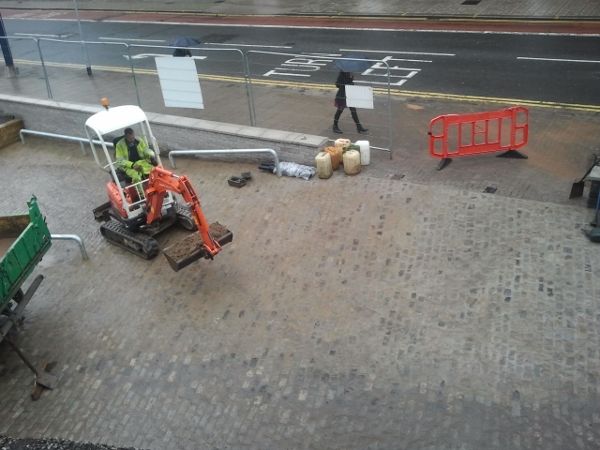
    Take a look at the picture below, taken in Bristol on Monday 8th October. Fairly unremarkable isn’t it? What’s the most interesting thing about it? The digger perhaps?

    No, the most interesting aspect of the picture is what isn’t there. However, before we come to that, a bit of history and context is required.

    Lower Castle Street, Bristol
    Lower Castle Street, Bristol showing the old alignment (cobbled) and the new alignment (asphalt)

    As the caption states, the image shows Lower Castle Street in central Bristol. The cobbled surface near the foot of the picture shows the street’s old alignment hard by the moat and outer defensive walls of the now demolished Bristol Castle; the modern asphalt surface beyond is the modern alignment of Lower Castle Street designed to accommodate modern motorised traffic. The old cobbled bit of what was Lower Castle Street has been incorporated into Castle Park, which occupies the site of Bristol Castle and what was Bristol’s main shopping area until the Luftwaffe razed it during the Blitz in the Second World War.

    Bristol City Council has recently commissioned some works in the corner of the park occupied by the old alignment of Lower Castle Street, as the picture shows. New flowerbeds or grassed areas (it is not yet obvious what they’ll be) have been laid out and the cobbles relaid. So far, so good.

    However, before Bristol City Council sent in its contractors to do the works, the old cobbled bit of Lower Castle Street held what some would regard a significant element of the city’s transport heritage: one of the last set of tram rails visible in any road surface in the city and, as can be seen from the picture, these have now vanished; this leaves just one place in the city where tram rails can still be seen set into the road surface – Bristol Temple Meads station, where the tracks are part of the former tram terminus between the ramp and the old station.

    Perhaps the City Council thinks that ‘heritage’ is something that belongs in a museum. It doesn’t: it’s part of everyday life in a city like Bristol which has existed since Saxon times; and some parts of the city are even older than that. By its vandalism the City Council has shown it is not a fit and proper curator of the city’s history and heritage.

    There’s yet one more place in central Bristol where a tram rail – a single one – can still be seen; it’s in the churchyard of St Mary Redcliffe. During the Second World War a bomb exploded in a nearby street, throwing a rail from the tramway over the houses and into the churchyard, where it remains to this day.

    (I am indebted to Pete Insole for information re Temple Meads.)

  • Bristol Mayor – employment special

    If you’re a Bristol resident, it cannot have escaped your notice – unless you’ve been on a drink and drugs bender for the last 6 months – that the city is due to go the polls in November to choose its first elected mayor, following an underwhelming referendum result in May 2012.

    My home has been mercifully spared too much attention to date by party animals, canvassers and leaflet drops. In fact, I only recently received my first leaflet, as it happens from Labour mayoral candidate Marvin Rees.

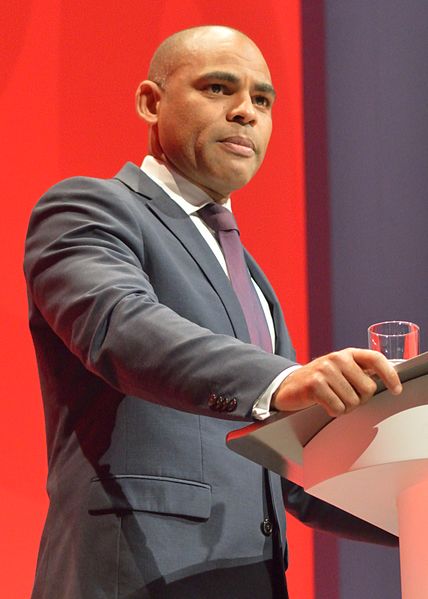
    Marvin Rees
    Picture courtesy of Wikimedia Commons

    As usual, the leaflet contains the conventional promises about how wonderful life would be if only the reader could be persuaded to vote for the candidate concerned, including the following about local employment:

    We are living in tough times. I will work to get jobs and growth in Bristol.

    That’s a very laudable and important aim to have for someone seeking election to a major public office in the city on a salary that will probably be in the region of £1,000 a week.

    However, Marvin’s commitment to “work to get jobs” in Bristol is shot totally out of the water by the very end of his leaflet.

    Yes, Marvin’s leaflet is printed in the far-flung Bristol suburb of Forest Farm, Cardiff, providing employment in CF14 in these “tough times”.

    Is it really difficult to get printing done in Bristol? Not really: a quick Google using the words Bristol, UK and “leaflet printing” returns over 2,300 results in a fraction of a second.

    However, Marvin is not alone in supporting employment anywhere but Bristol. The city council, of which Marvin will be in charge if elected, has form here too, as in spending £73,000 with a Manchester firm for logos.

    Update 6/10/12: Yesterday I received a joint leaflet featuring Marvin for mayor and John Savage for the elected Police & Crime Commissioner. This one was printed in an outlying district of Bristol, i.e. Laindon in Essex.

  • Local youngsters get chance to win a Raspberry Pi

    Although my postal address says Easton, I’ve lived in Bristol’s Lawrence Hill ward for 35 years now and was delighted to see there was a competition to win a Raspberry Pi in the latest edition of Up Our Street, the quarterly regeneration and community matters magazine produced by Easton and Lawrence Hill Management.

    The Raspberry Pi is of course a small Linux computer available at pocket money prices and aimed at young people who wish to learn programming.

    Raspberry Pi in a case

    To be eligible for the competition, entrants must be under 25 years of age and live in either Lawrence Hill or Easton ward in Bristol.

    Entries stating why you would like to win the Raspberry Pi should be sent by email to stacy (at) eastonandlawrencehill.org.uk by the closing date of 30th November and should also include your name, date of birth and address.

  • Gert lush

    The story that the fair city of Bristol is to see the roll-out of 4G mobile access has not escaped the eagle eyes of The Daily Mash, as the screenshot below shows.

    Screenshot of Daily Mash news piece

    4G is shorthand for the fourth generation of mobile telecommunications standards and the successor to third generation (3G) standards.

    Urban Dictionary defines ‘gert lush’ as: “The highest form of praise that can be given to anything by a Bristolian.”

    Proper job, says I. 😉

Posts navigation