Politics

  • Fast food litter petition

    in 10 years of campaigning for less litter and fly-tipping in east Bristol’s Lawrence Hill and Easton wards, one constant factor has been litter generated by takeaways, particularly the major franchises like Burger King, KFC and the like.

    A petition has now been started on change.org to help tackle part of the problem, namely littering by their motorised customers, some of whom seem to have no compunction at just pitching the packaging their meal came in out of the vehicle window once their appetites have been sated.

    Fast food litter
    Fast food litter. Image courtesy of Wikimedia Commons

    The back streets of Easton and Lawrence Hill are a good mile of so from the nearest McDonalds, Burger King or KFC, but that does not stop litter from those outlets blighting the neighbourhood.

    The relevant petition is entitled “Fast food restaurants to print vehicle reg on takeaway packaging to discourage littering” and reads as follows:

    The recent break in fast food companies business has given us time to be able to start to clean up the streets once littered with empty McDonald’s bags, KFC boxes and other takeaway restaurant litter.
    KFC has been back open merely a couple of days and already pictures of carelessly discarded boxes are circulating on the internet. Let’s not slip back to where we were in terms of litter before the Covid lockdown. Let’s make compulsory that all drive through restaurants, who sell takeaway food, have to print the purchasers vehicle registration onto their bags or boxes. This will make it much easier to trace the litter back to the purchaser and result in a fine or preferably litter picking duties. I am proposing the idea of 3-4 stickers around the size of the bottom of the restaurants cup, printed with date/time and car registration, placed onto the bottom of the bags, cups and boxes to make it difficult for repeat litterers to remove their details without spilling the remaining contents into their cars/vans. The restaurants CCTV will back up this evidence with pictures of the driver and vehicle to provide solid evidence that they were the purchaser of said litter. The fine or community hours need to be big enough to cover costs of enforcement officers investigation times, resulting in nobody “slipping the net”.
    If we can reach 100,000 signatures I can show clear public interest and go straight to the Secretary of state for Environment, Food and Rural Affairs and demand change. As this could result in a fine for the offenders this will make it much more appealing to the government to pass as law and thus resulting in a cleaner environment for everyone to enjoy.
    Please help your local and national environment by merely signing this petition and sharing on social media platforms and as many large groups as you can, making a small but very needed step in the right direction.
    Thank you good citizens.

    Sign the petition.

    If the petition is successful, that just leaves how to resolve the problem of those on foot who litter after eating their takeaways whilst walking home… 🙁

  • Abandoned cycle removal – a Bristol how-to

    Cycling has undergone an upsurge in popularity in recent times due to it being a healthy and convenient mode of transport.

    Nevertheless, this increase in popularity does have some drawbacks, one of which is damaged or abandoned cycles  being left attached to cycle racks or other street furniture, like this typical example on Lawrence Hill by the station steps.

    Damaged, abandoned cycle attached to Sheffield stand

    Even though I’ve been involved for a decade with trying to stem the tide of litter and fly-tipping that blight our streets, I was uncertain of the procedure to follow to report dumped bikes and get them removed.

    I therefore turned to the Community Engagement Team of Bristol Waste, a council-owned company responsible for recycling and waste collections and street cleansing, for advice.

    The relevant part of their response is quoted below.

    The process is – logging a web form under street cleansing (https://www.bristol.gov.uk/streets-travel/street-that-needs-cleaning) and then provide the details of where the bike is. The crew will go and cut it off and dispose of it. If it looks like its owned by someone, then we put a notice on for 3 weeks and then go back and remove it if still there.

    That seems very simple indeed.

    Thanks, for your helpful reply, Bristol Waste!

    I now hope others will join me in keeping the streets free of abandoned clutter.

    NB:: as abandoned bikes are not specifically mentioned in the drop-down list of items that can be reported for attention, I chose to class it as ‘Litter‘. 😀

  • A language lesson for an ignorant MP

    The continuing ignorance of the hardline Tory MPs who spearheaded the UK’s departure from the European Union is a gift that just keeps on giving.

    Not only do they not understand how the EU works (clue: it’s a rules-based organisation. Ed.), they also do not know how international trade works (clue: that’s also a rules-based system. Ed.).

    When it comes to ignorance of the workings of international trade – and tariffs in particular – Shrewsbury and Atcham MP Daniel Kawczynski has previous form, ending up looking a lemon in respect of, er, lemons.

    However, there appears to be no start to Daniel’s ignorance and no end to his vanity in wanting to draw attention to the same. On Monday 22nd February he posted the tweet below on his Twitter account.

    Tweet reads: Now we have left EU & creating exceptionally strong global economic partnerships with key non European partners, the time has come for a debate as to which languages are taught to children in schools. I feel the almost total domination of French Spanish & German needs review.

    Daniel no doubt believes that these languages are spoken solely in countries such as France, Spain and Germany in the hated EU.

    Time to think again, Danny Boy! 😀

    Let’s start with your last mentioned language shall we, Daniel (especially as it might be considered the easiest to dismiss.Ed.)?

    German is, of course, spoken in Germany. However, it’s also the official language in Austria as well as being one of Belgium’s four official languages. In Italy’s province of Alto Adige (also known as the Südtirol. Ed.), 62% of the population are German speakers. Outside the EU, German is also one of Switzerland’s four official languages. German is a recognised minority language in the Czech Republic, Hungary, Poland, Romania, Russia and Slovakia. Beyond Europe there are still 25,000-30,000 native German speakers in Namibia, despite it ceasing to be a German colony over a century ago: some 12,000 persons whose first language is German currently live in South Africa. Turning to South America, there are an estimated 1 million German speakers, with German-speaking minorities in almost every Latin American country including Argentina, Belize, Bolivia, Brazil, Chile, Colombia, Costa Rica, Dominican Republic, Ecuador, Guatemala, Mexico, Nicaragua, Paraguay, Peru, Uruguay, and Venezuela. In North America, there are also German-speaking minorities in both the USA and Canada.

    The map below illustrates where German is spoken around the world.

    German speaking areas of world
    The German-speaking world. Image courtesy of Wikimedia Commons.

    How does Daniel fare with French?

    Equally badly is the answer.

    Besides the EU countries of France, Belgium and Luxembourg, French is also spoken within Europe in Monaco and parts of Italy. Throughout the world there are estimated to be some 274 million French speakers, of whom some 77 million are native speakers. Within the EU alone, French is the third most widely spoken language (after English and German), being spoken by 19.71% of the population and is the second most-widely taught language after English. It’s an official language not only in France, but Belgium, Luxembourg, Monaco and Switzerland. It is also widely spoken in Italy’s Aosta valley region.

    However, it is in Africa – and particularly former French colonies and territories – that the majority of the world’s French speakers live. According to a 2018 estimate from the Organisation Internationale de la Francophonie, an estimated 141 million African people spread across 34 countries and territories can speak French as either a first or a second language. This estimate does not include those inhabitants of non-Francophone African countries who have learned French as a foreign language.

    Looking at the Americas, French is the second most common language in Canada, after English, and both are official languages at the federal level. It is the sole official language in the Canada’s Quebec province. In the USA, French is the fourth most-spoken language in the United States after English, Spanish, and Chinese, when all forms of French are considered, according to the United States Census Bureau.

    The following map shows membership of the Organisation internationale de la Francophonie, the international organisation representing countries and regions where French is either a lingua franca or customary language.

    Map of membership of the Organisation internationale de la Francophonie
    Membership of the Organisation internationale de la Francophonie. Image courtesy of Wikimedia Commons


    So far that’s two own goals Daniel’s scored on the worldwide importance of 2 of the major foreign languages taught in British schools.

    How does he fare with his third target – Spanish?

    In short, not any better.

    Today Spanish has 500 million native speakers, mainly in Spain and the Americas and is the world’s second-most spoken native language after Mandarin Chinese and the world’s fourth-most spoken language overall after English, Mandarin Chinese, and Hindi. Overall there are estimated to be 586 million speakers of Spanish in the world. As befits its large number of speakers, Spanish is one of the six official languages of the United Nations and it is also used as an official language by the European Union, the Organization of American States, the Union of South American Nations, the Community of Latin American and Caribbean States, the African Union and many other international organisations, as well as being one of the world’s most widely taught foreign languages.

    Below is a map showing where in the world Spanish is spoken.

    Map of the Hispanophone world
    Map of the Hispanophone world. Image courtesy of Wikimedia Commons

    So how’s Daniel done?

    In brief, not very well.

    If Mr Kawczynski had been a footballer instead of a member of Parliament, he would have gone down in the match report as having scored three goals for the opposing side, also know as own goals (Kawczynski 3, og).

    Finally, it’s worth pointing out that Daniel has been appointed the UK’s trade envoy to Mongolia. If his tweet was an attempt to increase the teaching Mongolian as a foreign language in British schools, it was, to say the least, extremely clumsy.

  • Welsh Not still alive and well

    In the 18th, 19th and early 20th centuries, Welsh children who used their native tongue in schools were subject to a particular form of punishment and humiliation – the Welsh Not.

    The Welsh Not (also Welsh Knot, Welsh Note, Welsh Stick, Welsh Lead or Cwstom) was an item used in Welsh schools in the 18th, 19th and 20th centuries to stigmatise and punish children using the Welsh language, according to Wikipedia.

    Welsh NotTypically “The Not” was a piece of wood, a ruler or a stick, often inscribed with “WN“. On any schoolday, it was given to be worn round the neck to the first pupil to be heard speaking Welsh. When another child was heard using Welsh, “The Not” was passed to the new offender: and on it went. Pupils were encouraged to inform on their classmates. The pupil in possession of “The Not” at the end of the lesson, school day or week – depending on the school – received additional punishment besides the initial shaming and humiliation.

    In recent times the Welsh Not seems to have transformed from being a physical object to a mental one, but one that is nevertheless still used to stigmatise speakers of one of the country’s oldest languages – one that was already old when Old English (which some call Anglo-Saxon. Ed.) first became established as England’s common tongue.

    The persistence of stigmatisation is just one matter covered in a Metro opinion piece by Lowri Llewelyn entitled Why the Welsh language deserves respect not ridicule.

    Looking specifically at stigmatisation, Lowri, who learned Welsh as a child and grew up in a bilingual household, writes:

    I can’t count how many times English folk have jeered about my ‘dead language’.

    At least it wasn’t referred to as “gibberish“, Lowri!

    To reinforce her point, she continues:

    Fuelled by anti-Welsh sentiment from England, the Welsh even came to oppress and disrespect themselves.
    She then goes on to point out how, as a teenager she would only speak English to friends and be dismissive of her native culture, before going on to point out how she has since changed her attitude and welcomes efforts to increase the presence of Welsh.

    Lowri concludes by pointing out some of the encouraging signs of a renewed interest in Welsh.

    For instance, in recent times Welsh has become the fastest growing language in the UK on the Duolingo language learning platform. One explanation might be a renewed interest in the cultures and history of the nations that make up Great Britain, given the severe restrictions on foreign travel imposed as a result of the coronavirus pandemic.

  • Insert word of choice

    For many years the garage sitting at the apex of the junction of Russelltown Avenue, Cannon Street and Whitehall Road in BS5 has featured a changing sequence of slogans painted by Stan Jones, who lives in the house to which the garage belongs.

    It was 2017 when I first noticed it and, at that time, it focussed on the madness of Brexit.

    Garage wall featuring Exit Brexit slogan
    Exit Brexit

    In 2019 its message was still focussed on Brexit but had been repainted to featur the wording “Buck Foris” (fine use of a Spoonerism there. Ed.) and “Fromage not Farage“, so I think it’s fair to say Stan is not impressed with the right-leaning part of what passes for Britain’s political class.

    In 2019 Stan’s efforts accidentally suffered the attentions of Bristol City Council’s fight against graffit. There was, however, a happy outcome as Stan received an apology and some paint from the corporation, as the Bristol Post reported at the time.

    Below is Stan’s latest contribution, which really needs no further comment from me.

    Text on building reads What the [insert word of choice] is happening?
    Stan’s latest (shame about the tags)


  • The rubber stamp of approval

    Approved stampGoing back to my schooldays over 5 decades ago, I recall being taught in English language classes that to rubber stamp means officially to approve a decision without giving the matter in question any proper scrutiny or thought.

    Rubber stamping is indicative of lack of care, attention and is indicative of perfunctoriness.

    Furthermore, the definition I was taught all those long years ago is confirmed by Collins Dictionary, which states:

    When someone in authority rubber-stamps a decision, plan, or law, they agree to it without thinking about it much.

    Nevertheless, there seems to be a general trend nowadays in the press to use this verb routinely for the approval of any decision, whether or not it is preceded by lengthy or indeed any debate at all.

    It’s as if to rubber stamp has become synonymous with to approve, which is really isn’t.

    One very guilty party in this respect is the Bristol Post, now rebranded as Bristol Live by its Reach plc masters, as per this example from 12th February, where we read:

    The plan is due to be rubber stamped at a council meeting on Monday (February 15).

    If there’s one thing I know about planning meetings (having attended them. Ed.), it’s that their decisions are never rubber stamped, as councillors serving on planning committees generally tend to consider all applications in the most minute detail. There’s no waving agenda items all through in a couple of minutes, so members can retreat early to the pub or somewhere else more interesting than a council meeting room.

    I hope any passing member of the fourth estate will take note of – and act upon – the content of this little post.

  • Premises, premises

    When related to property, the noun premises is defined by Collins Dictionary as:

    a piece of land together with its buildings, esp considered as a place of business.

    When related to property, premises has since time immemorial (or even longer. Ed.) been a plural noun.

    However, it is a source of constant surprise how many people these days regard premises as a singular noun, as shown by this recent example, courtesy of Manchester City Council.
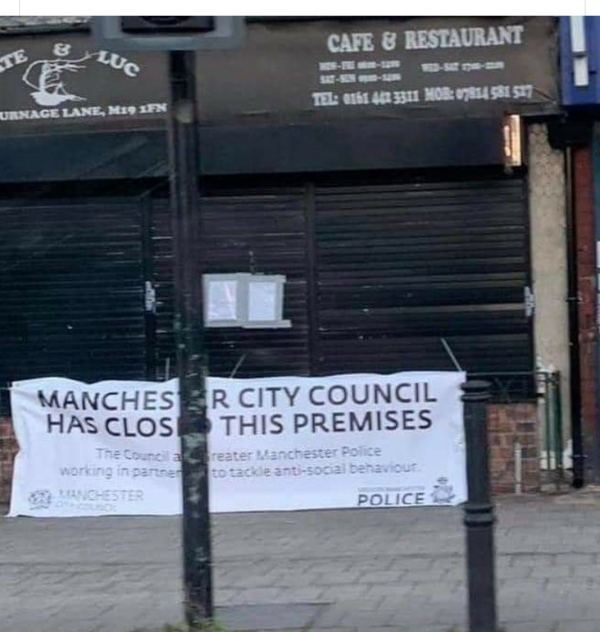
    Banner in image reads: Machester City Council has closed this premises
    A singular example

    However, it should be remembered that premise does exist as a singular noun, in which instance it takes the following definition:

    something that is supposed to be true and is used as a basis for developing an idea.

    Local authorities are not the only people to get confused about premises and premise as regards use of the plural and singular.

    Take this example on Twitter courtesy of the constabulary in Shrewsbury.
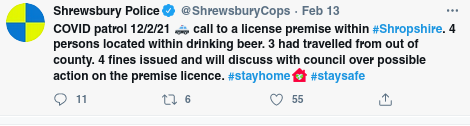
    Tweet reads: COVID patrol 12/2/21  🚓  call to a license premise within #Shropshire. 4 persons located within drinking beer. 3 had travelled from out of county. 4 fines issued and will discuss with council over possible action on the premise licence.
    A singular licence

    That’s right. Why have a premises licence when a premise licence will do just as well? I’m sure Mr Plod meant the former, but having a licence for a premise raises many new questions indeed.

    Professor Paul Brains of Washington State University has included the confusing of premises and premise in his book, Common Errors in English Usage. Read his simple, eloquent distinction.

    Premises are also quite particular about where any action takes place too. Anything that happens always, always takes place on them, not in them.

    The introduction of a blanket ban on smoking indoors gave rise to a wave of illiteracy, as exemplified by this typical example.
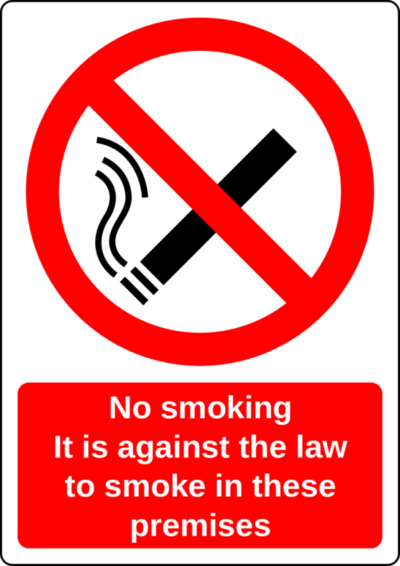
    Sign reads No smoking. It is against the law to smoke in these premises
    Image courtesy of Wikimedia Commons

    It does feel as though those of use who are held to higher standards of language use and/or were taught proper English (Ahem! Ed.) are fighting a losing battle. Will premises become increasingly singular? Will actions take place in them ( or it? Ed.) in future?

    For the answers to such questions, one must wait and see.

    Only time can tell as language always has been dynamic, i.e. a moving target: and what is regarded as proper usage will always be subject to change, just like language itself.

  • Mold: no interpreter; justice delayed

    Although it’s not hitting the national headlines any more, the Ministry of Justice’s disastrous decision to outsource interpreting services for courts and tribunals in England and Wales continues to delay the administration of justice.

    The latest instance your correspondent has discovered occurred last Friday at Mold, according to the County Times.

    Mold Law Courts
    Mold Law Courts. Image courtesy of Wikimedia Comms.

    That day a case against two Vietnamese defendants, Quan Vu and Bang Vu, had to adjourned as no Vietnamese interpreter had been arranged to attend court for their plea hearing.

    Both defendants are charged with being concerned in the production of cannabis in Newtown in Powys.

    Judge Niclas Parry adjourned the case. A plea hearing will now take place on Friday, 8th March, with the trial date set provisionally for 15th April.

    Mr Justice Parry remarked that a letter of explanation was required as to why no interpreter had been arranged.

    In the meantime both defendants remain in custody.

  • Stupid boy! Another pair of lookalikes

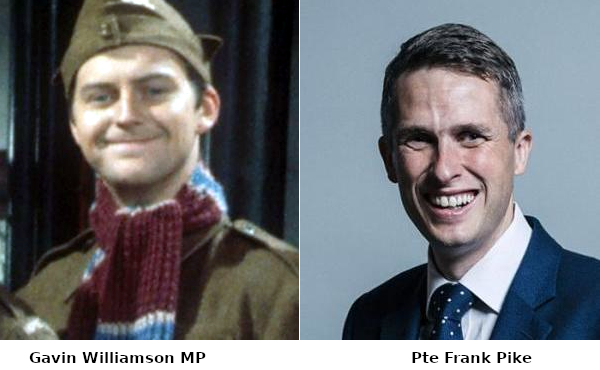
    It’s no secret that Gavin Williamson MP, the current Secretary of State for Defence, is nicknamed Private Pike, after Frank Pike, the fictional Home Guard private and junior bank clerk in the BBC television comedy Dad’s Army, who was frequently referred to by platoon commander Captain Mainwaring as “stupid boy“.

    Composite of Private Pike and Gavin Williamson

    Young Gavin, who is the Member of Parliament for South Staffordshire, had a real stupid boy moment last week.

    On Monday, in a gung-ho speech to the Royal United Services Institute, Williamson confirmed that the first of Britain’s next-generation aircraft carriers, the Queen Elizabeth, will tour the Pacific as part of its maiden voyage and that the vessel likely to tour the South China Sea at a time of growing tensions regarding China’s territorial ambitions.

    Needless to say this has not gone down well in Beijing, resulting in a planned trade visit by Chancellor Philip Hammond being cancelled.

    Even former Chancellor George Osborne has commented, also alluding to Williamson as a stupid boy, but using rather more words, as iNews reports:

    You have got the defence secretary engaging in gunboat diplomacy of a quite old-fashioned kind at the same time as the chancellor of the exchequer and the foreign secretary are going around saying they want a close economic partnership with China.

Posts navigation