Maris Dombovskis of Longton is charged with failing to provide a specimen of breath for analysis, driving without insurance and without a licence on January 19.
District Judge Jack McGarva adjourned the case until February 29 to arrange for an interpreter.
This was the second time last week that a court case at this court complex had to be adjourned for lack of an interpreter.
On Tuesday 23rd February magistrates adjourned the case of a Polish resident of Smallthorne charged with assault for 3 days to arrange for an interpreter, The Sentinel also reported.
While the Bristol Post’s report concentrated on the 4% increase in council tax and Bristol’s donation of £500,000 for a Concorde museum in neighbouring South Gloucestershire, its political editor, Ian Onions, somehow managed to omit some important news for those fighting environmental crime in the city.
This news was that the city council will be employing two more so-called “streetscene” enforcement officers next year, bringing the total number of these officers employed by the city council to 8. These officers are responsible for bringing fly-tippers and litter louts to book.
Lawrence Hill ward councillor Marg Hickman conveyed this news to Tidy BS5 campaigners yesterday evening, stating that the Labour group’s amendment calling for the 2 additional officers was the only amendment to the Mayor’s budget to receive 100% support in the council chamber.
Marg was one of 2 councillors to speak to the amendment (another colleague spoke on dog fouling, another of the blights of urban life, in support of the amendment. Ed.). Her speech is transcribed below and conveys many of the sentiments that Tidy BS5 campaigners have been voicing to the council for the past 2 years, with the local authority’s lack of action to date neatly summarised by the phrase “glacial speed of change“, although your correspondent reckons that glaciers actually move faster than Bristol City Council and a more accurate comparison would be with tectonic plates.
Institutional neglect has been the impact of Green Capital on parts of the city. What is certain is that, when it comes to the cleanliness of most areas of the city, this much-praised initiative has had minimal effect.
In 2013/14 Bristol had the unenviable status of the dirtiest place in the South West. According to government statistics, Bristol residents reported 10,472 incidents of fly-tipping – can you imagine how many more unreported incidents there must have been? It was with this statistic as a backdrop that the number of street scene enforcement officers was cut in 2013 from 10 officers, plus support staff and 3 dog wardens, to approximately 6 today. In comparison I can reveal that during our Green Capital year we had an army of PR experts – 45 in total – all employed to make the council look good. Well, I know, and I am sure many of you would agree, that our residents would prefer it if we employed more people to keep our communities looking good rather than ourselves.
There seems to me to be complacency in the council regarding the unacceptable levels of fly-tipping and litter in areas from Lawrence Hill and Eastville to Lawrence Weston, and it is compounded in the south of the city by the Mayor’s refusal to sign off the waste recycling centre in Hartcliffe.
In BS5, one of the city’s fly-tipping hotspots, which stretches from across the road from Cabot Circus to Eastville, there have been 32 enforcement actions taken against people. This low level of enforcement is because of the cuts and the lack of ongoing training and development of the enforcement staff. We need to augment our street enforcement officers and provide proper support and training, and learn from best practice from around the country to deal with the issue of waste at a time of shrinking budgets.
We have to support communities across Bristol blighted by this environmental eyesore and come up with solutions that work. We need to consult affected communities, speed up the glacial speed of change, and increase the number of properly trained and supported enforcement officers.
We have before us an amendment that will get the ball rolling and help kick-start the change we need to clean up our streets. Surely money would be better spent on this rather promoting more and more PR people.
We would all benefit from this amendment. The communities you serve would benefit and Bristol as a whole would be a cleaner and happier city. Please support this amendment today so that Bristol can be the cleanest city in the South West and not the dirtiest.
On Tuesday the Welsh Government website reported that legislation to improve the protection and management of Wales’ unique historic environment had been passed by the National Assembly for Wales.
Once the Bill is law, Wales will also become the first country in the UK to put historic environment records on a statutory footing – a measure that many groups having been calling for across the UK.
These records will allow advice on decisions by planning authorities and land managers to be based on sound information.
The records will also provide access to the new list of historic place names in Wales – another first for Wales.
Station sign at Llanfairpwllgwyngyllgogerychwyrndrobwllllantysiliogogogoch – Wales’ longest place name. Image courtesy of Wikimedia Commons
Reporting on the place names records, the BBC states that the scheme will see the names of fields, river pools, caves and even ruined cottages collected and used to develop a definitive digital map. Furthermore, the names themselves will also make their way onto a National Library of Wales database.
As a language, Welsh emerged in the 6th century from Common Brittonic, the common ancestor of Welsh, Breton, Cornish and the extinct language known as Cumbric, according to Wikipedia.
Shelf life is the length of time that a commodity may be stored without becoming unfit for use, consumption, or sale. In other words, it might refer to whether a commodity should no longer be on a pantry shelf (unfit for use), or just no longer on a supermarket shelf (unfit for sale, but not yet unfit for use).
As one of these four submarines is supposed to be at sea at all times, perhaps Mr Daly would care to explain to his readers, why the quartet is cluttering up the quartermaster’s stores instead. 😉
Alternatively, perhaps Patrick could learn the definition of the term “service life“. 🙂
Update 12/02/16: The piece has since been amended and the offending “shelf-life” replaced.
Since 1990 the spelling reform approved by the Académie Française has never really been pursued. “Oignon” without an “i“, the removal of some circumflex accents: at the start of the next academic year, teachers should finally implement this reform, TF1 reports. A total of 2,400 words are going to be changed; here are 10 examples.
The word “nénuphar” will henceforth be able to be written as “nénufar“. The spelling reform of 6th December 1990 that was approved by the Académie Française is finally going to be applied at the start of the next school year by the publishers of school textbooks and thus by teachers.
One of the new features is that circumflex accents are going to disappear gradually. The verb “s’entraîner” will therefore be able to be spelt with a simple “i” and thus minus the circumflex accent. This part of the reform should make learning spelling easier for children.
Special National Education Official Bulletin no. 11 of 26 Novembre 2015 gives a reminder that the spelling reform to be applied to the schooling of a child is that of 1990. Spelling and grammar textbooks will therefore carry the wording “New spelling” from the start of the next academic year.
Another brain-teaser
Only 45% of French people were proficient in the rules of spelling in 2015. What will happen when students have to learn to spell the same word in two different ways? Teachers are already reticent about this question.
The change in French spelling has not been accepted by the world of work and business for 26 years. The 2,400 words involved in this reform could therefore be regarded as errors by prospective employers although the 2 spellings will be accepted.
10 words which will change at the start of the school year
Oignon to ognon (onion) Nénuphar to nénufar (water lilly) S’entraîner to s’entrainer (to train oneself) Maîtresse to maitresse (mistress) Coût to cout (cost) Paraître to paraitre (to appear) Week-end to weekend Mille-pattes to millepattes (millipede) Porte-monnaie to portemonnaie (purse) Des après-midi to des après-midis (afternoons)
Online opposition
However, The Guardian reports that the changes to French spelling have not met with universal approval. There have been complaints that the Socialist government is dumbing down the language of Molière.
Polish is one of the most common foreign languages for which interpreters are required in UK courts, yet it seems that Capita Translation & Interpreting, which holds the contract for supplying interpreters in courts and tribunals, still seems to be experiencing difficulties in providing Polish interpreters, nearly four years after the incompetent outsourcing giant got its hands on the contract.
Yesterday’s Worcester News reports that a case against 3 Polish nationals accused of producing 105 cannabis plants in Worcester had to be adjourned yesterday.
Marcin Pobiegly, Lukasz Kloch and Andrzey Ratowski appeared before magistrates in Worcester on Friday concerning a cannabis grow in the city’s Vauxhall Street.
However, the case had to be adjourned due lack of court time as magistrates waited in vain for a Polish interpreter to arrive.
It will now be heard on Monday, always providing that a Capita interpreter bothers to turn up.
Update 02/02/16: An interpreter did turn up on Monday and that day’s Worcester News states that the case has now been referred to Crown Court.
A couple of days ago, the Tory Police & Crime Commissioner candidate for Gloucestershire, Will Windsor-Clive criticised the £100,000 or so the Gloucestershire constabulary spends annually on interpreters (posts passim) in an early campaign effort to deploy bigotry and xenophobia.
Today, the Western Daily Press reports that the current Police and Crime Commissioner, independent Martin Surl, has defended his force’s expenditure on linguists.
He is reported to have said the following:
Translators [sic] are highly qualified professionals who provide a fundamental service.
Victims must be protected and the law administered without fear or favour and effective communication is essential to the process of justice.
It is also a legal requirement that if a case comes to court, all sides must be understood and be able to understand the proceedings.
Well said, Mr Surl, although you need to see my handy illustrated guide to appreciate the difference between translators and interpreters. 🙂
This May sees a whole slew of elections to local councils, the Welsh Assembly, Scottish Parliament and last but not least, 41 local Police & Crime Commissioners (PCCs).
As regards the election of the PCC for Gloucestershire, Will Windsor-Clive, the Conservative candidate, has decided to play the bigotry and xenophobia card early. He’s doing so by questioning the £100,000 the force spends annually on interpreters, having filed a Freedom of Information Act request on the subject, the Western Daily Press reports.
The paper reports the overall costs have remained around £100,000 a year over the three years between 2011 and 2014.
In a quote for the paper, Mr Windsor-Clive is reported to have commented: “This is an unseen cost of high levels of immigration. Taxpayers quite rightly want their money spent on keeping their community safe, not on providing translating services. I’m determined to find ways of cutting back-office costs to spend on frontline policing and this is one area that needs investigating.”
Here are a number of questions electors (and others) should ask Mr Windsor-Clive.
1. Is it right to whip up bigotry and xenophobia for electoral gain?
2. Does Mr Windsor-Clive regard the rule of law and the administration of justice as priceless commodities in a civilised society?
3. If the answer to 2. above is yes, wouldn’t any reasonable person regard £100,000 a reasonable price to pay to enable the full participation of both victims and accused persons who don’t speak English proficiently in the enforcement of the rule of law and the administration of justice?
4. If Mr Windsor-Clive were to fall foul of the police in a foreign country whose language he did not speak, would he be content to forego the services of an interpreter, as he obviously wants to do in Gloucestershire?
On Wednesday evening Bristolians had an opportunity to question the city’s elected mayor, George Ferguson, at the City Academy on Russell Town Avenue.
Your ‘umble scribe attended, hoping to ask George a question on the city council’s dreadful record on keeping on top of fly-tipping, litter and other environmental crimes within the city as a whole and east Bristol in particular.
The session was chaired by BS5 resident and freelance journalist Pamela Parkes, who did an excellent job.
Your correspondent was successful in putting his question to the mayor, which read as follows:
This year Stoke-on-Trent City Council managed to find £750K of additional funding to tackle environmental crimes such as fly-tipping. What additional budget allocations will the mayor be making this year to emulate the Potteries?
Needless to say, the mayor ducked answering the additional funding bit (from which one can infer that no additional resources will be made available in Mr Ferguson’s forthcoming budget. Ed.) and laid great emphasis on £80m cuts imposed by central govt. on Bristol and how much Bristol City Council was actually spending on waste management in Bristol. I thought most of his answer was emollient waffle, blustering about the establishment of Bristol Waste, early days for them etc. However, facilitator Pamela Parkes pointed out that despite all the campaigning by residents, both informally and formally under the banner of Tidy BS5, the situation locally hasn’t improved at all. To be fair to George Ferguson, he did make a good point about the need to promote the repair and reuse of consumer goods, to reduce the amount going to landfill.
George then handed over to the head of Bristol Waste whose name I cannot remember. She made the point that fly-tipping had remained constant in Bristol over recent years. When challenged about the level of fly-tipping – four times that in neighbouring local authorities, back came the defeatist line that fly-tipping is always higher in cities.
So overall it looks like there will be little change in the council’s competence or motivation in tackling fly-tipping in the city
Besides my question, others tackled the mayor on education, housing and homelessness, the treatment of BME communities (following the cancelling of this year’s St Paul’s Carnival and current management problems at the Malcolm X Centre) and transport.
At the end there was a lively open session, during which there was a lot of hostility to the mayor from the public on various matters – the previously mentioned carnival and Malcolm X woes, growing Islamophobia, declining community cohesion and the total waste of Green Capital (which GF characterised as the most successful Green Capital year yet. Ed.), to mention but a few.
George placed great emphasis on his listening skills, stating he’d listen to anybody. However, he has past form in his post-listening dismissals of members of the public. This was not lost on his audience on Wednesday, one of whom queried along the lines of: “You may be listening George, but are you hearing what they’re saying to you?”
A T-shirt design produced after George’s dismissal of a member of the public in 2013. Picture courtesy of Wikimedia Commons.
In the end the session overran and City Academy staff were heartily thanked for sacrificing their time so generously.
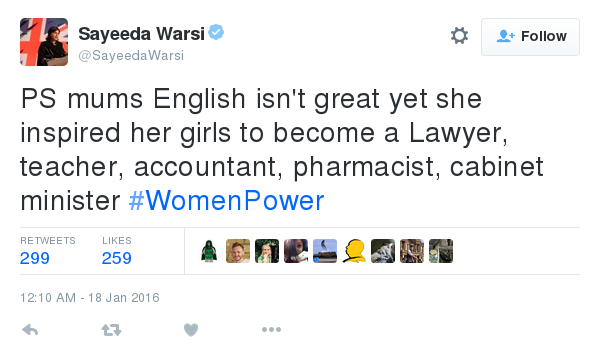
Earlier this morning a man doing Prime Minister impressions appeared on the BBC’s Today programme to explain why Muslim women should be encouraged to learn English.
That person – a man called Cameron – is reported by the press to be advocating such an idea to “combat radicalisation“.
At the same time, this Prime Minister impersonator announced £20 mn. additional funding to teach Muslim women English, an initiative that applies a sticking plaster to the massive wounds inflicted to English language teaching by his governments since 2010. The most recent of these cuts was last July, involving a £45 mn. scheme that taught English to 47,000 foreigners.
Whilst I would concur that parents with a poor command of English in this country would place them at a disadvantage when it came to understanding the influences on their children, why are Muslim women being singled out for special treatment? After all, there are plenty of women of other religions – and none – with poor English skills.
Furthermore, Cameron’s pronouncement has been roundly condemned by the Ramadhan Foundation whose Chief Executive Mohammed Shafiq commented as follows earlier today:
The Prime Minister David Cameron and his Conservative Government are once again using British Muslims as a political football to score cheap points to appear tough. There are three million Muslims in this country and the Prime Minister chooses to focus on a very small minority of extremists when clearly the majority of British Muslims reject extremism.
The Ramadhan Foundation has been clear for many years that we face an increased risk from terrorism and an ideology of hatred, the best way to confront it is to build support within Muslims and support the work done across the country and not lashing out and denigrating Muslims.
The irony of the Prime Minister calling for more resources to help migrants learn English when his Government cut the funding for English classes in 2011 has not been lost on many people.
This was a right wing, neo con Prime Minister delivering more of the same disgraceful stereotyping of British Muslims rather than focusing on the positive contribution of our faith and community he focuses on the extreme minority of issues which clearly is not representative.
Many in the British Muslim community will reject this neo con agenda and continue our work in confronting extremism and terrorism without the support of the Conservative Government.
 Lawrence Hill ward councillor

 Since 1990 the spelling reform approved by the
  Polish is one of the most common foreign languages for which interpreters are required in UK courts, yet it seems that Capita Translation & Interpreting, which holds the contract for supplying interpreters in courts and tribunals, still seems to be experiencing difficulties in providing Polish interpreters, nearly four years after the incompetent outsourcing giant got its hands on the contract.
 A couple of days ago, the Tory Police & Crime Commissioner candidate for Gloucestershire, Will Windsor-Clive criticised the £100,000 or so the Gloucestershire constabulary spends annually on interpreters (
 As regards the election of the PCC for Gloucestershire,
  On Wednesday evening Bristolians had an opportunity to question the city’s elected mayor,