A damp Sunday yesterday saw Make Sunday Special come to Easton’s Stapleton Road.
The Tidy BS5 crew were there with an information stall inside Easton Leisure Centre with a group of young volunteers giving out advice on how to make the most of the city council’s recycling services, ordering new recycling bins and the like.
Meanwhile the activists had arranged to do a bit of street theatre. Having persuaded a member of Bristol Samba to get dressed up in a customised Bristol Waste uniform and themselves armed with placards, we set off towards the main stage, filming as we went…
… ending up storming the main stage!
Tidy BS5’s sweeper on stage at Make Sunday Special
The final edited video will be posted on YouTube in the near future, so keep your eyes peeled. 🙂
The British government has announced it is now consulting and seeking comments on its latest open standards proposals.
The standards on which it is inviting comments are:
Exchange of location point information
An open standard for the exchange of location information, allowing coordinates to be translated between systems.
Exchange of property / place address information
A proposed standard to define and exchange address information between government departments. This is not about changing your postal address, but it could change the way government records information about your location.
Once the comment period closes, proposals will be assessed by a panel composed of civil servants and industry specialists, which will decide whether the proposal should go forward for consideration by the Open Standards Board. The Open Standards Board will then make a recommendation about the standard’s adoption across government.
Thank you for summiting [sic] your statement to Full Council in regards [sic] to the fly-tipping and litter issues you are currently experiencing in Easton.
Easton has historically been an area where greater resources have been needed, and this is still the case today: the Council provides more resources for this area to remove waste and litter than in most other parts of the city. The introduction of communal bins seems to have improved the situation in Easton; prior to their introduction there was more widespread fly tipping [sic] throughout the area. In some cases, however, this measure has led to fly-tipping occurring around the bins, as it has been observed in other parts of the city, from Clifton to St Pauls. The communal bin areas are proactively patrolled by our contractor, who responds to fly-tip and street cleansing reports made through Customer Services or submitted on webforms throughout Bristol. Training has been provided to our contractor’s operatives to search waste for evidence of its potential source & evidence is passed to Streetscene Enforcement Team to investigate.
We require the support of the public to help us identify offenders and would encourage all residents and visitors to Bristol to report incidents of fly-tipping they observe to Bristol City Council as soon as possible. To take enforcement action against offending individuals or businesses requires evidence and the more information we receive, the more likely we can build a case and target them. Recruitment is currently underway to return the Streetscene Enforcement Team to a full complement of 6 officers. This will allow for the officers to concentrate their activities within smaller areas and allow for more proactive work and operations. For instance, all businesses on Stapleton Road are currently in the process of being visited to check that they have relevant commercial waste contracts and make them aware that we are searching for evidence of commercial waste being deposited in the domestic communal bins. The Streetscene Enforcement Team continues to explore new ways of working with partners, both within the Council and local community, to target environmental crime and support improvements to the local environment. For this reason, we appreciate your efforts in working with us to achieve a cleaner Easton, and thank you for your patience while we effect the necessary improvements.
Yours sincerely,
(signed)
George Ferguson CBE
Mayor of Bristol
Having carefully examined the text of Hannah’s reply and the one I received, it can be confirmed that the two responses are identical, even down to the same typographical errors.
Whilst I am pleased to learn that IT skills in the Mayor’s office have now reached a level equivalent to those of novice computer users, it is disconcerting that the staff in the Mayor’s office still think it appropriate to draft the same response to 2 statements on the same subject that raised different points. This illustrates the continuing contempt by council officers for residents of the inner city – a contempt that should never have been allowed to develop in the first place, let alone persist down the decades.
Bristol City Council should not be allowed to get away with this.
At the same full council meeting there were 3 statements from campaigners trying to prevent part of the River Frome flood plain being used for luxury housing by Colston’s School. I wonder if they received identical responses too. If any of those campaigners did, kindly mention it in the comments below.
Bristol Mayor George FergusonFollowing my submission of a statement to last month’s full council meeting (posts passim), at which Hannah Crudgington’s video statement on fly-tipping received a standing ovation from Labour councillors, I’ve now received a written reply to my statement from Bristol’s elected Mayor, George Ferguson. Even though I had no opportunity to present my statement verbally to councillors due to the incompetent and thoroughly dreadful chairing of the full council meeting by Lord Mayor Clare Campion-Smith, all those submitting statements were promised a written response.
The response to my written statement has now been received and is reproduced in full below for the information and amusement of passing readers.
Dear Mr Woods,
Thank you for summiting [sic] your statement to Full Council in regards [sic] to the fly-tipping and litter issues you are currently experiencing in Easton.
Easton has historically been an area where greater resources have been needed, and this is still the case today: the Council provides more resources for this area to remove waste and litter than in most other parts of the city. The introduction of communal bins seems to have improved the situation in Easton; prior to their introduction there was more widespread fly tipping [sic] throughout the area. In some cases, however, this measure has led to fly-tipping occurring around the bins, as it has been observed in other parts of the city, from Clifton to St Pauls. The communal bin areas are proactively patrolled by our contractor, who responds to fly-tip and street cleansing reports made through Customer Services or submitted on webforms throughout Bristol. Training has been provided to our contractor’s operatives to search waste for evidence of its potential source & evidence is passed to Streetscene Enforcement Team to investigate.
We require the support of the public to help us identify offenders and would encourage all residents and visitors to Bristol to report incidents of fly-tipping they observe to Bristol City Council as soon as possible. To take enforcement action against offending individuals or businesses requires evidence and the more information we receive, the more likely we can build a case and target them. Recruitment is currently underway to return the Streetscene Enforcement Team to a full complement of 6 officers. This will allow for the officers to concentrate their activities within smaller areas and allow for more proactive work and operations. For instance, all businesses on Stapleton Road are currently in the process of being visited to check that they have relevant commercial waste contracts and make them aware that we are searching for evidence of commercial waste being deposited in the domestic communal bins. The Streetscene Enforcement Team continues to explore new ways of working with partners, both within the Council and local community, to target environmental crime and support improvements to the local environment. For this reason, we appreciate your efforts in working with us to achieve a cleaner Easton, and thank you for your patience while we effect the necessary improvements.
Yours sincerely,
(signed)
George Ferguson CBE
Mayor of Bristol
What strikes me about the response – apart from its occasionally abysmal English usage – is firstly its emollient, placatory tone: to begin with, it commiserates with me for the “fly-tipping and litter issues you are currently experiencing in Easton“. It’s not just now that I’m experiencing those so-called issues; I’ve watched the area get filthier for the last 4 decades!
Secondly, the response manages to duck a couple of major points, namely the disparity between the number of enforcement officers compared with the Council’s excessively large press, PR and communications staff (posts passim), as well as the response (if any) of council officers and Assistant Mayor Daniella Radice to ideas from elsewhere around the UK and world for combating fly-tipping (these have probably been kicked into the long grass by both the Assistant Mayor and officers under time-honoured “not invented here” rules. Ed.).
As the response was unsatisfactory, I shall be attempting to make another statement to full council in September and will draw the Mayor’s attention to the shortcomings in the response.
Finally, Hannah Crudgington received a reply to her video statement that was almost identical to mine. Isn’t it good to know that IT skills down the Counts Louse have reached the cut and paste level? 😉
Responses have been received to my recent Freedom of Information Act (FoI) requests requests to Bristol City Council.
These concerned the relative numbers of staff involved in press, PR, etc. and so-called ‘streetscene (i.e. fly-tipping, litter, dog fouling and the like). This is a subject which this blog has tackled previously. However, I felt it necessary to obtain the most up-to-date figures I could.
This is a request for information under the Freedom of Information Act.
Kindly disclose the number of press, public relations and communications staff/officers who are employed at present by Bristol City Council and/or have their place of work in Bristol City Council offices.
Yours etc.
The response to the request reads:
The number of press, public relations and communications staff/officers who are employed at present by Bristol City Council and/or have their place of work in Bristol City Council offices:
(The list below shows the number of full-time equivalent staff)
Service Manager: Corporate Communications x 1
Service Manager: Public Relations x 1
Design Manager x 1
Senior Designer x 1
Designer x 4.49
Assistant Designer x 5
Senior Communications & Marketing Officer x 5.41
Senior Communication Officer – Enterprise Zone x 1
Senior Communication Officer (Corporate Campaigns and Special
Projects Team) x 0.81
Marketing & Communications Officer (Level 1 and 2) x 9.51
Marketing & Communcations Support Officer x 4
Internal Communications Manager x 1
Internal Communications Support Officer x 2.39
Channel Editor (Level 2) x 1
Digital Public Relations Officer x 2
Senior Public Relations Officer x 1.2
Public Relations Officer x 5
Exhibition Designer x 1
Apprentice x 1
Total Full-Time Equivalents: 48.81
This is a request for information under the Freedom of Information Act.
Kindly disclose the total number of streetscene officers who are employed at present by Bristol City Council, as well as the total number employed in the last financial year.
I would also be grateful if you would inform me whether the said officers are employed full-time or part-time and how many, if any, are on long-term sick leave.
Yours etc.
This was duly answered as follows:
Our reply to your request is:
In 2014/15 we employed 5.7 full-time equivalent (FTE) Streetscene Enforcement Officers up until November 2014. Since November 2014 we have employed 4.7 FTE. There are four full-time officers and one
part-time officer. Presently, we plan to recruit an additional 1.5 FTE.
There are currently no Streetscene Enforcement Officers on long-term sick leave
The staffing situation is thus more out of kilter than was originally imagined. Bristol City Council is now actually employing more press, PR and communications staff than when examined previously by the Press Gazette in its FoI request.
Bristol City Council priority: weasel words in press releases
Presumably this is due to the additional quantities of bullshit needing to be shovelled out of the Council House due to Bristol’s unwarranted elevation this year to European Green(wash) Capital.
On the other hand, council staffing managers have deemed that the city can get by with a maximum of 6 people chasing fly-tippers and litter droppers for the time being.
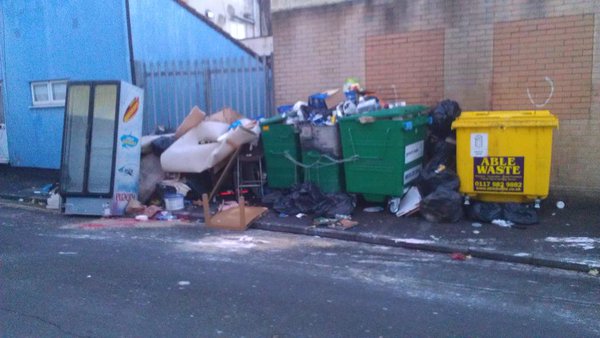
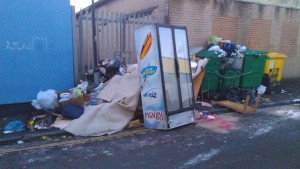
Not a council priority: fly-tipping in Woodborough Street, BS5
In my opinion the city would be a tidier and more truthful place if the above numbers were reversed, with the council employing 49 enforcement officers (they’re really needed! Ed.) and under 6 press, PR and communications wonks.
Whether you agree or disagree with my opinion, please feel free to comment below.
Today there’s a full meeting of the elected members of Bristol City Council at 6 pm.
Each council meeting has a slot of 30 minutes allotted to statements from members of the public to raise concerns.
This evening’s meeting will be treated to 2 statements by Tidy BS5 campaigners, namely Hannah Crudgington and your ‘umble scribe.
In addition, Hannah will be screening a video of one minute duration to the assembled councillors and officers.
Hannah will also be making a statement to councillors after her video. This statement reads as follows:
I have made my home and set up my business in Easton of the last 12 years or so.
It is extremely sad to report that after an initial improvement and vibrancy, the last five years have seen a huge deterioration and this is largely due to ill thought decisions by people without practical experience of the area at grass roots level.
Bristol City Council has been made well aware of the issues of waste in BS5 and yet the problems are getting worse. In the last year, it has gone from fly tipping and litter to fly-tipping, litter and a horrendous stench. So it is no longer an annoyance or inconvenience but more a health hazard.
So what is Bristol City Council doing to resolve this, what are your time scales and finally would you put up with this?
My statement will be:
It is with a sense of profound despair and regret that I’ve watched the problem of litter and fly-tipping in the Easton area over the past few decades.
Given that Bristol is European Green Capital for 2015, it’s an absolute disgrace that scenes such as those in Hannah Crudgington’s video are a daily occurrence in the inner city.
However, fly-tipping and litter are not just an eyesore; they are a health and safety risk, attract vermin such as rats and gulls, make people feel insecure on the streets and attract anti-social behaviour; residents have observed people urinating on piles of fly-tipped rubbish and using the communal bins installed by the council as a screen for defecating in the streets.
Would you tolerate this in the area where you live? We refuse to.
Concerned residents have been raising these matters with local councillors and council officers for well over one year. Given the glacial pace at which Bristol City Council moves, it has taken that long for streetscene enforcement officers to turn their attentions to Easton and Lawrence Hill. Whilst I appreciate the enforcement officers’ efforts I feel that their presence may be a matter of too little, too late.
Furthermore, the total number of these enforcement officers is very small: there are only 6 of them to cover the whole city, far too few for the size of the city’s problems with litter and fly-tipping, which it must be remembered is not exclusive to the 2 wards in which I and other Tidy BS5 campaigners are working. I regularly receive reports – as I’m sure ward councillors do – of problems with litter and fly-tipping in Ashley, Bedminster, Fishponds, St George, Avonmouth and Lawrence Weston, to name a few more areas of our city blighted by environmental crime.
Finally, it’s worth noting that the city council employs 43 press and PR officers – more than seven times the number of streetscene enforcement officers. This suggests to me that the city council has a warped sense of priorities: it has a real citywide problem with litter, fly-tipping and other environmental crimes; it does not have a problem with weasel words.
Communal bin in Villiers Road, Easton attracting dumped furniture
The Open Document Format for Office Applications (ODF) Version 1.2, the native file format of the free and open source LibreOffice productivity suite and many other applications, has been published as International Standard 26300:2015 by ISO/IEC.
ODF defines a technical schema for office documents including text documents, spreadsheets, charts and graphical documents like drawings or presentations.
“ODF 1.2 is the native file format of LibreOffice. Today, ODF is the best choice for interoperability, because it is widely adopted by applications and is respected by applications in every area”, says Thorsten Behrens, Chairman of The Document Foundation. “ODF makes interoperability a reality and transforms the use of proprietary document formats into a relic of the past. In the future, people will tell stories about incompatible document formats between two releases of proprietary office suites as a bygone problem”.
ODF is developed by the OASIS consortium. The current version of the standard was published in 2011 and then was submitted to ISO/IEC in 2014.
The standard is available in three parts – schema, formula definition and packages – from the repository of Publicly Available Standards as a free download, as follows:
Over the weekend a new amenity – either an art installation or a new public convenience – has appeared on the A420 Lawrence Hill in east Bristol.
If the latter, it’s conveniently located next to the site of Lawrence Hill’s original Victorian public lavatories, sadly demolished some years ago by Bristol City Council and the site sold off to developers.
Public convenience or crap art installation?
Continuing with the theme of convenience, if it is a new public lavatory – whether provided at public expense or by the private sector – it will no doubt come as a relief to the thousands of commuters from Kingswood, Hanham and other parts of South Gloucestershire who clog up the A420 inbound on weekday mornings and outbound on weekday evenings respectively.
However, I suspect it is the work of east Bristol’s shadowy network of fly-tippers, in which case it needs reporting to Bristol City Council. 🙂
According to Alessandro Tomasicchio, the councillor with responsibility for technological innovation, “In this way we guarantee the participation of citizens in public sector decision-making.”
In addition, the council is adopting ODF – the standard file format of LibreOffice and other open source office suites – as the standard file format that meets all the authority’s technical requirements.
Management of the project entails various kinds of skills, from the analysis of flows of documents within the council to the management of interactions between users and IT systems. Great attention has been paid to staff training and internal communication, which are regarded as fundamental elements for achieving the local authority’s goal.
After analysing the software solutions available and practical testing, the Innvoation Department decided to adopt the free and open source LibreOffice suite, which is compatible with other proprietary office suites, including MS Office currently used by Bari.
The choice of LibreOffice, unlike proprietary software, is compliant with the provisions of Article 68 of the [Italian] Digital Administration Code and the Apulia Region‘s law on the adoption and promotion of open source by public sector organisations.
By the end of the current year at least 75% of Bari’s workstations will migrate from Microsoft Office to LibreOffice.
Antonio Cantatore, head of Bari’s Innovation Department also stated that one reason for switching to LibreOffice would be major savings in the total cost of ownership (TCO). By not having to pay licence fees to Microsoft for the Office package currently installed on 1,700 of Bari’s workstations, the local authority is looking at costs savings €75,000 +VAT.
As a result, there have been some strange coloured – one might almost say greenwashed – buses thundering through this proud and ancient city, as captured below.
FirstGroup bus in full greenwash livery
However, FirstBus has also been able to buy a ‘greenwash-lite‘ version for its sponsorship that consists of the Bristol Green Capital logo slapped on top of its usual ‘Barbie‘ livery.
The flanks of the Barabie double-deckers now have the Bristol Green Capital logo splashed across their sides, whilst the single-deckers have a smaller version the logo above the driver’s cab.
Barbie meets greenwash
Whilst public transport is a greener option than using a private motor car, emissions from the diesel fuel on which buses run.
According to Wikipedia:
It is reported that emissions from diesel vehicles are significantly more harmful than those from petrol ones.Diesel exhaust contains toxic air contaminants and is listed as carcinogen for humans by the IARC (part of the World Health Organization of the United Nations) in group 1. Diesel exhaust contains fine particles which are harmful. Diesel exhaust pollution was thought to account for around one quarter of the pollution in the air in previous decades, and a high share of sickness caused by automotive pollution.
Any resemblance between the full greenwash livery and the British Racing Green livery of the old Bristol Omnibus Company is purely coincidental.