Down in untidy BS5, the fly-tipping is still continuing, as shown by this fine example of that environmental crime from Heron Road, Easton reported to the council this very morning.
However, word of this informal campaign by residents is spreading. Just ahead of Monday’s TidyBS5 residents’ summit (posts passim), news reaches my inbox that the litter picket organised in conjunction with the last Easton & Lawrence Hill Neighbourhood Forum (posts passim) has been discovered by CleanupUK.
CleanupUK is a charity whose main focus is on helping those who are most in need, usually in areas of deprivation, to combat the litter problem where they are. Through involvement in this activity, people feel their communities are safer, more welcoming and friendlier.
Living as I do near the Severn Beach line, I was pleased to read in the Bristol Post that the Victorian railway station building at Avonmouth has been given a temporary reprieve from demolition after campaigners lobbied the city council.
Network Rail wants to demolish the building, but this seems a daft move given the huge increases in passenger numbers on the Severn Beach line in the last few years. As the building is not currently protected by listing or is in a conservation area, a full planning application would normally not be needed for demolition.
Council officers say Network Rail has failed to give enough detail about their plans and have refused the demolition application, but could very well approve a new application.
A petition has been set up asking both the city council and Network Rail to reconsider the future of the station building.
Until quite recently the building was used as a hairdressers and there is no good reason – apart from the destructive intentions of Network Rail – why it should not be used for commercial purposes again (or even as a station building. Ed.).
Avonmouth’s Victorian station building. Image courtesy of mattbuck/ Wikimedia Commons
Local MP Charlotte Leslie has joined the ranks of campaigners trying to save it, remarking, “Avonmouth railway station is an irreplaceable part of our heritage and planning officers have a duty to ensure that our future generations benefit from its preservation. Indeed, it is my belief that the building should be subject to a Conservation Order or Listed status – owing to its local historical importance and obvious aesthetical [sic] qualities”.
Charlotte has been a passionate campaigner throughout her term of office for local rail, including the reopening of the Henbury Loop (posts passim).
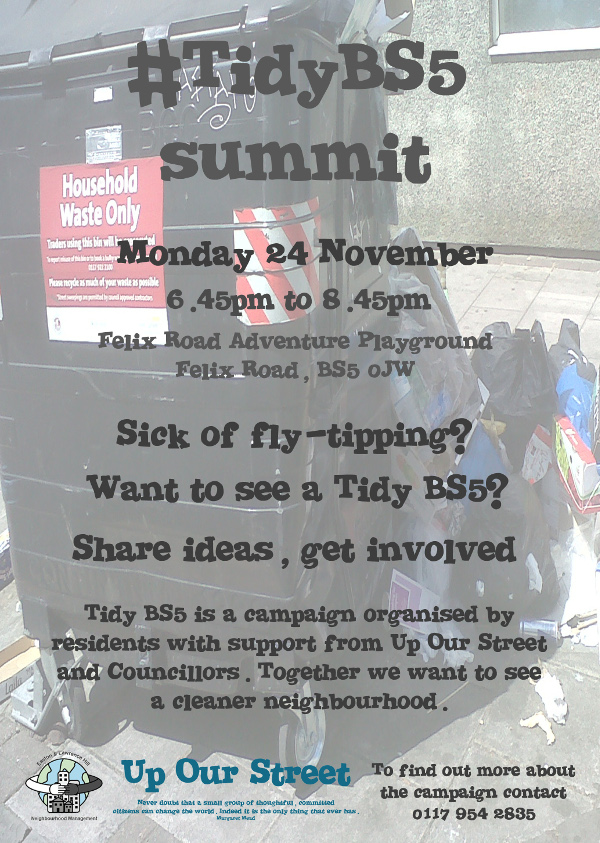
On Monday 24th November, a Tidy BS5 summit is being held for residents at Felix Road Adventure Playground, Felix Road, Easton, Bristol, BS5 0JW (map) from 6.45 to 8.45 pm.
The aims of this meeting are:
To bring together residents who are concerned about fly-tipping, littering and rubbish and want to work together to do something about it;
To identify exactly what the problems are and generate ideas for how to solve them; and
To officially launch the Tidy BS5 campaign and a year of action to tackle these problems.
The meeting is being organised by residents, councillors and Up Our Street and will be chaired by local resident Liz Jones.
All are welcome and the local media have been invited.
Selby District Council’s website is not one of your correspondent’s regular online haunts. However, last week’s news section of the site carries a report with exclusive spectacular news: a Mr Steve Wadsworth has won a competition to name the new Selby Leisure Centre, which is due to open in 2015, by naming it, erm, Selby Leisure Centre!
There was even someone armed with a camera to record this historic event, whose like has probably not been equalled in that part of Yorkshire since the Battle of Stamford Bridge in 1066. 😉
Whilst the present government’s record may be regarded by some as controversial, to say the least, there’s one area where some real progress has been made; and that’s the adoption of open standards by central government.
Yesterday, the Open Standards Board announced that RFC 5545 (iCalendar) and RFC 6350 (vCard) have now been adopted as open standards for government for exchanging calendar events and contact details respectively.
This means both vCard and iCalendar are now in the implementation phase and Sir Humphrey and his colleagues are encouraged to report problems with adopted standards on the Standards Hub.
The vCard and iCalendar formats have both been in widespread use for more than 10 years. The versions selected by the Board are specified and maintained by the Internet Engineering Task Force who ratify a number of commonly used extensions. The versions are largely backwards compatible with previous versions produced and consumed by a very wide range of applications.
What could George have been doing in Easton to have fled minus his trousers? Answers in the comments below.
Of course, as a politician George sometimes risks more than the loss of his trousers; he’s wagering the shirt off his back on 2 potentially huge white elephant projects in Bristol both being funded by municipal borrowing – the Bristol Arena and Metrobus/BRT, whose costs keep escalating out of control.
A couple of years ago, after a less than ideal consultation by Bristol City Council (my own street was omitted from the process! Ed.), communal bins – called skip bins by some – were imposed on residents.
They are not popular with locals since they attract abuse – fly-tipping by traders, dumping of recyclable materials by the uncaring and so on – and are unappealing to have outside one’s front door. They may be a good idea for block of flats if adequately screened, used properly and regularly emptied, but not for residential areas or shopping streets. Even in my own road where the communal bins never suffer the levels of abuse or levels of filling that they do in on busier streets, they are not popular with residents.
A local Stapleton Road resident has now produced a short video to draw attention to the problems they engender and her evident frustration with the council’s attitude to Easton.
As regards abuse of the communal bins, recent analysis of 2 bins on Stapleton Road by the city council revealed that their contents were roughly:
one-third waste for landfill;
one-third recyclable materials; and
one-third illegally dumped trade waste.
That analysis shows there is clearly a lot that needs to be done both as regards educating residents on what materials can be recycled, as well as enforcement, cracking down on traders who are not complying with their obligations in respect of proper disposal of the waste from their businesses.
When it comes to trade waste, the council has 2 options when it comes to enforcement action. It can impose a fixed penalty of £300 or taking offenders to court, where a maximum fine of £50,000 and/or up to five years imprisonment.
As regards the siting of communal bins, the idiocy evident in the video is not an isolated instance. Walton Street in Easton, which is some 300 metres in length, has one communal bin, whilst adjoining Northcote Street – a third of the length of Walton Street – has three!
If having to put out the rubbish on a cold, rainy night, I’d prefer to live in Northcote Street. Wouldn’t you?
Furthermore, it’s not just the major thoroughfares that have problems with fly-tipping, trade waste and the like, as this blog has previously highlighted with Jane Street (posts passim) on the borders of Redfield and Lawrence Hill districts.
Next month a residents’ rubbish summit will be held at Felix Road Adventure Playground as part of the #tidyBS5 initiative. Details will be posted here when they are finalised.
Hamburg’s Green want to wean the city council off its Microsoft dependency and are pointing to Munich city council’s use of Linux and free and open source software, German IT news website heise reports today.
The 2014 Open IT Summit, whose emphasis is on open source and data security, is taking place today (Tuesday) as an alternative event to the IT summit with German Chancellor Angela Merkel taking place in Hamburg. The range of topics extends from the Heartbleed bug via cloud computing up to a Microsoft exit strategy for Hamburg. a podium discussion will sound out whether a migration to free software is realistic for Hamburg.
THE news of 15-year-old girl Yusra Hussien leaving Bristol to become a supporter of IS, allegedly, is a worrying outcome and I echo what Stephen Williams said, that such an objective is not only foolish but profoundly unwise.
In some ways, what Al Qaeda started in 2001 has produced many problems of his kind.
Yes, you did read that correctly: “problems of his kind“, i.e. problems like him, if you prefer to paraphrase.
The Post has exclusively revealed that Bristol West MP Stephen Williams is a problem that has been caused by Al Qaeda, an organisation never before known for its links to the UK’s Liberal Democratic Party, let alone elected members thereof.
Perhaps Mr Williams would care to comment on his links to Al Qaeda below; or alternatively perhaps the Post could employ a little more care when publishing reader’s letters where a lost or missing consonant can give a phrase a whole new meaning.
A community market event took place earlier today on the section of Stapleton Road between Easton Way and Lower Ashley Road.
Image courtesy of Bristol News
Although interspersed with showers, the event was well attended and had such attractions as food, music, bouncy castles, face painting and – at one point – a samba band adding yet more sound and vibrancy to our main local street in this part of town.
The event was organised by the local community for the local community and has evidently gone down well with the people at Bristol News, who commented:
The amazing people on Stapleton Road are having fantastic fun today and doing it for far less money than Make Sunday Special has ever done. And more importantly the community is doing it for itself. This is the “real spirit of Bristol” not the water slides, skiing clowns and ambling bands.
It also shows a different side of a place that’s frequently just regarded, particularly by the rest of Bristol, as a source of inner city problems.




 Hamburg’s Green want to wean the city council off its Microsoft dependency and are pointing to Munich city council’s use of Linux and free and open source software, German IT news website
  On the occasion of the impending
  The Post has exclusively revealed that