Today the WalesOnline website features a textbook example of an ambiguous headline, i.e one that has or expresses more than one possible meaning.
Ambiguity in a headline – or anywhere else in a piece of factual reporting – is not an example of good writing style.
A headline should be clear, convey sufficient information to interest or pique the curiosity the (potential) reader and not be capable of being misinterpreted.
WalesOnline is part of the Reach plc* stable of regional press titles.
Reach titles have past form with ambiguous headlines (posts passim).
One would almost think it’s written into the group’s style guide (if it has one. Ed.).
* The Reach stable also includes the national titles, the Daily Mirror and Daily Brexit (which some still call the Express. Ed.)
Yesterday the Information Commissioner’s Office (ICO) reported that it had fined American Express Services Europe Ltd. (Amex) £90,000 for sending four million unlawful, unsolicited marketing emails.
IT news site The Register has done some number crunching and worked out that the fine imposed by the ICO is equivalent to 0.021p per offending email or 0.009 per cent of Amex’s annual profits.
The regulator instigated investigations after receiving complaints from American Express customers who had specifically opted out of receiving marketing information. During its investigation the ICO found that American Express had sent over 50 million so-called “servicing emails” to customers (which anyone sensible would call spam. Ed.). The ICO revealed that between 1st June 2018 and 21st May 2019, over 4 million of those emails were marketing emails, designed to encourage customers to make purchases on their cards, thus benefiting the company financially.
Andy Curry, the ICO’s Head of Investigations said:
This is a clear example of a company getting it wrong and now facing the reputational consequences of that error.
The emails in question all clearly contained marketing material, as they sought to persuade and encourage customers to use their card to make purchases. Amex’s arguments, which included, that customers would be disadvantaged if they weren’t aware of campaigns, and that the emails were a requirement of its Credit Agreements with customers, were groundless.
Our investigation was initiated from just a handful of complaints from customers, tired of being interrupted with emails they did not want to receive. I would encourage all companies to revisit their procedures and familiarise themselves with the differences between a service email and a marketing email, and ensure their email communications with customers are compliant with the law.
Francoinfo reports that Le Petit Robert, a popular single-volume French dictionary, reckons that “usage is law” and considers that the word “covid” is used as a masculine noun in the majority of French-speaking countries.
In its 2022 edition, Le Petit Robert, one of the two major commercial dictionaries in France (the other being Larousse. Ed.), reckons the word “covid” is written with a lower case first letter and is also masculine.
To designate the viral disease which has spread throughout the world, Robert distinguishes the generic term “covid“, as in the example “suspected covid“, and the specific one of “Covid-19” with a capital letter. Robert’s definition of “covid” is: “Infectious and contagious disease caused by a coronavirus”.
Its competitor Larousse consistently uses a capital first letter, i.e. “COVID-19” or “Covid-19“.
Its gender has been the subject of doubts in French. For Le Petit Robert, it is “masculine or feminine“, but more often masculine, whereas for Larousse, it is “feminine or masculine“: more correct as feminine, but masculine for many speakers.
When introducing its 2022 edition of the dictionary, Le Petit Robert reckons that “it is usage that dictates the law. If the feminine is adopted in French-speaking Canada, the masculine is currently used by the majority in France where the opinion of the Académie Française (the principal French council for matters pertaining to the French language. Ed.) has been late in coming, whilst the masculine was already well established”.
Rush of words linked to the pandemic
Le Petit Robert has added several words linked to the pandemic, some of which are very current in today’s language, such as “déconfinement” (end(ing) or lifting of lockdown), and rarer ones such as “aérosolisation” (“airborne diffusion of fine particles by aerosol”).
French is not the only language to have experienced a surge of neologisms linked to the pandemic. German broadcaster Deutsche Welle reports that 1,200 new German terms have been inspired by this global health crisis.
“The vision thing” is a comment made by George H. W. Bush ahead of the 1988 United States presidential election when urged to spend some time thinking about his plans for his prospective presidency.
The embracing of vision – with or without the thing – is widespread in public life in Britain at both local and national levels. Every party leader is expected to have one; and any plans for the wholesale remodelling of large areas of our town and cities are expected incorporate vision too.
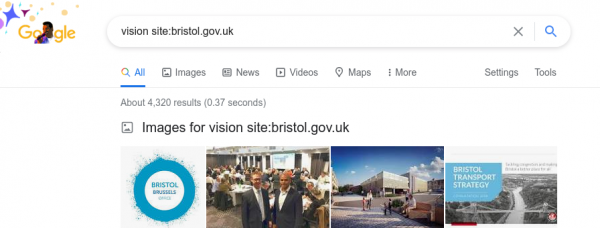
An investigation into the prevalence of vision in the organs of the British state reveals just how ingrained use of the term is. A quick Google search for items containing “vision” on websites within the .gov.uk domain is revealing.
No, your eyes do not deceive you – 2.3 million instances of use.
Looking more locally, a recent search (mid-April) of the Bristol City Council website for the term returns a total of over 4,200 hits. It has probably risen since last month (and with all that evident ocular deployment, one would have thought that the inhabitants of the Counts Louse – which some refer to as City Hall – would realise there’s a major cleanliness problem with the city’s streets. Ed.).
With all that vision in use in the country, opticians and their colleagues must be raking in the money. 😀
Sie hatten Recht, Herr Bundeskanzler!
Or is it necessarily opticians and associated practitioners that should be profiting from this phenomenon? There is some scepticism about the benefits of visions.
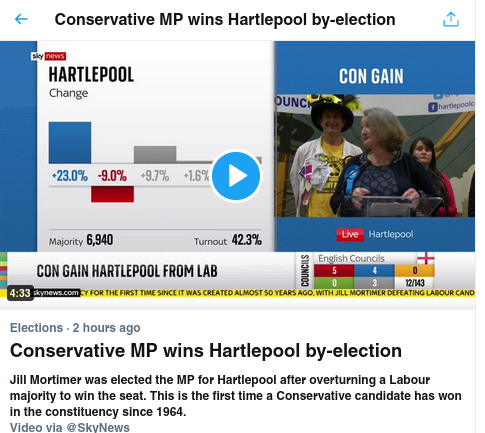
The media and social media today are awash with the result of yesterday’s Hartlepool by-election which was surprisingly won from Labour by the Tories*.
However, some of the language being used to describe the victory is prone to error, such as the example below from Twitter’s trending topics.
As the winning Tory was not the sitting MP, the correct way to describe her is as a candidate, not an MP. She only becomes an MP upon winning a parliamentary (by-)election.
In times past such a basic error would have been picked by a sub-editor or similar, but they were all dispensed with some years ago. 🙁
*= Hartlepool hasn’t had a Tory Member of Parliament since it was represented in Westminster by Peter Mandelson. 😉
We’re now in May and one reliable natural occurrence of the time of year is the flowering of common hawthorn (Crataegus monogyna), which is also known as the oneseed hawthorn, or single-seeded hawthorn.
Other common names include may, mayblossom, maythorn, quickthorn, whitethorn, motherdie, and haw.
The Woodland Trust have produced a short video depicting one year in the life of the hawthorn.
The specimen below can be found in the Easton section of the Bristol & Railway Path near the Brixton Road access point.
Hawthorn is amongst the first trees to start budding in the spring (the above specimen first put out leaves in late January. Ed.) and is also a fast-growing plant. This may explain the alternative name of quickthorn.
As it forms a dense, thorny mass of branches, it is often used for hedging, particularly where livestock has to be contained.
Besides its agricultural value as hedging, common hawthorn can support more than 300 insects. It is a food plant for caterpillars of numerous moths. Its flowers are eaten by dormice and provide nectar and pollen for bees and other pollinating insects. The haws (berries) are rich in antioxidants and are eaten by migrating birds, such as redwings, fieldfares and thrushes, as well as small mammals.
Furthermore, the dense, thorny foliage makes fantastic nesting shelter for many bird species of bird.
Folklore and symbolism
Hawthorn is a pagan symbol of fertility and has associations with May Day stretching back beyond written history. It was the forerunner of the Maypole and its leaves and flowers provided the source of May Day garlands as well as appearing in the wreath of the Green Man.
In medieval times hawthorn was never brought indoors as it was generally believed that bringing its blossom indoors would result in illness and even death. In those times it was also commonly believed that hawthorn blossom smelled like the plague. In more recent times scientists have discovered the chemical trimethylamine (which smells like ammonia or rotting flesh. Ed.) in hawthorn blossom is also one of the first chemicals formed in rotting animal fish, hence the tree’s traditional linking with illness and death.
In spite of the beliefs and symbolism outlined above, the young hawthorn leaves, flower buds and young flowers are all edible. The leaves are often described as having the flavour of bread and cheese. They can be added to green salads and grated root salads. The developing flower buds are particularly good. The haws can be eaten raw (beware a stomach upset. Ed.), but are most commonly used to make jellies and wines.
A final personal note
In my own life, the blossoming of the hawthorn always reminds me that spring is giving way to early summer.
In particular, it reminds of when I was 8 years old and my mother took my 2 younger siblings and me by train all the way from Stafford to Harling Road in Norfolk – the nearest station to my grandmother’s home. The journey took the best part of a day (showing how difficult it was to travel cross-country in England, even in pre-Beeching times. Ed.). The fields on either side of the railway lines on which we travelled were thick with hawthorn blossoming pink and white.
Whenever I see hawthorn in bloom these days, I’m immediately reminded of that one train journey, even though it’s now almost 6 decades in the past.
Update: After writing this post, I asked both my siblings if they remembered that journey and if so, what they recalled. My sister replied that she recollected the journey as being interminable and her chief memory was all the trackside telegraph poles, whilst my brother – the youngest of us – responded with a question as to whether that was the railway trip during which he was sick. He obviously had other matters than lineside shrubbery on his mind. 😀
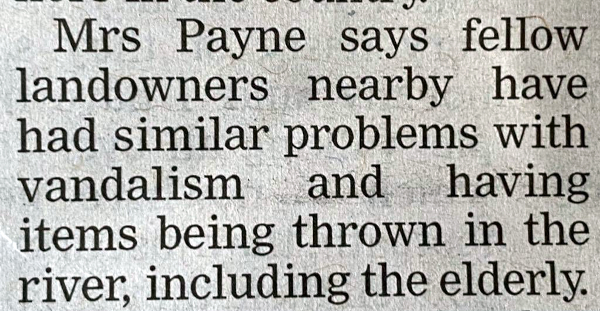
Even though the elderly have had a bath thanks to ambiguity and poor proofreading in the Evesham Journal’s dead tree version, this age discrimination has thankfully been eliminated from the paper’s online version of the report.
No pensioners were harmed – or dunked – in the drafting of this blog post.
Yesterday, which was Earth Day, US President Joe Biden organised a two-day virtual climate summit bringing together dozens of world leaders.
Apart from world political leaders, Biden also inexplicably invited one Alexander Boris de Pfeffel Johnson, Britain’s part-time alleged Prime Minister, to participate.
Besides his propensity never to let the truth escape from his lips, Johnson is well known for his lack of attention to detail, his loose tongue and gaffes; and true to form he didn’t fail to embarrass the country of which he is supposed to be the highest elected public official, as shown in the following video clip.
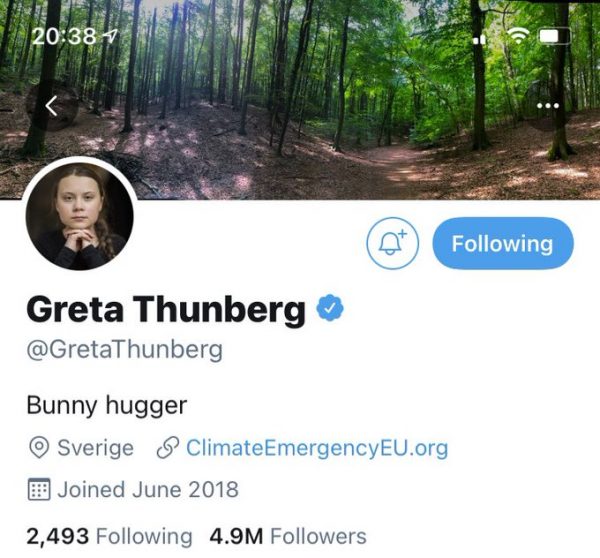
Yes, you did hear that correctly – “politically correct green act of bunny hugging“!
Needless to say, Bozo the Clown had half of the country’s social media users rolling their eyes in despair, condemning his cavalier attitude and wondering what the blonde buffoon was going to sully next with his reverse Midas Touch.
However, it wasn’t just Britons who reacted to Bozo’s gaffe.
Amongst them was one Greta Thunberg, an 18 year-old Swede whose name is not exactly unknown on the world stage where climate change is concerned.
Greta very quickly changed her Twitter bio to reflect Johnson’s words.
Nice work, Greta! 😀
As for the embarrassment that is part-time alleged Prime Minister Alexander Boris de Pfeffel Johnson, you can consider yourself well and truly pwned.
It’s getting close to election time again and the period of what is informally known as “purdah” (also known rather more formally and stuffily in local authority circles as the “pre-election period” Ed.), which has very little to with purdah’s original definition, i.e. a religious and social practice of female seclusion prevalent among some Muslim and Hindu communities, and more to do with preventing central and local government from making announcements about any new or controversial initiatives that could be seen to be advantageous to any candidates or parties in the forthcoming election.
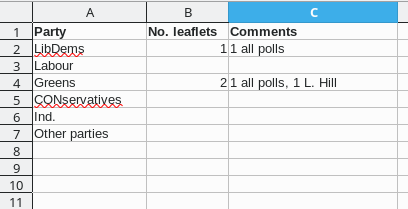
As is usual with matters electoral, I keep a record on a LibreOffice spreadsheet of all election leaflets received, which ultimately end up in their rightful place – the waste paper recycling box (apart from personally addressed material, which is fed to the confidential waste shredder. Ed.).
The latest state of the parties – as of first thing this morning – is shown below.
As can be seen, the Greens are clearly putting a major effort into depriving Labour of their 2 ward seats for Lawrence Hill in the council chamber.
Whilst elections may be regarded as a vehicle of change, there are certain features that are reassuringly familiar and are thus recycled election after election.
For instance, the first leaflet received after the notices of persons nominated were announced was one from the Liberal Democrats, as per their decades-long reputation for opportunism.
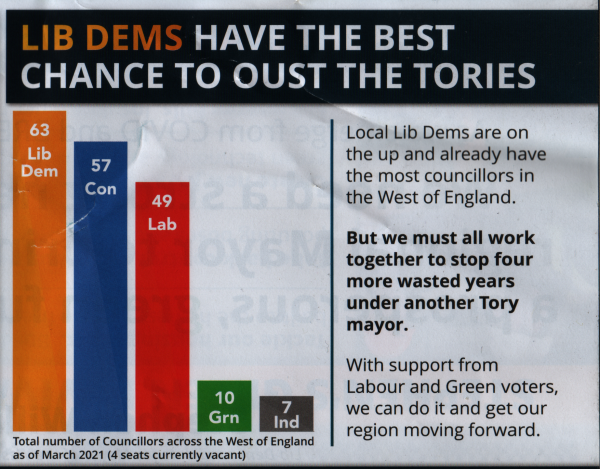
That leaflet also comprised other reassuringly familiar Liberal Democrat tropes, such as the bar chart below for the WECA Mayor. I am reliably informed by a fellow linguist who took a ruler to the y axis, that the column sizes are reasonably accurate (for once. Ed.)
That just leaves the equine graphic with the heading “It’s a 2 horse race! (Insert_party_name) can’t win here!” and the traditional graphics requirements for LibDem leaflets will have been fulfilled.
More leaflets can of course be expected to land on the doormat as polling day approaches, so updates will be provided in due course.

 IT news site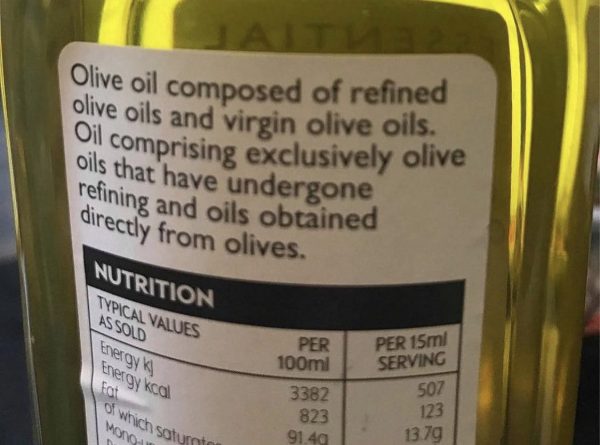
 Francoinfo reports