Language

  • English translation required?

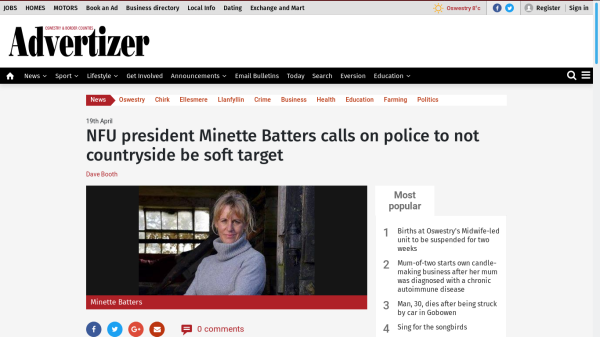
    Although it’s not one of his regular local media reads, your ‘umble scribe might just start visiting the Oswestry and Border Counties Advertizer website more to keep up to date with dynamic, one could even say groundbreaking, developments in use of the English language, if the headline of the report shown below is in any way typical of modern journalism.

    headline reads NFU president Minette Batters calls on police to not countryside be soft target

    The same piece, by the same author, also appears in yesterday’s Whitchurch Herald, where similar sub-editing skills are in evidence.

  • France – plus ça change…

    …Plus ce n’est plus la même chose ! 🙂

    As I sit in my sister’s apartment on the coast of Brittany this Easter, the thought comes to mind that it’s nearly five decades since my first visit to France as a callow schoolboy in 1971.

    This realisation has prompted me to consider just how much France has changed – albeit gradually but nevertheless steadily – over the intervening years. Below are four (for the sake of brevity. Ed.) obvious changes your ‘umble scribe has noticed have changed, haven’t changed and are completely new.

    Things that have changed or are now apparently rare

    • The distinctive smell of French built-up areas, the odour being composed mostly of bad plumbing and the pungent aroma of Gauloises and Gitanes.
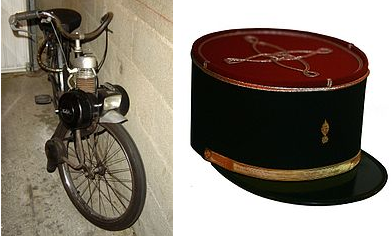
    • Mopeds, particularly the 50cc Mobylette or front wheel drive Solex, plus the classic Citroën 2CV.
    • In one and a half weeks here, I have yet to see someone working for the French state wearing a kepi. This headgear is now only worn by Customs officers and gendarmes on ceremonial occasions and by the military on “appropriate occasions”.
    • The lack of public conveniences; the average small French local authority now has more public loos than even large city authorities in the UK (who’ve been shutting theirs under austerity and costs-savings measures. Ed.).
    Solex and kepi
    The Solex and the kepi – destined for obsolescence?

    Things that haven’t changed

    • Grumpy-looking gendarmes and police officers.
    • The excellent quality of food on markets and in supermarkets and shops, plus affordable prices for alcoholic beverages.
    • French motorists’ psychopathic attitude to other motorists and contrasting extreme courtesy to cyclists.
    • Drinkable coffee and lovely hot chocolate in bars and cafés.

    Novelties

    • Ubiquitous cycle helmets, along with cycle routes and cycle lanes.
    • Roundabouts working on the same principal as in the UK (traffic on the roundabout has priority over that entering) have proliferated in the last 2 decades.
    • Pre-packed British style sandwiches on sale in supermarkets, along with ready meals: definitely a retrograde step. 🙁
    • Major stores opening on Sundays.

    If any readers wish to add to either list, comments are welcome below.

  • French seaweed farmers to sue Hanna-Barbera for breach of copyright?

    In Brittany collecting seaweed off the beaches and out at sea for use as fertiliser on fields has a long tradition.

    In the early 1960s, the job of collecting seaweed was given a major mechanical boost with the invention of the scoubidou, a corkscrew-like tool that is used for the commercial harvesting of seaweed, consisting of an iron hook attached to a hydraulic arm. Its invention is credited to Yves Colin and it is largely used for gathering oarweed.

    A scoubidou can be seen in action below.

    A scoubidou in action off the coast of Brittany
    A scoubidou in action off the coast of Brittany

    Scooby-Doo the cartoon dogLet’s fast forward to the USA in 1969. At animation company Hanna-Barbera, a character in the shape of a male Great Dane called Scooby-Doo has just been invented and becomes the eponymous hero of an animation series featuring amateur detectives.

    The franchise proved very successful with the cartoon series being shown all around the world, culminating in a feature length film in 2002.

    News has now emerged that Breton seaweed harvesters, also known as goémoniers, might now be considering suing the animation company for copyright infringement.

    Breton seaweed harvesters’ spokesperson Avril Fouelle has commented: “It’s only right that we seek recompense. If it hadn’t been for those darn kids in Hollywood stealing our terminology for financial gain, Brittany’s géomoniers would today be living more comfortably than they do.”

  • Mad dogs – an Englishman speaks

    During my first visits to France in my teens one frequently saw blue-enamelled signs mounted on gates and walls and bearing the words “Chien méchant“, the French equivalent of “Beware of the dog“. However, we used to translate it literally and, as the only other creature we’d come across which could also be described as “méchant” (= naughty*) was children, we settled on “naughty dog” as the accepted definition or translation and had a good chuckle. However, as time progressed and language studies reached higher levels, one gradually came to realise that literal translation is often unreliable, as exemplified by our French four-legged friends.

    The classic French "Chien méchant" sign from yesteryear
    The classic French “Chien méchant” sign from yesteryear

    Yesterday afternoon in Sainte Marine when out walking with my sister we came across the sign below.

    sign with French wording mad dog

    The alleged four-legged friend to which the sign refers is clearly a canine which has strayed well beyond being merely “méchant“, is clearly mentally unstable and would – if human and resident in England and Wales – be admitted to hospital against its will under the Mental Health Act.

    However, for we open source enthusiasts, “mad dog” – or in this case “maddog” – has other connotations. “Maddog” is the nickname of programmer Jon Hall, the Executive Director of Linux International, a non-profit organisation established by computer professionals with the aim of supporting and promoting Linux-based operating systems.

    Finally, any mention of mad dogs by an Englishman would be incomplete without a passing nod to Noel Coward, so here it is. 😀

    * = With enhanced vocabulary knowledge one subsequently became aware of other meanings of “méchant“, such as nasty or spiteful, which although laden with anthropomorphism are particularly pertinent to dogs and their bite. 😀

  • Fishy business

    When it comes to advertising, your correspondent shares George Orwell’s opinion as expressed in 1936 in “Keep the Aspidistra Flying“, i.e.:

    The public are swine; advertising is the rattling of a stick inside a swill-bucket

    However, I’ll make an exception for a local fishmonger’s van seen on Good Friday in Fouesnant market in Brittany and depicted below.

    Fish van seen in Fouesnant market. Brittany
    Click on the image for the full version

    Billing themselves as a hard-working/responsible/serious company (Maison sérieuse), Poissonnerie Cabioch & Fils’ signwriter clearly has a humorous streak when it comes to advertising her/his client’s common items of trade.

    For those not well versed in French, the bounties of the sea shown on the side of the van are listed below with their equivalents in English. Some also have slang meanings in French. Each link in the list leads to the relevant Wikipedia page in the respective language for the species concerned.

    Talking of fishy things, it’s very nearly April Fools’ Day, or for the French “Poisson d’avril“. For children, “Poisson d’avril” consists of sticking a paper fish on the backs of people they wish to make fun of.

    The earliest known occurrence of “Poisson d’avril” in French is found in the “ Doctrinal du temps présent” by the 15th century French poet and priest Pierre Michault, dating from 1466. However, its use to describe a traditional trick played on 1st April is only confirmed in the 17th century, when its earliest known occurrence is found in “La Vie de Charles V, duc de Lorraine” by historian Jean de Labrune published in 1691. It is first recorded in the dictionary of the Académie française, the guardians of the French language, in 1718.

    Fish fingers going over a weir
    A fish-fingery April Fools’ prank. Image courtesy of Wikimedia Commons.

    Finally fish – in this case rotten fish – also come into play in French if one wants to call someone every name under the sun; the equivalent French expression is “engueuler comme du poisson pourri“.

  • Trinity Mirror local “news” – readers respond

    Ever since the takeover of the Local World newspaper titles by Trinity Mirror in October 2015, several Local World titles seem to or actually have given up on reporting serious local news preferring to give preference to what are essentially advertorials (e.g. restaurant reviews) and trivia instead of the hard work of investigating corruption and wrongdoing in the local corridors of power and/or amongst the
    city’s so-called great and good.

    This certainly seems to ring true if one examines the Bristol Post, the city’s newspaper of warped record.

    Today’s most spectacular piece of trivia from the Temple Way Ministry of Truth concerns an encounter with an unpleasant object in the men’s toilets of McDonalds, not a caterer likely to feature in the aforementioned restaurant reviews (McDonald’s restaurants is a well-known modern oxymoron. Ed.).

    When allowed to comment, Post readers are not shy in expressing their views, as shown by the exchange below on the offending article.

    comments read 1 This is not news and 2 The Post isn't a newspaper

    As alluded to above, most of the Post’s alleged online news content can accurately be described as “clickbait“, which is defined by Wikipedia as “web content whose main goal is to entice users to click on a link to go to a certain webpage or video. Clickbait headlines typically aim to exploit the “curiosity gap,” providing just enough information to make readers curious, but not enough to satisfy their curiosity without clicking through to the linked content“.

  • It’s Pi Day

    Listening to Radio 3 this morning, presenter Petroc Trelawny announced that today is Pi Day, an annual celebration of the mathematical constant π (pi). Following the US date format style (MMDDYY), Pi Day is celebrated 14th March, since 3, 1, and 4 are the first three significant digits of π. Pi has to date been calculated to over one trillion digits beyond its decimal point.

    A Pi pie. Image courtesy of Wikimedia Commons
    A Pi pie. Image courtesy of Wikimedia Commons

    The earliest known official or large-scale celebration of Pi Day was organised by by physicist Larry Shaw in 1988 at the San Francisco Exploratorium, where he worked, at which fruit pies were consumed.

    Besides maths and the sciences, Pi also turns up in the arts. In literature for example, in Terry Pratchett’s fictional Discworld city of Ankh-Morpork, Unseen University is a school of wizardry staffed by a faculty mostly composed of indolent and inept old wizards whose main function is not teaching, but eating big dinners. The University’s unofficial motto is “η β π”, or “Eta Beta Pi” (Eat A Better Pie).

    Still in world of literature, Life of Pi is a fantasy novel by Yann Martel, which was adapted into a 2012 film of the same name directed directed by Ang Lee.

    Finally, Kate Bush’s 2005 album Aerial features the track Pi.

    Happy Pi Day! I shall be celebrating by eating a pastry product. 😀

  • Driverless vehicles – a nationwide danger?

    Every day in the UK people are being seriously injured or even killed by vehicles which apparently have minds of their own or are not under the control of a human being.

    If you need confirmation of this fact, just open any local newspaper or visit any local news website.

    Police Accident road sign

    Yesterday’s Bristol Post carries such a story of a fatal collision in Burnham-on-Sea in Somerset.

    Bearing the headline “Pensioner driving a mobility scooter dies after being hit by truck in Burnham-on-Sea“, this is a tragic tale, whose first sentence reads:

    An 80-year-old man has died after being hit by a pickup truck while driving his mobility scooter in Burnham-on-Sea.

    Further details are then provided by a police officer who confirms the absence of human intervention the other party involved in the incident. The officer is quoted as saying the following:

    At about 11.50am, a Nissan Navara was travelling along Oxford Street and, having turned into Adam Street, was in collision with the man who was on his mobility scooter.

    Nowhere in the article – short though it is – is there any mention of the Nissan Navara having a driver.

    This phenomenon of vehicles without drivers but with a mind of their own is not confined to the West Country either.

    A quick glance at the Express and Star website reveals that yesterday in the Bewdley and Stourbridge area, another crash occurred in which at least one of the vehicles was driverless.

    The crash involved a black Ford Ka and a black Ford Fiesta.

    The driver of the Ford Ka, an 18-year-old woman, sustained serious head injuries.

    Why is such a peculiar style of wording used for press reports of road traffic collisions? Are the highways and byways of the country really full of driverless, out of control vehicles with a sadistic or psychopathic streak?

    Probably not.

    The likely explanation for this curious style of reporting is that the majority of road traffic incidents ending in collision and injury will involve either insurance liability or criminal liability or both. The wording used carefully avoids attributing any blame.

    Furthermore, these collisions are often referred to as “accidents“. The last thing the majority of road traffic incidents are is accidental since the majority of them involve either driver error, as shown by the graph below.

    Dept of Transport graph showing causes of collisions 2005 to 2014
    Source: Department of Transport

    So, are the country’s roads full of metal boxes intent on causing harm to humans? Unlikely, but they are full of frail, fallible humans in charge of potential killers.

  • This year’s first celandines

    Spotted on Stapleton Road this morning.

    celandines spotted on Stapleton Road on 5th March 2018

    Actually, the plant’s full name is the lesser celandine (Ficaria verna).

    According to the Woodland Trust, lesser celandines may be found along damp woodland paths and tracks, as well as stream banks and in ditches. They also grow well in the shade of hedgerows, in meadows and in gardens: they usually start to flower between January and April each year.

    As one of the first flowers to appear after winter, they provide an important nectar source for early pollinating insects, including some bee species.

    In earlier times, the plant had medicinal and nutritional uses: lesser celandine was once believed to be a remedy for haemorrhoids and was known as ‘pilewort’. It is also high in vitamin C and was used to prevent scurvy.

    Furthermore, the lesser celandine has its place in literature too. William Wordsworth (1770-1850) composed three poems to the plant between 1802 and 1807, of which one – To the Small Celandine – is reproduced below.

    PANSIES, lilies, kingcups, daisies,
    Let them live upon their praises;
    Long as there’s a sun that sets,
    Primroses will have their glory;
    Long as there are violets,
    They will have a place in story:
    There’s a flower that shall be mine,
    ‘Tis the little Celandine.

    Eyes of some men travel far
    For the finding of a star;
    Up and down the heavens they go,
    Men that keep a mighty rout!
    I’m as great as they, I trow,
    Since the day I found thee out,
    Little Flower!–I’ll make a stir,
    Like a sage astronomer.

    Modest, yet withal an Elf
    Bold, and lavish of thyself;
    Since we needs must first have met
    I have seen thee, high and low,
    Thirty years or more, and yet
    ‘Twas a face I did not know;
    Thou hast now, go where I may,
    Fifty greetings in a day.

    Ere a leaf is on a bush,
    In the time before the thrush
    Has a thought about her nest,
    Thou wilt come with half a call,
    Spreading out thy glossy breast
    Like a careless Prodigal;
    Telling tales about the sun,
    When we’ve little warmth, or none.

    Poets, vain men in their mood!
    Travel with the multitude:
    Never heed them; I aver
    That they all are wanton wooers;
    But the thrifty cottager,
    Who stirs little out of doors,
    Joys to spy thee near her home;
    Spring is coming, Thou art come!

    Comfort have thou of thy merit,
    Kindly, unassuming Spirit!
    Careless of thy neighbourhood,
    Thou dost show thy pleasant face
    On the moor, and in the wood,
    In the lane;–there’s not a place,
    Howsoever mean it be,
    But ’tis good enough for thee.

    Ill befall the yellow flowers,
    Children of the flaring hours!
    Buttercups, that will be seen,
    Whether we will see or no;
    Others, too, of lofty mien;
    They have done as worldlings do,
    Taken praise that should be thine,
    Little, humble Celandine!

    Prophet of delight and mirth,
    Ill-requited upon earth;
    Herald of a mighty band,
    Of a joyous train ensuing,
    Serving at my heart’s command,
    Tasks that are no tasks renewing,
    I will sing, as doth behove,
    Hymns in praise of what I love!

    Incidentally, back in 2011, the Daily Mirror christened Stapleton Road “Britain’s worst street” where “murder, rape, shootings, drug-pushing, prostitution, knifings and violent robbery are commonplace“.

    As a local resident for over 40 years, I didn’t agree then and nowadays still don’t agree with or recognise the Mirror’s sensationalist description. Surely somewhere that dangerous wouldn’t be home to such gentle and uplifting life-forms as the lesser celandine, which have inspired such souls as one of the great English Romantic poets?

  • The D’ohval Office

    There have been many occupants of the Oval Office in the White House that have possessed of brilliant minds and some not so brilliant.

    When it comes to the latter, think of both Presidents Bush as prime examples.

    Bush Senior, i.e. George H.W. Bush, even gave rise to a neologism for gaffes – Bushisms. Below is an example.

    It’s no exaggeration to say the undecideds could go one way or another.

    (We’ll draw a discreet veil over Bush Senior’s Vice-President Dan Quayle and his “Potatoe” gaffe. Ed.)

    The lack of intellectual firepower must be hereditary. “Dubya”, as the 43rd president was affectionately known, seems to have inherited his father’s legendary language skills, as per the following example, uttered in Bentonville, Arkansas, on 6th November 2000.

    They misunderestimated me.

    For masochists, there’s plenty of Dubya gaffes out there.

    Coming right up to date, many would concede the 45th President of the United States of America was not at the front of the queue (or line for Transatlantic readers) when brains were being handed out. His mental stability has even been called into question.

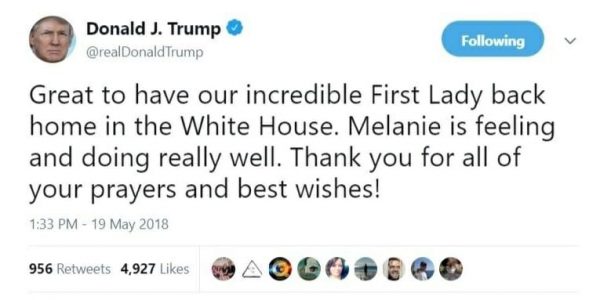
    The Donald is well known for his irrational outbursts and prolific use of social media, sometimes combining both, as in this tweet from a few days ago.

    Trump tweet saying In the East, it could be the COLDEST New Year’s Eve on record. Perhaps we could use a little bit of that good old Global Warming that our Country, but not other countries, was going to pay TRILLIONS OF DOLLARS to protect against. Bundle up!

    Let’s just analyse that tweet a bit and before we begin, it’s worth remembering insisting that global warming is a “hoax” invented by the Chinese, not to mention his appointment of climate change sceptics/deniers to both his cabinet and the Environmental Protection Agency.

    Firstly, there’s the term Global Warming. The generally accepted term for what is happening to the earth is now climate change. NASA helpfully points out the following:

    “Climate change” and “global warming” are often used interchangeably but have distinct meanings. Similarly, the terms “weather” and “climate” are sometimes confused, though they refer to events with broadly different spatial- and timescales.

    This is exactly what Trump has done, not only confused climate change and global warming but weather and climate too.

    To quote NASA on all these matters:

    Weather refers to atmospheric conditions that occur locally over short periods of time—from minutes to hours or days. Familiar examples include rain, snow, clouds, winds, floods or thunderstorms. Remember, weather is local and short-term.

    Climate, on the other hand, refers to the long-term regional or even global average of temperature, humidity and rainfall patterns over seasons, years or decades. Remember, climate is global and long-term.

    Global warming

    Global warming refers to the upward temperature trend across the entire Earth since the early 20th century, and most notably since the late 1970s, due to the increase in fossil fuel emissions since the industrial revolution. Worldwide since 1880, the average surface temperature has gone up by about 0.8 °C (1.4 °F), relative to the mid-20th-century baseline (of 1951-1980).

    Climate change

    Climate change refers to a broad range of global phenomena created predominantly by burning fossil fuels, which add heat-trapping gases to Earth’s atmosphere. These phenomena include the increased temperature trends described by global warming, but also encompass changes such as sea level rise; ice mass loss in Greenland, Antarctica, the Arctic and mountain glaciers worldwide; shifts in flower/plant blooming; and extreme weather events.

    Referring to “good old Global Warming“, this is POTUS getting down with his supporters denoting someone something – in this case global warming – that will do what is wanted or expected of them or it respectively.

    As for shouting about “trillions of dollars”, remember that climate change denier Trump has pulled the USA out of the Paris Agreement.

    Donald has received plenty of criticism from many quarters for the above tweet. One of the most interesting implies that Trump is being hypocritical. The Hill reports that celebrity chef José Andrés has more or less accused Trump of hypocrisy.

    On the same day as the infamous Trump tweet, José Andrés tweeted the following response:

    Why are you trying to build a wall in Ireland to protect your Golf club from raising seas?…..Mr. Trump just we had one of the bigger seasons of hurricanes in a century! People in USA are without homes, food and electricity because of Global warming!!! Really?

    Andrés was originally going to be opening a restaurant in a Trump establishment in Washington, D.C., but pulled out after Trump made racist remarks about Mexicans during his presidential campaign.

    Trump sued then Andrés for breach of contract; the chef countersued.

    Although a settlement was reached earlier this year, Andrés has continued to criticise Trump, particularly in respect of the response to Hurricane Maria’s devastation of Puerto Rico and Trump’s attitude to Moslems.

    Even given some stiff competition from the Bush family, Trump’s global warming tweet is in my mind the dumbest thing to come out of the Oval Office since the days of Ronald Reagan, who, incidentally, was out-acted by a chimpanzee in Bedtime for Bonzo in 1951.

    On 11th August 1984 Reagan famously gave the following sound check for his weekly Saturday address on National Public Radio:

    My fellow Americans, I’m pleased to tell you today that I’ve signed legislation that will outlaw Russia forever. We begin bombing in five minutes.

    Coming back environmental matters, Reagan also matches Trump in idiocy. Your ‘umble scribe can never forget the following, as quoted by Martin Schram in ‘Nation’s Longest Campaign Comes to an End’ in the Washington Post of 4th November 1980:

    Trees cause more pollution than automobiles do.

Posts navigation