Language

  • Proofreader, what proofreader?

    Evidence that accuracy is not a priority at the Temple Way Ministry of Truth abounds every day in the online edition of the Bristol Post.

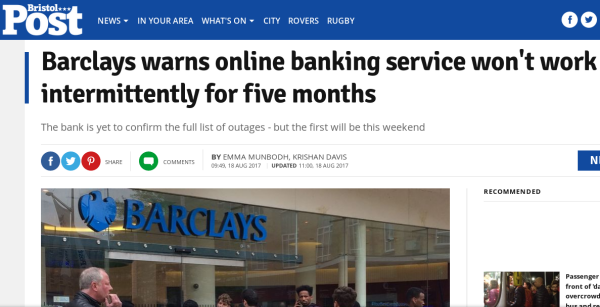
    Below is a screenshot of the most egregious example of a lack of quality control in what passes for today’s local news since the title’s takeover by the quality-unconscious Trinity Mirror plc.

    headline reads Barclays warns online banking service won't work intermittently for five months

    For those interested, the title’s sub-editors, the people that exercised quality control over what was actually published, were all made redundant many years ago. It is now up to the folk who write the copy to check it themselves.

    That being so, your correspondent does wonder whether standards of English language teaching have declined in the five and a half decades since he first entered full-time education, or whether the teaching he received was of an exceptional quality.

    If you have any thoughts about the quality of media reporting or language teaching, please feel free to comment below.

  • Ambiguity

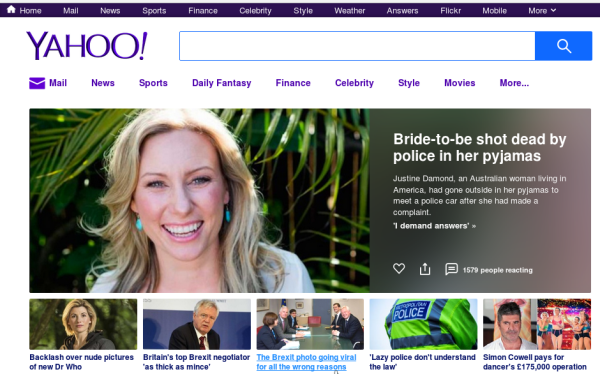
    Throughout my professional life, writing so that one’s meaning is clear and there is no room for misinterpretation has been of paramount importance.

    However, writing without ambiguity is a skill that’s evidently bypassed those who currently write the news headlines for Yahoo’s UK website…

    caption to news story reads bride-to-be shot dead by police in her pyjamas

    Enquiries are continuing as to how the cops came to be in the woman’s pyjamas in the first place. 😀

  • Tidy Barton Hill

    Bristol Clean Streets logoYesterday, along with Kurt James, Bristol City Council’s co-ordinator for the Bristol Clean Streets campaign, and local resident Eric Green, I joined a group of volunteers from Tawfiq Mosque in Barton Hill (usually rendered as “Bart Nil” in the local vernacular. Ed.😉 ) for a community litter pick.

    Starting at 10.30 in the morning, we split into 6 groups and tackled six different parts of the area for the next 2 hours, picking up litter and noting any larger, fly-tipped items for reporting later.

    While picking, we did get passers-by thanking us for our efforts, but ultimately I’m sure all those taking part would prefer it if our fellow citizens didn’t mess the area up in the first place. 😀

    It was a successful event and I was most encouraged by the cheerful enthusiasm and commitment of those involved. The photo below shows just some of the stuff we collected.

    litter pickers and litter picked
    Some of the litter picked up assembled at the Urban Park collection point.

    Your correspondent understands the mosque plans to make this a regular event. If so, I’ll try and get along again to assist.

    In the meantime, if you spot a problem on a Bristol street, be it an abandoned vehicle, litter, fly-tipping, a blocked drain or anything else, please report it to the council for attention.

  • IATE reaches double figures

    As a linguist one of the great developments in the way I work has been the development of online resources in recent years.

    These vary from dictionaries to terminological databases and it’s one of the latter that this post is about.

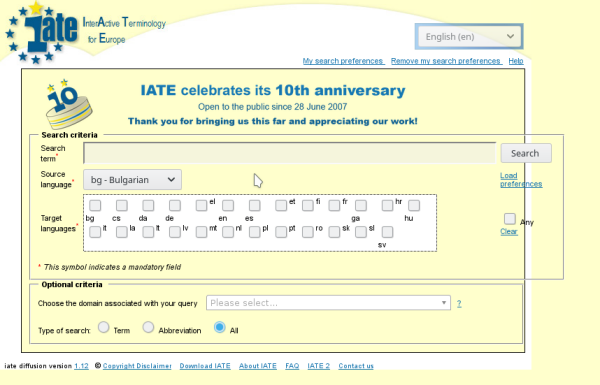
    Last week, IATE celebrated its tenth anniversary of being accessible to the public and proudly publicised its entry into double figures.

    screenshot of IATE website celebrating 10 years

    As can be seen from the screenshot IATE is short for InterActive Terminology for Europe; and it’s a great resource. Searches can be conducted in language pairs from the following languages:

    • Bulgarian
    • Czech
    • Danish
    • German
    • Greek
    • English
    • Spanish
    • Finnish
    • French
    • Irish
    • Croatian
    • Hungarian
    • Italian
    • Latin
    • Lithuanian
    • Latvian
    • Maltese
    • Dutch
    • Polish
    • Portuguese
    • Romanian
    • Slovak
    • Slovenian
    • Swedish

    Searches can also be refined by picking specialist subject areas from, for example, accounting to the wood industry.

    It’s a particularly good resource for terminology involving the European institutions, political matters and international relations in general, but is also no slouch when it comes to specific terms for, say, forestry.

    History & background

    IATE is the EU’s inter-institutional terminology database. IATE has been used in the EU institutions and agencies since summer 2004 for the collection, dissemination and shared management of EU-specific terminology. The project partners are:

    • European Commission
    • European Parliament
    • Council of Ministers
    • Court of Justice
    • Court of Auditors
    • Economic & Social Committee
    • Committee of the Regions
    • European Central Bank
    • European Investment Bank
    • Translation Centre for the Bodies of the EU

    The project was launched in 1999 with the objective of providing a web-based infrastructure for all EU terminology resources, enhancing the availability and standardisation of the information.

    IATE incorporates all of the existing terminology databases of the EU’s translation services into a single new, highly interactive and accessible inter-institutional database. Legacy databases from EU institutions have been imported into IATE, which now contains some 1.4 million multilingual entries.

    The IATE website is administered by the Translation Centre for the Bodies of the European Union in Luxembourg on behalf of the project partners.

    Download the database

    Having been produced at public expense, the entire database has been opened up to the public can be downloaded, all 1.4 million entries!

    Happy birthday, IATE! Here’s to the next 10 years

  • Post politics

    The Bristol Post, the city’s newspaper of (warped) record, hasn’t had and doesn’t have a reputation for accuracy in reporting – a situation which has not improved since it and all the other Local World regional newspaper titles were taken over by Trinity Mirror.

    This is more than evident in the title’s reporting of politics today.

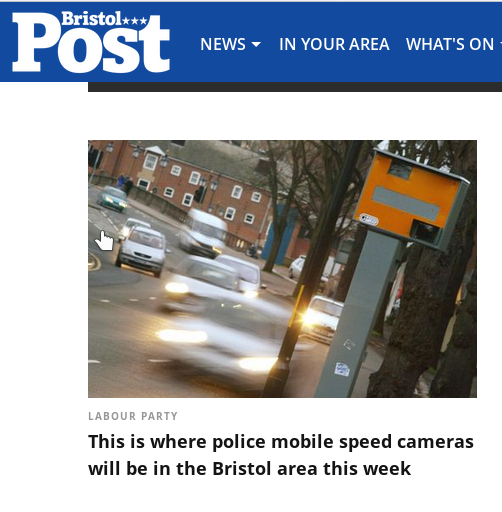
    The last (New) Labour government had a reputation for authoritarianism and what can best be described as “control-freakery“, so it is no surprise to see the Post assigning the comrades an authoritarian and control freak role amongst today’s headlines.

    text reads Labour Party This is where police mobile speed cameras will be in the Bristol area this week

    Mind how you go now! 😉

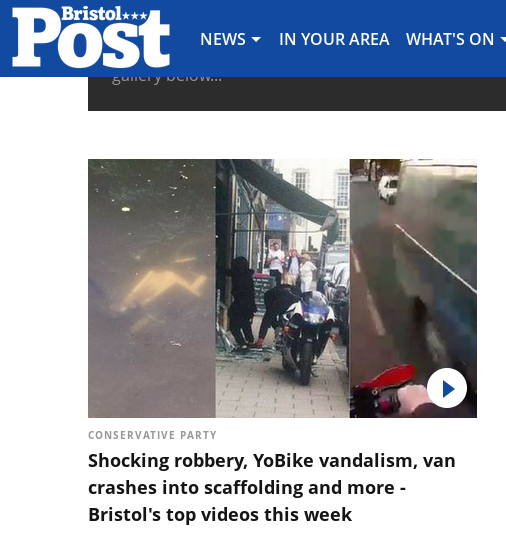
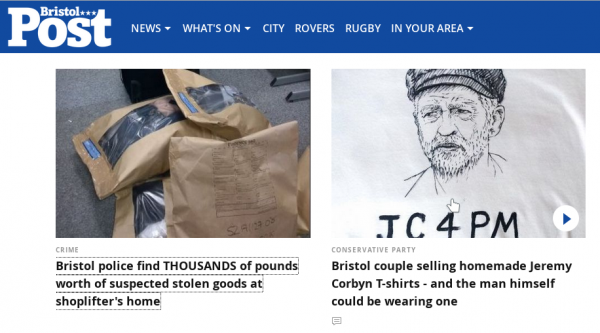
    Furthermore, for the sake of balance and impartiality, the Post also includes some news of the Conservatives, as per the following screenshot.

    text reads Conservative Party Shocking robbery, YoBike vandalism, van crashes into scaffolding and more - Bristol's top videos this week

    At this point, a small history lesson might be in order.

    The nickname of the Conservative and Unionist Party – to give them their full name – is the Tory Party.

    As a piece of English vocabulary, Tory has interesting origins. Etymologically, it’s derived from the Middle Irish word tóraidhe, which equates in modern Irish to tóraí and to tòraidh in modern Scottish Gaelic. It has the meaning of outlaw, robber or brigand, from the Irish word tóir, meaning “pursuit”, since outlaws were “pursued men”.

    It appears that since the term was coined, the Conservatives’ outlawry has expanded to encompass vandalism and careless driving. 😀

    If more classes of crime can be ascribed to the party, please mention them in the comments below.

    Update: as of this afternoon, one of these howlers has been corrected by the residents of the Temple Way Ministry of Truth. However, the Conservative Party are still responsible on the Post website for robbery and mayhem. 🙂

  • Lincoln Blue

    There are 6 days to go until the polls open for Theresa May’s snap election that she wasn’t going to call and the war of words is really hotting up.

    This blog has previously drawn attention to Theresa May’s description of the Conservatives as the “Nasty Party” (posts passim) and how under her premiership, she and her members have striven to be as nasty as they can.

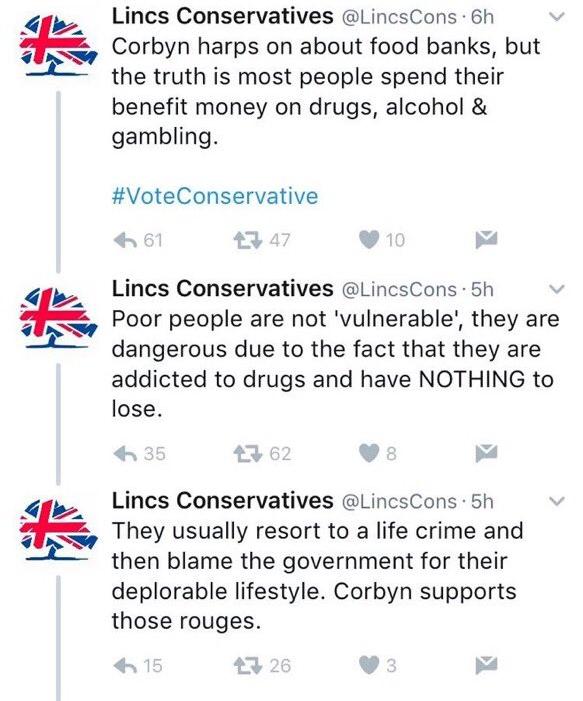
    This has continued with increasing fury during the election campaign and has intensified as the Tories’ lead in the opinion polls has narrowed, as shown by this series of tweets by the party’s faithful in Grantham, birthplace of the grocer’s daughter who went on to become the Conservatives’ revered Leaderene (once known as the “Milk Snatcher”. Ed.).

    screenshot of tweets demonising and insulting people on benefits

    In that series of postings, Lincolnshire Tories have been faithfully parroting the bile the party has been encouraging their allies in the right-wing mainstream media since their return to government in 2010.

    Note too, the spelling error in the final tweet: “rouges” instead of “rogues“. It must be an orthographical error as I can conceive of no predictive text application that would come up with such a substitute.

    Any rouge, otherwise known these days as blusher, is a cosmetic product and thus quite appropriate to this load of made-up nonsense. 🙂

    Since the posting of those tweets, the account has been suspended by Twitter, most likely for abusive tweets and/or behaviour.

  • Mumblin’ Harry Wales

    Who’s he?

    Some obscure blues artist?

    Not quite.

    Read on.

    a membling overprivileged aristocratGermany’s federal state of North Rhine-Westphalia (NRW) has decided to cut out part of an English exam including a speech by a a member of Britain’s so-called royal family after thousands of students complained that they could not understand him, The Local reports.

    On Tuesday North Rhine Westphalia’s school ministry announced it would be discarding part of a final English exam for 100,000 16 year-olds which involved their listening to a speech by young ‘Arry and then answering questions on it.

    More than 45,000 examination candidates signed a petition after the test last week calling for a retake because of Mr Wales’ “mumbly” enunciation and the recording’s poor quality.

    Regional teachers’ organisation Lehrer NRW commented that even mother tongue English teachers struggled to understand what he was saying.

    There were also complaints about poor vocabulary preparation for other parts of the examination.

    In response to the controversy, the NRW education ministry explained that markers would be given more leeway in assessing other areas of the test to account for what was taught in class.

    In a press release (German), Lehrer NRW said that what was being proposed was a “fair solution“.

  • Election special: Corbyn crosses the floor

    [Update at end]

    There’s a phrase in English politics – crossing the floor. The floor is that of the House of Commons and it means that an elected MP has switched allegiance from one party to another.

    One former MP – Sir Hartley Shawcross – was rumoured to be constantly on the point of changing allegiance throughout the early and mid-1950s and was consequently nicknamed Sir Shortly Floorcross. 😀

    It is a practice normally indulged in by rank and file MPs, not party leaders, unless Bristol’s newspaper of (warped) record is to be believed as per the following screenshot.

    Above headline are the words Conservative Party
    A proper Red Tory?

    Yes, your eyes are not deceiving you. According to the Bristol Post, Labour leader Jeremy Corbyn has joined the Conservatives just 3 weeks away from a general election.

    Your correspondent is now awaiting confirmation of this report from other mainstream media outlets.

    Update: 14.00 hrs, 21st May – The header over the link has now been changed to read “Politics”. However, use of a special creative writing technique would have avoided the original gaffe. Its name: proofreading! 😀

  • Election special: Tory buzzword bingo

    Cricket fans have long been acquainted with the delights of Boycott Bingo (posts passim), where the regular verbal mannerisms on Test Match Special of the greatest living Yorkshireman have been turned into a game.

    Following the recent announcement of the snap general election next month, followers of politics can now play their own game of buzzword bingo with the stock phrases and soundbites of the nation’s political leaders and election candidates.

    Expect these buzzwords to be wheeled out until everyone is absolutely fed up with them, usually after about 48 hours.

    The Conservatives’ soundbites are particularly limited in scope and number and, from what I’ve seen and heard, to call their candidates’ and leader’s performance wooden would be an insult to trees.

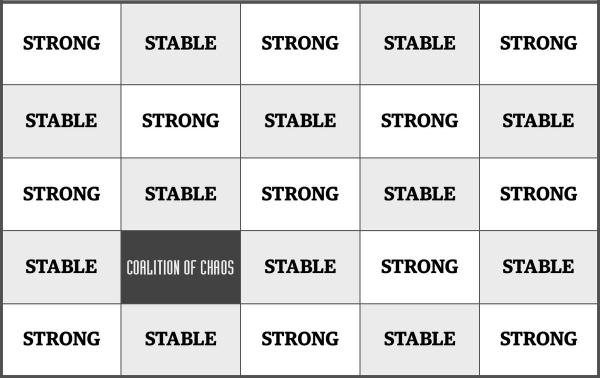
    Below, courtesy of The Guardian, is your very own buzzword bingo card for use with Tory leader Theresa May (whose main method of operation seems to consist of avoiding saying anything of substance. Ed.) and her colleagues.

    Good luck!

    bingo card featuring words strong, stable and coalition of chaos

  • Still verminous

    At the Conservative Party conference in 2002, new party chairwoman Theresa May stunned delegates with her keynote speech by saying the following:

    Yes, we’ve made progress, but let’s not kid ourselves. There’s a way to go before we can return to government. There’s a lot we need to do in this party of ours. Our base is too narrow and so, occasionally, are our sympathies, You know what some people call us: the nasty party.

    Since 2010 the Conservatives have proved in government that they haven’t changed and they’re still the Nasty Party writ large with their austerity policies that have cut funding to local authorities, cutting benefits for the disabled and referring to the unemployed as scroungers and shirkers.

    Theresa May has since moved on from Conservative Party chairwoman via the Home Office to doing Prime Minister impressions at a lectern outside 10 Downing Street and at the despatch box in the House of Commons. Although her 2002 admonishment might have been the first time that a prominent Tory had criticised the party, the Tories’ political opponents have been doing so along the same lines for decades.
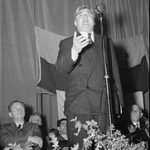
    Aneurin Bevan at the microphoneOne of the most prominent of these criticisms in the post-war period came on 4th July 1948 when Aneurin Bevan, then the Labour government’s Minister of Health, addressed a Labour Party rally in Manchester on the anniversary of Labour’s accession to power.

    Bevan’s speech was largely a review, followed by a pledge that the Government could carry out its entire programme, including nationalisation of the steel industry, a pledge in the party’s 1945 election manifesto.

    However, Bevan recalled what he described as the bitter experiences of his early life. For a time he was forced to live on the earnings of an elder sister and was told to emigrate.

    On this point, he remarked:

    That is why no amount of cajolery, and no attempts at ethical or social seduction, can eradicate from my heart a deep burning hatred for the Tory Party that inflicted those bitter experiences on me. So far as I am concerned they are lower than vermin. They condemned millions of first-class people to semi-starvation.

    Yes, that’s right. In Bevan’s eyes, the Conservatives were “lower than vermin“.

    Oxford Dictionaries defines vermin as follows:

    Wild animals which are believed to be harmful to crops, farm animals, or game, or which carry disease, e.g. rodents.

    It also offers the additional sub-definition below:

    People perceived as despicable and as causing problems for the rest of society.

    As regards its origin, the word vermin first appears in Middle English and comes from from Old French based on Latin vermis ‘worm’ since it originally denoted animals such as reptiles and snakes.

    However, this demotion of the Tories to rank below rats, mice and the like wasn’t the only attack on the Conservatives during Bevan’s speech, since he is also reported as asking the meeting rhetorically at one point: “For what is Toryism, except organised spivvery?“. This reference to wartime black marketeers may sound anachronistic, but there are still senior members of the Conservative Party who are even nowadays referred to as spivs (posts passim) – and by others apart from your ‘umble scribe.

    Finally, in view of the impending general election, it might be worth recalling what Bevan went on the say about the Conservatives of his time, since these words still have relevance and pertinence today.

    Now the Tories are pouring out money in propaganda of all sorts and are hoping by this organised sustained mass suggestion to eradicate from our minds all memory of what we went through. But, I warn you young men and women, do not listen to what they are saying now. Do not listen to the seductions of Lord Woolton. He is a very good salesman. If you are selling shoddy stuff you have to be a good salesman. But I warn you they have not changed, or if they have they are slightly worse than they were.

    Ouch! All that needs changing to make the above quotation contemporary to the 2017 election would be to replace the name of Woolton with that of a present-day prominent right-wing Tory grandee. Will any opposition candidate do so?
Posts navigation