Language

  • What is open?

    Open Knowledge Foundation logoThe Open Knowledge Foundation is doing marvellous work in the fields of open data and open content.

    The Foundation has just published version 2 of its Open Definition. This definition is released under a Creative Commons Attribution licence and is reproduced verbatim below (complete with US spellings and punctuation throughout. Ed.).

    Open Definition

    Version 2.0

    The Open Definition makes precise the meaning of “open” with respect to knowledge, promoting a robust commons in which anyone may participate, and interoperability is maximized.

    Summary: Knowledge is open if anyone is free to access, use, modify, and share it — subject, at most, to measures that preserve provenance and openness.

    This essential meaning matches that of “open” with respect to software as in the Open Source Definition and is synonymous with “free” or “libre” as in the Definition of Free Cultural Works. The Open Definition was initially derived from the Open Source Definition, which in turn was derived from the Debian Free Software Guidelines.

    The term work will be used to denote the item or piece of knowledge being transferred.

    The term license refers to the legal conditions under which the work is made available. Where no license has been offered this should be interpreted as referring to default legal conditions governing use of the work (for example, copyright or public domain).

    1. Open Works

    An open work must satisfy the following requirements in its distribution:

    1.1 Open License

    The work must be available under an open license (as defined in Section 2). Any additional terms accompanying the work (such as a terms of use, or patents held by the licensor) must not contradict the terms of the license.

    1.2 Access

    The work shall be available as a whole and at no more than a reasonable one-time reproduction cost, preferably downloadable via the Internet without charge. Any additional information necessary for license compliance (such as names of contributors required for compliance with attribution requirements) must also accompany the work.

    1.3 Open Format

    The work must be provided in a convenient and modifiable form such that there are no unnecessary technological obstacles to the performance of the licensed rights. Specifically, data should be machine-readable, available in bulk, and provided in an open format (i.e., a format with a freely available published specification which places no restrictions, monetary or otherwise, upon its use) or, at the very least, can be processed with at least one free/libre/open-source software tool.

    2. Open Licenses

    A license is open if its terms satisfy the following conditions:

    2.1 Required Permissions

    The license must irrevocably permit (or allow) the following:

    2.1.1 Use

    The license must allow free use of the licensed work.

    2.1.2 Redistribution

    The license must allow redistribution of the licensed work, including sale, whether on its own or as part of a collection made from works from different sources.

    2.1.3 Modification

    The license must allow the creation of derivatives of the licensed work and allow the distribution of such derivatives under the same terms of the original licensed work.

    2.1.4 Separation

    The license must allow any part of the work to be freely used, distributed, or modified separately from any other part of the work or from any collection of works in which it was originally distributed. All parties who receive any distribution of any part of a work within the terms of the original license should have the same rights as those that are granted in conjunction with the original work.

    2.1.5 Compilation

    The license must allow the licensed work to be distributed along
    with other distinct works without placing restrictions on these other works.

    2.1.6 Non-discrimination

    The license must not discriminate against any person or group.

    2.1.7 Propagation

    The rights attached to the work must apply to all to whom it is redistributed without the need to agree to any additional legal terms.

    2.1.8 Application to Any Purpose

    The license must allow use, redistribution, modification, and compilation for any purpose. The license must not restrict anyone from making use of the work in a specific field of endeavor.

    2.1.9 No Charge

    The license must not impose any fee arrangement, royalty, or other compensation or monetary remuneration as part of its conditions.

    2.2 Acceptable Conditions

    The license shall not limit, make uncertain, or otherwise diminish the permissions
    required in Section 2.1 except by the following allowable conditions:

    2.2.1 Attribution

    The license may require distributions of the work to include attribution of contributors, rights holders, sponsors and creators as long as any such prescriptions are not onerous.

    2.2.2 Integrity

    The license may require that modified versions of a licensed work carry a different name or version number from the original work or otherwise indicate what changes have been made.

    2.2.3 Share-alike

    The license may require copies or derivatives of a licensed work to remain under a license the same as or similar to the original.

    2.2.4 Notice

    The license may require retention of copyright notices and identification of the license.

    2.2.5 Source

    The license may require modified works to be made available in a form preferred for further modification.

    2.2.6 Technical Restriction Prohibition

    The license may prohibit distribution of the work in a manner where technical measures impose restrictions on the exercise of otherwise allowed rights.

    Non-aggression

    The license may require modifiers to grant the public additional permissions (for example, patent licenses) as required for exercise of the rights allowed by the license. The license may also condition permissions on not aggressing against licensees with respect to exercising any allowed right (again, for example, patent litigation).

  • New version of Sigil epub editor released

    In February this year John Schember announced the end of the Sigil free e-book editor on the Sigil project website due to time pressures. However, now there is a new release which is due to the contribution of developer Kevin Hendrick. In addition to some bug fixes and minor improvements, Sigil 0.8.0 mainly provides plug-in support.

    Sigil screenshot
    Sigil screenshot. Click on image for full-sized version

    Like its predecessor Sigil 0.8.0 is open source and licensed under the GNU GPLv3. Nevertheless, the plug-in system was written in a way that allows plug-ins to be released under any licence their author wants and must not necessarily be open source. Plug-ins are called upon with the aid of a plug-in launchers which is itself covered by a BSD licence. The plug-ins themselves remain independent and could also be used by other applications. The new plug-in API is similar to that of Calibre, so that some Calibre plug-ins can be used with only minor changes. John Schember’s blog provides comprehensive details of the release announcement.

    The new version of Sigil is available for download on the project’s Github page as source code, as well as for Windows and Mac OS. For Linux distros, the current release is already available for Arch Linux in the community repository, whilst for Fedora it is in testing. There are also packages for Ubuntu in various unofficial Launchpad repositories.

  • Greengrocer returns to Post

    Thursday’s Bristol Post saw the welcome return to journalism of a local greengrocer, with a report featuring a superfluous apostrophe in the headline.

    Bristol Post headline featuring greengrocer's apostrophe

    The writer from the fruit and vegetable trade has been rather quiet on Temple Way recently. This blog has not featured his or her work for nearly a year now (posts passim).

    One question that should be asked of Localworld, owners of the Bristol Post, is whether it was it such a great idea to get rid of sub-editors?

  • Today is International Translation Day

    St Jerome in his study
    Today, 30th September is International Translation Day which is celebrated each year on this date. 30th September is the feast day of St. Jerome (pictured right), who is credited with translating the Bible into Latin (the so-called Vulgate Bible. Ed.) in the late 4th century. In 382 Jerome was commissioned by Pope Damasus I to revise the Vetus Latina (“Old Latin”) collection of Biblical texts in Latin then in use by the Church. St Jerome is also the patron saint of translators.

    International Translation Day has been promoted by the FIT (the International Federation of Translators) since its inception in 1953. In 1991 the FIT launched the idea of an officially recognised International Translation Day to show solidarity of the worldwide translation community (would that include our interpreter colleagues? Ed.).

    St Jerome’s early work definitely had a lasting effect, since the world’s most translated literary work is still the Christian Bible, followed by Carlo Collodi‘s Le avventure di Pinocchio.

  • Even carefully placed litter is still litter

    It’s not just fly-tipping that’s a problem in my part of Bristol (posts passim). Litter’s an associated problem that makes the place look scruffy and gives it that intimidating air.

    Collins Dictionary defines litter as “small refuse or waste materials carelessly dropped, esp. in public places“.

    However, some litter is not carelessly dropped, but is carefully placed – preferably off the ground – so that the perpetrator doesn’t feel so bad about being anti-social, as in the example below.

    discarded bottle placed on street sign

    Here’s a quick reminder for the hard of thinking: even carefully discarded waste materials are still litter if not placed in an appropriate container, like a bin. Not using a bin – or mistaking the street or public open space for a litter bin – may earn you an on-the-spot fine of £75 in Bristol.

    As for those who drop litter next to a litter bin, words fail me.

    Anyway, that particular bottle is plastic and can be recycled, so will be out with the rest of my recycling tomorrow, ready for collection.

    If you want to report litter in Bristol, the city council’s website has a handy form.

  • Nice one!

    News site www.thebusinesswomanmedia.com has got the emphasis just right here on its report on a wedding that’s causing the media to get excited and distract attention from all the nasty things going on in the world like Ebola in West Africa or the continuing madness in the Middle East (news passim).

    screenshot of headline stating internationally acclaimed barrister Amal Alamuddin marries an actor

    However, it could have added the word(s) ‘ageing’ and/or ‘greying’ in front of ‘actor’. 😉

  • Islamic State: potted history

    If you’re having difficulty in understanding what’s happening with the militants of Islamic State in Iraq and Syria at the moment without going any further back than Bush War II (the overthrow of Saddam Hussein – and the roots of the conflicts and tensions in the region do go back to at least the end of World War 1 and the Treaty of Versailles! Ed.) then Aubrey Bailey of Fleet in Hampshire has provided a concise and not too confusing potted guide.

    image of newspaper letter with the heading Clear as mud

    Hat tip: Marina S.

  • Mobility scooter drink-driving case adjourned due to lack of interpreter

    image of gilded statue of Justice on top of Old BaileyYesterday’s Stoke Sentinel reports on the case of a Romanian man in court on a charge of being drunk in charge of a mobility scooter.

    On 7th August Staffordshire police stopped Romanian-born Silviu Croitoru on the A34 London Road in Newcastle-under-Lyme: 47 year-old Croitrou – now resident in Trent Vale, Stoke-on-Trent – was driving his mobility scooter at the time and gave reading of 95 microgrammes of alcohol in 100 millilitres of breath; the legal limit is 35 microgrammes.

    Magistrates at the North Staffordshire Justice Centre in Newcastle-under-Lyme adjourned the case to arrange for the attendance of an interpreter and to allow time for defence representations.

    One would have thought that if the defendant required an interpreter, this should have been noted and arranged for the initial hearing, but waste and incompetence seem to be endemic in the justice system nowadays.

  • Project Fear revs up

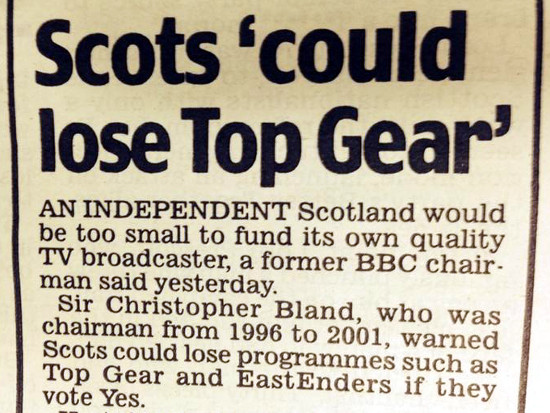
    The No campaign against Scottish independence has since the outset been playing on people’s uncertainties about the fate of an independent Scotland to such an extent that supporters of independence have dubbed it Project Fear.

    In recent times, some of these have included some strange arguments, such as the one illustrated below.

    headline reading Scots could lose Top Gear

    That’s right! Project Fear has now put the idea in the minds of Caledonian petrolheads that they could lose the likes of Clarkson & Co.

    I can think of nothing more that would make me vote yes were I a Scot and was eligible to partake in the referendum.

Posts navigation