Lookalikes: his master’s voice

Hat tip: John Porter.
Hat tip: John Porter.
Like many, I was saddened to hear of the death of Muhammad Ali. As a young lad growing up in the 1960s and keen on sport of all kinds, he was a large presence on the TV sports programmes and the newspaper sports pages.
His achievements in the ring and his stand against conscription and the Vietnam War helped reinforce his reputation: he really did end up as “the greatest“.
However, news emerges via the Bristol Post that Ali’s death may not be all it seems: Muhammad’s demise could have been at the behest of Marvin Rees, Bristol’s newly elected mayor.
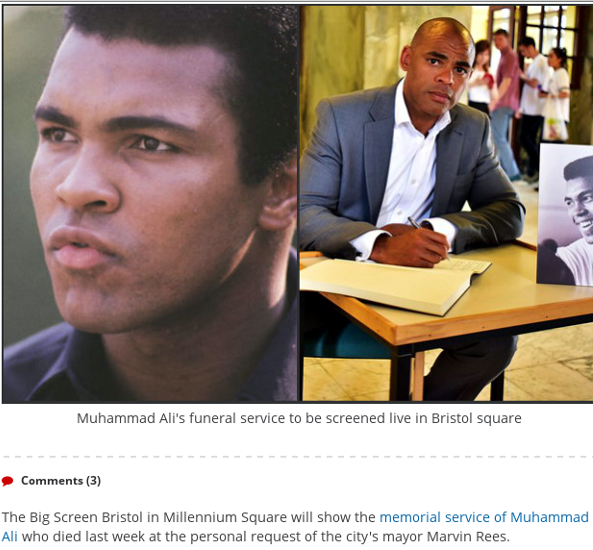
However, as per usual, it is merely a case of the endemic bad use of English, appalling grammar and ambiguity by the Post’s semi-literate hacks.
In contrast, Ali was renowned for his eloquence and use of the English language, something which the current crop of Post journalists will never, ever emulate.
One of the joys of the illiteracy of the Bristol Post – the city’s newspaper of warped record – is the unintentional humour the manifestations of that lack of skill inspire.
Such an instance occurred yesterday when the Post reported, with a local angle of course, on the reopening of the inquest into the victims of the Birmingham pub bombing by the IRA on 21st November 1974.
One of the survivors – Frank Thomas – now happens to live in Bristol and the Post’s reported duly managed to get rumble and rubble confused, as shown in the following screenshot of the article’s first paragraph.

Should any passing Post hack wish to avoid future confusion, the definitions of rumble and rubble are helpfully transcribed below from Cambridge Dictionaries Online.
Rumble (n.) – a low continuous sound.
Rubble (n.) the piles of broken stone and bricks, etc. that are left when a building falls down or is destroyed.
As published yesterday on the Bristol Post website.
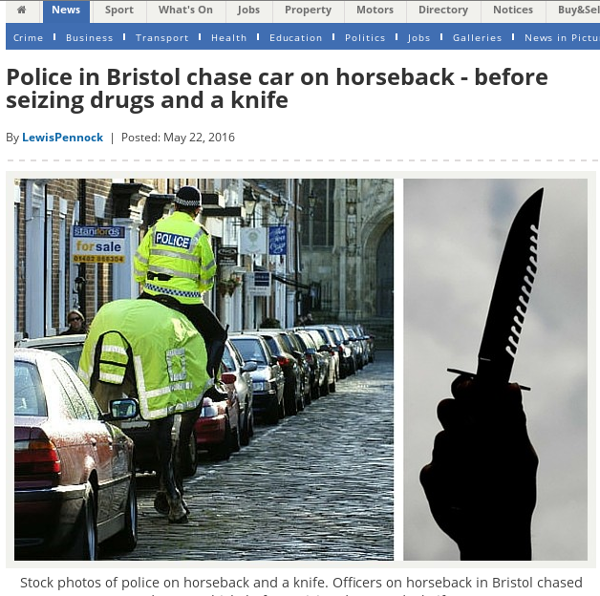
Unfortunately, the reporter concerned fails to tell readers how the car was able to stay in the saddle, given the inability of the car’s wheels to fit into the stirrups. 😉
Very soon after graduating and getting my first job with Imperial Group, I was taught by my then manager to avoid any ambiguity when writing. Times have clearly changed!
Microsoft has a reputation for forcing unwanted updates and upgrades on users.
Its actions reached a new nadir when it made Windows 10 a recommended update for users of earlier versions – 7 and 8.* – of its operating system.
Since this occurred there have been numerous reports of the new operating system installing itself without either user consent or much warning.
One of the most public of these attempted upgrades happened 2 days ago live on air at TV station KCCI of Des Moines, Iowa, as per the following screenshot.

That’s right! With impeccable bad timing, Windows 10 update barged unannounced into Metinka Slater’s heavy rain and thunderstorms update. However, the TV meteorologist managed deal professionally with the unwelcome intrusion into her work and switch quickly to an alternative video source to continue her broadcast, as shown by the following video.
With the notable exception of Test Match Special‘s cricket commentary on long wave, BBC sports commentators seem to be employed more for their ability to shout than proficiency in the English language, judging from the rare bits of sports commentary that get broadcast as part of Radio 4’s news bulletins.
This opinion received further support yesterday when the BBC Sport Twitter account sought the views of Aston Villa FC fans on news that the club at the bottom of the Premier League (that’s the English First Division in old money. Ed. 🙂 ) table would be playing in the Championship (the old Second Division. Ed.) next year, as per the following tweet, which has since been deleted:

Wait off the shoulders, Auntie? This blog is giving you a red card and you should now proceed from the field of play for an early bath and thence to your reserved place in Heterograph Corner! 🙂
Hat tip: OwlofMinera.
Yesterday evening there was dark smoke on the skyline as your correspondent returned from an early evening pint. However, it wasn’t until this morning that its full significance and exclusive nature was revealed by the Bristol Post, the city’s newspaper of warped record.

As per the screenshot above, the Post duly reported a fire at a scrapyard in the Fishponds area, although a later report moved the fire to nearby Speedwell.
Furthermore, the conflagration must have been painful on the ears for anyone in the vicinity or downwind as the smoke was “bellowing“.
However, as the witnesses interviewed by the paper make no mention of noise, it can only be assumed that the hapless hack had an unfortunate vowel movement.
The later report did state correctly that “A scrapyard in Speedwell left dark smoke billowing over parts of Bristol,” but not until the hopeless howler had caused much merriment in the reports comments section.
If the reporter in question happens upon this post, the definitions of bellow and billow are given below for future reference:
Bellow: (of a person or animal) emit a deep loud roar, typically in pain or anger: e.g. “he bellowed in agony”
Billow: (of smoke, cloud, or steam) to move or flow outward with an undulating motion: e.g. “smoke was billowing from the chimney-mouth”.
Both definitions are courtesy of Oxford Dictionaries.
Court cases around the country are still being delayed for want of interpreters who are supposed to be supplied by arch outsourcers Capita.
Today’s Sentinel reports on a case that was adjourned yesterday at North Staffordshire Justice Centre in Newcastle-under-Lyme.
Maris Dombovskis of Longton is charged with failing to provide a specimen of breath for analysis, driving without insurance and without a licence on January 19.
District Judge Jack McGarva adjourned the case until February 29 to arrange for an interpreter.
This was the second time last week that a court case at this court complex had to be adjourned for lack of an interpreter.
On Tuesday 23rd February magistrates adjourned the case of a Polish resident of Smallthorne charged with assault for 3 days to arrange for an interpreter, The Sentinel also reported.
Beware if you ever visit the gents at the Bull Hotel at Fairford in Gloucestershire; the vitreous china might attack you.
Last Friday’s Wilts & Gloucestershire Standard reports that a customer who smashed the toilet to bits claims he was acting in self defence.

The unnamed Kempsford man claims he was about to be attacked and smashed the toilet to attract the attention of other patrons.
However, the local constabulary were unimpressed by his assertions and he’s due to appear before Cheltenham Magistrates on 24th February.
Hat tip: Dr Bob Irving.
Where Bristol has the Bristol Post, formerly the Bristol Evening Post, as its newspaper of record (warped. Ed.), the Potteries has The Sentinel, formerly the Evening Sentinel.
Both newspapers now belong to the Local World stable and share many common features: the content management system running their websites, difficulty in distinguishing editorial content from advertising, a cavalier attitude to the correct use of the English language and so on.
Yesterday’s Sentinel carried a report of a railway signal failure in the Stafford area.
The report was helpfully illustrated with a photograph as per the screenshot below.

The photograph is also helpfully captioned, as follows:
DELAYS: Rail services have been hit by signalling problems at Stafford.
It is evident for a number of reasons that the anonymous members of the Sentinel’s “Digital_team” who put together this report are no great users of the railway network.
Firstly, the photograph shows semaphore signals. These are not used at Stafford, which lies on the West Coast Main Line, where semaphore signals were removed and replaced with colour light signals many decades ago.
Secondly, the plate on the signal mast identifies the signals as part of the Severn Bridge Junction signal complex.
Thirdly, what is the Abbey Church of St Peter & St. Paul in Shrewsbury doing in the background, lurking behind the largest sempaphore signal box in the country? 😉