Media

  • A new perishable commodity: nuclear missile submarines

    It’s said that “to err is human“; and journalists are no exception to this.

    Some while ago, a hapless hack at the Bristol Post, disclosed to an unbelieving city readership that bridges have a shelf life (posts passim).

    Now it seems that bridges have been joined on the shelf by another perishable commodity – submarines carrying the UK’s nuclear deterrent.

    Reporting today on the pro-Trident stance of Bristol MPs Kerry McCarthy and Karin Smyth, political correspondent Patrick Daly lets the cat out of the bag:

    The four submarines, which carry nuclear warheads, are due to come to the end of their shelf-life by the late-2020s…

    A Vanguard class submarine capable of carrying Trident missiles leaving the Forth of Clyde
    A Vanguard class submarine capable of carrying Trident missiles leaving the Forth of Clyde. Image courtesy of Wikimedia Commons

    For those who need some explanation of the definition of shelf life, Wikipedia has a very useful article which starts as follows:

    Shelf life is the length of time that a commodity may be stored without becoming unfit for use, consumption, or sale. In other words, it might refer to whether a commodity should no longer be on a pantry shelf (unfit for use), or just no longer on a supermarket shelf (unfit for sale, but not yet unfit for use).

    As one of these four submarines is supposed to be at sea at all times, perhaps Mr Daly would care to explain to his readers, why the quartet is cluttering up the quartermaster’s stores instead. 😉

    Alternatively, perhaps Patrick could learn the definition of the term “service life“. 🙂

    Update 12/02/16: The piece has since been amended and the offending “shelf-life” replaced.

  • France: 10 words whose spelling will change at the start of the school year

    upper and lower case a with circumflexSince 1990 the spelling reform approved by the Académie Française has never really been pursued. “Oignon” without an “i“, the removal of some circumflex accents: at the start of the next academic year, teachers should finally implement this reform, TF1 reports. A total of 2,400 words are going to be changed; here are 10 examples.

    The word “nénuphar” will henceforth be able to be written as “nénufar“. The spelling reform of 6th December 1990 that was approved by the Académie Française is finally going to be applied at the start of the next school year by the publishers of school textbooks and thus by teachers.

    One of the new features is that circumflex accents are going to disappear gradually. The verb “s’entraîner” will therefore be able to be spelt with a simple “i” and thus minus the circumflex accent. This part of the reform should make learning spelling easier for children.

    Special National Education Official Bulletin no. 11 of 26 Novembre 2015 gives a reminder that the spelling reform to be applied to the schooling of a child is that of 1990. Spelling and grammar textbooks will therefore carry the wording “New spelling” from the start of the next academic year.

    Another brain-teaser

    Only 45% of French people were proficient in the rules of spelling in 2015. What will happen when students have to learn to spell the same word in two different ways? Teachers are already reticent about this question.

    The change in French spelling has not been accepted by the world of work and business for 26 years. The 2,400 words involved in this reform could therefore be regarded as errors by prospective employers although the 2 spellings will be accepted.

    10 words which will change at the start of the school year

    Oignon to ognon (onion)
    Nénuphar to nénufar (water lilly)
    S’entraîner to s’entrainer (to train oneself)
    Maîtresse to maitresse (mistress)
    Coût to cout (cost)
    Paraître to paraitre (to appear)
    Week-end to weekend
    Mille-pattes to millepattes (millipede)
    Porte-monnaie to portemonnaie (purse)
    Des après-midi to des après-midis (afternoons)

    Online opposition

    However, The Guardian reports that the changes to French spelling have not met with universal approval. There have been complaints that the Socialist government is dumbing down the language of Molière.

    On Twitter, opposition to the reform gave rise a #JeSuisCirconflexe campaign, along the lines of the #JeSuisCharlie hashtag in the wake of the atrocity at the offices of the satirical magazine Charlie Hebdo (posts passim).

  • Gloucestershire PCC defends linguists

    Gloucestershire PCC Martin SurlA couple of days ago, the Tory Police & Crime Commissioner candidate for Gloucestershire, Will Windsor-Clive criticised the £100,000 or so the Gloucestershire constabulary spends annually on interpreters (posts passim) in an early campaign effort to deploy bigotry and xenophobia.
    Today, the Western Daily Press reports that the current Police and Crime Commissioner, independent Martin Surl, has defended his force’s expenditure on linguists.

    He is reported to have said the following:

    Translators [sic] are highly qualified professionals who provide a fundamental service.

    Victims must be protected and the law administered without fear or favour and effective communication is essential to the process of justice.

    It is also a legal requirement that if a case comes to court, all sides must be understood and be able to understand the proceedings.

    Well said, Mr Surl, although you need to see my handy illustrated guide to appreciate the difference between translators and interpreters. 🙂

  • PCC candidate queries paltry interpreting bill

    This May sees a whole slew of elections to local councils, the Welsh Assembly, Scottish Parliament and last but not least, 41 local Police & Crime Commissioners (PCCs).

    Will Windsor-Clive looking dapperAs regards the election of the PCC for Gloucestershire, Will Windsor-Clive, the Conservative candidate, has decided to play the bigotry and xenophobia card early. He’s doing so by questioning the £100,000 the force spends annually on interpreters, having filed a Freedom of Information Act request on the subject, the Western Daily Press reports.
    The paper reports the overall costs have remained around £100,000 a year over the three years between 2011 and 2014.

    In a quote for the paper, Mr Windsor-Clive is reported to have commented: “This is an unseen cost of high levels of immigration. Taxpayers quite rightly want their money spent on keeping their community safe, not on providing translating services. I’m determined to find ways of cutting back-office costs to spend on frontline policing and this is one area that needs investigating.”

    Here are a number of questions electors (and others) should ask Mr Windsor-Clive.

    1. Is it right to whip up bigotry and xenophobia for electoral gain?

    2. Does Mr Windsor-Clive regard the rule of law and the administration of justice as priceless commodities in a civilised society?

    3. If the answer to 2. above is yes, wouldn’t any reasonable person regard £100,000 a reasonable price to pay to enable the full participation of both victims and accused persons who don’t speak English proficiently in the enforcement of the rule of law and the administration of justice?

    4. If Mr Windsor-Clive were to fall foul of the police in a foreign country whose language he did not speak, would he be content to forego the services of an interpreter, as he obviously wants to do in Gloucestershire?

  • Bristol Mayor wins greenwash award

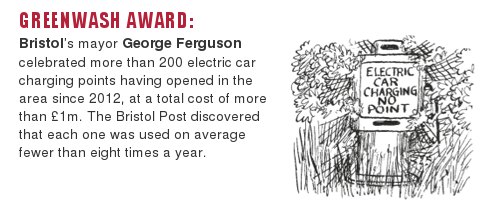
    As a fitting end to Bristol’s year as European Green Capital, Mayor George Ferguson has won the Greenwash Award in Private Eye’s Rotten Boroughs awards for 2015.

    screenshot of Private Eye item

    From your correspondent’s vantage point in the inner city, it has to be said that Bristol’s year as Europe’s beacon of best environmental practice has hardly been crowned with glory, with money wasted on pointless art projects, widespread wildlife habitat destruction and the continuing blight of fly-tipping.

    Will George Ferguson be collecting his award in person from Lord Gnome? 😉

  • Chinese village creates a modern Ozymandias?

    News emerged today in the British national press of a 36-metre tall statue of the late Chinese leader Mao Zedong being built in a village in China. Here’s The Guardian’s report of this story as an example.

    The statue of the so-called “Great Helmsman” is being constructed at Zhushigang village in Tongxu County in Henan Province.

    It is reported to be costing some RMB 3 mn. (approx. £312,000). The materials used in its construction are steel and concrete, with the exterior being coated in gold paint.

    36-metre tall statue of Mao Zedong
    History is looking on your works and despairing, Mao! Photo: CFP

    Reading about the statue and thinking about its future, not to mention what has happened to statues of past powerful leaders (particularly dictators. Ed.) around the world, Percy Bysshe Shelley‘s 1818 sonnet, Ozymandias came to mind.

    I met a traveller from an antique land,
    Who said—”Two vast and trunkless legs of stone
    Stand in the desert. . . . Near them, on the sand,
    Half sunk a shattered visage lies, whose frown,
    And wrinkled lip, and sneer of cold command,
    Tell that its sculptor well those passions read
    Which yet survive, stamped on these lifeless things,
    The hand that mocked them, and the heart that fed;
    And on the pedestal, these words appear:
    My name is Ozymandias, King of Kings;
    Look on my Works, ye Mighty, and despair!
    Nothing beside remains. Round the decay
    Of that colossal Wreck, boundless and bare
    The lone and level sands stretch far away.”

    In antiquity, Ozymandias was a Greek name for the ancient Egyptian pharaoh Ramesses II. Shelley began writing Ozymandias soon after the announcement of the British Museum’s acquisition of a large fragment of a statue of Ramesses II from the thirteenth century BC, leading some scholars to believe that this had inspired Shelley.

    In more modern times, Mao’s record is chequered. His supporters credit him with driving imperialism out of China, modernising the country and building it into a world power, promoting the status of women, improving education and health care, as well as increasing life expectancy as China’s population grew from around 550 million to over 900 million during his leadership. Mao is also known as a theorist, military strategist, poet and visionary.

    On the other hand, his critics consider him a dictator comparable to both Hitler and Stalin who severely damaged traditional Chinese culture, as well as being a perpetrator of systematic human rights abuses who was responsible for an estimated 40 to 70 million deaths through starvation, forced labour and executions.

    Look upon my works and despair indeed!

  • Spelling or sleeping?

    There was a great clanger in a tweet this morning from Bristol’s Western Daily Press, the sister publication of the Bristol Post (and joint occupier with it of Bristol’s Temple Way Ministry of Truth. Ed.) and likewise subject to many of the latter’s failings with the English language.

    Here’s an image of the tweet in question.

    text of tweet reads Simon Cowell's home gets burgled while he and his family spelt inside

    The morals of this tale are clear: if you run a tawdry TV talent show orthography is as dangerous as shut-eye if housebreakers are around; if you run the social media account of a mediocre regional paper, learn to proof-read before posting online*! 🙂

    * The spelling error in the tweet originally appeared in the article itself, but has since been corrected.

  • Bristol Post balls – rescued from the rescue services?

    There seem to be times when confusion is rife in the Bristol Post’s headquarters on Temple Way. This was exemplified yesterday by the headline in this report, of which a screenshot follows, just in case Post hacks realise a mistake has been made.

    screenshot of headline stating Man rescued from Bristol Floating Harbour fire brigade after a night on the town

    In spite of the headline, Post reporter Emma Flanagan fails to explain in her article why anyone would need rescuing from the fire brigade after a night out.

    Furthermore, there is no explanation either for the logic behind Bristol’s City Docks having their own fire brigade.

    Perhaps kind readers could help her out and provide plausible reasons in the comments below. 🙂

Posts navigation