Media

  • An inappropriate juxtaposition

    The screenshot below comes from the Bristol Post website early this morning and shows 2 news items in succession about Nick Gargan, the Chief Constable of Avon & Police.

    image of 2 news items on Nick Gargan

    Is being suspended for ‘inappropriate behaviour’ part of a typical light-hearted day for Avon & Somerset’s finest?

    Answers in the comments below, Bristol Post hacks and sub-editors. ๐Ÿ™‚

  • The rustication of Clifton

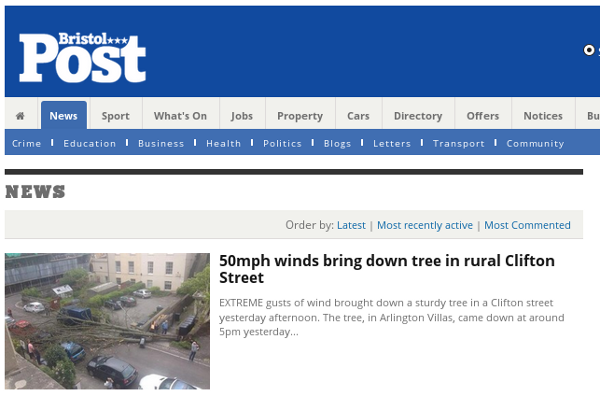
    Earlier today, the news section of the Bristol Post transported the city’s affluent district of Clifton to the countryside, describing it as ‘rural’, as shown in the following screenshot.

    screenshot of Post website showing dodgy wording

    According to the Oxford English Dictionary rural has many meanings; the one implied by the Post’s usage is the OED’s definition 1c:

    Employed or stationed in country districts.

    Are the people of Clifton yokels?

    Bristol absorbed Clifton in the 19th century, so any green wellies seen will be very clean and not covered in cow’s muck; they’ll be worn for fashion not for necessity. Although Clifton’s renowned Downs are still common land, the locals don’t seem to graze much livestock upon them. Nevertheless, some activities which may be regarded as animal take place up there.

    The word rural has since been removed from the headline.

    I always believed press articles supposed to be sub-edited before being posted. Apparently this does not seem to be the usual practice down at the Temple Way Ministry of Truth.

  • Bryan Lunduke says: “Linux sucks”

    I’m indebted to Linux.com for alerting me to the video below.

    Bryan Lunduke is social media marketing manager at SUSE (the first Linux distribution your correspondent used daily. Ed.), as well as a writer and commentator.

    The talk was delivered at LinuxFest Northwest in Bellingham, Washington on Saturday 26th April 2014.

    Lunduke takes a good-humoured critical aim at some of the things that make Linux annoying, the development process which is likened to ‘herding millions of cats’, the large amount of forking that goes on, the age of the X.Org display server and the insistence of some distributions, particularly Fedora and Ubuntu on developing their own alternatives – Wayland and Mir respectively – for what is essentially something old, trusted and reliable, like X.Org.

    Fedora and Ubuntu/Canonical come in for plenty of gentle ribbing from Lunduke.

    About halfway through, Lunduke then turns the criticism completely on its head by stating that all the annoyances are actually what make Linux great and why we users love it. Furthermore, he points out that we can criticise our operating system of choice – and have it criticised – without acrimony; at this point Lunduke mentions something about Mac users… ๐Ÿ™‚

    Anyway, the video itself is 45 minutes long, but well worth it. I hope you watch it all the way through and enjoy it (you should do if you you’re more than just content with running Linux as an operating system. Ed.). I certainly did.

  • ORG: Don’t sell our tax data, HMRC!

    The current government’s asset stripping of the British state has now moved onto HMRC, according to an article in yesterday’s Guardian. To quote directly from the Guardian piece:

    The personal financial data of millions of taxpayers could be sold to private firms under laws being drawn up by HM Revenue & Customs in a move branded “dangerous” by tax professionals and “borderline insane” by a senior Conservative MP.

    The senior Conservative MP in question is David Davis, who has taken a particular interest in civil liberties in recent years. According to The Guardian, Davis has said:

    “The officials who drew this up clearly have no idea of the risks to data in an electronic age. Our forefathers put these checks and balances in place when the information was kept in cardboard files, and data was therefore difficult to appropriate and misuse.

    “It defies logic that we would remove those restraints at a time when data can be collected by the gigabyte, processed in milliseconds and transported around the world almost instantaneously.”

    HMRC logo
    HMRC – your data isn’t safe in their hands

    Outside Parliament, the Open Rights Group is campaigning against the madness that has afflicted the taxman. According to ORG, the use of personal data without consent is meant to be against data protection laws, so what are the Information Commissioner and Data Protection Registrar doing about this proposed flagrant breach of data protection legislation?

    In the meantime, the ORG has set up a petition to which you can add your name. The petition reads as follows:

    I call on the government to halt plans to sell personal tax data to private companies and researchers. Please don’t sell our private financial information to companies. Anonymisation is not foolproof and it is my right to object to my information being shared in this way.

    Any access to my personal information held by the government should only be given after my explicit personal consent.

    Sign the petition.

    I have. My financial data submitted to HMRC is meant for them alone, not to be sold to the highest bidder, even in allegedly ‘anonymised’ format.

  • Top Bristol Post headline today

    Today’s online edition of the Bristol Post features a great headline to this story, as per the screenshot below.

    Post article screenshot

    There is however one thing wrong with the headline: it isn’t true since male tortoises – being reptiles – don’t have a penis, but a cloaca (which is the Latin word for sewer. Ed.) – an opening that serves as the only opening for the intestinal, reproductive and urinary tracts of certain species.

    To be fair the fact that male tortoises have cloacas is indeed mentioned by the Post’s unnamed author in paragraph 2:

    The four year-old spur-thighed tortoise is suffering from a prolapse of the cloaca which requires immediate treatment.

    Never let the truth get in the way of a good headline” seems to be a maxim of the British press at both local and national levels.

    Finally, this blog wishes Cedric and his owner every success in remedying Cedric’s problem. ๐Ÿ™‚

  • BBC employs greengrocers

    The BBC – and Radio 4 in particular – is often criticised for being the voice of middle England speaking to itself.

    However, it seems that Auntie is now making great strides to improve the diversity of its staff, as shown by the Tweet below, which was posted during last night’s broadcast of Any Questions.

    Yes, Radio 4 is now employing greengrocers (shouldn’t that be greengrocer’s? Ed. ๐Ÿ™‚ ), or at least people who know how to use superfluous (or greengrocers’) apostrophes.

  • Crash course in language

    Have you ever noticed the language used when road traffic incidents are reported?

    As a typical example, look at this story from Wednesday’s Bristol Post.

    The headline reads:

    Man taken to hospital after his car collided with road sign in Avonmouth

    The first sentence outlines how the incident occurred:

    A man in his 40s had to be removed on a spinal board after his car collided with a road sign in Avonmouth.

    Note how the car’s occupant – presumably its driver – plays a passive role; the car apparently collided with a road sign of its own volition without any human intervention. One would almost think that cars and other motor vehicles are so capricious and flighty that conscious action by human beings is imperative to stop the public highway becoming a large linear scrapyard in next to no time and remaining such permanently.

    Perhaps a more accurate headline would have been Man taken to hospital after driving into road sign.

    Similar examples of this use of English can be found in any local paper in the country.

    However, such language is not confined to the print media. An similar example from inside the BBC in Bristol was posted on Twitter this morning (screenshot below).

    tweet screenshot

    Note the absence of any human involvement in the incident: a horse was killed by a fast car. Was it an unoccupied, autonomous vehicle? A more accurate rendition would be that a horse was killed by a fast driver.

    Then there’s the way large swathes of the media report collisions using the noun accident to describe them. In the vast majority of cases, there’s nothing accidental about them. According to RoSPA, 95% of all road ‘accidents’ involve some human error, whilst a human is solely to blame in 76% of road ‘accidents’.

    According to the Collins English Dictionary, accident has the following definitions:

    an unforeseen event or one without an apparent cause
    anything that occurs unintentionally or by chance; chance; fortune
    a misfortune or mishap, esp one causing injury or death

    It would seem that the third definition is the one relied upon by the media. Interestingly, the British police stopped using the term Road Traffic Accident (RTA) some years ago; the police now refer to a Road Traffic Incident (RTI) instead.

    Perhaps the media should follow the example of the police if they wish to retain their alleged reputation for truth and accuracy.

  • Bloggers under attack as pingback abused

    WordPress logoWordPress’ pingback function can be abused to mount a denial of service (DoS) attack on blogs without their owners noticing, Germany’s Heise IT website reports. It is unlikely that the problem will be remedied with an update.

    Security company Sucuri reports on an attack on one WordPress installation in which more than 162,000 other WordPress sites were misused as a DDoS platform. In this instance the attacker used the software’s pingback function in order to cripple the target website. With a pingback, one WordPress site can notify another that it has quoted its blog post.

    The attack works in such a manner that an attacker searches for a legitimate blog which has pingback activated (currently the default configuration for new WordPress installations) and then simulate a pingback from the victim’s site. The victim’s blog then queries the victim for the post which was quoted in the faked pingback. If the attacker does this with many sites, the flood of traffic is difficult for the target site to black as the queries look completely legitimate and originate from trustworthy sources.

    In the attack observed by Sucuri randomly generated URLs were quoted in the fake pingbacks for the victim’s ostensible posts. This results in WordPress’ caching mechanism does not take effect and the web server is so overloaded since the database must attempt to deliver the supposed posts for each request. Of course, in reality the server just serves up 404 error pages, since there are no pages for the random URLs. Nevertheless, if there are many such requests, this is sufficient to cripple the WordPress installation’s database. On Unix and Linux systems such an attack can be launched very simply by using the curl command on the command line.

    As the attack is misusing the ordinary working of the pingback function, it cannot be assumed that WordPress developers are going to do something about the problem. Site owners can prevent their blog being miused in this way by deactivating their installation’s pingback functions. Sucuri itself is proposing source code for a WordPress plug-in which should block the attacks, as follows:

    add_filter( โ€˜xmlrpc_methodsโ€™, function( $methods ) {
    unset( $methods[‘pingback.ping’] );
    return $methods;
    } );

    Use Sicuri’s WordPress DDoS Scanner to check if your site is being used for launching such attacks on other websites.

Posts navigation