Earlier this year I blogged about the Home Office’s so-called racist van (posts passim). Yesterday along with most of the national media the BBC reported that the Home Office had admitted that just 11 illegal immigrants had left the UK as a result of its ill-advised campaign.
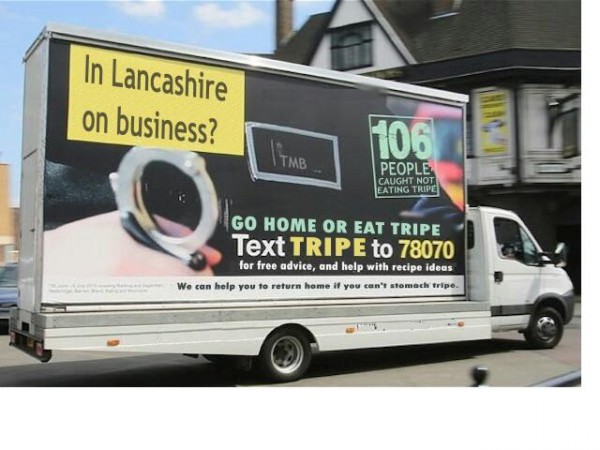
Although the Home Office’s efforts were ill-advised and less than successful, its use of mobile billboards has inspired their use by others like the Tripe Marketing Board, as the picture below – allegedly from Lancashire – shows.
There are annual events that pepper the year providing easy copy for the media. One of these is Bonfire/Guy Fawkes Night on 5th November.
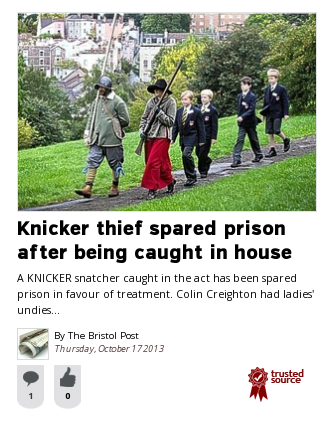
As 5th November is less than a week away, most media outlets are publicising local fireworks events. Here’s today’s offering of that ilk from the Bristol Post.
As usual a screenshot has been taken, just in case authors Rachel Gardner and Alex Cawthron realise they’ve posted a half-finished article. Additional black marks to Rachel and Alex too for a lower case start to the headline.
The UK’s dreadful, destructive coalition government has done something right – for a change.
As part of the forthcoming Local Audit and Accountability Bill, which will be debated by MPs in the House of Commons on Monday, new rights will be granted to the press and citizens to film and report council meetings, the Department for Communities and Local Government (DCLG) has announced.
In 2012 the government changed secondary legislation to open up councils’ executive meetings to the press and public. However, this did not apply to councils’ committee meetings or full council, nor to parish councils. Eric Pickles, the Secretary of State for Communities and Local Government, asked councils to open up their committee meetings, but many councils are still not complying. Many councils, particularly in Yorkshire and Lincolnshire are still keeping democracy behind closed doors. Some councils had even banned local residents from recording, blogging and tweeting at council meetings. Ministers believe these councils are clinging to outdated analogue ideals in a digital age.
Mr Pickles said: “An independent local press and robust public scrutiny is essential for a healthy local democracy. We have given councils more power, but local people need to be able to hold their councils to account. I want to do more to help the new cadre of hyper-local journalists and bloggers.
“I asked for councils to open their doors, but some have slammed theirs shut, calling in the police to arrest bloggers and clinging to old-fashioned standing orders.
“This new right will be the key to helping bloggers and tweeters as well as journalists to unlocking the mysteries of local government and making it more transparent for all. My department is standing up for press freedom.”
Here in Bristol, the council is well ahead of Mr. Pickles. Meetings have been webcast for years and members of the public and elected councillors freely tweet proceedings from the Counts Louse.
Today’s Independent puts the christening of George Windsor into perspective: one sentence at the foot of page 27 of its dead tree version.
However, the paper’s customary lack of deference is completely ruined by the paper’s online version which features both a photo gallery and a comment piece. 🙁
A screenshot has been omitted in the interests of taste. 🙂
Leading French daily newspaper Le Monde reports today on how the American National Security Agency (NSA) spies on France.
The documents leaked by former NSA contractor Edward Snowden also contain information about communications intercepted by the NSA in France. One image in the documents leaked by Snowden, some of which have been accessed by Le Monde reveals that the NSA recorded the data from “70.3 million French telephone calls” from 10th December 2012 to 8th January. The content of SMS (text) messages is also recorded by scanning their contents for keywords.
Quite.
Explanations in the documents consulted by Le Monde suggest that the NSA was targeting “both people suspected of links with terrorist activities and individuals targeted simply for belonging to the worlds of business, politics or the French government” under a programme codenamed US-985D. When contacted on this point, the American authorities simply referred to the statement issued on 8th June 2012 by James R. Clapper, National Intelligence Director which states that the United States Government can only collect data if it suspects activities linked to terrorism, to cyber-attacks and nuclear proliferation, according to Le Monde Informatique.
I think the reviewer had got his vowels muddled and actually meant Colombia, a South American country famous for the supply of a variety of white nasal decongestant allegedly enjoyed at one time by Mr Crosby.
Vampires are a mainstay of horror films. Seemingly dead, they rise again unbidden under the right circumstances – usually nightfall – to carry on their (non-)existence.
The press equivalent of the vampire is the story which is initially posted online, only to be deleted (with its expectant reader served up a 404 error page instead. Ed.) and then reappear at a later date.
This happened with the Bristol Post story featured in the screenshot below.
Controversial or what? The Bristol Post’s latest vampire article
This story originally appeared online first thing on Friday morning, only to be pulled a couple of hours later. It has now risen from the dead bearing a Sunday timestamp.
Why was it pulled in the first place, some may be wondering, particularly as it seems like a fairly innocuous tale of an elderly gentleman moaning about parking and especially since those with an intimate knowledge of the Bristol Post will be well aware of its passion for the motor car and all matters motoring.


 There’s hardly a day goes by without the Bristol Post screwing up somewhere.