Where litter belongs. Picture courtesy of Wikimedia CommonsFor as long as I’ve been going abroad to the mainland of Europe – some 45 years – one aspect that I’ve never failed to notice is just how clean other countries are compared with the United Kingdom. During my first visit to Germany in 1975 the streets – compared to those in UK – seemed clean enough to eat one’s dinner off.
It’s unfortunate that despite the decades of campaign efforts of Keep Britain Tidy and local campaigners throughout the country, the United Kingdom remains the dirty man of Europe. A stroll down any street or road in the country will readily confirm this if readers have any doubts.
A major element in littering is stuff dumped out of cars by the lazy and uncaring. This ranges from small stuff like cigarette butts to discarded fast food packaging from meals eaten on the move, right up to really nasty stuff such as used disposable nappies.
The UK is a very scenic country – why trash it?
Why indeed?
38 Degrees Petition
There are other people equally concerned about the amount of litter in the UK and a petition has just been posted on 38 Degrees.
The introduction to the petition reads:
This petition is calling for local councils in Yorkshire and across England to be given new powers to fine people who litter from vehicles. Littering shouldn’t be a consequence-free crime and enforcement acts as a deterrent as well as a punishment. The Government already approved the necessary legislation in 2014 but Defra has delayed producing the required regulations for over a year. This delay must end.
Why helping councils with enforcement is important
The petition’s explanatory text continues:
Clearing up litter costs Yorkshire councils over £77m a year, contributing to the national figure of over £800m. Clearing roadsides is particularly costly and dangerous, so preventing littering from vehicles is extremely important. Local councils said for many years that they needed new powers to fine people who throw litter from vehicles, as a £75 fine will make most people think twice before throwing litter again.
The existing law, in the Environmental Protection Act 1990, said the council needed to prove which person in the vehicle threw the litter – something that was mostly impossible. The Government agreed to introduce a new law, via the Anti-social Behaviour, Crime and Policing Act 2014, which meant local councils can issue a fine to the registered keeper of the vehicle, which is what happens when vehicles are caught speeding and or are parked in the wrong place.
To make sure councils know how to implement this new law, the Government needs to provide them with regulations. However, the department responsible – Defra – has delayed these regulations for over a year and councils are no nearer to being able to take action against litterers. This also means there are now two pieces of legislation on litter that are essentially useless.
The Secretary of State must make sure her officials are taking the required action to bring this legislation to life and to prevent further littering from vehicles.
It’s the first Monday of October 1973. With a sense of trepidation, an 18 year-old lad leaves home, a large proportion of his possessions and a heavy set of books in a rucksack on his back. He’s off to Wolverhampton in the Black Country to join the second ever intake on the BA Modern Languages (BAML) course being offered by Wolverhampton Polytechnic.
Let’s fast forward to May 2015. With a sense of trepidation a 59 year-old man leaves his home in Bristol, a laptop in a rucksack on his back and a suit in a holdall in his hand. He’s off to Wolverhampton to reunite with the second ever intake on the BA Modern Languages course once offered by Wolverhampton Polytechnic.
There have been lots of changes in the meantime. The polytechnic has transformed into the University of Wolverhampton. Wolverhampton itself has changed from a large industrial town with belching blast furnaces and gained city status. The Black Country either side of the railway between Birmingham and Wolverhampton – once a realistic implementation of a medieval painter’s vision of hell with flames, smoke and smut – is now de-industrialised with leafy areas interspersed with pleasant housing.
Sticking with the leafy pleasantness, the reunion is being held at The Mount Hotel in the Tettenhall Wood area of Wolverhampton, not a frequent haunt of student days when town centre pubs and night clubs were preferred to comfortable, content suburbia.
The Mount is a grade II listed manor house that was originally the home of Mander family of Wolverhampton (who made their money from paint and varnish. Ed.), which acquired the Mount in 1890 for £5,000 and refurbished it extensively. In 1929 the then master of the house Charles Tertius Mander was unfortunately killed in a hunting accident, leaving his wife Mary a widow. The Mount was far too large for post-war life without servants and the house was sold by Charles Marcus Mander at auction in 1952 after being in the family for just ninety years and started its new life as a hotel.
Once settled in, the minor worries started: would I recognise anyone – and would they recognise me? The rest of the crew were veterans at reunions, having held a couple in the intervening years, whilst I was the novice tonight. Standing outside, I scrutinised the faces of those passing, trying to see if any matched features whose recollection was dimmed by nearly 4 decades, whilst that same amount of time had etched its effects on the faces of my contemporaries.
At table: Jill, Steve and Stuart. Photo courtesy of Jill Easton.In all honesty I shouldn’t have worried: as we assembled at 7.00 p.m. for pre-dinner drinks, the memory went into action and I readily recognised most of the faces familiar from of old, although most now came complete with a partner. There were even a few lecturers there. Apologies to those I miss, but these included course director Alan Dobson, French lecturer Stuart Williams and politics lecturer Harvey Wolf.
The 3 courses of dinner were most pleasant: I was seated between Jill Easton (née Marshall) and Stuart Williams. The meal itself, with 3 choices for each course, was delicious and passed in leisurely fashion. Between the main course and dessert a hiatus occurred for the obligatory speeches.
First on his feet was course director Alan Dobson. He passed on greetings from John White, the former head of the poly’s department of languages and praised him for his foresight in establishing the modern languages degree course; and once more trepidation intervened. Alan explained the sense of trepidation in establishing the course. At that time Wolverhampton didn’t exactly have a great reputation. It was the but of jokes. As an academic institution, the polytechnic didn’t exactly have the prestige of a traditional university, something not helped by the presence in those days of a sleazy massage parlour over the road from campus.
The teaching accommodation often left something to be desired in those days. Alan reminded us of the long-vanished St. Peter’s Hall, whose top floor was leased to the polytechnic for teaching. It was invariably freezing cold in the autumn and winter and the landlord’s use of the building’s heating system was a juggling act: downstairs was leased as a potato store and the stock needed to be kept cool. As students we were probably regarded as cool enough in one sense, but fingers stiff with cold are not best suited to taking lecture notes.
Alan was followed by Paul Sutton. Paul and his wife Gwenda had done most of the organisation of the event (and done it splendidly. Ed.). Of those in the 1973 course intake, most had been located and contacted: only 6 remain lost. One of our number, Viv Allum, sadly passed away a number of years ago. The development of the internet had been of great assistance in finding folk; Sheila Searle had done most of the detective work, I believe.
Paul praised the quality of the education we’d received and the skills gained, which have seen many of the alumni employed in fields far removed from languages. The fact most of us have been continuously employed since graduation is ample evidence that the investment in human capital made in those years at Wolverhampton had been amply repaid many times over with interest.
Paul recalled life in Wolverhampton in 1973 when we arrived: beer at 13p a pint in the Union bar, Derek Dougan taking to the field for Wolverhampton Wanderers F.C. (his slipping into the Union Bar for a quick pint was not unknown either. Ed.), Queen supporting Mott the Hoople at Wolverhampton’s Civic Hall shortly after our arrival on campus.
He also reminisced fondly of the polytechnic’s first halls of residence: Brinsford Lodge. These former munitions factory buildings helped accommodate students from 1964 to 1982. Others have started documenting student life at Brinsford, including Richard Elliott’s Brinsford pages and brinsfordlodge.co.uk.
Some of the luxurious student accommodation at Brinsford in the early 1970s. Photo courtesy of Tim Baker.
Paul mentioned that there would be a further reunion in 2 years’ time to mark the 40th anniversary of our graduation. Responsibility for organising it would fall to the first member of the student body to head off to bed!
With speeches, dessert and coffee out of the way, it was time for dancing and the old crew proved that time had not diminished their enthusiasm for partying. The inevitable group photographs were taken, like the example below.
Class of ’73. Well, a lot of them anyway! Course director Alan Dobson is on the far left of the picture. Photo courtesy of Wendy Jackson.
Some group photos even took a sideways look.
An alternative group shot. Photo courtesy of Paddy Ring.
The dancing continued till 1.00 a.m., after which the night owls chatted the darkness away until long after dawn peeped over the horizon. However, we weren’t just reminiscing but discussing contemporary matters and the future too.
Breakfast on Sunday morning was a subdued affair for most.
It was wonderful to meet the BAML crew again. My time spent on the course with you represents an important stage of making me the person I am today. I now realise what I missed by not attending previous reunions; I’ll definitely be at the 2017 one as long as there’s breath in my body.
Thank you all for a brilliant weekend. 😀
Update 13/05/17: The comment below arrived yesterday (well after the end of the period for submitting comments. Ed.) from Gary (Gaz) Peters, another of the class of ’73.
Steve, just seen the blog on Wolves Poly 73. Really brought back memories and I wish that I had been found when you were trawling the net for BAML 73 alumni! I have sadly lost touch with everyone from those halcyon days and have regretted it for a long time. Do you know when the next reunion is? Would love to meet up with everyone. Very best wishes, Gary (Gaz) Peters
Look forward to seeing you again as the next get-together, Gaz! 😀
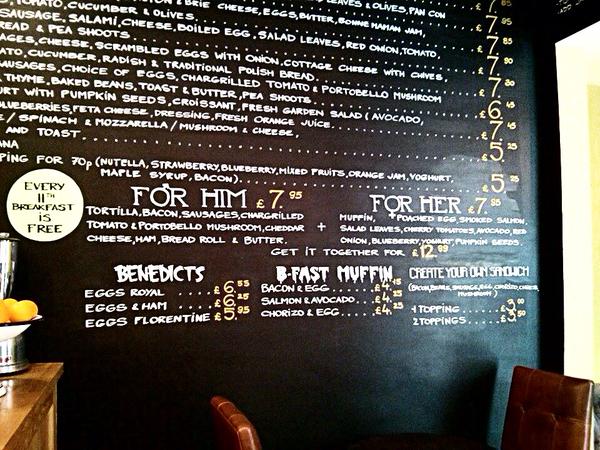
An unnamed café in Bristol is apparently serving his and hers breakfasts.
Yes, that’s right! Men get to scoff tortilla, bacon, sausages, 2 token items of fruit/vegetables (tomato and mushroom), Cheddar cheese, ham roll and butter, whilst women are supposed to pick their way daintily through muffin, poached egg, smoked salmon, salad leaves, cherry tomatoes, avocado, red onion, blueberries, yoghurt and pumpkin seeds.
Men can obviously let their figures go to pot (and blood cholesterol levels too. Ed.), whilst women are automatically assumed to be on a diet; women have “gotta stay slim for our men obvz” in the scathing words of one on social media.
This isn’t the first time that sexism has emerged at breakfast time (posts passim).
Peregrine falconYesterday it was a joy to discover that the peregrine falcons which nested on the old generator house by St Philip’s Bridge were nesting there again (posts passim). Talking to a gentleman on the bridge who’d been watching them through binoculars, it would appear our urban peregrines are also adapting to our urban environment and are also learning to hunt after sunset using the city’s streetlighting.
A couple of weeks ago, my attention was caught by peregrine calls when walking down Redcliff Street. They weren’t emanating from a falcon at all, but it’s taken your correspondent until now to track down their source. Looking up at the roof of the old, soon to be redeveloped Patterson’s building, I saw the sight below.
Note the electric wire and turntable. It’s a plastic peregrine which looks very realistic to the local gull population. It rotates on its turntable, flaps its wings and also calls like a real falcon from time to time. It won’t fool me again.
Today is Document Freedom Day, an annual international celebration of open formats and open standards and an opportunity to promote their use.
The use of open standards is definitely gaining ground, particularly where it matters, such as in dealings with government bodies. This was amply illustrated last year by the UK Cabinet Office’s announcement of the adoption of open standards for collaborating on government documents.
Why do open standards matter?
Open standards are vital for interoperability and freedom of choice. They provide freedom from data lock-in and the accompanying vendor lock-in. This makes open standards essential for governments, companies, organisations and individual users of information technology.
What is an open standard?
An open standard refers to a format or protocol that is:
Subject to full public assessment and use without constraints in a manner equally available to all parties;
Without any components or extensions that have dependencies on formats or protocols that do not meet the definition of an open standard themselves;
Free from legal or technical clauses that limit its use by any party or in any business model;
Managed and further developed independently of any single supplier in a process open to the equal participation of competitors and third parties;
Available in multiple complete implementations by competing suppliers, or as a complete implementation equally available to all parties.
How do open standards affect you?
April, the French open source advocacy organisation, has produced a handy graphic in English to illustrate the difference between open and closed formats. Click on the image below for the full-sized version.
Examples of open standards
Many open standards are in wide use. Here are 3 examples:
ODF, the default file format of free and open source office suites such as LibreOffice and OpenOffice. ODF can also be handled by Microsoft Office versions from Office 2007 onwards.
Document Freedom Day is being promoted on social media by the use of the #DFD2015 hashtag.
Following the post on Friday on Bristol City Council‘s response to my open standards FoI request (posts passim), more information has come to light.
It was all sparked by a discussion on Twitter between myself and Alex, a leading member of the Bristol & Bath Linux Users’ Group (BBLUG).
It all revolved around what was really meant by the phrase “not fully digital” in respect of PDF files.
My speculation was that if text documents are scanned, these are usually converted to image-based PDFs with which the screen readers used by blind and visually impaired people can have problems.
It turned out this was a good point, but not the real reason.
The latter was supplied by Gavin Beckett, BCC’s Chief Enterprise Architect, who actually responded to my FoI request. It seems Gavin’s main reason for describing PDFs as “not fully digital” is that PDF is basically an attempt to make electronic files emulate paper. The move by the council away from PDF to HTML when responding to citizens is that more mobile devices (tablets and smartphones) are now being used by the public to communicate with the local authority and the latter wishes to provide the same – i.e. “fully digital” experience to all.
Finally Gavin promised to follow up with his colleagues my gripe about using MS formats for responding to FOI requests. He conceded this was one example where PDF would be better.
Yesterday, 5th February, was National Voter Registration Day.
Many political parties, civil society organisations and others were yesterday encouraging the disenfranchised to register to vote for the forthcoming local council and general elections on 7th May.
One of those parties campaigning was UKIP, which doubtless was ignorant of the hypocrisy of its message in the tweet shown in the following screenshot.
That’s right! A party actively opposing immigration to the UK is actively encouraging UK citizens who’ve become immigrants in other countries to register to vote in elections in the old mother country.
Social media has responded quickly to the horrific attack on the offices of French satirical magazine Charlie Hebdo in Paris today, which resulted in 12 deaths and 5 injured. Four of those killed were Charlie Hebdo cartoonists Charb, Cabu, Tignous and Georges Wolinski.
The press office of Amnesty International in France has described that attack as “A black day for press freedom”.
Many Twitter accounts changed their avatar to the Je suis Charlie image shown below, whilst many tweets were also tagged with the #JesuisCharlie hashtag.
Some of the harshest condemnations of the attack have come from the attackers’ co-religionists. The imam of Drancy, Hassen Chalghoumi, is reported to have said: “Their barbarism has nothing to do with Islam”.
My deepest condolences to the victims and their families.
This morning residents living around Gaunt’s Ham Park in Barton Hill became the latest to add their support for the TidyBS5 campaign to rid the streets of BS5 of litter and fly-tipping (posts passim).
The picture below was posted online earlier this morning by Up Our Street.
Picture courtesy of Stacy Yelland
The more support, the more chance there is that Bristol City Council will take the residents of East Bristol seriously when the raise their voices, something they have not always done in the past.
These awards are presented every year to people who make a difference in the part of East Bristol where I live. Nominations all come from the local community, i.e. friends and neighbours.
This year the awards were presented by local MP Stephen Williams, whilst the event was compèred by local broadcasting husband and wife team Pat Hart and Sherie Eugene Hart. Those honoured ranged in age from people still at school to pensioners.
The biggest cheer of the night was for Lil Stiddard, who received a standing ovation. Lili’s citation read:
It was 32 years ago that Lil and her husband became involved in setting up a club for older people in the community. Before Easton Community Centre was built, they met at the Chelsea Road Old Co-op. The floor collapsed with all the dancing the first time they used a temporary venue. At the age of 97, Lil is still active in the club, setting out the tables and chairs, bringing the tea and assisting the treasurer. “We are all human beings,” she says, “and need to learn to pull together.”
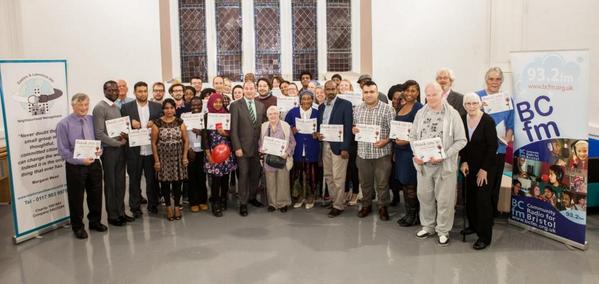
All the winners were photographed together at the end of the presentation.
Here’s a short film of vox pops shot at the awards.






 Today is
 Following the post on Friday on