Linux

  • Breathe new life into your old XP box with Linux Live

    image of Tux, the Linux kernel mascotMicrosoft announced some time ago that it will be ending support for Windows XP, now 12 years old, on 8th April 2014.

    The Bristol & Bath Linux Users’ Group (BBLUG) has seen this as an opportunity to introduce people still using XP to a reliable free and open source Linux operating system and has planned an event called “Linux Live 2014” to be held from 10.00 am to 4.00 pm on Saturday, 15th March 2014 – a couple of weeks before the official end of XP support – at the Pervasive Media Studio, Watershed, 1 Canons Rd, Bristol, BS1 5TX (map).

    Linux Live 2014 is part of a worldwide initiative to turn tired old computers running XP into efficient, well running ones running Linux. An old, tired computer can be given a whole new lease of life by installing a modern Linux operating system (Linux has lower system requirements than MS operating systems. Ed). BBLUG has decided to plan an event for people in Bristol and the surrounding area to inform them of the various uses and benefits of Linux.

    BBLUG’s Peter Hemmings says: “As Windows XP is not being supported from April 2014 we have decided to hold ‘Linux Live 2014’. It is a free workshop held by Linux user groups like ours where members get together to introduce new users to various distributions and give them a Live USB Stick to try on their hardware without interfering with other operating systems. Time permitting, it can be installed on hardware during the event or the Live USB Stick can be taken home to install. In holding an event such as this, we help extend the life of the hardware, saving people money in time of austerity. Simply bring your personal computer/laptop to the event and we will help you get Linux up and running on it, for free!”

    The BBLUG Linux Live 2014 event has its own website and is being sponsored LinuxIT of Emerson’s Green.

  • Can’t figure out Linux? Become a Romanian schoolteacher!

    Last year, Romanian supermarket chain Profi donated laptops running Edubuntu Linux to schools in that country. Quoting Romanian TV station Pro TV, Joinup, the EU’s public sector open source news website, now reports today that some of those schools are letting their donated laptops gather dust because the teachers don’t know how to use Linux. In at least one school the laptops are still in their boxes, whilst other schools have replaced Edubuntu and its bundled software with Windows and proprietary alternatives.

    About half of the 1,800 laptops donated to schools are still not being unused, according to Pro TV.

    Edubuntu log-in screen
    Edubuntu log-in screen

    Writing on its website, Pro TV states that only a few teachers know how to use Linux. When asked about the laptops gathering dust, one headteacher is reported to have said: “It is impossible for teachers to teach using two different programs.” Pro TV also quotes one IT specialist who stated that it would take just a few weeks to learn how to use the laptops. “It is easy and the great advantage is that it is free.”

    Romanian free and open source advocates are concerned upset about teachers’ poor IT skills. “I’ve been contacting the Linux groups across the country to get them to help the schools get started”, says Răzvan Sandu. “But it is possible that schools will hesitate to accept help from outsiders.”

  • My Valentine

    It’s February 14th, St Valentine’s Day, a busy day for florists, restaurateurs and people selling greetings cards.

    I love Free Software heartI’m declaring my love here online: I love free software.

    If you are unaware what free software is – and it has far more to do than merely being gratis (think free as in speech, rather than free as in beer. Ed.) – look at the Free Software Foundation’s free software definition.

    From the Debian GNU/Linux operating system to the Gimp graphics package and the LibreOffice productivity suite, I couldn’t do without it.

    If you love free software too, show your passion too in one of the following ways:

    • Writing an e-mail or letter to contributors expressing how much you like what they are doing.
    • Sharing your feelings about free software on social networks and microblogs using the hashtag #ilovefs. Or you can write a blog post about your favourite piece of free software.
    • Buying your favourite contributor a drink. Or buy someone else a drink and while enjoying it, tell her/him about your favourite free software program.
    • Giving a contributor a hug (ask for permission first). You might be amazed how many free software developers live in your area!
    • Helping the Free Software Foundation Europe (FSFE) collecting quotes for its testimonials of people who love free software. Ask developers, artists, politicians, or other users to send their quotes to FSFE.
    • Taking a picture of yourself showing your feelings for free software and posting it online.
    • Donating to free software initiatives or the FSFE to express your gratitude. They depend on your contribution to continue their work.
    • Finally you can help spread the love by sharing the campaign banners by e-mail, (micro)blog or by social media (please use the hashtag #ilovefs for this).
  • Malta launches new open data site running open source

    Malta’s new open data website is running on open source software, according to Joinup, the EU’s public sector open source news site.

    Screenshot of Malta's new open data site
    Screenshot of Malta’s new open data site

    The site, which is run by the Maltese Local Councils Association, uses Centos Linux as the operating system, the MySQL database management system, the Nginx web server and the WordPress content management system.

    At present it offers a wide number of tourism datasets open for using and reusing as well as useful and interesting information concerning open data.

    The open data portal has been created as a result of the EU’s HOMER project, harmonising open data in the Mediterranean through better access and reuse of public sector information.

    Open Data Malta aims to make available and exploitable Public Sector Information (PSI) related to the tourism sector in order to ensure transparency. By simply opening PSI, citizens can be better informed and participate in the decision making process.

  • LibreOffice 4.2 offers increased performance and interoperability

    The Document Foundation has announced the release of LibreOffice 4.2 for Linux, Windows and Mac OS X. The new version is better integrated into Windows 7 and 8, as it now groups the preview of opened documents on the taskbar by application. A list of the last documents opened can now be displayed on the taskbar with a right mouse click.

    According to The Document Foundation, Calc – the spreadsheet application – has undergone the most extensive changes in its history, which should result in considerable increases in speed when calculating large volumes of data. A new optional formula interpreter enables massively parallel calculation of formula cells using the GPU via OpenCL.

    In addition to this, LibreOffice developers have improved interoperability with Microsoft Office, particularly when reading and writing .docx files. Amongst other things, LibreOffice 4.2 interprets MS SmartArt graphics better than the previous version. New import filters now also read Abiword documents and Apple Keynote presentations. A new start screen now shows a preview of recently opened documents.

    screenshot of new start screen in LibreOffice 4.2 running on Ubuntu Linux
    New start screen in LibreOffice 4.2 running on Ubuntu Linux

    The improvements also include the option in Windows environments the ability of centrally managing and locking down the configuration with Group Policy Objects via Active Directory and blocking individual options.

    On the mobile side, LibreOffice now supports an Impress Remote Control for iOS – in addition to the already available Impress Remote Control for Android – which allows visual management of presentation delivery on the laptop using the screen of an iPhone or iPad. The app is currently waiting for review from Apple, and will be announced as soon as it is available on iTunes Store.

    Moreover, the development team has also cleaned up and tweaked the user interface and revised 70% of dialog boxes. It will also look more modern due to the new flat Sifr icon set.

    All the new and improved features of LibreOffice 4.2 have been summarised here.

  • How to write user help

    A product’s user guide or help is an essential element of most items of software or consumer products today.

    Well-written help can save hours of confusion and frustration as new users get to grips with tools. It should be concisely written but cover all aspects of the use of the software or product.

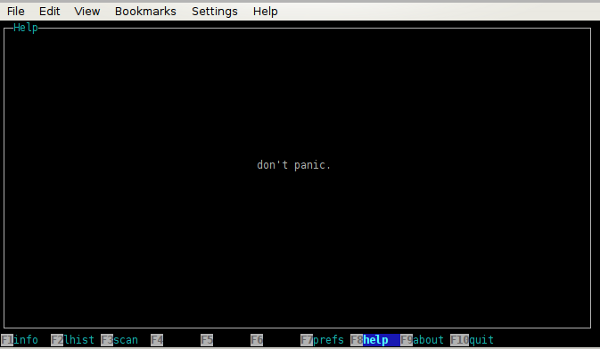
    The wavemon program for Linux is a monitor for wireless devices. It allows users to watch the signal and noise levels, packet statistics, device configuration and network parameters of their wireless network hardware.

    Here’s wavemon’s help file.

    screenshot of wavemon help file

    Concise isn’t it?

  • UK’s CESG finds Ubuntu most secure OS

    Ubuntu logoUbuntu 12.04 LTS proved to be the most secure product in a client operating system investigation by British security body Communications Electronics Security Group (CESG), which is part of GCHQ and provides assistance to government departments on their own communications security, according to a report today in Germany’s Linux-Magazin.

    The test field consisted of 11 desktop and mobile operating systems, including Windows 7 and 8, Windows RT, Android 4.2, Apple’s iOS 6 and Mac OS X 10.8, as well as Google Chrome OS 26. CESG investigated the security of the systems in various categories, e.g. VPN, hard drive encryption, secure boot, sandboxing, implementation of security policy and update policy.

    No system was able to meet all demands for use by the British authorities, but Ubuntu 12.04 LTS was shown to be the most secure system of those tested. Windows Phone 8 has the most critical vulnerabilities.

    Ubuntu supplier Canonical has summarised the results as it sees them in a PDF. The company is hoping to do even better with the forthcoming Ubuntu 14.0 LTS version of its operating system, particularly by supporting secure boot.

    More detailed information about the test is available on the CESG website, including CESG’s Ubuntu-specific report.

    First published by Bristol Wireless.

  • 0 A.D. Alpha 15 “Osiris” released

    Just before the end of last month Wildfire Games announced the release of 0 A.D. Alpha 15 “Osiris”. 0 A.D. is a real time strategy game and the new release comes with additional functions. It’s available free of charge for Linux, Mac and Windows and is licensed under Version 2 of the GPL. The Alpha 15 release, which is playable, provides a multi-player lobby, in which players can meet and play each other, whilst a new playable civilisation can be added with the Ptolemaic Egyptians. However, only some of the latter’s buildings units and play functions can be tested; the civilisation itself shall only be made available in the next alpha version.

    A new play mode has been added to the game with so-called “Skirmish Maps”. Units now also gain a bonus if they come within reach of a certain building or special unit. Up top now temples regenerate the health of nearby units and most heroes also have such an “aura”. This function will be further refined and extended in future versions of the game.

    The user interface has also been improved so that players can now order their troops to defend other units or buildings. An audible signal or a chat message notifies when a player is being attacked, whilst flashing pixels on a miniature map show where the attack is taking place. Fighting units can be returned to the civilian work they were previously carrying out with a new “Back to work” button.

    In addition, there are new graphic elements, pieces of music and bug fixes, etc. in 0 A.D. Alpha 15 “Osiris”. The game is available for download from the project website.

    Finally, the project is seeking volunteer contributors in programming, art, sound, documentation and more. For details, log onto #0ad-dev on QuakeNet on IRC and meet the developers or register on the project’s forums and start participating!

    Previously published on the Bristol Wireless website.

  • Greens/EFA using Debian and encrypted email

    Debian logoJoinup reports that the European Parliament’s Greens/EFA Group has started trial use of laptops running a tailored version of the Debian GNU/Linux distribution and “is reaching out to the Free Software community”, in order to achieve trustworthy email encryption in moves to counter mass surveillance by companies and governments.

    In a press release, Greens/EFA co-president Rebecca Harms stated:

    “Thanks to Snowden we are beginning to understand the full scope of what it means to live in a digital environment polluted by pervasive surveillance. Commercial and governmental surveillance is undermining trust in our democratic institutions and corrupts the very fabric of democracy. This is now a global problem of such scale that each individual effort will fail, yet without taking small concrete steps from accepting where we are, no progress is possible. Therefore, the Greens/EFA is now reaching out to the Free Software community to join in a small project to use trustworthy email encryption in cooperation and dialogue with the European Parliament IT services.

    “As the Green Group in the European Parliament we want to make an effort to ensure that nobody but the intended recipient of an email can read it. Such emails need to be encrypted, travel over the internet, and then be decrypted on the receiving computer — and nowhere else. In this project, me and colleagues in the Greens/EFA will use a selection of Free Software from Debian and run it on computers dedicated for this purpose. We will start small scale with 10 regular consumer laptops. This is not special hardware running special software, but general computers running software available for everybody.”

    For secure email, a combination of the cryptographic software tools provided by GnuPG and the Icedove email client (a Debian-specific version of Mozilla Thunderbird) will be used as the European Parliament’s proprietary email solution cannot offer trustworthy encryption.

  • Enlightenment 0.18 released

    Just before Christmas the release of version 0.18 of the Enlightenment desktop environment for Linux was announced, according to Heise. Modules for controlling Bluetooth and music software are amongst the new features for the Enlightenment 0.18.0 (E18). It has been released as planned just one year after version 0.17.0 (E17), whose development took 12 years.

    In the new version the compositor which combines the application windows and desktop components into an overall picture is no longer optional, but firmly integrated into the desktop’s main components. Support for running Wayland, the potential successor X11 is also new, as is better interaction with systemd, the system management daemon designed exclusively for the Linux kernel API. The developers have also fixed several crashes and made considerable improvements to the file manager, according to the release notes.

    e18 desktop screenshot

    The developers are currently working on Enlightenment 0.19.0 (E19), which will be able to work as a Wayland Compositor. Details of these plans may be found on the E19 Release Manager blog, as well as in the video below.

Posts navigation