Tech

  • Free digital workshops for over 55s

    Starting this Friday, Eastside Community Trust is organising a series of digital skills workshops for the over-55s from 12.30 to 2.30 pm as part of the Eastside Connect project.

    Eastside Connect is a peer-to-peer project that works with people over the age of 55, who live in Easton or Lawrence Hill. The project strives to harness the skills and experience both lived and knowledge base to enable participants to share and discuss their desires for what older people want to see and do in the area they live, either individually or collectively. We have a variety of activities, all asked for by those who attend such as “Cuppa to Connect” a time for tea and a natter, “Come dine with us” – a community meal and more recently “East Mingle” at Trinity Arts creating a way to connect through dance, music and discussion.

    Digital workshops poster

    The sessions are free and there’s the added lure of free refreshments, so if you’re free on Friday, an apprentice or fully qualified pensioner come along with your device – be it laptop, tablet or mobile phone – and problems and the delightful Gary and your ‘umble scribe will provide loads of useful advice and try to sort them out for you! 😀

  • Introducing Ubuntu Pro beta

    Ubuntu logoCanonical is currently offering a public beta version of Ubuntu Pro, giving Ubuntu Linux users extended maintenance and security compliance for software packages ranging from the Node.js runtime to Python 2 and Rust. Security cover will be extended for average and high common vulnerabilities and exposures (CVE) for thousands of applications and toolchains including Ansible, Apache Tomcat, Apache Zookeeper, Docker, Drupal, Node.js, Puppet, Python 2, Rust and others.

    A free thirty days trial is available for businesses. Ubuntu Pro is available for data centres and workstations. A free level is being offered for small-scale personal use (up to 5 machines).

    Since the launch of Ubuntu LTS with 5 years support for the main operating system, businesses have asked the supplier to cover a larger area of the open source landscape under private commercial agreements. These benefits are now offered free of charge to anyone with a free personal subscription to Ubuntu Pro. This may also be combined with 24/7 enterprise level for the Ubuntu operating system.

    Ubuntu Pro is available for all Long Term Support (LTS) versions of Ubuntu from version 16.04 LTS upwards. The standard Ubuntu Pro subscription covers security updates for all Ubuntu packages. In addition, Canonical’s Ubuntu Advantage for Infrastructure subscription has been renamed Ubuntu Pro (Infra-only) with no change in its price or range. The Infra-Only subscription covers the base operating system and the private cloud components required for large-scale and bare metal and excludes wider cover for applications. Subscribing to Ubuntu Pro costs US $25 dollars per year excl. tax for one workstation or US $500 dollars per year for a server. On public clouds Ubuntu Pro costs some 3.5% of the average cost of the underlying processing environment.

  • Amazon Workspaces offers Ubuntu virtual desktops

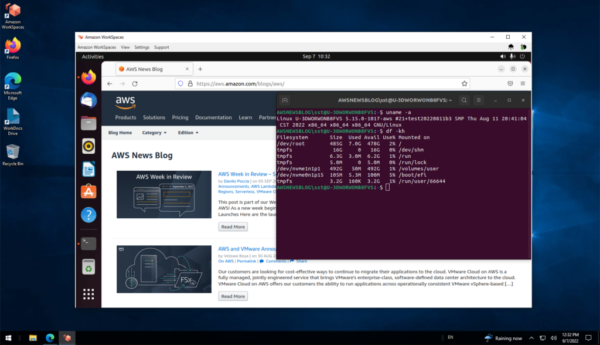
    The AWS blog writes that the company loves to give its customers choices: the choice of infrastructure to deploy their workloads, store their most important data, or the operating systems for their virtual desktops.

    To this end it has started offering Ubuntu virtual desktops, based partly on the premise that “Ubuntu is the most widely used operating system among professional developers (66 percent Ubuntu, 61 percent Windows, and 57 percent macOS)”.

    AWS Ubuntu virtual desktop

    To date your correspondent has seen both Ubuntu’s Unity desktop – as shown above – and the lightweight Xfce desktop as an alternative.

    It has been a quip of open source enthusiasts that next year will be the year of Linux on the desktop (instead of the Beast of Redmond’s ubiquitous operating system.

    AWS is now demonstrating that 2022 is the year of the Linux desktop on someone else’s computer. 😀

  • EU open source repository now online

    EU flagThe EU Commission has launched the code.europa.eu open source repository with over 100 projects to promote open software development, heise reports.

    The EU Commission has started operations of its open source development platform code.europa.eu without much ado. The Director General for Informatics, Veronica Gaffey, announced the launch of the open source repository two weeks ago at an Open Forum Europe conference two weeks ago. The platform should facilitate “the collective development, exchange and reuse of solutions for European public services”.

    In Gaffey’s words: “We created a central code repository, one which I can now announce publicly. You will find our software development platform at code.europa.eu. So, code.europa.eu facilitates the open development of software projects from the Commission as well as the other European Union institutions. We start today with just over 100 projects and 150 developers, but the OSPO is busily onboarding others.”. The focus is on projects by the Commission and other EU institutions, but also “in Bulgaria, the Czech Republic, Estonia, France, Germany, Italy, the Netherlands and elsewhere in the EU”.

    In December last year we got rid of an outdated, complicated, bureaucratic legal process that stopped us sharing open source. Now Commission projects that wish to share their software with others are free to do so,” Gaffey explained.

    The European Public License (EUPL) 1.2 should be used as the main licence for new source code on the platform, according to EU open source news site Joinup. The EUPL has been adapted to European law and is compatible with version 2 of the more well-known GNU General Public License (GPL). Code added to existing projects will use the same license as previously, such as the Dynamic Discovery Client, which uses the GNU Lesser General Public License (LGPL).

  • Audacity 3.2 released

    When it comes to open source audio editing software, Audacity is the software package your ‘umble scribe has been using and recommending to others for over a decade and a half.

    The latest minor point release for the software – to version 3.2 – nevertheless brings some major new features, including real-time effects. Furthermore, the package will now run natively on Apple’s Silicon Macs, according to German IT news website heise, whose headline rates it as ‘Genuine competition for commercial audio software‘.

    Audacity was first released in 22 years ago and since then it has made major strides towards becoming a fully-fledged end-to-end production tool for everyone who works with audio, from multi-track recording and editing to podcast production, i.e. a complete digital audio workstation (DAW).

    The new version press release states that the Audacity team has been working hard to empower audio creators with the following highlights of this release: real time editing capabilities, VST3 plugin support and sharing, the latter via Audacity’s new audio.com sister service.

    For a full list of changes in Audacity 3.2, read the release notes.

    Audacity is available for download for Linux, Mac and Windows and your correspondent is awaiting the new version’s arrival in the Debian GNU/Linux software repositories.

  • Surveillance for corporate profit

    Automatic Number Plate Recognition (ANPR) surveillance seems to be on the rise since your ‘umble scribe first reported on its use by B&NES for access control to the council’s rubbish tips recycling centres some years ago.

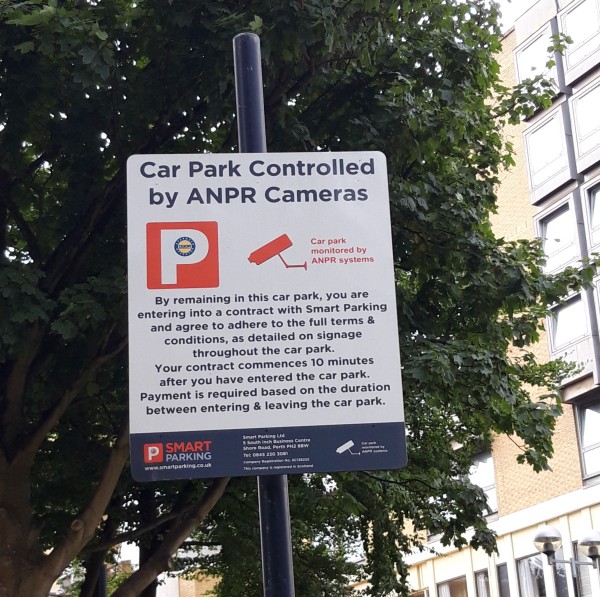
    It’s now being used by parking management companies to catch drivers who overstay their welcome in private car parks, as shown by the example below spotted in central Bristol today outside the snappily named Double Tree by Hilton hotel on Redcliffe Way.

    Sign warning of use of ANPR to control car park use
    Somebody’s watching you…
    The hotel car park in question is ‘managed’ by Smart Parking, whose website boasts the company is ‘Reinventing the Parking Experience’. The manner in which Smart Parking is ‘reinventing’ parking (minus the experience. Ed.) can best be described by your correspondent as ‘Orwellian‘.

    The adjective Orwellian is no exaggeration if one peruses the company’s marketing brochure to glean how ANPR is used. It states:

    Smart Parking’s automatic number plate recognition (ANPR) / license plate recognition (LPR) parking system is a simple, efficient and cost-effective way of off-street car park management.
    Cameras placed at entry and exit points take a timed photo of the number plate of each vehicle entering and exiting the premises. Customers then simply pay and walk, using their license place as identification. We can also configure sites to have validated parking which can include permit only, staff only, free limited time parking and definable grace periods, to name a few.
    As with our other solutions, SmartANPR/LPR work with the SmartCloud platform to deliver occupancy, stay rates and enforcement efficiency reporting for car park management and future planning.

    Note the American English usage of license.

    Of course, for any users who outstay their welcome, the company wants to make a profit with its penalty charges (note to any passing journalists, despite your constantly referring to these charges in your copy as ‘fines‘, they are in fact invoices; only the judicial authorities can impose fines. 😀 Ed.) and so needs to obtain details of the vehicle’s keeper from the DVLA. The DVLA is more than willing to divulge this information for a fee, as confirmed by the answer to a Freedom of Information Act request from 2012.

    The law allows the DVLA to disclose vehicle keeper information to those who can demonstrate a reasonable cause for requiring it. Reasonable cause is not defined in legislation but the Government’s policy is that it should relate to the vehicle or its use, following incidents where there may be liability on the part of the driver.

    The DVLA also charges a fee for the disclosure of this information, as the response further clarifies:

    The fees levied by the DVLA for Fee Paying Enquiries are set to recover the costs of processing requests and ensure that the cost is borne by the requester and not passed onto the taxpayer.

    Even so, the agency has fallen foul of the Information Commissioner’s Office for “not using the correct lawful basis to disclose vehicle keeper information“, as The Guardian reported a few months ago.

    Your correspondent feels an urge to submit another FoI request for the DVLA to enquire about the amount of money received by the agency for this service, but has more than a suspicion such a request would be refused on the grounds of commercial confidentiality.

  • LibreOffice 7.4 released

    The release was announced today of LibreOffice 7.4 Community, the latest version of the free and open source office suite. It is available immediately for download for Linux, MacOS (Apple Silicon and Intel processors) and Windows.

    LibreOffice 7.4 banner

    The new release comes packed with many new features and improvements.

    GENERAL
    • Support for WebP images and EMZ/WMZ files
    • Help pages for the ScriptForge scripting library
    • Search field for the Extension Manager
    • Performance and compatibility improvements
    Writer (Word processor)
    • Better change tracking in the footnote area
    • Edited lists show original numbers in change tracking
    • New typographic settings for hyphenation
    Calc (spreadsheets)
    • Support for 16,384 columns in spreadsheets
    • Extra functions in drop-down AutoSum widget
    • New menu item to search for sheet names
    Impress (Presentations)
    • New support for document themes

    The new features are summarised in the following video.

    LibreOffice 7.4 provides a large number of improvements and new features targeted at users sharing documents with MS Office or migrating from MS Office: such users should check regularly for new LibreOffice releases since the development progress is so fast, that each new version offers dramatic improvements compared with its predecessor.

    LibreOffice provides the highest level of compatibility within the office suite market segment, with native support for the OpenDocument Format (ODF) – beating proprietary formats for security and robustness – to superior support for MS Office files, to filters for a large number of legacy document formats, thus returning ownership and control to users.

    LibreOffice for Business

    For business deployments, TDF strongly recommends approaching the LibreOffice Enterprise family of applications from its partners – for desktop, mobile and cloud – with a large number of dedicated value-added features and other benefits such as SLAs; see the dedicated business page for details.

  • Happy 25th birthday, GNOME

    GNOME's 25th anniversary banner

    Yesterday the GNOME Foundation announced the happy news that the project had reached the venerable age of 25 years old, with special thanks to its founders, Miguel de Icaza and Federico Mena Quintero, plus its contributors and supporters over the last quarter of a century.

    As is fairly common within the technology world, the GNOME name is an acronym for GNU Network Object Model Environment.

    In its lifetime,GNOME has the default desktop environment of many major Linux distributions, including Debian, Endless OS, Fedora Linux, Red Hat Enterprise Linux, SUSE Linux Enterprise, Ubuntu and Tails; it is also fulfils the same role for Solaris, a Unix operating system.

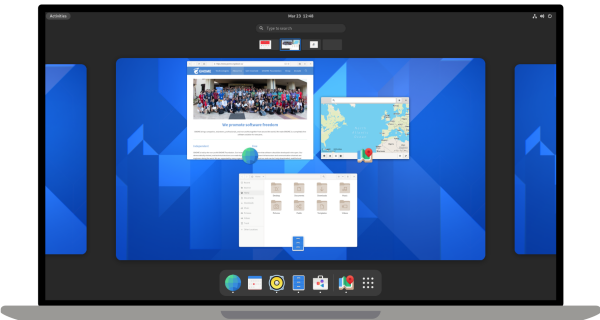
    GNOME42 desktop environment

    What began as a two-person project has certainly grown and flourished over the years, attracting support from not only volunteers but major players in the free and open source world such as Red Hat. Furthermore, there’s a new, special commemorative website to visit too: https://happybirthdaygnome.org/.

    Many happy returns!

  • DuckDuckGo blocks Microsoft trackers

    French IT news site Le Monde Informatique reports that DuckDuckGo has decided to block Microsoft’s trackers in its mobile browser applications and browser plug-ins in an effort to extend its approach to privacy protection. It had already been criticised at the start of the year on the matter.

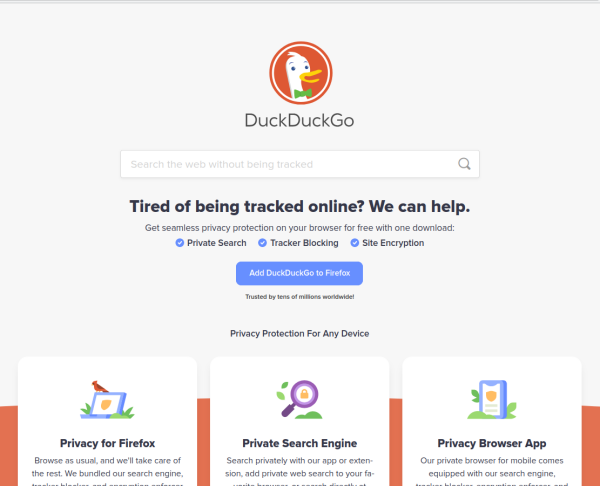
    Screenshot of DuckDuckGo search engine

    Protecting internet users from tracking and protecting their anonymity is not simple. DuckDuckGo is part of this move and was very upset to find out that as part of its agreement with the Bing search engine, Microsoft had given the green light for user tracking. This is no longer the case since from that date onwards DuckDuckGo’s CEO, Gabriel Weinberg, has stated that blocking the loading of scripts on websites by the browser was extended to Microsoft’s scripts in DuckDuckGo browser applications for iOS and Android and browser extensions (Chrome, Firefox, Safari, Edge and Opera) and that beta applications will follow next month.

    DuckDuckGo is attempting to block tracking scripts from search engines and sites such as Facebook, as well as other types of tracking scripts or software. It uses what it calls third-party tracking loading protection to prevent these third-party scripts or cookies from being loaded into the browser. If they did, they could track movements on the web and build a profile of the user, their preferences, etc. If other browsers and browser plug-ins also enable users to protect their privacy, DuckDuckGo has made privacy its priority.

    Delayed neutralising

    Mr Weinburg’s decision was taken after the discovery at the start of the year by security researcher Zach Edwards that DuckDuckGo was blocking trackers from Google and Facebook, but was allowing some of Microsoft’s trackers via Linkedin and Bing. The discovery was then reported by BleepingComputer. “Previously, we were limited in how we could apply our third-party tracker download protection to Microsoft tracking scripts due to policy requirements related to our use of Bing as the source of our private search results,” Weinberg explained, adding that, “We’re glad that’s no longer the case. We didn’t have and don’t have similar restrictions with any other company.”

    DuckDuckGo still has an advertising relationship with Microsoft, which it will maintain. Clicking through on advertisements on DuckDuckGo is anonymous and Microsoft has undertaken not to profile DuckDuckGo users. If Microsoft continues to save the user’s link, it will not associate them with a profile. On an updated support page, DuckDuckGo has provided a summary of everything which its its browser authorises and does not authorise, as well as providing details of web tracking protection.

  • Fedora Project wants to ban CC0 licence for software

    The CC0 Creative Commons licence exempts work form copyright claims, but does not exclude patent claims; and this presents a problem for free and open source software, as German IT news site heise reports.

    Fedora logoThe Fedora Project would like to remove the Creative Commons Zero (CC0) licence from the list of permitted software licences, as Richard Fontata from the Fedora Legal Documentation Team wrote in a post to the Fedora mailing list. The reason for the change is that the Fedora Project has agreed that software under a licence which does not exclude patent claims cannot be regarded as free and open source software (FOSS).

    Public Domain logoThe Creative Commons Zero (CC0 1.0) licence is the most liberal Creative Commons licence. It places works in the public domain, with the copyright holder waiving all copyright and related rights worldwide insofar as this is legally possible. However, the patent or trade mark rights of any party are specifically not affected by CC0, so it is thus possible to place works subject to patent rights under CC0.

    Patents against open source

    In the 2000s various companies, including Microsoft, have attempted to asset patent claims against Linux and open source software. The Open Invention Network (OIN), whose members mutually waive all patent claims against one another, came into existence as a response to these moves.

    Furthermore, in the open source world, there is the risk that companies could release code which is protected by that company’s own patents. If other developers use this code, they are unwittingly exposed to the risk of patent lawsuits. There is therefore widespread agreement in the FOSS world that open source licences must explicitly exclude the possibility of patent claims by the author*.

    In its permitted licences list the Fedora Project distinguishes between licences for software, content, documentation and fonts. CC0, which was previously listed as a permitted licence for software and content, will in future only be allowed for content. According to Fontana, it still has to be clarified whether any program packages will be affected by this change.

    *= for intellectual property purposes software is regarded as a work of literature.

Posts navigation