Today The Document Foundation (TDF) announced the availability of LibreOffice 5.4.6, the sixth minor release of LibreOffice 5.4 family which is currently targeted for deployment in an enterprise or corporate environment and conservative users.
Download LibreOffice
LibreOffice 5.4.6 is available for immediate download.
LibreOffice 5.4.6 includes almost 60 bug and regression fixes. Technical details about the release can be found in the RC1 and RC2 change logs.
Professional support
TDF advises mainstream users and companies to deploy LibreOffice with the support of certified developers, migrators and trainers.
Several companies sitting in TDF’s Advisory Board provide either value-added LTS versions of LibreOffice or consultancy services for migration and training.
Donate to help LibreOffice development
LibreOffice users, free software advocates and community members can support The Document Foundation with a donation. Donations help TDF to maintain its infrastructure, share knowledge and fund attendance at events like LibreOffice Conference, which this year takes place in Tirana.
Yesterday The Document Foundation (TDF) announced the release of LibreOffice 5.4.3, the third minor release of LibreOffice 5.4 family, which includes some 50 bug and regression fixes.
LibreOffice 5.4.3 represents this free and open source office suite’s very latest in terms of features and is therefore targeted at technology enthusiasts and early adopters.
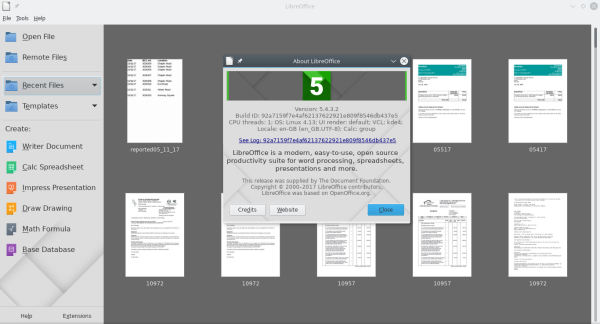
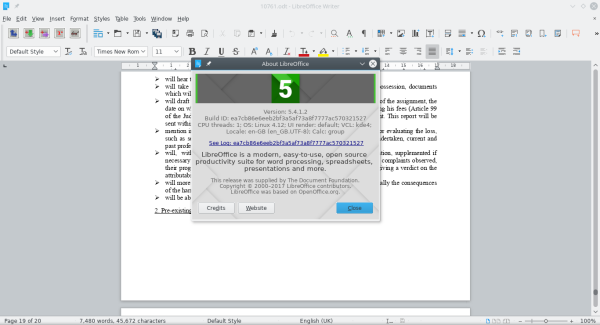
LibreOffice 5.4.3.2 running on the author’s laptop
Download LibreOffice
LibreOffice 5.4.3 is available for immediate download for all major operating systems – Linux, MacOS and Windows.
Your ‘umble scribe has now downloaded and installed the latest release and it works beautifully.
Donate to LibreOffice
LibreOffice users, free software advocates and community members can support The Document Foundation with a donation. Donations help TDF to maintain its infrastructure, share knowledge and organise events such as the Month of LibreOffice, which has last week and will be active until the end of November (https://blog.documentfoundation.org/).
Finally, several companies sitting in TDF’s Advisory Board provide either value-added long-term support (LTS) versions of LibreOffice or consultancy services for migrations and training.
Yesterday The Document Foundation (TDF) announced the release of LibreOffice 5.4.2, the second minor release of the LibreOffice 5.4 family. LibreOffice 5.4.2 continues to represent the bleeding edge in terms of features and as such is targeted at technology enthusiasts and early adopters.
LibreOffice 5.4.2 includes approximately 100 bug and regression fixes. Technical details about the release can be found in the RC1 (release candidate) and RC2 change logs.
Download LibreOffice
LibreOffice 5.4.2 is available for download for all major platforms (Linux, MacOS and Windows).
Donate to LibreOffice
LibreOffice users, free software advocates and community members are invited to support the work of The Document Foundation with a donation. Donations help TDF to maintain its infrastructure, share knowledge, and organise events such as the LibreOffice Conference, with the next one taking place next week in Rome.
LibreOffice wins survey amongst Ubuntu users
LibreOffice was the runaway winner in a survey of Ubuntu Linux users for desktop productivity software with 85.52% of the votes. The closest competitors were Google Docs with 4.29%, WPS Office with 3.22% and Apache OpenOffice with 1.96%, while all other office suites accounted for less than 1% responses.
“Even with Windows shipping Ubuntu/Bash on their desktop, even with Google shipping Chromebooks with Linux+Chrome pre-installed, even with Mac OS running away with a premium segment of the desktop market, even with Android phones and tablets, there are many tens of millions of passionate Ubuntu desktop users who are eager to have their voices heard! And LibreOffice continues to be THE enabler of local office productivity on the Ubuntu Desktop,” says Dustin Kirkland, Vice-President of Product Development for Ubuntu at Canonical.
The results of the Ubuntu 18.04 LTS Default Desktop Applications Survey were presented by Dustin Kirkland at the UbuCon Europe conference in Paris in September.
It’s a well-known fact that when the Brits go abroad and want to converse with Johnny Foreigner, the most convenient is (for Brits of course) to speak English very s-l-o-w-l-y and very LOUDLY; there’s no need to go through all that tedious process of learning how to have intercourse with the locals in the vernacular.
Mrs Theresa May, a woman who does very poor Prime Minister impressions, went to Florence in Italy on Thursday to make a speech (posts passim). However, it is unlikely that non-Brits understood it as it was delivered sotto voce.
As my working life as a linguist has been devoted to improving international understanding, I felt it was my duty to help the EU negotiators understand what Mrs May said and have therefore translated her Florence speech into foreign, as per the screenshot of her opening paragraphs below.
To convert May’s speech into foreign was simplicity itself. Indeed it was so simple I don’t know why Theresa’s staff at 10 Downing Street didn’t bother to do it themselves.
The first stage was to copy the transcript of May’s speech from the government’s website, open a new document in the excellent free and open source LibreOffice productivity suite (other, usually proprietary, office suites are available. Ed.), paste the content from the operating system’s clipboard, then hit Ctrl+A to select all the text, followed by going to the Format menu and selecting Text -> UPPER CASE.
Job done! I now had a copy of Mrs May’s Florence speech in easily intelligible foreign and one perfect for online use as it is also 100% shouty. 😉
Your ‘umble scribe’s version in foreign is available to download (PDF) should readers also wish to promote international understanding. 😀
The Délégation générale à la langue française et aux langues de France (= General Delegation for the French language and the languages of France) has published the latest version of its vocabulary recommendations for information and communication technologies (ICT), today’s Le Monde Informatique reports.
The Délégation générale à la langue française et aux langues de France has been working since 1979 on a Gallicisation of the English language terms that populate the digital world. A new version of its recommendations for ICT vocabulary terms has just been published with several updates compared with the previous version released in 2009. The document contains 488 pages and can be downloaded free of charge as a PDF.
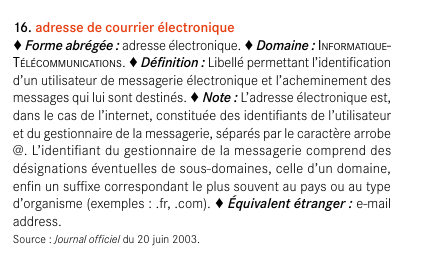
The Vocabulary’s entry for email address
The document brings together all the recommendations made in the last half century and published over the years in the French Official Journal. In theory, use of these terms is mandatory instead of English language terms, particularly in documents that have to be written by law in French (e.g. documents required for work in particular). After an introduction summarising the history and meaning of the work that has been completed, the main bulk of the document comprises a dictionary of recommended terms, with the entry for each word comprising not only its definition but the foreign equivalents to be excluded. The end of the vocabulary contains an index of both the French and foreign language terms.
This work could be regarded as a move to defend France’s “belle langue“. However, living languages are always enriched by contact with regional or foreign languages. The task of the vocabulary can be regarded rather as an effort to retain a consistent and fair mode of expression.
One point often made is that, drop for drop, ink for inkjet printers is more expensive than vintage champagne.
However, in France one organisation is taking a stance against the profiteering practices of some printer manufacturers, Le Monde Informatique reports.
More expensive than champagne, but much less enjoyable
For the HOP (Halte à l’Obsolescence Programmée = Stop Planned Obsolescence) campaign group, the office printer industry has a developed processes which force users to renew their equipment and consumables whilst they are still fully functional.
On 18th September HOP filed an initial complaint against persons unknown with the Nanterre District Court for planned obsolescence. Brands such as HP, Canon, Brother and Epson are cited in the arguments accompanying the petition. To bring its action HOP is using the Consumer Code as a basis; since 2015 this has punished “recourse to techniques by means of which the person responsible fora product’s marketing deliberately intends to reduce its service life to increase its replacement rate”. This is an offence punishable by two years imprisonment, a €300,000 fine and even a financial penalty of up to 5% of the guilty party’s turnover.
Impossible to print while there’s still plenty of ink left
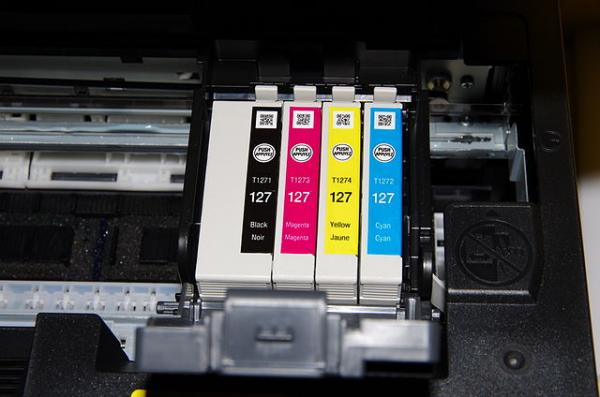
HOP rebukes manufacturers for knowingly preventing printing on the pretext that a cartridge is empty while it still contains ink. Epson, which is often cited to support the charge, uses a chip to count the number of copies and print head cleaning operations carried out in order to determine the level of ink left. The system is not particularly reliable since tests carried out on some Epson equipment have shown that there is sometime at least 20% in left in some cartridges. However, the manufacturer prevents printing at this level until a new cartridge is inserted, according to HOP, which views this as a wish to make the product unusable and thus increase replacement rate for the very expensive cartridges.
Shortening the life of a working printer
HOP’s other argument condemning the manufacturers’ planned obsolescence strategy highlights the fact that they use the same counting method to indicate the end of life of the waste ink pads fitted in inkjet printers. Once again, the paid is not full when the message is broadcast to users who are nevertheless unable to print from that point onwards. According to HOP, the proof is that reprogramming utilities enable printers to be unlocked and high quality copies produced for a long time afterwards. For manufacturers the aim is to push new equipment sales as the cost of repair and replacing the pad would be greater than a printer’s purchase price.
A head start on compatible cartridge manufacturers
In addition, HOP’s petition states: “by bringing about the purchase of a new printer, the manufacturer is also bringing about the purchase of a new cartridge model that accompanies it, also gaining several months in its race against compatible cartridges. This possibility implies or gives rise to suspicion of a prior agreement between all the manufacturers.”
It remains to be seen if the court will initiate a serious inquiry into the basis of the complaint filed by HOP. If so, it would have to demonstrate the intent of the printer manufacturers. In the United States HP was sued by a consumer association for some of the same reasons put forward by HOP, with the outcome that the manufacturer had to reach an agreement, paying out $5 mn. to compensate the plaintiffs.
Digital services provided and used by public sector organisations are the critical infrastructure of the 21st century. Central and local government agencies must ensure they have full control over systems at the core of our digital infrastructure to establish trustworthy systems. However, this is rarely the case due to restrictive proprietary software licences.
All the signatories are asking individuals and other organisation to sign the open letter, which will be sent to candidates in the forthcoming German parliamentary election and, during the coming months, to other representatives of the EU and EU member states until the 2019 European Parliament elections.
Public institutions spend millions of euros each year on the development of new bespoke software. The public sector’s procurement choices play a significant role in determining which companies are allowed to compete and what software is supported with taxpayers’ money. Public sector organisations often have problems sharing code with each other, even if they fully funded its development. In addition, sensitive personal data on citizens is at risk if there is no option for independent third parties to run audits or other security checks on the code.
FSFE President Matthias Kirschner says:
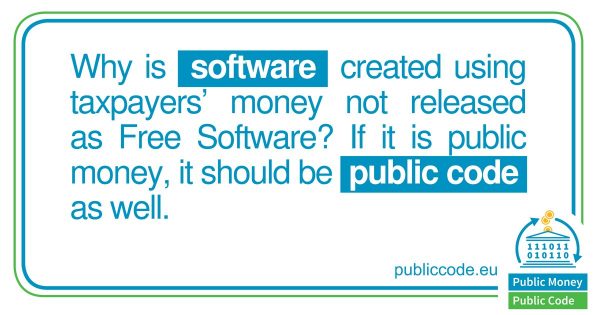
We need software that fosters the sharing of good ideas and solutions. Only like this will we be able to improve digital services for people all over Europe. We need software that guarantees freedom of choice, access, and competition. We need software that helps public administrations regain full control of their critical digital infrastructure, allowing them to become and remain independent from a handful of companies. Public bodies are financed through taxes. They should spend funds responsibly and in the most efficient way possible. If it is public money, it should be public code as well!”
Social media platform Twitter uses Bing Translate, (another fine Microsoft product? Ed.), for tweet translation.
However, as this blog has highlighted before, Bing Translate isn’t all that good.
Indeed, for all practical purposes, it’s completely useless.
Evidence for this is legion. The latest in my timeline is shown below, where Bing Translate manages, with no external aid or interference, to confuse Somali, a Cushitic branch Afro-Asian language, with Estonian, a Finnic branch Uralic language.
This for me is reminiscent of the old Stork margarine advertisements that were doing the rounds in my childhood, where gullible television viewers were improbably told that the taste of Stork was indistinguishable from that of butter (or butter from a dead crab. Ed.).
On the last day of August, The Document Foundation (TDF) announced two point releases for the popular LibreOffice productivity suite: LibreOffice 5.4.1 “Fresh”, the first minor release of the new LibreOffice 5.4 family; and LibreOffice 5.3.6 “Still”, the sixth release of the mature LibreOffice 5.3 family.
LibreOffice 5.4.1 represents the bleeding edge in term of features, and as such is targeted at technology enthusiasts and early adopters, whereas LibreOffice 5.3.6 is targeted at more conservative users and enterprise deployments.
As regards enterprise use, TDF suggests deploying LibreOffice 5.3.6 with support from certified professionals. Furthermore, many companies sitting on TDF’s Advisory Board also provide either value-added Long Term Supported versions of LibreOffice or consultancy services for migration to LibreOffice and training.
LibreOffice 5.4.1 includes approximately 100 bug and regression fixes, along with document compatibility improvements. Technical details about the bug fixes can be found in the RC1 and RC2 change logs.
LibreOffice 5.4.1 (Writer) in action
LibreOffice 5.3.6 includes approximately 50 bug and regression fixes. As with 5.4.1, technical details about the release can be found in the change log.
Download LibreOffice
LibreOffice 5.4.1 and LibreOffice 5.3.6 are available for immediate download for GNU/Linux, Mac OSX and Windows. Select the version you desire for your preferred operating system.
Please note that if you’re still using Windows XP or Windows Vista, LibreOffice 5.4 will be the last release that will run on those legacy operating systems.
Support LibreOffice
LibreOffice users, free software advocates and community members are invited to support The Document Foundation with a donation. Donations help TDF to maintain its infrastructure, share knowledge and organise events, such as this year’s LibreOffice Conference, which will be taking place in Rome in October.
 Today The Document Foundation (TDF) announced the availability of LibreOffice 5.4.6, the sixth minor release of LibreOffice 5.4 family which is currently targeted for deployment in an enterprise or corporate environment and conservative users.