Tech

  • LibreOffice 5.0.2 announced at LibreOffice Conference

    To underline the importance of the event for the community, The Document Foundation (TDF) has today announced the release of LibreOffice 5.0.2 during the opening session of the 2015 LibreOffice Conference in Aarhus, which runs until Friday 25th September.

    LibreOffice 5.0.2 is the second minor release of the LibreOffice 5.0 family, with a large number of fixes over the first minor (5.0.1) release announced in August. Based on feedback from the marketplace, the LibreOffice 5.0 family has so far proved the most popular LibreOffice release ever.

    LibreOffice 5

    LibreOffice 5.02 will offer OpenGL rendering by default on Windows for the first time for those with the very latest Windows drivers. In the event of problems, this functionality is easy to disable by accessing Tools > Options.

    LibreOffice 5.0.2 is aimed at technology enthusiasts, early adopters and power users. For more conservative users and for enterprise deployments, TDF recommends the “still” version: LibreOffice 4.4.5. For commercial deployments, The Document Foundation recommends the backing of professional support by certified people.

    People interested in technical details about the release can access the change logs via the following links: bugs fixed in RC1 and bugs fixed in RC2.

    LibreOffice 5.0.2 is available for immediate download from http://www.libreoffice.org/download/.

  • FSFE elects new top officials

    FSFE logoMatthias Kirschner and Alessandro Rubini are the new President and Vice-President respectively of the Free Software Foundation Europe (FSFE). They were elected last week in Bucharest during FSFE’s General Assembly, while Reinhard Müller was re-elected as Financial Officer. They will serve FSFE in those capacities for the next 2 years.

    Matthias Kirschner has been an FSFE employee since 2009. He started using GNU/Linux in 1999 and realised that software is deeply involved in all aspects of our lives. Matthias is convinced that this technology has to empower society rather than restrict it. While studying Political and Administrative Science, he convinced the FSFE to accept him as its first intern in 2004. Since then he has been helping other organisations, companies and governments to understand how they can benefit from Free Software and how those rights help to support freedom of speech, freedom of the press and privacy.

    Alessandro Rubini is an electronic engineer and holds a Ph.D. in computer science. He was an early Linux adopter, installing Linux 0.99.14, is an active Free Software user and developer, and author of the book “Linux Device Drivers”. After his doctorate, he left the university as he did not want to just write academic papers and now works as an independent consultant in the industrial use of GNU/Linux, mainly on device drivers and embedded system as well as on micro-controllers and PCB design. Recently he has been working with CERN within the White Rabbit project, aimed at sub-nanosecond synchronisation of I/O cards. One reason he enjoys working with CERN is the organisation’s policy of releasing all their work as Free Software and Free Hardware.

    Alessandro was previously a member of the Free Software Foundation Europe from 2001 to 2006 and recently rejoined. He felt that FSFE is the right place for positive and constructive discussions about Free Software.

    “I am happy to welcome both Matthias and Alessandro to their new roles,” says Executive Director Jonas Öberg, “both have been instrumental in shaping the organisation into its current form and I look forward to the expertise they will bring as we go about empowering users to control technology.”

    Reposted from Bristol Wireless.

  • Dutch public sector to adopt ODF as standard?

    ODF file iconThe Dutch Standardisation Board would like to see the mandatory use of Open Document Format (ODF) for the country’s public sector organisations, according to a report on Joinup giving details of a presentation made by Nico Westpalm van Hoorn to the recent ODF Plugfest held in The Hague.

    Van Hoorn stated that over 450,000 documents are transferred each day between the Dutch central
    government and citizens or companies.

    His presentation contained 3 main messages:

    • The only way reuse of document content is achievable for open data is by using the ODF format;
    • The only way to ensure sustainable access is by using the ODF format; and
    • “This format cannot be opened,” as a remark by a public servant is not acceptable when somebody sends an ODF document.

    Within the Dutch government, ODF is used as the default format for editable documents that are posted online. Documents are by default shared as HTML, PDF (for archiving) and as ODF. Furthermore, all central government workstations are capable of working with ODF, suggesting that civil servants who cannot open the format need some IT training.

    Speaking at the same event, Steven Luitjes, director of Logius – an agency assisting government organisations in building e-government services, admitted that ODF is often ignored by public sector organisations and that a failure to standardise on formats is increasing the cost of public sector IT.

    If the Dutch government does adopt ODF as a standard, this would follow on from the recent announcement of the standard’s adoption by the Italian Ministry of Defence (posts passim) and the UK government’s publication of guidance for the introduction of ODF.

  • Tomorrow is Software Freedom Day 2015

    Besides being International Talk Like a Pirate Day, 19th September 2015 is also a date for the diaries of people advocating free and open source software; it’s Software Freedom Day 2015.

    Software Freedom Day 2015 bannerThe idea of Software Freedom Day (SFD) is for everyone without a vested interest in proprietary software to unite and educate the world about the ideals of Software Freedom and the practical benefits of Free Software. August 28th 2004 was the first ever Software Freedom Day and was initiated group of FOSS believers – Matt Oquist, Henrik Omma and Phil Harper – with the idea of distributing The OpenCD – a collection of free and open source software for Windows – to everyone.

    SFD has since extended around the world with events being organised on every continent.

    Why is software freedom important?

    The United Nations’ Universal Declaration of Human Rights is a set of basic human rights that most people would agree would be a bare minimum. Not often are our basic rights thought of in the context of technology, but as more and more our lives are dependent on technology, it is a rapidly growing concern. Technologies that matter to our freedom are used in our voting systems, our leisure, our work, education, art and our communication. What does this mean to you? It means that the basic human freedoms you take for granted are only as free as the technologies you use.

    Transparent and sustainable technologies are vital to ensuring we can protect our freedoms.

    Think about any software you use everyday that is proprietary and the consider that you can’t be sure what it is actually doing. Does your email system send copies of your mail to a third party? Is your web browser, logging and automatically sending your browsing history to someone?

    As more and more of the world’s population starts using technology, getting online and developing the next major life-changing event of the future (such as the internet was for many of us), ensuring open, transparent and sustainable approaches are considered best practice is important; i.e. important to a future where technology empowers everyone equally, where knowledge is forever and where our basic human freedoms are strengthened, not hampered, by technology.

    Reposted, with some edits, from Bristol Wireless.

  • LibreOffice & ODF to be adopted by Italian military

    The Italian military is moving to LibreOffice and Open Document Format (ODF), according to Joinup, the EU’s public sector open source news website. This will be Europe’s second largest migration to a free and open source office suite and open standards since the Italian Defence Ministry will be installing LibreOffice on 150,000 machines.

    LibreOffice

    The migration will begin in October 2015 and is expected to be completed at the end of 2016.

    The deployment of LibreOffice will be jointly managed by Libreitalia and the Italian Defence Ministry, with the former providing trainers and the Ministry devising course materials, which will later be released under a Creative Commons licence.

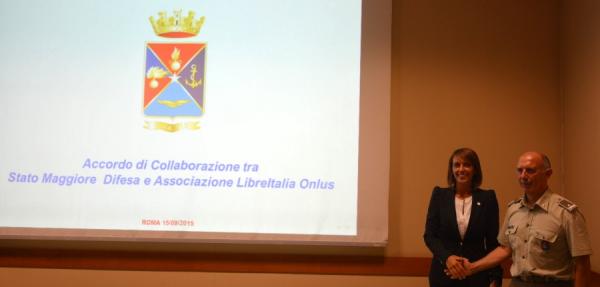
    An agreement between the Ministry and LibreItalia was signed on 15th September in Rome by Rear Admiral Ruggiero Di Biase, General Manager of the Italian Ministry of Defence’s Information Systems and LibreItalia president Sonia Montegiove.

    Sonia Montegiove and Rear Admiral Ruggiero Di Biase

    The Ministry of Defence is the first Italian central government organisation to migrate to open source software for office productivity. On the other hand, many regional public sector organisations have already made this move, such as the Emilia-Romagna region, the provinces of Perugia, Cremona, Macerata, Bolzano and Trento, the cities of Bologna, Piacenza and Reggio Emilia, the Galliera Hospital in Genoa and healthcare ASL 5 in Veneto, to name but a few.

    The Italian Defence Ministry project is also one of Europe’s largest migrations to date to a free and open source office suite. The largest European public sector organisation using free software office suites is currently the French Interior Ministry with some 240,000 desktops. Many French ministries use open source office suites including the Tax Agency, the Finance Ministry, the Ministry of Foreign Affairs and the Ministry of Agriculture. LibreOffice is deployed on some 72,000 PCs within the French Gendarmerie, which also uses Ubuntu Linux as its operating system of choice.

    In June 2014, the autonomous regional government of Extremadura (Spain) confirmed that 10,000 PCs in its healthcare organisation are running open source office applications and that the same is planned for its own 22,000 PCs. In Germany the city of Munich runs also runs LibreOffice on over 17,000 Linux workstations.

  • Bing Translator shows its cluelessness again

    This blog recently drew attention (posts passim) to the fact that Microsoft’s Bing Translator tool had difficulty distinguishing English from Norwegian.

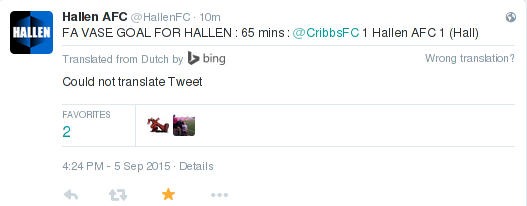
    It now seems this is not the only two languages with which it has trouble since it also cannot differentiate between Dutch and English, as per the following screenshot of a tweet from Hallen FC from my Twitter feed this afternoon.

    screenshot showing Bing Translator confusing English and Dutch

    I wonder if the rest of the Beast of Redmond’s software offerings are as reliable as Bing Translator. 😉

  • Can’t tell Norwegian from English? It must be Bing Translator

    According to Wikipedia, Bing Translator “is a user facing translation portal provided by Microsoft as part of its Bing services to translate texts or entire web pages into different languages.”

    Or it would be if only it could actually recognise languages accurately.

    Twitter uses Bing Translator as an interface ostensibly to help users with languages they do not know.

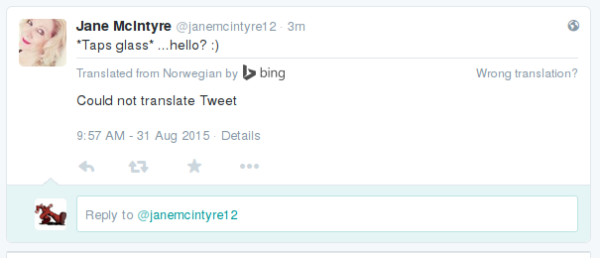
    However, Bing Translator still has some way to go before it recognises languages accurately, as shown by the following screenshot.

    Bing Translator mistakes English for Norwegian

    Whilst it is understandable that online machine translation tools can occasionally get confused between closely related members of the same language family (Google Translate has been known to confuse Norwegian and Danish. Ed.), this is the first time I can recall such a back end helper being a real tool and getting muddled over languages as distinct from one another as English and Norwegian.

    Perhaps any passing Microsoft developers would care to explain this anomaly in the comments below.

  • FSFE supports recognition for User Data Rights

    FSFE logoThe Free Software Foundation Europe (FSFE) has announced today that it supports the publication of the User Data Manifesto 2.0, which aims at defining basic rights for people to control their own data in the internet age. The manifesto is published today and also supported by GNOME, KDE, Netzpolitik.org, ownCloud, Spreed, “Terms of Service – Didn’t Read” and X-Lab.

    Whether for social networking, collaboration or for sharing pictures, among many other activities, users are nowadays increasingly using online services and are thus at more risk than ever of losing control of their own data.

    According to the User Data Manifesto, people should have:

    • Control over user data access;
    • Knowledge of how user data is stored and which laws or jurisdictions are applicable; and
    • Freedom to choose a platform, without experiencing vendor lock-in. The FSFE believes that Free Software is necessary to guarantee this.

    “The recognition of the User Data Rights defined in the manifesto is an important block to build a free society in the digital age”, says Hugo Roy, deputy coordinator of FSFE’s Legal Team and co-author of the User Data Manifesto.

    The manifesto is a good starting point for an important debate about users’ rights online. The FSFE anticipates other organisations joining the effort to promote online services that respects users’ rights and freedoms.

  • LibreOffice 5.0.1 released

    Yesterday The Document Foundation, the German non-profit organisation behind the LibreOffice productivity suite, announced the release of LibreOffice 5.0.1, the first minor release of the LibreOffice 5.0 family.

    This version comprises a number of fixes compared with the major release – version 5.0.0 – announced on 5th August 5. So far, LibreOffice 5.0 is the most popular version of LibreOffice ever, based on the feedback from the marketplace.

    LibreOffice 5.0.1 is aimed at technology enthusiasts, early adopters and power users. For more conservative users and commercial deployments, The Document Foundation recommends LibreOffice 4.4.5. For commercial deployments, The Document Foundation suggests engaging certified professional support.

    Those interested in technical details of the release can consult access the change logs at https://wiki.documentfoundation.org/Releases/5.0.1/RC1 (fixed in RC1) and https://wiki.documentfoundation.org/Releases/5.0.1/RC2 (fixed in RC2).

    LibreOffice 5

    LibreOffice 5.0.1 is immediately available for download and users, free software advocates and community members are encouraged to make a donation to The Document Foundation.

  • Whitehall’s latest open standards consultations

    The British government has announced it is now consulting and seeking comments on its latest open standards proposals.

    The standards on which it is inviting comments are:

    Exchange of location point information
    An open standard for the exchange of location information, allowing coordinates to be translated between systems.

    Exchange of property / place address information
    A proposed standard to define and exchange address information between government departments. This is not about changing your postal address, but it could change the way government records information about your location.

    Publishing vacancies online
    A standard to help citizens searching for government jobs and apprenticeships.

    Once the comment period closes, proposals will be assessed by a panel composed of civil servants and industry specialists, which will decide whether the proposal should go forward for consideration by the Open Standards Board. The Open Standards Board will then make a recommendation about the standard’s adoption across government.

Posts navigation