Tech

  • Control Impress presentations from an Android phone

    the LibreOffice logoOnline tech news website The H reports that the developers of LibreOffice, whose version 4.0 is due for release within days (posts passim), are also planning to release the “Impress Android Remote” application that will enable the office suite’s presentations to be controlled from Android smartphones.

    Android logoCommunication between the phone and the presentation rendering system will be handled via Bluetooth, according to a presentation given by LibreOffice developer Michael Meeks to FOSDEM 2013 in Brussels over the last weekend.

  • Copyright’s wrongs

    image of Johannes Gutenberg
    Johannes Gutenberg
    It was said in the past that the development of the printing press and movable type by Johannes Gutenberg in 1450 was one of the great stimuli to the growth of human knowledge. Gutenberg’s work has been credited with laying the material basis for the modern knowledge-based economy and the spread of learning to the masses.

    It has been mooted for several years that the development of the internet and online technologies will have an even greater impetus than the development of the printing press and movable type.

    Gutenberg’s original work has in the internet era inspired the work of Project Gutenberg. I’ve written of Project Gutenberg before (posts passim). Project Gutenberg is the first and largest single collection of free electronic books or ebooks. The late Michael Hart, founder of Project Gutenberg, invented ebooks in 1971. Project Gutenberg’s ebooks are public domain, i.e. the copyright on the original works has expired, at least in the U.S.A., the jurisdiction to which Project Gutenberg is subject. Project Gutenberg has various sister projects, e.g. in Germany, Canada and Australia, which also publish books in the public domain subject to the terms of copyright legislation in their respective countries.

    Copyright has a history that extends almost as far back as Gutenberg’s press. As a legal concept, its origins in Britain were from a reaction to printers’ monopolies at the beginning of the 18th century. Charles II was concerned by the unregulated copying of books and passed the Licensing of the Press Act 1662 by Act of Parliament,which established a register of licensed books and required a copy to be deposited with the Stationers’ Company, essentially continuing the licensing of material that had long been in effect. The first actual implementation of copyright as it is known today was the Statute of Anne (full title: “An Act for the Encouragement of Learning, by Vesting the Copies of Printed Books in the Authors or Purchasers of such Copies, during the Times therein mentioned.” Ed.), enacted in 1710. Under this statute copyright was limited to a term of 14 years.

    image of George Orwell
    Orwell – in the public domain since 2000 in Canada & Australia
    Much has happened to copyright since the Statute of Anne. It has been introduced to jurisdictions throughout the world. It has also grown considerably in its term from the original 14 years. In the UK copyright exists on works for the author’s life plus 70 years. Canada is slightly more generous to the public domain: copyright is the author’s life plus a mere 50 years. This means that the works of (say) George Orwell, who died in January 1950, have been in the public domain in Canada since 2000, whilst in the UK they won’t enter the public domain until 7 years’ time in 2020.

    The internet drives a coach and horses through differences in the length of copyright terms enshrined in national copyright legislation: if I so wanted I could freely download public domain copies of Orwell’s works from the Gutenberg sites in Australia or Canada to my hard drive in the UK; and I doubt very much whether those sites would stop me by blocking my IP address.

    As the internet is such a great leveller, perhaps the best way forward is to implement changes to copyright terms so as to harmonise them at a consistent number of years. Whilst previous adjustments have been upwards (much to the benefit of major media corporations, such as those churning out Hollywood’s fantasy world/world view), a move in the opposite direction might be appropriate now. What would be so wrong with a maximum worldwide copyright term of 50 years? Wouldn’t that be long enough to make money off one’s created work? After all, other intellectual property rights have far shorter terms than copyright. For instance, the term of protection for a patent – another (and in my opinion more important) intellectual property right – is generally twenty years, whilst trade marks – so vital for commerce – are normally registered for a (renewable) term of ten years.

  • French invent their own word for hashtag

    image of hash symbolAccording to the German IT news website Heise Online, the guardians of the French language known as the Commission Générale de Terminologie et de Néologie have thought up (PDF, French) their own word for the English term “hashtag” which is widely used on the internet, particularly on the social media site Twitter. In the language of Voltaire the term for the keyword in tweets will in future be officially termed “mot-dièse”. “Dièse” is French for the hash symbol “#”, with which keywords in tweets are labelled, whilst “mot” is “word”, of course.

    This attempt to preserve the purity of the French language was mainly met with ridicule on the internet. Heise’s report states that one Twitter user’s reaction after the publication of the new word in the French Official Journal on Wednesday, 23rd January was: “Apart from people of 70, who is seriously going to use this term?”

    Will it catch on? Only time will tell; ultimately it’s those who use the language that determine its direction rather than any committee.

    Update: since I first posted this article my French friend Julien has emailed to say: “Why the heck didn’t they choose the same word as Canada? “Mot-clic” makes way more sense…”. I cannot argue with that. 🙂

  • Basque council saves thousands with LibreOffice

    Spanish IT services company ElkarMedia S.L. reports (Spanish) that the municipality of Azpeitia in Spain’s Basque Country will be avoiding the maintenance costs involved in using Microsoft Office and saving up to €30,000-40,000 in 3-4 years since the company installed the free and open source LibreOffice office suite on the council’s computers.

    image of LibreOffice Mime type icons
    LibreOffice for all your office suite needs: word processing, spreadsheets, presentations, database, drawing and formulas

    In addition, ElkarMedia also provided training for council employees to enable them to use the new software.

    The council has also made the following two decisions:

    • Any computers bought in the future will have a free and open source operating system. This will result in a saving of €100 per machine by avoiding the cost of a Microsoft Windows licence;
    • Servers will also use a free operating system; the council’s servers are replaced every 4-5 years and this will produce a saving of €5,000.

    This article was originally posted on Bristol Wireless.

  • 3D printing for students – a first for UWE

    Bristol’s University of the West of England announced yesterday that it is leading the way amongst UK universities by making 3D printing technology available to all students (and staff. Ed.) by locating a 3D printer in the main university library.

    It is believed to be the first 3D printer in a UK academic library. The new initiative is made possible through a machine donation from 3D Systems Ltd.

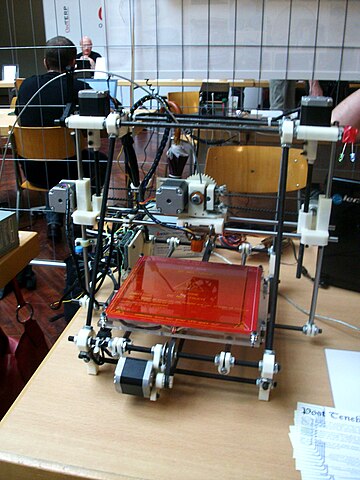
    image of 3D printer during the Rencontres mondiales du logiciel libre 2012, Geneva. Image courtesy of Wikimedia Commons.
    3D printer during the Rencontres mondiales du logiciel libre 2012, Geneva. Image courtesy of Wikimedia Commons.

    3D print technology, also known as additive layer manufacturing, is a rapidly developing technology with applications in manufacturing, engineering and academic research. It is sometimes available to university students on relevant courses – such as creative product design or engineering courses. For example UWE Bristol already has 3D printers within the Faculty of Technology and in the leading Centre for Fine Print Research.

    The machine, a triple head smoked 3DTouch, will be situated in the main library on the Frenchay Campus, where it will be available for all students and staff to use. During term time the UWE library has over 2,000 users per day.

    This new initiative will enable students to engage with the latest 3D print technology and develop their understanding of how it can be used in different subject areas. Students will be able to ‘draw’ their design in a 3D CAD package. The file will then converted through a process that will make it readable by the 3DTouch printer using free downloadable Axon software. When it is printing the 3DTouch print head moves back and forward, building up layers of thermoplastic polymer, as it prints the 3D object layer-by-layer.

    Andrew Bathchelor, UWE Senior lecturer in Product Design, says, “This initiative offers a valuable new resource for students. By linking with Bits from Bytes we are able to bring the concept of 3D printing to all students. Many of our Creative Product Design, Engineering and Fine Art Students, are already familiar with this technology, and use it within their academic work in their own departments. However, by offering this to the wider student body, we hope to stimulate usage of this technology and help students develop their understanding of how it can be applied. We hope students will come up with interesting applications, relevant to their subject. For example our students who are training to be teachers can familiarise themselves with technology that their pupils may have access to in the future. In addition Architecture and Planning students may choose to use the technology to ‘print’ out models for project work. We are sure UWE students will be inventive once they begin to see the possibilities of this technology. The 3DTouch will enhance the extensive range of resources we offer to students though UWE’s library service.”

  • Office 2013 – time to look at alternatives?

    Over on his Computerworld blog, Richi Jennings reports that the next release of the ubiquitous Microsoft Office suite – Office 2013 – is drawing nigh.

    However, he also points out that a huge price increase is in the offing for those that decide to update to the new version.

    But beware: The leaked Office 2013 pricing makes it seem that you’ll pay a lot more with the subscription model than buying the traditional, packaged software — as much as four times more!

    Perhaps this would be a good time for those thinking of upgrading to change their choice of office suite instead. Why not take a look at an open source office suite, such as LibreOffice or OpenOffice – the office suite from which LibreOffice was forked? As long as you’re not heavily reliant upon MS Office macros, the change should not be too painful. I’ve been working with both LibreOffice and OpenOffice for well over 7 years and none of my clients has noticed any difference.

    Both come with all the common elements of an office productivity suite – word processor, presentation package, spreadsheet, database, and the like and both can read and write MS Office formats. In addition, both work natively with the Open Document Format (ODF), an approved ISO international standard which is gaining more acceptance and wider use amongst governments and local authorities around the world as it will still be readable in years to come – unlike MS Office formats, whose useful life is purely dependent on Microsoft’s whim.

  • Bundestag study recommends amendment of law to promote open source

    Joinup, the EU’s public sector open source news site, reports today that a German parliament study group is recommending amendments to budgetary legislation to allow software produced by or for public sector organisations to be released as open source software. Germany’s budget law currently prevents public sector organisations from giving away software for free.

    In its report (PDF, German), the Bundestag’s Interoperability, Standards and Free Software group is proposing six measures to promote the uptake of free and open source software by Federal and regional authorities, including resuming funding the currently defunct open source competence centre. This could assist public sector organisations wanting to migrate proprietary to free and open source software. The group is also calling on all public sector organisations to create new software that is “as platform-independent as possible”.

    Furthermore, the group, which is chaired by FDP deputy Jimmy Schulz, also wants the Federal government actively to encourage the use of open standards. This would make access to the government easier for both citizens and companies, as well as being an incentive for software development.

  • Using Firefox Personas in LibreOffice 4.0

    LibreOffice developer Jan Holesovsky writes that he has had a late patch included in the LibreOffice 4.0.0 release candidate (posts passim).

    The patch in question enables support for Firefox Personas (now better known as lightweight Firefox themes. Ed.) in LibreOffice. Personas are “are easy-to-use themes” that let you personalize the look of your Firefox web browser.

    Oliver Hallot, a director of the Document Foundation (the organisation behind LibreOffice. Ed.) thought it would be a good idea to reuse Personas in LibreOffice.

    If you’re running LibreOffice 4, to set up Personas, go to Tools > Options > Personalisation > Select Persona. This opens a handy little dialog box, which will launch your web browser. Once you’ve found the Persona you like, you paste its URL (e.g http://www.getpersonas.com/persona/123456) into the appropriate input field, press OK, then OK again in Options and that’s it! Your LibreOffice install will then look similar to the one below.

    image of Firefox Personas applied to LibreOffice Writer
    Firefox Personas applied to LibreOffice Writer
  • LibreOffice 4.0.0 RC1 available for download

    the LibreOffice logoToday the first release candidate for LibreOffice 4.0.0 has been made available for download for evaluation, quality assurance (QA) testing and the like.

    The developers do nevertheless stress that they do not recommend the use of LibreOffice pre-release builds for “mission-critical” purposes. Information about QA testing can be found on the LibreOffice QA testers page.

    The developers also suggest reading the release notes.

    image of LibreOffice Mime type icons
    LibreOffice meets all your office suite needs

    If you’re interested in even more bleeding-edge binaries of LibreOffice’s current development, check out the nightly builds. However, these are potentially even less suitable for productive work, provided by individual contributors and not QA-approved in any way. Caveat emptor.

    To download LibreOffice 4.0.0.0 RC1 visit the pre-release page. To download the right package for your particular system, you’ll need to select the right package from the two dropdown lists on the page; there is an automatic detection system to help, but this might not work in all cases. The release candidate is available for GNU/Linux (rpm and deb-based package management systems), Mac OS X (both Intel and PowerPC versions) and Windows.

  • More dodgy spam comment script coding

    I’ve blogged in the past about blog comment spam (posts passim).

    Today another badly coded spam comment script misfired, leaving the comment below in the moderation cue:

    I Live THESE {fendi moncler bag|moncler mens clothing|moncler gamme bleu jacket|moncler paris boutique|moncler lucie jacket|moncler 2011 collection|moncler jacket women 2012|men moncler hats|moncler ski|moncler boots uk!!!

    Leaving aside the abysmal English – ‘live’ instead of ‘love’ – can you spot where the coding error? That’s right! The missing curly bracket at the end. As Homer Simpson would say: “Doh!”

Posts navigation