Monthly Archives: December 2025

  • Festive fly-tipping attracts street art

    Bristol has what could be described as a bit of form when it comes to street art, with the city being the original canvas of the artist known as Banksy.

    Indeed Bristol 247 today has a piece by John Nation, described as the city’s godfather of graffiti outlining why the city continues to be defined by the art form.

    Another form of art for which the city is less recognised is fly-tipping. A couple of days ago, Bristol Live highlighted that almost 200 fly-tipping incidents are reported to the city council every day. Last year the council recorded 10,268 fly-tipping incidents, an increase from 8,556 or over 20% during the previous year.

    The back streets of BS5 have once again provided ample evidence of the combination of street art and fly-tipping over the festive period, with festive fly-tipping attracting the spray can school of art. Look at what your ‘umble scribe found up St Mark’s Grove this morning.

    Mattress spray painted with Merry Christmas and a Christmas tree

    This is not the first time that fly-tipped materials have attracted the spray can crew in that particular street (posts passim).

    In the meantime, if you see fly-tipping, any other environmental crime or something that needs fixing, you can report it to Bristol City Council here, otherwise central government’s GOV.UK site has a handy page to find your local authority in England, Scotland and Wales and report fly-tipping.

  • Bristol annexes seaside town in Cymru

    Bristol ‘Live’, the city’s newspaper of (warped) record, has an unenviable reputation for finding a local Bristolian angle to news stories, whether that be by finding some vaguely connected person who just happens to have a BS postcode or by expanding the city’s boundaries into nearby or more distant local authorities or countries, whether there is any such angle or not.

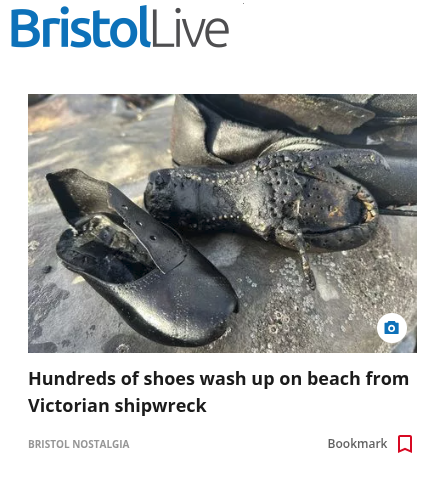
    A prime example of the latter came to light today concerning the sudden appearance of lots of Victorian footwear on the beach at Aberogwr (otherwise known as Ogmore-by-Sea. Ed.) in Morannwg / Glamorgan.

    How the story was announced and tagged on the paper’s main page is shown below.

    Hundreds of shoes wash up on beach from Victorian shipwreck

    Depending on one’s mode of travel, Bristol is over 100 km from Aberogwr and takes over an hour or even two. There is no way the latter falls within the civic boundaries of the City and County of Bristol, whose closest municipal boundary to Aberogwr extends as far as the low water mark on Ynys Echni / Flat Holm in the middle of the Severn Sea.

    Looking at the facts of the story itself, the founder of the beach clean-up group that removed the shoes said the following:

    “The strongest theory is that the shoes come from a shipwreck called the Frolic, that hit Tusker Rock about 150 years ago. It was carrying shoes and cargo from Italy. They were washed up the Ogmore River and every now and then they appear, especially when there has been erosion of the riverbank.”

    It’s only when one gets to the mention of Tusker Rock (Cymraeg: Ynys Tysgr. Ed.) that the slightness of the connection becomes apparent: it’s a rock in the Bristol Channel 3.2km west of Aberogwr that’s only visible at low tide, but one that has been the end of many vessels over the centuries.

  • Hell redefined

    Does hell exist?

    Most dictionaries – including Merriam-Webster – provide several definitions, including the following two which describe places that can be either real or imaginary:

    1. a nether world in which the dead continue to exist;
    2. a place or state of misery, torment, or wickedness.

    The second definition may or may not be connected with the first.

    These to have now been joined by a third – the current United States of America – courtesy of social media. Someone known as Vee posted the following on the federated Mastodon network yesterday.

    1am 76 years old. | have lived through the Cuban Missile Crisis, the JFK assassination, the Vietnam War, the Turmoil of 1968, Watergate, the Hostage Crisis, two oil crisis [sic], disco, Reaganomics, 9/11. The covid pandemic....These past 11 months have been easily the most miserable era in America in my lifetime. The hatred, the bigotry, the lies, the racketeering and pedophilia are beyond anything I have ever seen. We are not going to hell as a nation. We are IN hell.
    The burning coals background is a neat touch.

    Yes, you read that correctly, Vee believes hell on earth has been created by the second term regime (not administration. Ed.) of the disgraceful 47th and disgraced 45th president of the United States, insurrectionist, convicted felon, adjudicated sexual predator, business fraudster, congenital liar and golf cheat commonly known as Donald John Trump.

    That is an exhaustive list of calamities that have occurred in the world in the life of your average seventy-something. However, is the perceptive Vee being too hard on disco? Have your say in the comments below.

  • Meta must grant EU users full access to their data

    New logo as Facebook morphs into MetaAustria’s Der Standard reports that Meta, the parent company of both Facebook and Instagram, must grant European Union users full access to all their personal data within 14 days. The Austrian Supreme Court (OGH) ruled so on Thursday 19th December, according to the Vienna-Based data protection organisation noyb. The lawsuit was filed in 2014 by noyb founder Max Schrems.

    Schrems, an Austrian lawyer and data protection activist, started attempting to gain full access to his personal data stored by Meta in 2011. According to a press release from noyb, the company merely referred those affected to a “download tool” and its general privacy policy.

    14 days term

    According to a press release from the data protection authorities, the OGH has now ruled that Meta must disclose all personal data and provide information about this data, such as the source, recipients and purpose of the processing, within 14 days – i.e. by 31st December 2025.

    The court also found that Meta had unlawfully collected data from third-party apps and websites, according to a press release. Personalised advertising may only be shown with the explicit consent of the individuals concerned. Meta must also ensure that sensitive data is not processed together with other data.

    The case was heard three times before the OGH and twice before the European Court of Justice over the past eleven years. Schrems has been awarded €500 in compensation.

    Situation has changed

    Meta has told Reuters that it had taken note of the ruling. However, it referred to the situation as it existed at the time the lawsuit was filed. Meta stated that it no longer uses sensitive data for personalised advertising. EU users can now also use Facebook and Instagram for free with personalised or less personalised advertising or pay a subscription to prevent their data from being used for advertising purposes.

    In December 2025 the EU competition authorities approved Meta’s proposal to use less personal data under this pay-or-consent model.

  • Time to ditch Microsoft 365

    Microsoft has recently announced it is raising the price of its Microsoft 365 offering from July 2026.

    The new pricing for using Microsoft 365 will be applicable worldwide and as follows.

    Microsoft's pricing for the various MS 365 products from 1st July 2026
    Image courtesy of Microsoft

    Many people will no doubt be considering alternatives to this Microsoft subscription services to help keep business costs in check.

    Fortunately, many free and open source alternatives to the services provided by Microsoft 365 are available, work just as well and won’t cost users a penny. Email provider Tuta.com (recommended! Ed.) has kindly provided a useful summary under the deMicrosoft your life banner which is shown below should you consider ditching Redmond’s overpriced office offering and its other software.

    Free and open source alternatives to Microsoft products
    Click on the image for the full-sized version
  • ‘Tis the season to be triggered

    For some reason beyond the wit of any rational person, a religious festival celebrating the birth two millennia ago of a man who advocated peace and love seems to call forth a wave of hate and bile from those on the right of the political spectrum, who become more than usually scathing, either bleating that the traditional festival has been cancelled or railing against alleged political correctness.

    One of those who has taken to social media to vent her anger is one Susan Mary Hall, leader of the Conservative group in the Greater London Authority‘s London Assembly.

    Post reads: Look at this nonsense- NO - they are gingerbread men!!!

    Note in particular the use of not one, but three exclamation marks. As for the biscuits being of a male persuasion, I see no evidence of genitalia in their depiction on the packet, Ms Hall!

    Neverthless, have a happy Christmas, if you dare allow yourself such a luxury. 😀

  • EU Commission launches yet another investigation into a US tech giant

    EU flagAfter fining X €120 mn. last month for breaching the transparency obligations of the Digital Services Act, the European Commission has announced it has initiated a formal anti-trust investigation to assess whether Google has breached EU competition rules by using the content of web publishers and content uploaded to YouTube, for artificial intelligence (‘AI’) purposes.In particular, the investigation will examine whether Google is distorting competition by imposing unfair terms and conditions on publishers and content creators or by granting itself privileged access to such content, thereby disadvantaging the developers of rival AI models.

    The Commission is concerned that Google may have:

    • Used the content of web publishers to provide generative AI-powered services (‘AI Overviews’ and ‘AI Mode’) on its search results pages without appropriate compensation and without offering them the possibility to refuse such use of their content. AI Overviews shows AI-generated summaries responsive to a user’s search query above organic results, while AI Mode is a search tab similar to a chatbot answering users’ queries in a conversational style. The Commission will investigate to what extent the generation of AI Overviews and AI Mode by Google is based on web publishers’ content without appropriate compensation for that, and without the possibility for publishers to refuse without losing access to Google Search. Indeed, many publishers depend on Google Search for user traffic, and they do not want to risk losing access to it.
    • Utilised video and other content uploaded on YouTube to train Google’s generative AI models without appropriate compensation to creators and without offering them the opportunity to reject such use of their content. Content creators uploading videos to YouTube are obliged to grant Google permission to use their data for different purposes, including training generative AI models. Google does not remunerate YouTube content creators for their content, nor does allow them to upload their content on YouTube without allowing Google to use such data. At the same time, rival developers of AI models are barred by YouTube policies from using YouTube content to train their own AI models.

    If proven, the practices under investigation may breach EU competition rules that prohibit the abuse of a dominant position (Article 102 of the Treaty on the Functioning of the European Union (‘TFEU’)) and Article 54 of the European Economic Area (‘EEA’) Agreement.

    Commenting on the launch of the investigation, Teresa Ribera, Executive Vice-President for Clean, Just and Competitive Transition remarked as follows:

    A free and democratic society depends on diverse media, open access to information, and a vibrant creative landscape. These values are central to who we are as Europeans. AI is bringing remarkable innovation and many benefits for people and businesses across Europe, but this progress cannot come at the expense of the principles at the heart of our societies. This is why we are investigating whether Google may have imposed unfair terms and conditions on publishers and content creators, while placing rival AI models developers at a disadvantage, in breach of EU competition rules.
  • Dumb Britain surfaces in Easton

    For many years – longer than your ‘umble scribe chooses to remember – satirical magazine Private Eye has featured a column entitled Dumb Britain, which documents the hilariously wrong and ingorant answers given by contestants on television quiz shows.

    However, dumbness in the form of lack of knowledge, intelligence or common-sense is not confined to the small screen; myriad examples may be found in real life, as evidenced by the photograph below taken in St Mark’s Road (note the apostrophe, Bristol City Council! Ed.) in Easton last week when the street was undergoing road works.

    Junction of St Mark's Road and High Street whowing No Entry sign plus Road Ahead Closed sign.

    Maybe Private Eye should expand the criteria for Dumb Britain.

  • Status milestone for Kernewek, plus Scots and Gaelic

    The last week has been a good one for specific regional languages in the Untied* Kingdom, namely Kernewek (Cornish), Scots and Gàidhlig (Scots Gaelic).

    Firstly, Kernewek.

    Cornwall County Council has announced that Kernewek will be recognised alongside Welsh, Irish Gaelic and Scots Gaelic after the government recommended it for Part III status – the highest level of protection under European treaty.

    This outcome is the result of years of hard work by Cornwall Council, community groups and cultural organisations dedicated to protecting Kernewek. It officially recognises the importance of Cornish as a living language and a core part of the county’s cultural identity.

    Cornish language receives Part III status. Kernwek gets same recognition as Welsh, Irish Gaelic and Scots Gaelic

    Since 2002, there has been a Kernewek revival across the county.

    In 2024-2025, over a million searches were made using the online Cornish dictionary and Cornwall Council’s Cornish Language Team received more than 650 requests, translating more than 32,000 words into Kernewek – up 22% from the previous year.

    In addition, more than 200 people sign up for Kernewek classes each year and almost 6,000 schoolchildren are having fun with the Cornish language through the Go Cornish for Primary Schools programme, commissioned by Cornwall Council.

    “This is brilliant news for Cornwall. Achieving Part III status reflects years of hard work by Cornwall Council, our partners and the many community groups who have fought to keep the Cornish language alive. To see Cornish recognised alongside Welsh, Scottish Gaelic and Irish Gaelic is something we can all be extremely proud of,” remarked council leader Leigh Frost.

    Meanwhile in Scotland the Gaelic and Scots languages have gained official status in an “historic milestone”. Nation.Cymru reports that this one of a range of measures which come into force on November 30 (which also happens to be St Andrew’s Day. Ed.) through the Scottish Languages Act.

    “St Andrew’s Day is a fitting time to celebrate Scotland’s identity by recognising Gaelic and Scots as official languages,” said Scotland’s Deputy First Minister Kate Forbes.

    Ms Forbes also stated: “To support the continued growth of both languages the Scottish Government has already allocated £35.7 million for Gaelic and Scots initiatives this year, ensuring that this milestone translates into meaningful change for communities across the country.”

    Other measures in the Act include supporting the creation of areas of linguistic significance in Gaelic communities so that ministers can better target policies to support the language.

    Latest census statistics show that 130,161 people in Scotland had some Gaelic skills in 2022, an increase of 43,105 from 2011, whilst the same source also reveals that 2,444,659 people in Scotland had some Scots skills in 2022, an increase of 515,215 from 2011.

    * = Not a typographical error.