A holiday in Homophone Corner
This holiday offer at Llantysilio near Llangollen is not recommended for women of child-bearing age, for obvious reasons.
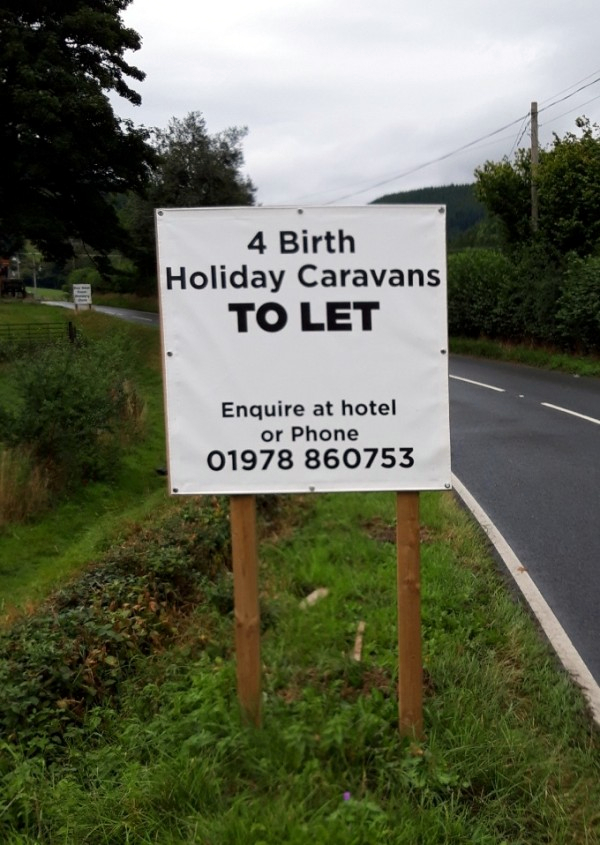
This holiday offer at Llantysilio near Llangollen is not recommended for women of child-bearing age, for obvious reasons.
The rise of the Thatcher fangirl, one Mary Elizabeth Truss, to the office of prime minister of the English Empire cannot be regarded as universally welcomed. Indeed her candidacy for the leadership of her party was supported by fewer than were seduced into putting an X against the name of her predecessor, one Alexander Boris de Pfeffel Johnson (Truss garnered 57% of the vote for leader by party members, cf. 66% for the lying scarecrow).
In her incarnation as Johnson’s Foreign Secretary over the last couple of years in Johnson’s cabinet of sycophants and Brexit zealots and during the party leadership campaign, Truss has hardly shone, managing top lose friends and alienate people, particularly important ones with whom the government wishes to negotiate trade deals, in particular the United States (a trade deal with the USA is regarded as the Holy Grail by those politicians who worship at the altar of Brexit. Ed.), by picking fights with those beastly foreigners on the other side of the so-called English Channel over the Northern Ireland Protocol, which she threatened to tear up, thereby trashing this country’s reputation as a firm believer in upholding international law.
Nor have those beastly foreigners turned a blind eye to Truss’ roundabout route to arrive at the black-painted door of Number 10. They are only too aware that Truss started out as a member of the Liberal Democrats who is on record as supporting the abolition of the monarchy.
During the Brexit referendum campaign, Truss still supported the country’s remaining in the European Union, only to do a 180 degree about turn before being elevated to high political office by the blonde scarecrow.
In her climb up the Tory political ladder, Truss has made no secret of her admiration for the dreadful Margaret Hilda Thatcher, aka the Iron Lady, whose manner of dress and publicity stunts Truss has shameless emulated.
Putting her changing political views and her imitation of Thatcher together, the French media have this week been referring to the English Empire’s fifth Tory prime minister since 2010 as the ‘Girouette de fer‘, i.e. the Iron Weathercock, as per the following typical example.

Automatic Number Plate Recognition (ANPR) surveillance seems to be on the rise since your ‘umble scribe first reported on its use by B&NES for access control to the council’s rubbish tips recycling centres some years ago.
It’s now being used by parking management companies to catch drivers who overstay their welcome in private car parks, as shown by the example below spotted in central Bristol today outside the snappily named Double Tree by Hilton hotel on Redcliffe Way.
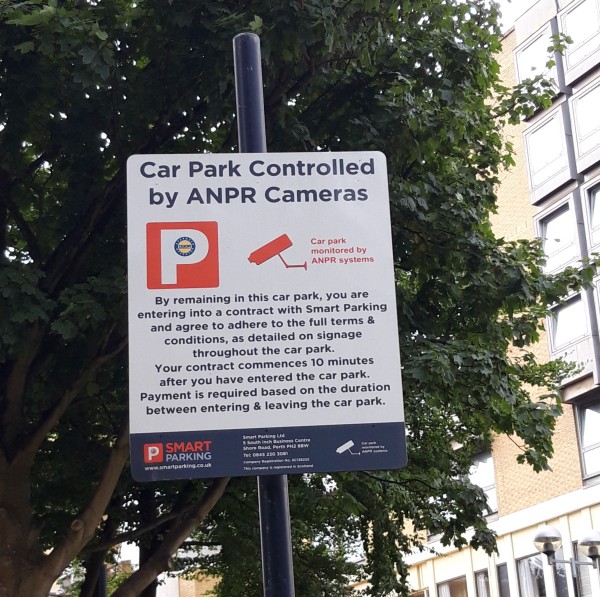
The adjective Orwellian is no exaggeration if one peruses the company’s marketing brochure to glean how ANPR is used. It states:
Smart Parking’s automatic number plate recognition (ANPR) / license plate recognition (LPR) parking system is a simple, efficient and cost-effective way of off-street car park management.
Cameras placed at entry and exit points take a timed photo of the number plate of each vehicle entering and exiting the premises. Customers then simply pay and walk, using their license place as identification. We can also configure sites to have validated parking which can include permit only, staff only, free limited time parking and definable grace periods, to name a few.
As with our other solutions, SmartANPR/LPR work with the SmartCloud platform to deliver occupancy, stay rates and enforcement efficiency reporting for car park management and future planning.
Note the American English usage of license.
Of course, for any users who outstay their welcome, the company wants to make a profit with its penalty charges (note to any passing journalists, despite your constantly referring to these charges in your copy as ‘fines‘, they are in fact invoices; only the judicial authorities can impose fines. 😀 Ed.) and so needs to obtain details of the vehicle’s keeper from the DVLA. The DVLA is more than willing to divulge this information for a fee, as confirmed by the answer to a Freedom of Information Act request from 2012.
The law allows the DVLA to disclose vehicle keeper information to those who can demonstrate a reasonable cause for requiring it. Reasonable cause is not defined in legislation but the Government’s policy is that it should relate to the vehicle or its use, following incidents where there may be liability on the part of the driver.
The DVLA also charges a fee for the disclosure of this information, as the response further clarifies:
The fees levied by the DVLA for Fee Paying Enquiries are set to recover the costs of processing requests and ensure that the cost is borne by the requester and not passed onto the taxpayer.
Even so, the agency has fallen foul of the Information Commissioner’s Office for “not using the correct lawful basis to disclose vehicle keeper information“, as The Guardian reported a few months ago.
Your correspondent feels an urge to submit another FoI request for the DVLA to enquire about the amount of money received by the agency for this service, but has more than a suspicion such a request would be refused on the grounds of commercial confidentiality.
Staying in Glasgow for a few days for my niece’s wedding, your correspondent cannot help comparing and contrasting the differences between how Glasgow and Bristol City Councils set about tackling the public nuisance and environmental crime of fly-tipping, particularly as regards the use of public notices for enforcement and dissuasion.
Exhibit A: the public notices used by Bristol City Council.
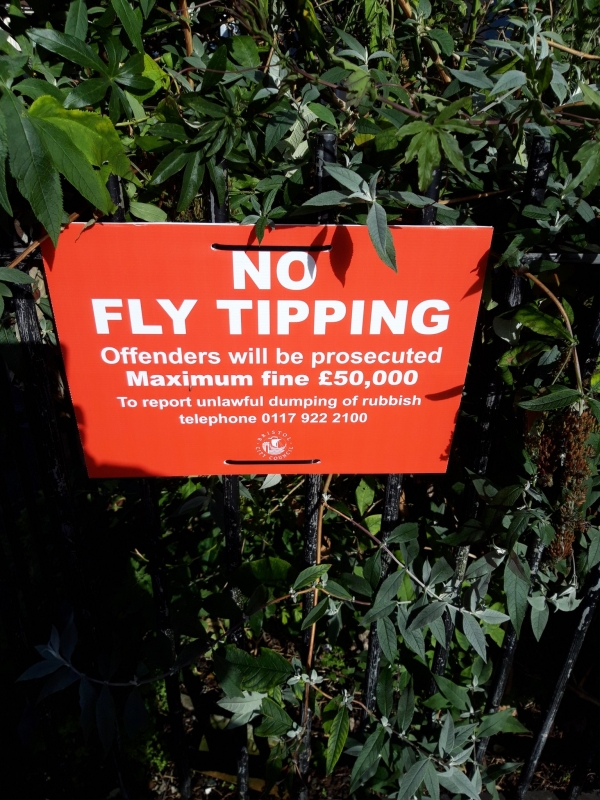
This is an A5-sized sign with no redeeming graces, which threatens the maximum possible fine under law of £50,000 (no mention of the alter#native maximum penalty of 6 months’ imprisonment or a combination of the two. Ed.). Should anyone feel public -spirited enough to fancy reporting any fly-tipping, the public is directed to the council’s main switchboard number, with no mention of the very convenient option of reporting fly-tipping online.
Exhibit B: a public notice used by Glasgow City Council, as seen in Holmlea Road.
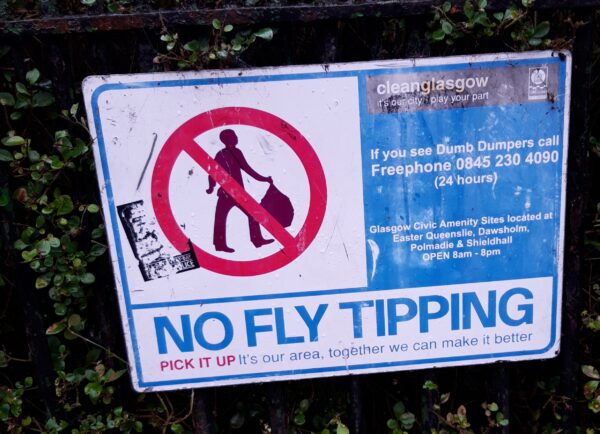
The initial difference is the size of the notice: at least A4 instead of A5, i.e. twice the size. There’s no mention of any maximum penalty, but residents are encouraged to report Dumb Dumpers via a 24-hour 0845 number. 0845 telephone numbers are “business rate numbers” (otherwise known as “non-geographical premium rate phone numbers“, for which the charge for mobile telephones and landlines is “up to 7p and your phone company’s access charge“. The UKPhoneIfo website warns that “charges for dialling 0845 numbers can be significantly higher – up to 41p per minute” when calling from a mobile number and that “when an 0845 number is called, the call recipient receives a small share of the call cost.” This number is a Scotland-wide number for reporting fly-tipping (there’s also a pan-Scottish Dumb Dumpers reporting website too, Ed.), in addition to which Glasgow City Council website also offers online reporting of fly-tipping and other environmental crimes.
Two more differences to Bristol are apparent: the locations of the council rubbish tips (civic amenity sites) are given in a further attempt to change anti-social behaviour, whilst finally residents are reminded that the state of the neighbourhood is their responsibility, as well as that of the council.
There are lessons that Bristol City Council could learn from Glasgow, as long as it ditches the not invented here attitude that seems to pervade the corridors of the Counts Louse.
One final note: even though the city is still being tidied up following the end of the recent Scottish bin collectors’ strike, your correspondent’s overall impression is that the streets of Glasgow are not as filthy as those of Bristol. Whether this is due to belittling and disparaging those who despoil the urban area as Dumb Dumpers has yet to be proven empirically, but is another tactic BCC could try, if so inclined.
Genius (or should that be genious? Ed.) headline writing from today’s Daily Post, alias North Wales Live.
Is the entire editorial team asleep at their desks?

Such a glaring spelling mistake and the obvious lack of quality control remind your ‘umble scribe of a Mark Twain quotation regarding a still extant US newspaper, i.e.
I think the Cincinnati Enquirer must be edited by children.
Like many other parts of the city, the Easton area of Bristol has been subject to an immense wave of gentrification in the last decade or so, with all the usual signs: rocketing house prices, overpriced bacon butties made with sourdough, etc.
Indeed, local house prices have risen so dramatically within the city that an old college mate’s son and his partner couldn’t afford to buy anywhere in BS5 and eventually had to move to Cheltenham in order to find somewhere more affordable than Bristol’s inner city.
Last year the Bristol Post/Live published its own guide on how to spot the signs of gentrification.
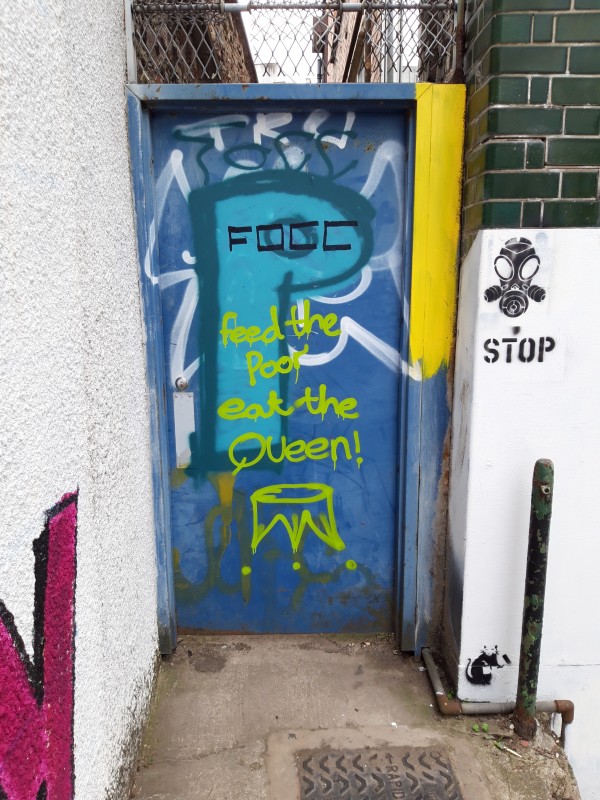
It would be fair to say that gentrification has given rise to some local resentment on the streets, as shown below.

The signs of gentrification have even started showing in the types of items fly-tipped on local streets (in a sort of waste-related version of trickle-down economics. Last month your ‘umble scribe reported his first ever fly-tipped futon base and one of his other tasks today is to notify the council of this morning’s sighting of a fly-tipped golf bag on St Mark’s Road.
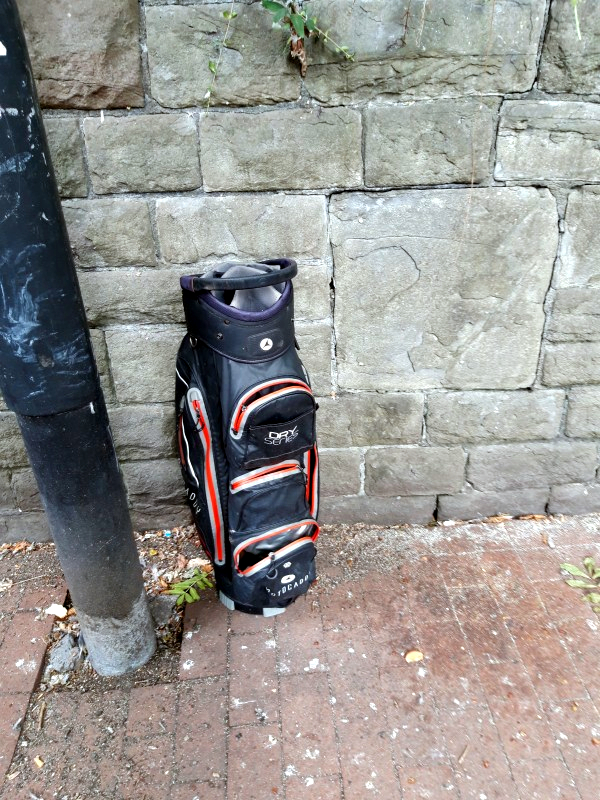
Fore!
As a linguist, your ‘umble scribe has, during his working life, always used language as a precision tool. Were using le mot juste can mean the difference between a one-off job or repeat business is confined to linguists is unusual or not, is a matter for conjecture, There are certain other professions where the use of the right vocabulary is vital, particularly in the law and in the field of intellectual property (e.g. trade marks, patents).
It often does not apply in the world of journalism, where a columnist may be taking a deliberately ambiguous angle.
This accuracy of language definitely does not apply to the titles of the Reach plc stable of local news titles, including Bristol’s (news)paper of warped record, the Bristol (Evening) Post and the accompanying Bristol Live website.
As a prime example of this is contained in Thursday’s piece about the redevelopment of Trinity police station.
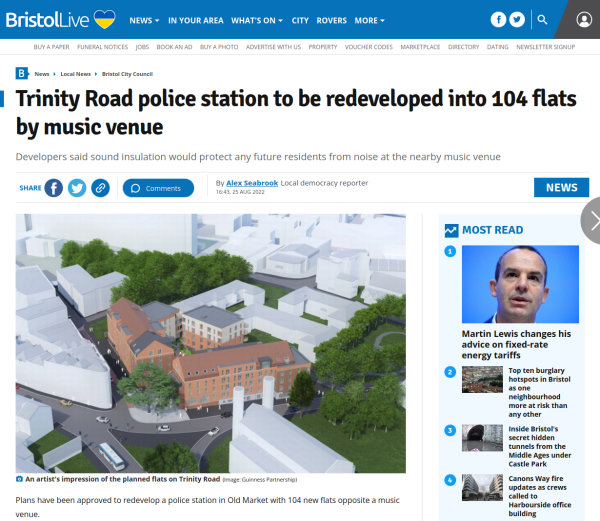
The headline implies that the as-yet unnamed music venue itself will be building the housing, not some developer who has just realised that, due to the proximity of entertainment, the building bill will now be augmented by the addition of acoustic insulation.
The police station to be demolished and redeveloped just happens to be over the road from the Trinity Centre, with which your correspondent has a long association (posts passim).
What is obvious from perusing the article is that the person(s) writing the headline is/are different from the one who write the article. This seems to be standard practice.
Furthermore, it is also evident that the headline writers do not carefully read what reporters have written, as shown by the latest version of how the story is presented on the paper’s website, with the soon-to-be former cop shop itself transformed a new music venue.
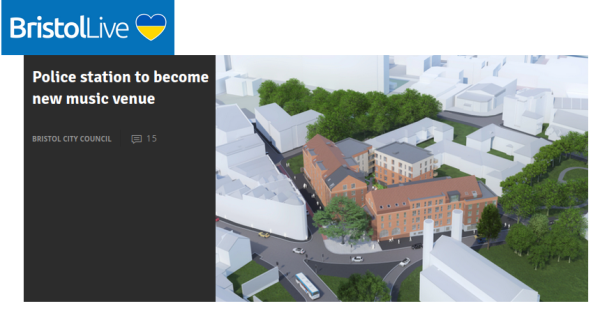
Sacking all those sub-editors a few years ago to save some money has really paid off in terms of the quality of your ‘journalism’, hasn’t it, Reach plc?
Other than ‘All hail kakistocracy‘, no further comment required.
Bristol is a city in which, according to the 2011 census data, more than 90 languages are spoken: no surprise for the UK’s tenth most populous city.
Given its proximity to Wales – a mere train ride or short drive away over one of the two bridges spanning the Môr Hafren (aka the Severn Sea. Ed.), there’s always been more than a bit of friendly rivalry between the city and county and South Wwales, with a topping of mutual parochial condescension reserved for near neighbours.
Given the diverse nature of east Bristol’s population, it’s not unusual to see shop signs in languages other than English, but the Tenovus Cancer Care charity shop in St Mark’s Road (kindly note the apostrophe you prefer to ignore, Bristol City Council. Ed.), has achieved what to your ‘umble scribe’s recollection a first for BS5: a Welsh/English bilingual sign offering – on one side at least – a free health check. The reverse of that bilingual offer is in Welsh only.
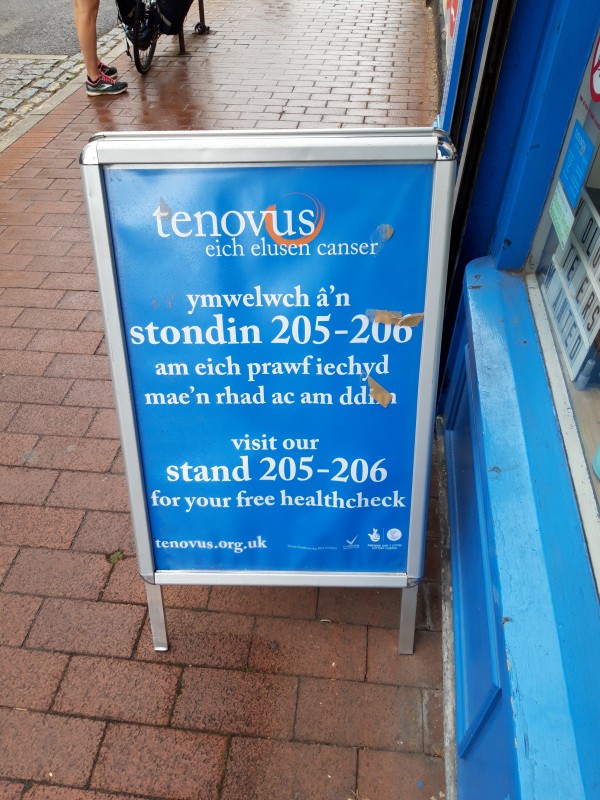
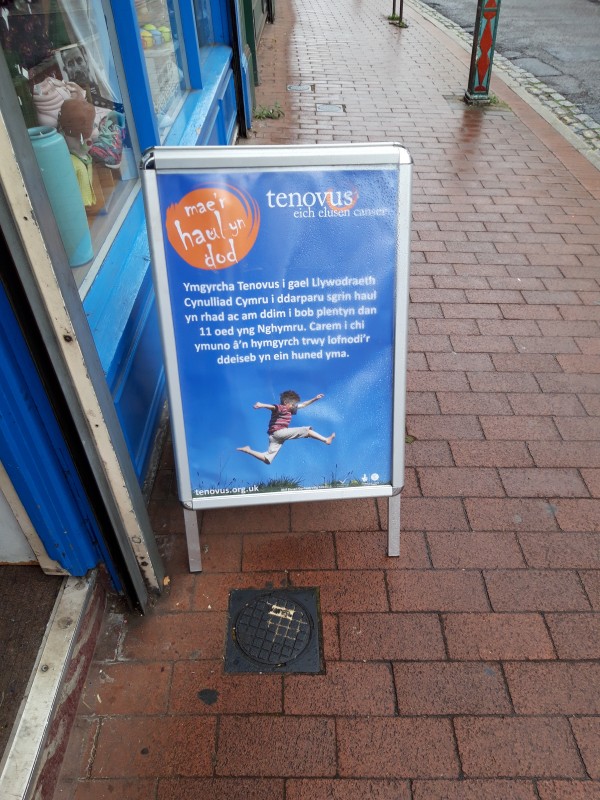
This is not the time that Welsh signage has turned up in use to the east of Offa’s Dyke. Back in June a Welsh bilingual road works sign was observed doing splendid work in Coventry, as Wales Online reported.
Bragg’s Lane, Bristol, BS2.
No further comment necessary.