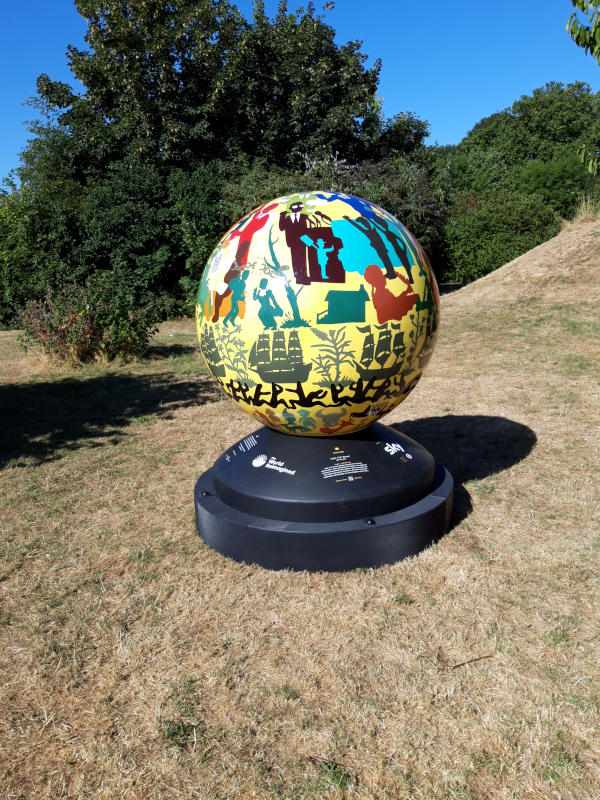
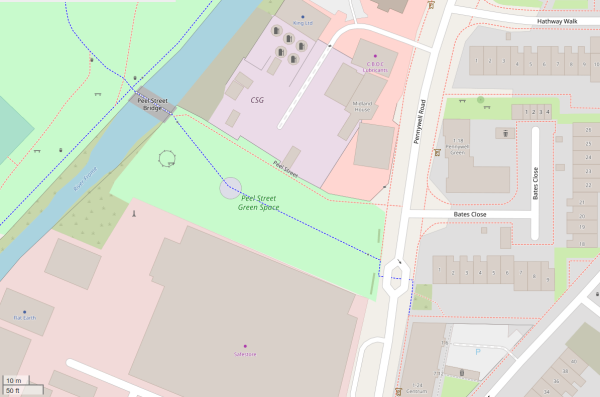
A piece of artwork has appeared on the parched grass of Peel Street Green Space, which occupies the ground between Pennywell Road and Riverside Park on the far side of Peel Street Bridge over the Frome (aka the Danny in east Bristol. Ed.).
Its arrival seems to have pre-empted the Bristol Post, which today wrote:
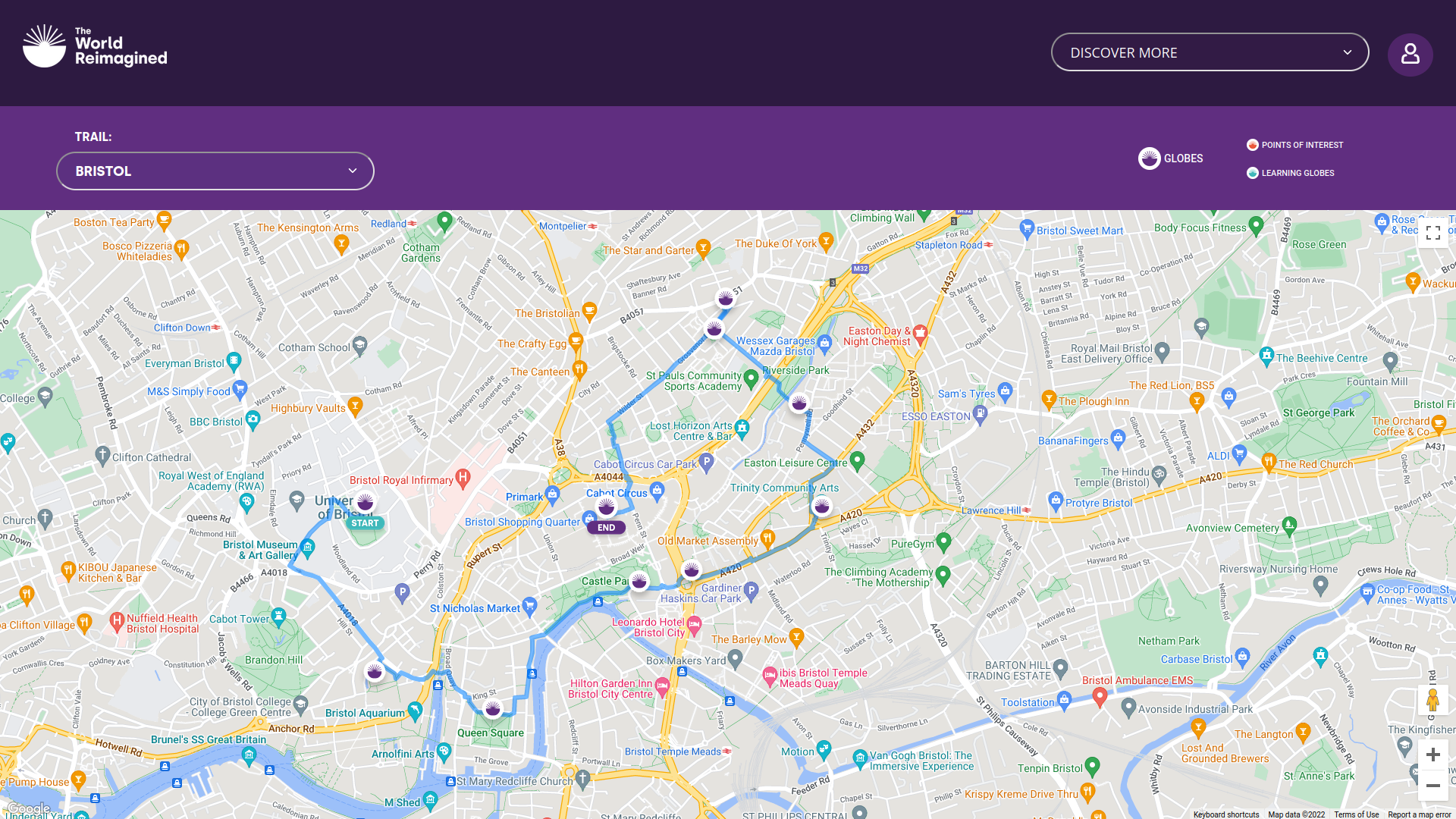
A new public art trail reflecting on colonial histories and the impact of the slave trade is coming to Bristol. More than 100 artist-designed globe sculptures will appear in seven cities across the UK from Saturday and will be free to view by the public until October 31.
The project, which is organised by The World Reimagined, aims to explore the UK’s relationship with the Transatlantic slave trade, its impact on society and how action can be taken to make racial justice a reality. The designs of the globes produced by the commissioned artists explore themes such as the culture of Africa before the slave trade and an ode to the Windrush generation.
The World Reimagined has sited 103 unique Globes across the 10 trails in 7 host cities across the UK – Bristol, Birmingham, Leeds, Leicester, Liverpool, London and Swansea. All the trails will be connected to a digital platform that enables visitors to explore the collection and the history it reflects.
Today’s Daily Post has a story – and accompanying video – about the efforts to make Plas Acton Garage in Wrexham the cheapest in North Wales.
Amongst the ideas implemented by the owners to keep prices down, the article states:
Regular customers can get their hands on “no strings attached” discount cards that strike a penny off every litre on the pump price indefinitely. In essence, if you topped up with roughly 50 litres of fuel you’d save 50p.
However, the owners are not offering one penny off the pump price, but ‘one pence‘, as evidenced by the voucher being held up in the video still used for the Daily Post piece.
If not the cheapest petrol station in North Wales, the wording on the voucher definitely makes it the region’s most illiterate petrol station.
The proprietors are not the first to be unaware that the singular of pence is penny. The most egregious misuse of one pence for one penny occurred at the Despatch Box in the Chamber of the House of Commons (where else? Ed.). The date was 20th March 2013, the occasion was the annual budget speech by the Chancellor of the Exchequer – one George Gideon Oliver Osborne, then aged 41 and three-quarters, who was very badly (and expensively) educated at St Paul’s School and Magdalen College, Oxford 😀 (posts passim).
During his lifetime, white supremacist mining magnate and alleged politician Cecil Rhodes was described as a ‘liability and a maniac‘ who nevertheless endowed his alma mater, Oriel College, Oxford with so much cash – £100,000 when he died in 1902 – that it duly commemorated him.
Move on one hundred and twenty years from Rhodes’ death and another ‘liability and a maniac‘ has come forward to support the deceased rich racist in the alleged government’s never-ending culture war centred on public works of art, usually involving dead white males of dubious moral character.
Which brings us to liability number two. Step forward one Nadine Vanessa Dorries, inexplicably elevated way beyond her extremely limited abilities to Secretary of State for Digital, Culture, Media and Sport (DCMS) by disgraced party-time alleged prime minister Alexander Boris de Pfeffel Johnson.
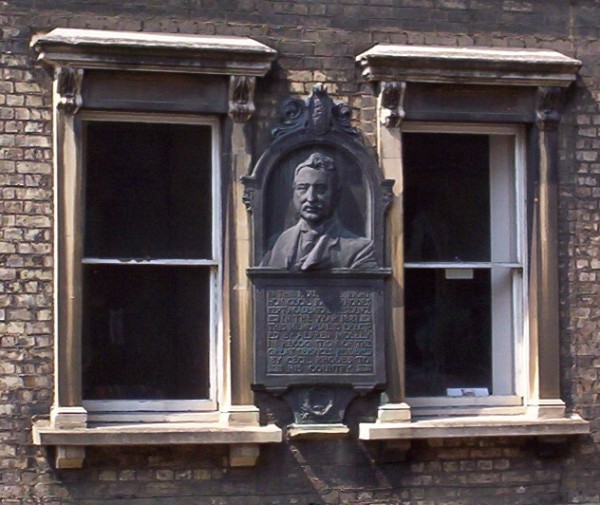
What links Rhodes and Dorries is the latter’s decision to award Grade II listed status to the plaque commemorating the Victorian imperialist Cecil Rhodes at Oriel College, as reported by The Guardian.
The Guardian goes on to report that Dorries’ decision ‘overrides an earlier judgment by Historic England determining that the plaque lacked the “richness of detail” required for listed status‘, with Historic England noting that the DCMS ‘agrees with our listing advice 99% of the time, meaning Dorries’ ruling is indeed out of the ordinary.
Dorries’ unilateral action also flies in the face of the intentions of Oriel College itself. Last year the college’s governing body published a report stating it wished to remove both the Rhodes statue and plaque: the college has since remarked it remains ‘committed to‘ removing them in spite of Dorries’ unwelcome intervention.
The statue of Rhodes has also attracted the attention of thousands of Rhodes Must Fall campaigners who have lobbied to have removed it because of Rhodes’ racist and colonialist views.
Needless to say, Dorries’ decision has not found favour with academics and campaigners. Kim Wagner, who’s a professor of imperial history at Queen Mary University of London (QMUL) remarked as follows:
This is simply what one would expect from Nadine Dorries and a discredited government, which has nothing left but the pursuit of its inept culture-war project.
Cecil Rhodes has become a rallying point for imperiophiliacs, and the slogan to ‘retain and explain’ is just part of the ongoing effort to whitewash his legacy and that of the empire more generally. Luckily, most of us don’t get our history from statues or plaques.
What little history of which Dorries is aware seems likely to have been gleaned from statues and plaques.
The inevitable DCMS spokesperson has been wheeled out to defend the ministerial edict, stating:
We are committed to retaining and explaining our heritage so people can examine all parts of Britain’s history and understand our shared past.
Update 08/08/2022: In an editorial opinion piece The Guardian yesterday described Dorries’ listing decision as ‘crass‘, as well as calling her move a ‘kneejerk [sic] response to a contemporary debate‘.
According to Wikipedia, Tatler is a British magazine published by Condé Nast Publications which is targeted towards the British upper-middle class and upper class and those interested in society events. The topics it covers include fashion and lifestyle, plus high society and politics.
Its coverage of politics cannot be said to be well researched if the following from its Twitter account is to be taken at face value.
Second-ever female PM, Tatler?
Try counting again; and this time engage your brain!
If the Tatler’s staff can’t even count to three, it has to be wondered how accurate the rest its coverage of politics actually is.
Over the years between 382 to 405 CE, a scholar called Eusebius Sophronius Hieronymus, also known as Jerome of Stridon, worked on a translation of the Hebrew bible into Latin. His translation became known as the Vulgate Bible. History remembers him as Saint Jerome, the patron saint of translators, librarians and encyclopedists.
Throughout the Catholic church Latin was the language in which God spoke and his word was transmitted until the medieval period, when calls began for translations of the bible into other languages.
Individual names are associated with the translations.
Whilst Martin Luther is rightly remembered as a seminal figure in the Protestant Reformation and scissions from the Church of Rome, he was also responsible for the translation of the bible into German, which had a tremendous impact on both the church and German culture, including fostering the development of a standard version of the German language. In the English-speaking world, whilst the first authorised version of the bible in English – the King James Version – was compiled by a committee, the overwhelming majority of the text used was in fact translated the best part of a century earlier by William Tyndale, who was executed in exile in Vilvoorde in what is now Belgium in 1536.
In those and earlier times many biblical translators were accused of heresy, a convenient crime against religion.
One bible translator who did not share Tyndale’s fate was William Morgan (c. 1545 – 1604), Bishop of Llandaff and of St Asaph, and the translator of the first version of the whole Bible into Welsh from Greek and Hebrew.
The bible in Welsh was the gift of Elizabeth I to Wales and went some way to redressing the crass colonialism of her father’s actions in 1536 when legislation was enacted that made important changes in the government of Wales.
Wales had previously been annexed – i.e. colonised – by the 1284 Statute of Wales, also known as the Statute of Rhuddlan. This introduced English criminal law to Wales, but Welsh custom and law were to operate in civil proceedings.
Henry’s new act declared the king’s wish to incorporate Wales within the realm. One of its main effects was to secure “the shiring of the Marches”, bringing the numerous marcher lordships within a comprehensive system of counties . Another of its effects was to introduce uniformity in the administration of justice. However, the latter entailed English being the only language of the courts of Wales. This meant that Welsh-speaking defendants appearing before the courts were dished up “justice” in a language they did not understand in proceedings in which they were unable to participate.
Furthermore, Henry’s legislation also decreed that those using the Welsh language were not to receive public office in the territories of the king of England.
Anyway, with the background out of the way, let’s get back to Bishop Morgan and his bible in Welsh.
Morgan was a student at Cambridge when leading Welsh Renaissance scholar William Salesbury published his Welsh New Testament in 1567. Whilst he was pleased that this work was available, Morgan firmly believed it was important that the Old Testament also be translated into Welsh. Morgan’s work on his own translation of the Old Testament commenced in the early 1580s and this, together with a revision of Salesbury’s New Testament, was published in 1588.
The Welsh bible is dedicated to Queen Elizabeth I (English translation of dedication here). Elizabeth, a fervent Protestant, is said to be a firm supporter of the introduction of the Welsh bible in Wales as she believed it would help spread Protestantism in Wales at the expense of Catholicism.
Morgan’s translation also allowed a highly monoglot Welsh population to read and hear the Bible in the vernacular for the first time. In the long run, the Welsh Bible saved the language from possible extinction.
If readers are by now asking why your ‘umble scribe has bothered to write several hundred words on religion, politics and history in Wales, may I refer readers back to this post’s title.
There are very few public memorials to translators (leaving to one side all those medieval painting of St Jerome in caves of varying levels of comfort. Ed.). One of these – of William Morgan himself – has just been installed in one of his old benefices, according to the Powys County Times. A decade ago sculptor Barry Davies created an oak statue of the Bishop which formerly stood outside the Public Hall in Llanrhaeadr-ym-Mochnant. The 7 foot tall statue has now been moved inside the parish church of St Dogfan by a team of local farmers, supervised by Mr Davies.
The statue of William Morgan in its initial home outside the Public Hall in Llanrhaedr-ym-Mochnant
The article states the following as the reason for the statue’s move:
The statute was commissioned 10 years ago as part of a lottery funded project in the village, but weather conditions had led to fears the statue could become damaged and so a decision to find an indoor home for the bishop was made.
Of the one thousand original copies of the first edition of Morgan’s Welsh bible produced, it is estimated that some 26 survive today. It was republished in 1620 and that edition was still in use as the standard Welsh bible until the 20th century.
British politicians and their fellow travellers have over the decades had some difficulty with the Irish names for that country’s political offices.
Many years ago, Hansard, the official record of transcript of Parliamentary debates in Britain, once famously mis-recorded the office of Taoiseach or prime minister as the ‘tea shop‘.
However, the Irish prime minister’s association with hot infused beverage establishments is not confined to parliamentary scribes on this side of the Irish Sea, as this Irish Independent report shows.
Hansard has now been jointed by one Elizabeth Mary Truss, improbably promoted to Secretary of State for Foreign, Commonwealth and Development Affairs, with a new variant – the ‘tea sockin one the English Empire’s continuing efforts to break international law, as evidenced by this short video clip from Irish broadcaster RTE.
Just in case Ms Truss happens upon this post, for her benefit, here’s a brief video pronunciation lesson for the basics of Irish politics. 😀
Party-time alleged prime minister Alexander Boris de Pfeffel Johnson survived a vote of confidence on Monday and is clinging to office despite 40% of his party colleagues voting against him, a higher proportion than previous no-confidence votes against former Tory premiers Margaret Thatcher (of sainted memory. Ed.) and Theresa May.
Since then Johnson and his supine cabinet have tried to appear competent with a flurry of policy announcements of the expired feline variety, including a ludicrous extension of the disastrous right to buy scheme to housing association tenants, including those on benefits.
Among those also spinning pointlessly – unlike a child’s top – is Penny Mordaunt, MP for Minister of State for Trade Policy, who tweeted a link to a piece (complete with a photograph of Rabid Dog [posts passim]. Ed.) she’d written for the Telegraph, house magazine of the Cult of the Adoration of the Boris and favoured reading matter of the Blue Team.
However, Mordaunt’s use of social media did not develop necessarily to her advantage, that of fellow members of the government of none of the talents or that of the party-time alleged prime minister, as the following exchange shows.
Yes, you read that correctly. One of the country’s leading fast food suppliers would not trust any current government minister to deliver their products, not exactly either a highly skilled or highly paid job.
Now that’s what your ‘umble scribe would call a proper vote of no confidence.
Whilst your ‘umble scribe has done his best to avoid the jubilee jollities, he cannot help noticing that, in addition to the usual criticism found on social media, two of the pillars of the British establishment, namely the Church of England and the monarchy itself, have been indulging in some very subtle digs at the government nominally under the supposed leadership of party-time alleged prime minister Alexander Boris de Pfeffel Johnson.
Finally, brothers and sisters, whatever is true, whatever is noble, whatever is right, whatever is pure, whatever is lovely, whatever is admirable—if anything is excellent or praiseworthy—think about such things.
Johnson’s lack of integrity is a matter of public record that extends back at least as far as his time as the Telegraph’s Brussels correspondent, when he would regularly tells lies and fabricate stories about what horrors the European Commission was hatching, thus adding further fuel to the xenophobic fire that eventually kindled into Brexit. Johnson has twice been sacked for lying, in addition to which he’s lied to his wives, his mistresses, parliament, the public and even to Elizabeth Mountbatten-Windsor herself. One of his employers, Max Hastings, is on record as saying: “Boris is a gold medal egomaniac. I would not trust him with my wife nor – from painful experience – my wallet.”
There is nothing pure, lovely, admirable, excellent or praiseworthy about the moral vacuum that resides beneath the superannuated blonde toddler haircut.
However, Johnson was not the only cabinet minister to be subjected to derision and ridicule.
Step forward please Priti Patel, a woman unfit to clean a public toilet inexplicably promoted way beyond her competence to the post of Home Secretary.
Patel’s choice of Barbie pink outfit to attend the jubilee thanksgiving service drew plenty of unpleasant comparisons on social media with Dolores Umbridge, a fictional character from the Harry Potter canon, who is described as “a fat, toad-like woman, with a wide, slack mouth, and a large bow usually in her hair and “one of the most hated, as well as the most compelling, villains in the series“.
Any resemblance to a cruel, inhuman and racist cabinet minister is purely coincidental.
Nevertheless, it was not only wags on Twitter who mocked the alleged home secretary. Buckingham Palace also joined in the fun.
Although the queen did not attend yesterday evening’s jubilee concert in person, she did appear in a specially commissioned video, as shown below. Here Paddington Bear who hails from ‘darkest Peru‘, arrived in this country wearing around his neck a label stating ‘Please look after this bear. Thank you.‘, and is perhaps this country’s best known fictional refugee (classified by the home secretary and her department as an illegal migrant. Ed.) is shown having tea at Buck House.
1977 was allegedly a year for celebration as Elizabeth Mountbatten-Windsor had spent 25 years as unelected head of state of the English Empire (which some still call the United Kingdom. Ed.).
At the time I was in the final year of my degree and well remember derelict buildings in the town centre being draped in bunting in preparation for a drive-by the queen.
All the sycophancy at that time helped turn your ‘umble scribe into a lifelong republican, i.e. someone who would like to see this country abolish the monarchy and switch to having an elected – not hereditary – head of state. This is not to be confused with a right-wing US political party spelled with an upper case first letter.
Come right up to date and Elizabeth Mountbatten-Windsor has now been minding the shop for 70 years, a record for the country. However, support for the monarchy is not as widespread or whole-hearted as it was in 1977 and in Scotland support for the monarchy is now down to 45%, as reported by The Guardian.
However, that does not mean that republicans are having an easy ride for their beliefs, which they allegedly have a democratic right to express, as illustrated by the tweet below from the account of the Jeremy Vine show on Channel 5, a low point in daytime TV.
I have no intention of being quiet. Indeed, yesterday I found the Stuff The Jubilee badge I bought in 1977 and am already wearing it with pride as per the encouragement from my ex-wife.
Your correspondent won’t be the only one in east Bristol not celebrating this momentous non-event. News of three of our local pubs organising a F*ck the Jubilee punk festival has not gone down too well with some sections of the city’s populace.
At a national level, Republic, the organisation campaigning for the abolition of the monarchy, has organised a petition to make Elizabeth the second the last monarch.
And finally, now for something completely different…
The Irish Council for Civil Liberties (ICCL) is pointing its finger at Google for spying on users, French IT news website Le Monde Informatique reports. A real-time bidding (RTB) system which is actively used by the company enables it to follow and share what everyone is looking at or doing online and note down this activity’s location. RTB is the technology underpinning all online advertising and it relies on sharing of personal information without user consent, according to the ICCL.
Google’s troubles are far from over. Widely singled out for its actions in terms of the use of personal data, the company is now in the spotlight for its tracking and advertising targeting activity. A report (PDF) published by the ICCL on 16 May accuses the search giant of an unprecedented data breach. The report sheds light on the RTB system, which works in the background on websites and in applications. “It tracks what you are looking at, no matter how private or sensitive, and it records where you go. Every day it broadcasts this data about you to a host of companies continuously, enabling them to profile you,” the report states.
The ICCL report claims it presents the scale of this data breach for the first time.
This data breach takes place throughout the world. The RTB system “tracks and shares what users are viewing online with their location in real time 294 bn. times in the USA and 197 bn. times in Europe each day”, it states. On average a person in the USA has their online activity and location tracked 747 times a day by those using RTB. In Europe, RTB exposes personal data 376 times a day. In Germany alone, Google sends 19.6 million broadcasts about German Internet users’ online behaviour every minute that they are online. “Europeans and U.S. Internet users’ private data is sent to firms across the globe, including to Russia and China, without any means of controlling what is then done with the data”. It is a high-earning business generating more than $117 bn. in the USA and Europe in 2021.
Advertising is an indispensable condition of this system as the majority of advertising on websites and in applications is placed there using RTB. Advertisers spend $100 bn. annually in the USA and Europe. The RTB market’s estimated value was $91 bn. in the USA in 2021 and €23 bn. in Europe in 2019. It therefore highlights that Americans’ online activity and their locations is exposed 57% more frequently than that of users in Europe.
Google is one of the five largest users of this real-time bidding system. No fewer than 4,698 US companies are authorised by Google to receive RTB data on people, whilst in Europe the number drops to 1,058 companies. More specifically, the data collected by Google, like what people are looking at online or doing with an application and their ‘hyperlocal‘ geographical location is broadcast 42 bn. times per day in Europe and 31 bn. times daily in the USA.
The ICCL is working to end the RTB data breach in Europe and has litigation ongoing in three European courts, as follows:
at the Landgericht in Hamburg against the tracking industry standards body IAB TechLab and against Microsoft’s online advertising exchange Xandr (https://www.iccl.ie/rtb-june-2021/);